
Weekly World Numismatic News for May 12, 2019
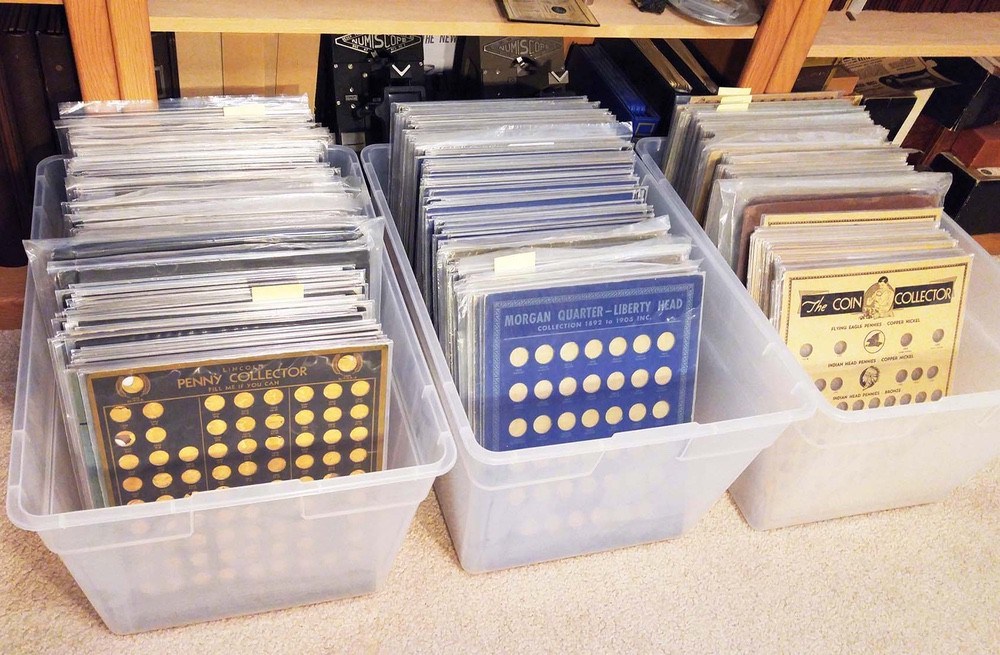
The Midwest Collection of Coin Boards (Image courtesy of David Lange)
Coin boards came before folders and albums. They provided a way for collectors to organize their coin collection. Some dealers used them as an incentive to have people pick coins out of pocket change to sell back to the dealer. The dealer would give the board away with the offer of a reward for bringing it back once it is full of coins.
David Lange is the hobby’s leading expert on coin boards. This past week, Lange announced that he purchased a lot of more than 400 coin boards from a midwest collector dubbed the “Midwest Collection.” The hoard includes several rare coin boards.
Lange’s fascination with coin boards is evident in the three books he has published about them. The most popular is his first book, Coin Collecting Boards of the 1930s & 1940s. It is a recommended book for anyone who wants to know more about numismatic history. He is now selling the book for $19.95 ($14.95 plus $5 for shipping). See his website for more details.
Even if you do not collect coin boards, it is good that there is someone like David Lange to preserve this aspect of the hobby. Otherwise, this aspect of numismatic history would get lost and forgotten. That would be a tragedy.
Congratulation Dave!
And now the news…
 May 5, 2019
The U.S. Mint, Washington, suspended its mutilated coin redemption program this May. The U.S.  → Read more at recyclingtoday.com
May 7, 2019The Royal Mint has unveiled a series of special £2 coins to mark 75 years since the D-Day landings. The coins pay tribute to those involved in the events on June 6, 1944, which are widely seen as a key turning point in the Second World War. → Read more at sports.yahoo.com
May 9, 2019How did these two coins, believed to be Spanish pieces dating to the 13th century, get to Glen Canyon NRA?/NPS → Read more at nationalparkstraveler.org
May 10, 2019The Royal Mint produced no £2 or 20p coins in 2017 as people used change in a rush to get rid of their pound coins as the old ones went out of circulation. → Read more at telegraph.co.uk
May 11, 2019Experts believe they may have found a Kilwa coin that could change what we know about the history of global trade → Read more at theguardian.com
May 12, 2019JapanToday Higashi-Azabu IS bldg, 4F 1-8-1 Higashi-Azabu Minato-ku Tokyo 106-0044 Japan Tel: +81 3 5561 7755 Fax: +81 3 5561 7756 Email: editor@japantoday.com ©2019 GPlusMedia Inc. → Read more at japantoday.com
May 12, 2019More than 3,000 4th Century Roman coins were found in a buried pot in Lincolnshire. → Read more at bbc.com
New $5 Bill Debuts with a Wi-5
Today, the Bureau of Engraving and Printing released a web-based video starring BEP Director Larry Felix, Treasurer Anna Escobedo Cabral, and Assistant Federal Reserve Board Director Michael Lambert. Central to the video is the new design of the 5-dollar federal reserve note with new security features similar to the ones on the redesigned $10 and $20 notes. Features used on the new 5-dollar bill are as follows:
- Watermarks on either side of Lincoln’s portrait. A larger “5” is to the right close to the edge and a vertical line of “5s” just to the left of the portrait.
- The embedded security thread is to the right of the portrait and a different style than used on other notes.
- The color added to the note is a light purple that is suspected to not duplicate well digitally
- Surrounding the portrait are a circle of stars rather than having no border.
- Micro-printing is still used on various areas of the note.
- A high-contrast, larger “5” is on the reverse to make it easier to read to help “those with visual impairments distinguish the denomination.”
BEP provides more multimedia information on the page announcing the new note.
Anyone who likes the look of interesting currency, such as the new Euro notes, will look upon the new design as more of the same. The BEP has attempted to modernize the notes while keeping a similar look that has been around since the 1920s. Other than the necessity for the security feature, the changes in the Federal Reserve Notes can be best described as “ho hum.” Maybe, if the BEP came up with better designs we might encourage more people to collect currency.
Is Customer Service an Oxymoron?
We collectors of US coins cannot live without the US Mint since they are the government’s exclusive manufacturer of coins. They run the world’s largest coin factory in Philadelphia, second largest in Denver, and they control the market for present-day collectibles. Last week, the Mint suspended the sale of uncirculated American Gold Eagles with the “W” mintmark because of the rising price of gold. It was reported that sales of gold American Eagles will be repriced and returned to sale on or after September 27.
Today, I visited the Mint’s website to order proof sets. On their front page is a graphical changing area that tells the web surfer about available coins. The first banner was for the uncirculated gold American Eagle coins. When I clicked on the image, I was sent to the on-line catalog that shows that these coins are are “not available.”
Even though I am not in the market for gold American Eagle coins, I found it distressing that the Mint would announce the situation to the media and leave the publically accessible website to provide conflicting information. The Mint public relations department should be more diligent at ensuring the website as the correct information, especially since the Mint wants more people to use it rather than the telephone services.
Since the recent growth in the collecting market, I have not had problems with orders from the US Mint. I once had problems with the Bureau of Engraving and Printing that was blamed on their mishandling of technology. But this example of conflicting information and careless treatment of public information can cause problems for some customers. As a government agency with exclusive manufacturing rights to our coinage, the Mint must be held to a higher standard for the integrity of the country they represent.
Sac’s New Back
In the final step before becoming a law, congress presented the president with H.R. 2358, Native American $1 Coin Act, for his signature. Introduced in the House of Representatives by Dale Kildee (D-MI 5th), and expected to be signed by the president, the bill calls for the reverse of the Sacagawea Dollar be redesigned every year to commemorate “of Native Americans and the important contributions made by Indian tribes and individual Native Americans to the development of the United States and the history of the United States.” The obverse will continue to have the Sacagawea design.
The bill calls for the denomination to be inscribed as “$1,” making it consistent with the Presidential dollars. The bill also calls for the same edge lettering used by the Presidential dollars to include the date and mint mark along with the inscriptions E Pluribus Unum and In God We Trust. As for the reverse designs, the bill calls for the Mint to consult the Committee on Indian Affairs of the Senate, the Congressional Native American Caucus of the House of Representatives, the Commission of Fine Arts, and the National Congress of American Indians, along with the usual bureaucracy of the Citizens Coinage Advisory Committee to vet the coin design. With the burden of this bureaucracy, the bill changes the start date to January 1, 2009 if enacted after August 25, 2007.
An interesting clause in the bill says that the design are to be issued “in the chronological order in which the Native Americans lived or the events occurred.” Since there is no specific end date to the program, it appears that the bureaucratic hurdles the Mint is being asked to jump for this program will need the extra year to determine a schedule. And if that was not enough, congress, who is not shy in making its own design suggestions, included the following potential designs in the bill:
- the creation of Cherokee written language
- the Iroquois Confederacy
- Wampanoag Chief Massasoit
- the “Pueblo Revolt”
- Olympian Jim Thorpe
- Ely S. Parker, a general on the staff of General Ulysses S. Grant and later head of the Bureau of Indian Affairs
- code talkers who served the United States Armed Forces during World War I and World War II
In addition to these new reverses, change to the circulating coinage will include new reverses on the Lincoln cent and Presidential Dollars with the reverses honoring, William Henry Harrison, John Tyler, James K. Polk, and Zachary Taylor. Non-circulating legal tender coins will include the Abraham Lincoln and Louis Braille commemoratives, special 2009 cent with the original copper composition, and the First Spouse gold coins honoring Anna Harrison, Letitia and, Julia Tyler, Sarah Polk, and Margaret Taylor. Finally, if H.R.392 is passed in the Senate (it passed in the House last January), the 50 State Quarters program will be extended to include the District of Columbia and the five territories.
It looks like 2009 could be a great year in numismatics!
How Coins Are Graded Video
Grading and encapsulation of coins has grown since the ANA started with the certification process 35 years ago. Over that time, the process and materials have evolved in an attempt to make the process better. Although the process has its flaws, the major third party grading services try to adhere to rigorous procedures to ensure integrity of their evaluation.
Although both NGC and PCGS have written nice details on how they grade coins, nothing really beats a good video. With the help of another intrepid numismatic surfer, the following video made by PCGS was found on YouTube. Yes, it has a number of self-serving propaganda statements (count the number of times the narrator mentions their “world-class graders”), but it does provide a very good overview of the grading process.
I found it interesting how they put together the slab. I knew of the process, but seeing it being done on the video was very interesting. I hope you enjoyed this as much as I did.
Fall Cleaning
Here in the United States, the first Monday of September is Labor Day. Labor Day is a United States federal holiday that dates back to 1883 to create a day off for the “working man.” Today, it is a symbolic mark of the end of summer as school begins either the week before or after the holiday.
Along with the start of school comes the start of Meteorological Fall. As opposed to astronomical fall, the meteorological seasons are aligned with the calendar and not the orientation of the Earth from the Sun. It is supposed to signal the beginning of atmospheric cooling.
With the summer over and the return of the routine, this change has me thinking about my collection. While I have a number of interests, including the “oh neat” factor, I have a number of collections that I am assessing whether I want to continue. Of today’s concerns are the dollar coin Registry Sets at the Collectors’ Society. Two of those sets are of a Susan B. Anthony Dollar uncirculated and proof Registry Sets. Although these sets are 50-percent completed, I am just not interested any more. I might keep the 1979 Wide Rim dollar because it is worth a bit more than the others. But the rest of the coins my be sold soon.

I also feel the same about my Eisenhower Dollar Registry sets. Aside from being my first set, I find the coin appealing as the last large dollar coin produced in the United States. But like my Susie B. sets, that spark is no longer there. If I sell this set, all but the 1976 dollars will be sold, including the 1971 coin graded MS65 where NGC Census reports that no 1971 Eisenhower Dollar has graded higher than MS66. This makes my MS65 worth a bit more than other coins of the same grade.
Regardless of what I do with these sets, I will continue to build the Bicentennial and the uncirculated American Silver Eagle sets. In fact, I have a number of coins I sent to NGC for grading that I hope improves my scores. I still like the competitive aspect of Registry sets as I wrote about in Competitive Collecting. But there is no need to collect something I am not interested in just for the competition.

If I decide to sell off the Eisenhower and Susan B. Anthony dollars, I will be posting them on eBay. Watch that space for these coins, possibly including the 1971 dollar that brings in over 300 registry points!
Support the Coin Collectors Blog
 Buy me a coffee
Thank you for your support!
Let Me Know What You Think
Are you going to the World's Fair of Money
Total Voters: 17
 Loading ...