Aug 10, 2013 | coins, counterfeit, legislative
The fight against fakes has taken a significant step forward with the passage of the Collectible Coin Protection Act in the House of Representatives before congress left for summer recess.
Formerly H.R. 1849, the current was reintroduced by Rep. G.K. Butterfield (D-NC) to resolve a technical issue. All of the co-sponsors for H.R. 1849 co-sponsored H.R. 2754 with the addition of Rep. Lee Terry (R-NE).
On July 30, H.R. 2754 was brought to the floor of the House of Representatives on the suspension calendar. Bills on the suspension calendar are those that are considered non-controversial and have broad support. For this bill, Rep. Michael Burgess (R-TX) was the floor manager and moved to suspend the rules and pass this bill. After a brief introduction, Rep. Butterfield spoke on behalf of the bill.
If you want to read what was said, it begins near the bottom of the second column of page H5147 in the Congressional Record. [PDF]
H.R. 2754 passed the House of Representatives on a unanimous voice vote.
The bill will be sent to the Senate but will not be considered until after the summer break.
It is not too early to contact your senator to ask for their support. Just go to senate.gov and use the pull down menu in the upper-right corner of the page to select the state you live or work. Please take the time to contact both of your senators. In fact, if they hold town hall meetings in your area, you can use that opportunity to
Collectors who live in North Carolina’s First District, can send email to Rep. Butterfield to thank him for his help. Everyone else can send him a quick note on Twitter to @GKButterfield to show your appreciation!
You can read the Collectible Coin Protection Act and track the bill’s progress at http://www.govtrack.us/congress/bills/113/hr2754.
Aug 9, 2013 | ANA, commentary, technology
Earlier this week I read an article by Patrick Heller how the aging collector population would affect the supply and demand for numismatic items. One point Heller makes is that as collectors pass on and leave significant collections to heirs, he finds “that most heirs do not share the same passion for the holdings as the coin collector who died.”
Heller further notes, “In more than a few instances, those selling the collections have much less numismatic knowledge than the collector who died to be able to liquidate the treasures for the best price.”
Although it was not the premiss of Heller’s article, what really has to be addressed is how to increase the number of collectors and provide help to non-collectors who find themselves in the position to have to deal with a collection left behind by a deceased loved one. Of course there are two books that will explain what those selling collections as part of an estate, but sometimes they need more help.
For those interested in collecting, there needs to be an outlet to find information and be able to participate in the community. Information has to be engaging and the collector should be encouraged to collect what they like and like what they collect.
There are so many ways to collect numismatic items that it will be difficult to list them in one place. One way to start is to try to engage the collector where they are. Today, that means finding them on the Internet.
The future of every hobby, business, and nearly every aspect of life will be online.
Some might suggest that you cannot do everything online. While that may be true, the online world helps open the doors to the off line experience.
I am not suggesting that numismatics should look at the Internet as one large online supermarket or auction house. The Internet can be the gateway to knowledge. It can explain to the family that inherited grandpa’s collection how to handle it without getting ripped off. It can explain that transportation tokens may be the ultimate local collectibles and finding them can be even more challenging than finding coins. It can explain what are the positives and negatives to collecting modern non-circulating legal tender coins. It can open the door to collecting foreign coins and currency from the country your parents or grandparents came from.
The Internet can also explain that your State Quarter collection may not be as valuable as you though, including those purchased on that alleged “special sale” on television. However, that extra tree on the Minnesota quarter may be worth just a bit more than 25-cents!
“Buy the Book before the coin” is a popular mantra repeated in the hobby. But which book? If you look at the catalogs of coin books from all publishers, there are so many books how do you know which one to buy. Some people even recommend reading auction catalogs. While many auction catalogs are really sales pitches, catalogs for special sales have some wonderful information, great images, and even pointer to other references.
There needs to be a central repository for numismatic information from a trusted source that is not trying to sell you on their version of numismatics.
This is where the American Numismatic Association comes in the picture.
Over the last year, the ANA has been working to enter the 21st century to offer more services online. Even though it may appear that the ANA is barely out of the 20th century in technology, employees at the ANA headquarters have done yeomen work with what they have. But the work is only beginning.
Building online services is not easy when your product is not easily defined. Those of us in the information industry call it the “Big Data” problem because data is the driver, there is a lot of it, and managing it is not as easy as it seems. Data can be ordered in more ways than an inventory of coins or a catalog of auctions.
When looking at the problem, data tends to grow and that growth has to be managed whereas a dealer’s inventory can be in flux and auction data is static and controllable.
These problems not only makes what the ANA is trying to do to be that information leader very difficult, but doing it in a compelling manner that makes that could help attract new collectors makes the job even tougher.
Next week at the World’s Fair of Money, the ANA Board of Governors will hear about the selection of a new contractor to help take the next steps in conquering big numismatic data. They will also hear from impassioned members of the Technology Committee who only wants this contractor to succeed and do so in a way to allow the ANA to provide premier online services—a model for other non-profit hobby organizations.
Creating these online services will not happen overnight. In fact, it may take a year or longer to see significant advancements. That is the nature of building these services essentially from scratch. But it is worth the wait.
In the end, there will be resources for members and the public that will promote the hobby in a way that only the ANA can do. Hopefully, it will convince those who let their membership expire to return to the ANA, strengthen the bond between ANA members and clubs, and lure collectors who are interested to join us.
As an ANA member and a member of the Technology Committee, I hope you will support the ANA’s efforts because if the demographics cannot be skewed a little younger, we may be looking at a bleaker future for the hobby.
About the pictures… when I talk about technology I tend to think about the time I started and the Control Data Corp. Cyber 18/30 that was significant in my college days. We used to call her “LC” for Little Cyber. It helps remind me of where computing has come, especially that my iPhone is millions of times more powerful than LC!
Of course if I’m taking a walk down memory lane, I have to include the Poly 88, the first computer I ever programmed!
Aug 2, 2013 | coins, commemorative, legislative, policy, US Mint
H.R. 2633: Thirteenth Amendment Commemorative Coin Act
Sponsor: Rep. Danny Davis (D-IL)
• To require the Treasury to mint coins in commemoration of the Sesquicentennial Anniversary of the adoption of the Thirteenth Amendment to the United States Constitution, which officially marked the abolishment of slavery in the United States.
• Introduced: July 9, 2013
• Referred to the House Committee on Financial Services
Track this bill at http://www.govtrack.us/congress/bills/113/hr2633
H.R. 2754: Collectible Coin Protection Act
Sponsor: Rep. George “G.K.” Butterfield, Jr. (D-NC)
• To amend the Hobby Protection Act to make unlawful the provision of assistance or support in violation of that Act
• Introduced: Jul 19, 2013; Referred to House Energy and Commerce Committee
• Passed in the House of Representatives: Jul 30, 2013 (voice vote)
• Received in the Senate: July 31, 2013; Referred to Senate Committee on Commerce, Science, and Transportation
Track this bill at http://www.govtrack.us/congress/bills/113/hr2754
H.R. 2760: Panama Canal and Pan-Pacific Exhibition Centennial Celebration Act
Sponsor: Rep. Nancy Pelosi (D-CA)
• To require the Secretary of the Treasury to mint coins in commemoration of the centennial of the Panama-Pacific International Exposition and the Panama Canal
• Introduced: July 19, 2013
• Referred to the House Committee on Financial Services
Track this bill at http://www.govtrack.us/congress/bills/113/hr2760
Jul 30, 2013 | coins, dollar, fun
I found this poem by Clifford Johnson on a site named OpEdNews.com. It is worthy of everyone enjoying here:
S. 1105: Dollar Coins or Paper Dollars?
by Clifford Johnson
Coin or paper?
What a caper!
One is proper,
one a whopper.
Drastic
is what’s inelastic,
plastic
more than gold’s fantastic.
What is copper
to a shopper,
what a penny?
One too many.
Paper powers
golden showers,
yet isn’t ours!
But a buck round
is square and sound.
One is proper,
one a whopper.
Coin or paper?
What a caper!
Images:
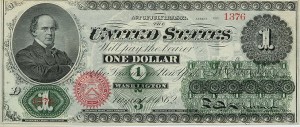
- First $1 bill issued in 1862 as a Legal Tender Note. (Wikipedia)
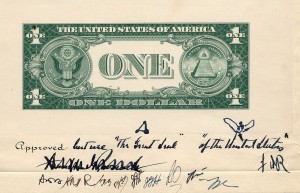
- President Franklin Roosevelt’s conditional approval of the one-dollar bill’s design in 1935, requiring that the appearance of the sides of the Great Seal be reversed, and together, captioned. (Wikipedia)
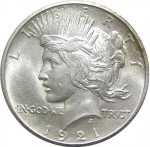
- 1921-D Peace Dollar. (Wikipedia)
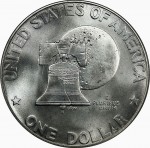
- 1976-S Type 1 (1975) Eisenhower Dollar with Bicentennial Design. (Wikipedia)
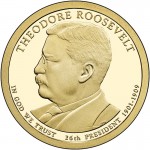
- 2013 Theodore Roosevelt Dollar. (U.S. Mint)
Jul 29, 2013 | bullion, coins, commemorative, nclt, policy
 Last March, three members of the Citizens Coinage Advisory Committee met with Rep. Andy Barr (R-KY), a freshman member of the House Financial Services Committee that oversees the U.S. Mint, to pitch the idea of Liberty-themed coins.
Initially, the proposal was to issue a series of Liberty-themed coins for the five silver-colored circulating coins but dropped the 5-cent coins after Barr said that there must be no cost to the taxpayer. Currently, the U.S. Mint reports that it costs 10.9-cents to produce the Jefferson nickel and was removed from discussion. What the politicians fail to grasp is that coin production does not cost the U.S. taxpayer anything because all of the money used to operate the U.S. Mint comes from the seigniorage collected on all coins, commemoratives, and tokens sold including circulating coinage to the Federal Reserve. Since the Federal Reserve does not use taxpayer money in its operation, the purchase of circulating coins generates a profit for the government.
Although removing the 5-cent coins from consideration is a wise political move, it demonstrates the illogic and dysfunction of the politics. It also illustrates why the current system of how congress controls the U.S. Mint is unsustainable and needs to be changed.
No other mint in the world is under the same legislative control as the U.S. Mint. Every other major mint are autonomous entities running under the authority of the government required to produce circulating coinage for the country’s central bank and must obtain approval from the central bank to create any legal tender coin. A government can decide that it should produce certain denomination or stop producing a denomination and the autonomous entity must comply.
People who want to discontinue the use and production of the one-cent coin looks to Canada as an example of how a country to stop producing their lowest denomination and be successful. While it is too soon to judge the success and failure of this move, what is lost on people is how the Royal Canadian Mint, a Crown corporation of Canada, is required to comply with the laws passed by the Canadian Parliament. If the Canadian Parliament passes a law that says the Royal Canadian Mint is not to produce any more one-cent coins, than the Royal Canadian Mint does not produce one-cent coins.
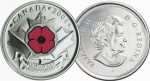
The 2004 Poppy Quarter was the Royal Canadian Mint’s first colorized circulating coin.
Nearly every mint operates in the same manner. while the Royal Mint is more conservative in their issues, the Perth Mint, the Mint of Poland, and Austrian Mint operate in a similar manner.
Some countries do not operate a mint even as a public corporation. Countries like Niue, Somalia, and Isle of Man that have produced popular NCLT issues contract their minting to other mints, such as the New Zealand Mint, or to private corporations like the family-owned Pobjoy Mint. Even the government of Israel thought it was best to privatize their mint. After being established in 1958 by then Prime Minister David Ben-Gurion, the Israel Coins & Medals Corp was privatized and sold in 2008 where they continue to operate under the authority of the Israeli government and the Bank of Israel.

2007 Somalia Motorcycle Non-circulating Legal Tender Coins
Those who would be against privatizing the U.S. Mint immediately point to Article I, Section 8 of the U.S. Constitution that says “The Congress shall have Power… To coin Money, regulate the Value thereof,” as the reason not to privatize the U.S. Mint. While the Constitution gives congress this authority, it does not say that the government has to own the means of production nor does it say that congress has to dictate the design of that money. In its most basic term, “to coin money” means to authorize production of and make legal tender of coins used in commerce (for a full description based on case law, see this section).
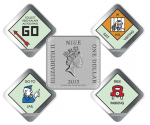
2013 Niue Monopoly Coins struck by the New Zealand Mint. Is this too much?
In a huff, those who argue against government-owned corporation point to Freddie Mac and Fannie Mae as examples of the dangers of making critical government functions private. Unfortunately, these people are reading the headlines and not the reasons for Freddie and Fannie’s problems caused by the recent fiscal crisis. While both companies can be blamed for their parts in the failure of the markets, a lot of their blame can be traced to the laws that congress passed giving them a complicated deregulated environment from which to try to accomplish their goals. Rather than find a way to fix the issues, congress wants to end the programs Freddie and Fannie support and close those entities even though new regulations have been working.
The problem with making the U.S. Mint a government-owned corporation would be the 535 member board of directors (congress) whose knowledge of what it would take to do this right is suspect. This is the same congress that has forced the Postal Service to over pay into its pension fund while forgetting that it has to the power “to pay the Debts and provide for the common Defence and general Welfare of the United States” by shutting down the government or preventing the payment of debt by manipulating the artificial debt ceiling.
It would be possible to make the U.S. Mint a government-owned corporation using the lessons learned from the governance of the Postal Service, Fannie Mae, Freddie Mac, and any number of other world mints. A charter would be established to make the government-owned Mint corporation the sole provider of circulating coins to the federal reserve and that its operations would be managed by a board with representation from the executive branch, legislative branch, and the Federal Reserve. The board would have oversight power over the Mint corporation and work within the parameters set up by the charter.
Provisions of the charter would be that congress would regulate coinage in that nearly every part of 31 U.S.C. § 5112 would be eliminated except for paragraph (a) that describes the denominations and their size specifications. All laws regarding weights, composition, and design with the exception of the first sentence of paragraph (d), would be eliminated.
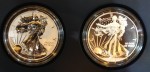
2013 American Eagle West Point Two-Coin Silver Set with reverse proof and enhanced uncirculated coins.
A new charter would allow congress to designate two commemorative coins per year with a surcharge to be paid to an organization as it does today, but the Mint corporation could create additional non-circulating legal tender coins with its own designs that are made legal tender by following the specifications of the law (e.g., 31 U.S.C. § 5112(a)(10) allows for “A five dollar gold coin that is 16.5 millimeters in diameter, weighs 3.393 grams, and contains one-tenth troy ounce of fine gold.”) and approved by the design board, the Mint charter board, and the Federal Reserve.
The design board would be the Citizens Coinage Advisory Committee. Rather than have two design groups, one that whose purpose outside of reviewing coins is to review architecture, only the CCAC would continue as the approved design board. This way, the Mint corporation would have artistic oversight by a dedicated organization and not have to worry about whether the U.S. Commission of Fine Arts, whose purpose is to oversee the architecture of Washington, understands design and the issues with striking those designs.
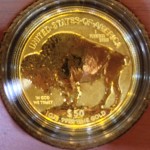
We should keep the 24-karat gold Buffalo coins, too!
Freeing the U.S. Mint to be more autonomous and provide them the ability to create new products will not cost the taxpayer anything. In fact, it has the potential for the new corporation to earn more than it does now with new products on the market because if you notice, I never said to get rid of the U.S. Mint Public Enterprise Fund (31 U.S.C. § 5136). On the contrary, the new Mint corporation should be required to set an operations budget and leave the budget plus 25-percent in the Public Enterprise Fund for emergencies. The rest should be deposited in the account of the company’s shareholders: the General Treasury of the United States of America.
In this scenario, it will not matter that it costs more than face value to manufacture the cent and 5-cent coins. The losses can be made up by selling other products to a world that trusts the U.S. Mint—a world that buys more bullion and collectibles from the U.S. Mint than any other country. Imagine how much the new Mint corporation could help reduce the deficit if allowed to be run more like a commercial enterprise than an over regulated government agency.
If it is said that the private sector can do better than the government, here is one way to put that rhetoric to a test!
Today’s Poll
What do you think? In addition to writing a comment below, how about participating in a poll. Do you think that the U.S. Mint should become a government-owned corporation?

Loading ...
U.S. Mint logo courtesy of the
U.S. Mint.
Image of the 2004 Canadian Poppy Quarter courtesy of
Talisman Coins.
2013 Niue Monopoly Coin images courtesy of the
New Zealand Mint.
All other images are property of the author.
Jul 27, 2013 | coins, nickels, US Mint
The other day I was talking with a someone who was not a coin collector to explain why I liked collecting coins. One of the reasons I mentioned was the thrill of the hunt. To be able to find that one coin to add to a collection or even reaching into my pocket and finding something interesting, even if it was not valuable.
To demonstrate what could happen, I reached into my pocket and happen to pull out what could be considered a type set of Jefferson nickels. I first found the 2012-P nickel that seems to now be in common circulation. Next was a 1982-D nickel with what looks like a filled “D” mintmark. For the time period, the blob for the mintmark was common and not worth anything more than a curiosity.
As I slid the 1982-D aside, I found the reverse the the Keelboat type 2004-P nickel. The person I was talking with was not aware of the Westward Journey nickel program commemorating the Lewis and Clark expedition to the west. I mentioned that the 2005 American Bison design was my favorite. Not only does it have the the American Bison on the reverse, the animal that most represents the country’s westward expansion, but the front has that wonderful bust of Jefferson designed by Joe Fitzgerald.
When I started to look at the last nickel, I said, “oh… this is older.” When asked how I knew before looking at the date, I explained how the relief had changed over the years. Using the four coins in hand, I could demonstrate how the relief and designs have been altered over the years to accommodate striking requirements. Even though the composition of the United States 5-cent coin has not changed since 1883 except for the silver-copper-manganese composition during World War II (1942-45), the U.S. Mint has lowered the relief of the coins in order to make the dies last longer and reduce production costs. According to the U.S. Mint’s 2012 Annual Report (PDF) it costs 10.9 cents to make one nickel. It could be more if the U.S. Mint had to use more dies to strike coinage for circulation.
I adjusted my glasses to see that the coin had the year 1956 then I flipped it over to see if there is a mintmark. When asked why I was looking for the mintmark on the back when it appeared on the front of the other coins, I said that up until 1964 the mintmark on the Jefferson nickel was to the right of Monticello and only if the coin was struck in Denver or San Francisco. Only the War Nickels had a mintmark prior to 1964. Luckily, I was able to demonstrate when a “D” mintmark appeared on the coin.
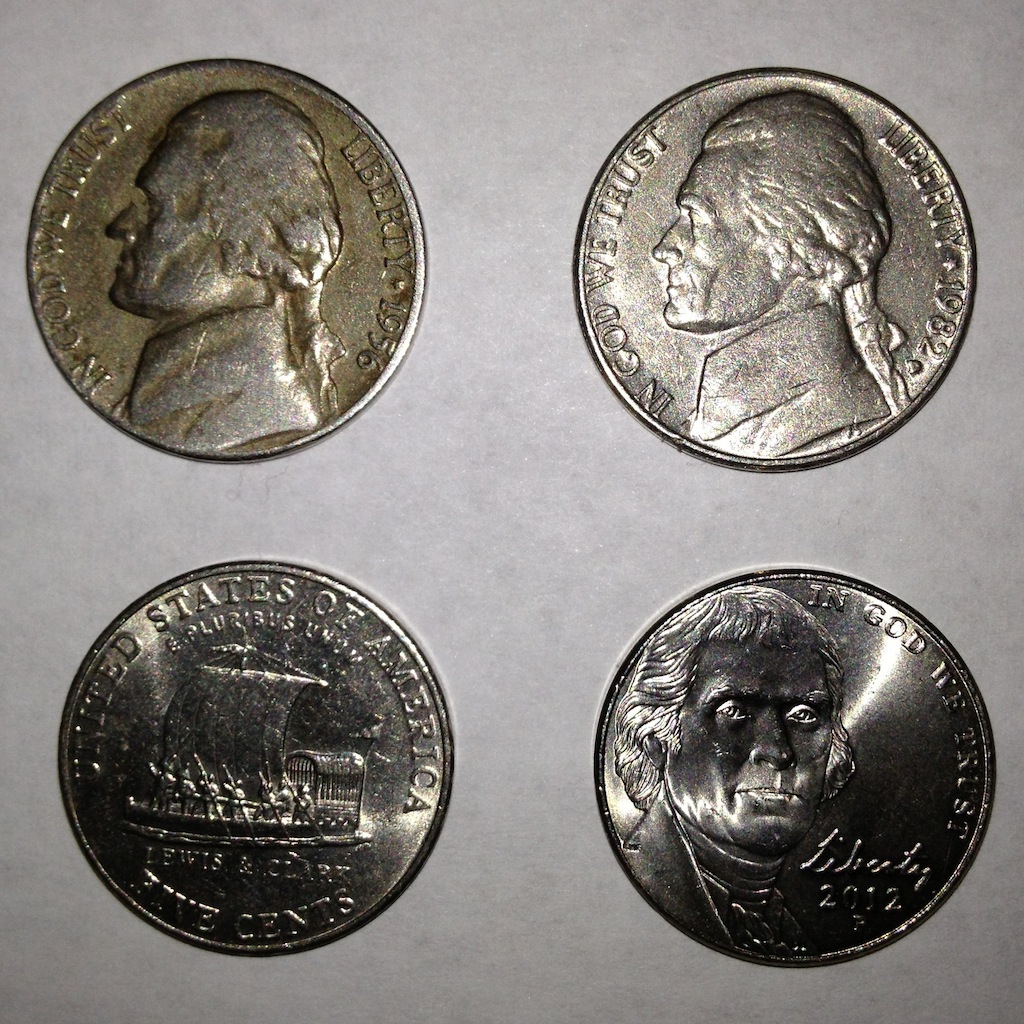
A small type set of Jefferson nickels found in pocket change.
Top row: 1956-D and 1982-P. Bottom row: 2004-P Keelboat design and 2012-P.
The next question was “How much is it worth?” Since the coin could be graded Good-4 at best, I said it would probably be worth 5-cents, face value. I decided to look up the price and saw that it was worth 6-cents! It is hardly worth the effort to sell. But the person that I was showing the coins found my little pocket-change type set was interesting.
Now that I have written about them, all four coins will go back into circulation for someone else to find. Who knows, maybe a young numismatist will find the 1956-D, think it is cool and add it to their collection. If you are in the Washington, D.C. metro area, you can be on the lookout for the 1956-D and other nickels I just wrote about. Happy change hunting!
Jul 26, 2013 | coins, US Mint
 If you have not heard, the U.S. Mint is offering free standard shipping starting today at noon eastern time through September 30, 2013. This means that all orders made over the telephone (800-USA-MINT or 800-872-6468) or their online catalog will not be charged the $4.95 shipping costs regardless of the purchase price and size of the order.
Expedited shipping will be charged only the UPS 2nd Day Air fee of $12.95.
Bag and box orders will be charged only the $7.95 surcharge.
If your order qualifies for free expedited shipping upgrades by costing more than $300, then your expedited shipping will be free.
Because this offer is only for domestic standard shipping service, international orders will continue to be charged $14.95 + $2.95 per item.
Although the U.S. Mint has not announced why they are doing this, they might feel that they need collectors to spend more money in order raise revenues. Since the U.S. Mint is largely self-sustaining, revenue projections may be lower because of the lowered production, the lack of enthusiasm for commemorative coins, and a reduction in sales of bullion products as the costs of precious metals continue to trade off their highs from earlier this year.
Since this offer will be good through the end of September, I probably will not buy anything from the U.S. Mint at the World’s Fair of Money. After all, I think it will be easier to have my collectibles shipped home than have to schlep it through the airport.
Jul 22, 2013 | coins, dollar, legislative, policy

Dollar Coin Alliance
The COINS Act is designed to eliminate the $1 federal reserve note from circulation by increasing the circulation of coins and reducing the circulation of the paper currency over three years. At the end of three years, the Federal Reserve will not be allowed to distribute the $1 not. The bill does allow the Bureau of Engraving and Printing to continue to distribute the $1 note as a collectible for numismatists.
The bill was introduced by Sen. Tom Harkin (D-IA) and co-sponsored by Sens. John McCain (R-AZ), Tom Coburn (R-OK), Mike Enzi (R-WY) and Mark Udall (D-CO). It supports the GAO reports that suggest the potential savings of using the coin over paper will be $13 billion.
If you are in the Washington, DC area and what to talk about the COINS Act, the briefing will be held a noon at the Russell Senate Office Building in Room 385. Attending the briefing for the Council for Citizens Against Government Waste and The Dollar Coin Alliance:
- Aaron Klein, Former Chief economist for the Senate Banking Committee and Deputy Assistant Secretary of the U.S. Treasury
- William Christian, Director of Government Affairs, The Council for Citizens Against Government Waste
- Former Congressman Jim Kolbe (R-AZ), Honorary Co-Chair of the Dollar Coin Alliance
If you cannot attend the briefing, take the opportunity to contact your senators to let them know how you feel about the bill.
Logo courtesy of the Dollar Coin Alliance.
Jul 21, 2013 | celebration, coins, fun, other
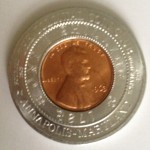
Encased cent given to attendees to the Colonial Coin Club’s 50th Anniversary celebration.
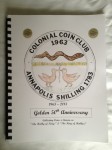
The Colonial Coin Club was founded in 1963 by members of the Baltimore Coin Club who commuted to meetings from Annapolis. While not that far of a commute, these members felt there was enough interest to form their own local club. The first meeting of the Colonial Coin Club was March 19, 1963. Fifty years later they are still a vibrant club serving collectors in the Annapolis area.
With my busy schedule, not only did I welcome the one night diversion to join the celebration at a nice restaurant in Gambrils, Maryland, but I had a chance to speak to congratulate them, encourage them to continue their good work for the next 50 years and beyond, and invite them to participate with the state organization and to visit the club I am president of, the Montgomery County Coin Club.
Colonial Coin Club has quite a history serving collectors in the eastern part of Maryland. Although Baltimore may be Maryland’s largest city, the areas around the Chesapeake Bay is the birthplace of the original Maryland colony. Although the Calvert family settled into what we now know as Baltimore, Annapolis was the colony’s economic hub. Amongst Annapolis’s residents was Jonas Green who became the colony’s official printer. Green served as an apprentice and worked for Benjamin Franklin in Philadelphia.
Green died in 1767 around the time that the colonial government was issuing its first currency. Taking over the printing business was his wife Anne Catherine Green making her the first woman to publish a newspaper in the colonies. Because of the social stigmas against women in these types of position, she printed her name as A.C. Green.
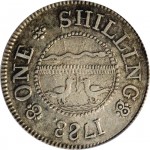
1783 Chalmers Shilling (PCGS XF 40).
The design of the Chalmers Shilling has been a matter of debate. Several references call the long animal depicted a worm while others call it a snake and the two birds as doves. Some claim the birds are fighting over the worm/snake and there is no speculation as to why the worm/snake is depicted over a hedge. If you consider Maryland’s history at the time, snakes were not as prevalent in the Annapolis area. Birds would be going after worms and the two birds, which could be doves, are not fighting but sharing the worm—a symbol of Chalmers trying to tell people to get along during the tense period of transition from being British subjects to a free country. Considering that the coins were designed by Thomas Sparrow, who also designed the Maryland currency when it was issued, The worm over the head was to show unity across the Maryland fields.
If nothing else, I am adding the speculation as to the meaning of the coin.
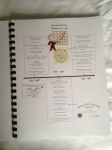
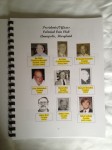
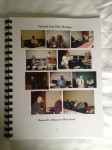
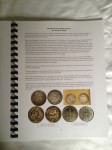
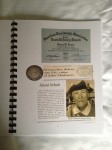
As part of the celebration, the club put together a nice book of their history with articles from their journals, members, press clippings, and images that also makes is a really nice modern scrapbook of the club. It is an impressive bit of work by Betty Meck, a past president of the club, with help from their current Secretary, club historian, and the member with the longest service to the club Hank Schab. Both of whom I had a pleasure to meet and want to make special note of their contributions.
Also attending was Will Mumford. Will is a past president of the Colonial Coin Club and archivist for the Maryland State Archives who wrote, Barter, Bits, Bills and Tobacco: The Story of Money in Early Maryland. Will also wrote Strawberries, Peas, and Beans about the Pickers Checks in Anne Arundel County.
For a good overview of picker checks, you can read Picker Checks, Currency of the crops [PDF] by Gilbert Sandler from the University of Baltimore archives.
Finally, I would like to thank Colonial Coin Club President Rod Frederick for inviting the Maryland State Numismatic Association to participate which allowed me to be there as their representative. I will be 103 when the club celebrates a century of serving the coin collectors of the Annapolis area. I hope they will invite me back to celebrate with them!
A few images of the Colonial Coin Club’s 50th Anniversary history and album:
Chalmers Shilling image courtesy of
Heritage Auction Galleries. Coin is from the January 2008 FUN Auction in Orlando and sold for $13,800 (including buyer’s premium).
Jul 13, 2013 | advice, ANA, technology
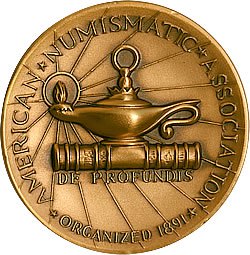 On Friday, I received a notice to renew my American Numismatic Association membership by the end of this month. Even though a few people wrote to me after the election saying that they would not renew their membership, I believe that the ANA is still a good organization worth of the support of every numismatist regardless of age, experience, and collecting interest. My only question is whether to change to the basic level to save trees.
Members renewing at the Basic level can read The Numismatist online or via my computer or the iPad app. I stopped using the iPad app for a while after having problems. The app was updated and seems to be working fine now. I think I would prefer to read it on my iPad than the paper version. It is more portable. However, if the program could be converted to work with Apple’s Newsstand, the ANA may be able to find a new revenue stream by selling individual issues.
After the election I received a lot of complaints about the the ANA and how it operates. In many cases, I agree with the assessments but I also see where there are changes coming and all of the changes are for the better!
First and foremost, the ANA is being dragged into the technology of the 21st century. In a move started by former Executive Director Jeff Shevlin, the ANA has engaged Amos Digita, the technology arm of Amos Press, the publisher of Coin World. Anyone who has seen the positive evolution of the Coin World website and has read Coin World Next online can see examples of their work. Working with Amos Digital is a very positive step for the ANA.
Between Amos Digital, the commitment of the ANA staff involved, and the Technology Committee (which I am a member) the future to better the ANA’s technology is looking very good!
Technology alone is not going to make the ANA a better organization but the technology will provide a platform to make the ANA more responsive to its members. Technology can help with virtual clubs, education, and to bring the information out to the members. Technology can enhance shows and deliver some of the content to the members who may not be able to attend the shows.
However, technology is only an enhancer—a tool to make the ANA better for you. The problem is that those of us who are putting the tool together may not know what will make the ANA a better organization for you. What do you want to see from the ANA? How can the technology be used to make your experiences better?
Although I have some ideas, I am a systems guy. I put together systems to do what my customers want. And even though I know what I want as a member, it is only my opinion.
As a member of the ANA Technology Committee I want your opinion. What do you want from this tool? How can the ANA use these tools to make your experience as a member the ANA better? I am handing you a blank sheet of virtual paper (the comment section, below). Let me and my fellow Tech Committee members know how we can use this tool to better serve the membership.
Medal image courtesy of Wikipedia.