To bring back the weekly poll, I thought about my post the other day about desktop finds where I discussed the items I found while cleaning my desk. I was thinking about this and was curious as to what other collectors do? After all, many of these items are the results of my saying “oh neat” and buying something outside of my collecting interest. Others are items that were given to me that are also outside of my collecting interest.
I read articles that say if you’re not a collector you’re an accumulator. But it is not that simple. Sometimes I over buy just to get one specific item. For example, the lot of Canadian dimes I found on my desk were purchased because I wanted one of the dimes for my collection. I will probably resell the rest of the dimes, but in the mean time they are on my desk.
Other items are souvenirs like the faux million-dollar bill and the package of shredded currency. While I may not have an attachment to them, they are not salable and I just do not want to throw them away. Maybe I’ll create an auction lot of this stuff to see if someone else wants it but it is still here, too.
What about you? Do you buy extra items and think you’ll resell them later? What about those souvenirs? How many of you have cheap items that you know you cannot resell or even give away? Take the poll. Comments are always welcome!
What kind of "extra items" are in your collection?
I have bought something I thought was neat or unusual. (35%, 6 Votes)
I have bought lots of coins or exonumia just for one or two items. (24%, 4 Votes)
I have souvenirs that are not part of my main collection. (18%, 3 Votes)
I collect souvenirs but have bought more than I should have. (12%, 2 Votes)
I have a box of goodies, want to see it? (12%, 2 Votes)
I just have what I collect and nothing extra. (0%, 0 Votes)
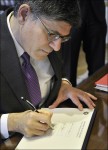
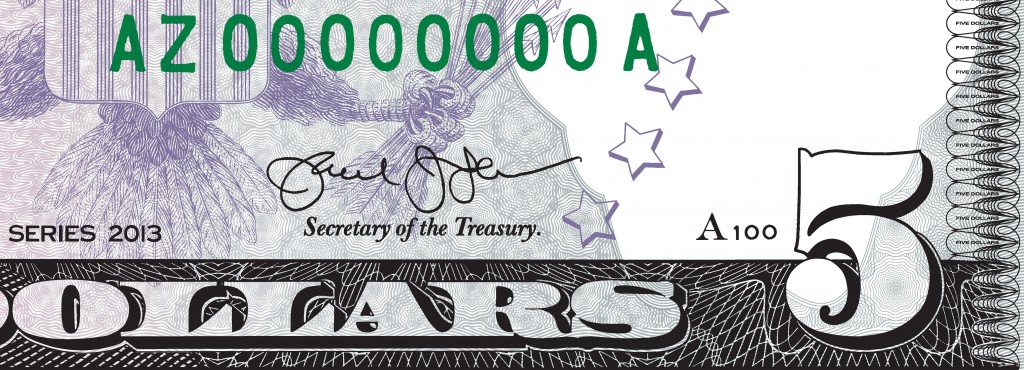
In one of those news items from while I was away, Secretary of the Treasury Jacob J. “Jack” Lew put pen to official paper and provided an autograph that will appear on United States Federal Reserve Note. Treasury reports that Lew’s signature will first appear on Series 2013 five-dollar notes that will be issued this fall. No plans were announced for other denominations.
Lew, whose autograph has been called “lewpty” and been compared to the decorative icing on a Hostess cupcake, made a promise to the president that he would do better with his penmanship. During his confirmation hearing, Lew told Sen. Max Baucus (D-MT), Chairman of the Senate Finance Committee, that he promised the president he would do better. This did not satisfy those with an ironic sense for the different when a petition appeared on the White House website to “Save the Lewpty-Lew.”
Mock-up of how Treasury Secretary Jack Lew’s autograph will appear on the Series 2013 $5 Federal Reserve Note in the Fall.
Remember as you were growing up spending time with a piece of paper practicing your signature? I wonder if Lew was doing this in his spare time?
While Lew’s autograph lost many of his infamous lewpts at least he did not go to the extreme that of predecessor, Tim Geithner. Geithner’s autograph was very readable and lacked character. At least Lew kept some of his lewpts. It will make for interesting conversations for currency collectors in the future as they examine the autographs on their collectibles.
Images courtesy of the U.S. Department of the Treasury.
Amongst my activities for the last month has been cleaning off the top of my desk. While for some this may be an easy project, for me it is a major proposition. One of the reasons is that the way I work can be best classified as “organized chaos.” Organized chaos builds piles of like items until there is no room. Rather than clean up the piles, priority items are reordered and piled on top of items that may not be needed until later. This keeps going until the desktop becomes unorganized as the piles get shifted looking for something that became buried. At some point the organization goes away and all that is left is the chaos. Finally, the day comes when a critical item can no longer be found.
I have had people tell me that the best way to keep my organization under control is to deal with the item right away. For some reason, I get attached to ideas, concepts, and the objects that are associated with them. Everything gets saved until I do something with them or I am faced with the difficult decisions to make it a priority when I finally dig out of the chaos.
But the digging can be fun because at the bottom of the pile, when the top of the desk is finally rediscovered, are the small items that are the most fun. In my case, there are a lot of coins, medals, tokens, and other items that I thought would be cool or nice to resell. Just to have a little fun, I gathered up some of the numismatic trinkets and decided to share it with my readers.
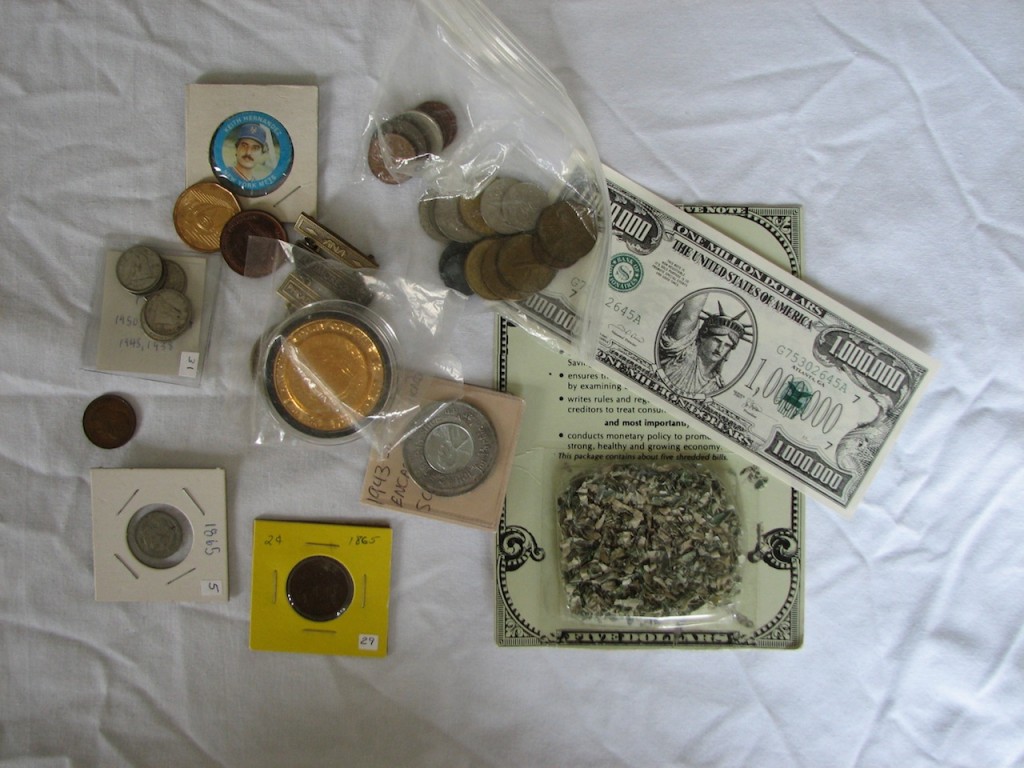
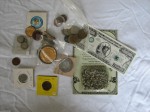
Some of the numismatic items found during my attempt to organize my chaos.
It looks like an eclectic little lot of stuff. I have a million dollar bill (talk about inflation money) sitting on top of a package of shredded currency that says has about $10 of chopped up notes, some Canadian money, and older U.S. coins. Those coins with the little numbered stickers were purchased at my coin club’s auction. There is a lot of five Canadian dimes, a copper 2-cent piece, and a nickel 3-cent coin.
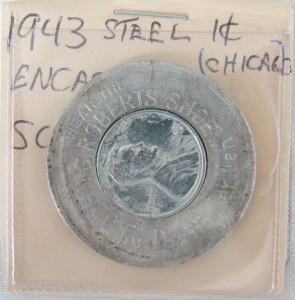
Encased steel cent advertising John C. Roberts Shoes “for the particular man.”
But some of these coins are a bit interesting. Let’s look at this encased steel cent. Up until I bought this coin from noted error dealer Fred Weinberg through eBay I had never seen an encased steel cent. The aluminum ring says “Wear the John C. Roberts Shoe” around the top and “For Particular Men” on the bottom. The reverse has the address of a store in Chicago, Illinois.
John C. Roberts was one of the founders of the Roberts, Johnson & Rand Shoe Company of St. Louis in 1898 as a wholesaler. The other founders were Jack Johnson, Oscar Johnson, and Edgar E. Rand. They were a competitor to Peters Shoe Company that was founded in 1836 but organized into a formal corporation under Missouri law in 1891 by Henry W. Peters. The Peters Shoe Company was a manufacturer and wholesaler.
Although these two companies were competitors, their policies, ideals. and business standards were so closely aligned that they were drawn together by a mutual respect. The companies merged in 1911 and changed their name to the International Shoe Company. The next year, in 1912, the International Shoe Company purchased Friedman-Shelby Shoe Company, another St. Louis-based shoe manufacturer. In 1921, International Shoe Company was incorporated in Delaware.
International Shoe Company was once the world’s largest manufacturer of shoes with Red Goose shoes being its flagship brand. At one time, International Shoe Company owned Florsheim and Savage Shoes, Canada’s largest shoemaker. In 1966 the company changed its name to Interco and tried to become a conglomerate in apparel, footwear, and retailing. The company’s troubles began as it branched into furniture by buying Ethan Allen and Broyhill Furniture in 1980 as the furniture manufacturing was declining in the United States.
Eventually, Interco filed for Chapter 11 bankruptcy in 1991 and sold off all of its operations except for Broyhill, Lane, Converse (which it bought in 1986), and Florsheim. By 1994, the company sold Converse and Florsheim to exit the shoe business. The company was rebranded as Furniture Brands International 1996 after buying Thomasville Furniture. Now they only manufacture and sell furniture leaving collectors with these encased coins to raise our curiosity.
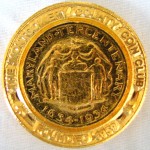
Obverse of Montgomery County Coin Club medal with standard logo that was gold plated for the 50th Anniversary.
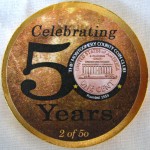
Reverse of the Montgomery County Coin Club medal with the special sticker commemorating the club’s 50th anniversary in 2009.
My next interesting find was my “gold” medal commemorating the 50th anniversary of the Montgomery County Coin Club in 2009. As president of the Montgomery County Coin Club, it was my job to help lead a celebration honoring our 50th anniversary. Since I was not a member for as long as others, I leaned heavily on longer tenured members for assistance. I believe the celebration went well.
To commemorate the occasion, we wanted a special medal but we did not want to spend a lot of money. Rather than buy new medals, we dipped into our ample supply of pewter medals and had them gold plated. On the back, I created a “50” logo that was similar to our regular logo that uses the reverse of the Maryland Tercentenary half-dollar but uses the reverse of the Lincoln Memorial cent that was released in 1959. That logo was added to a sticker and numbered. The club as #1 as a souvenir. Since I was the president, I was able to get #2. I just wish I made the background of that sticker a bit lighter.
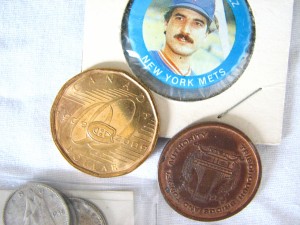
Miscellaneous Items with Canadian dollar, dimes, a TBTA token, and Keith Hernandez souvenir “coin.”
Sometimes there is just some loose stuff on the desk including a Canadian dollar commemorating the 100th anniversary of the Montreal Canadiens (they are a professional hockey team for those who do not follow hockey), a token from the Triborough Bridge and Tunnel Authority (TBTA) in New York City, a small set of Canadian dimes, and a Keith Hernandez “coin” from a 7-Eleven promotion in the mid-1980s. Hernandez was the Mets’ star first baseman when they won the 1986 World Series. Yes, I know he played for St. Louis before being traded to the Mets, but that is inconsequential to my collecting interests!
The TBTA token is interesting because it is smaller than the ones I used to use because it is for other tolls than the East River bridges. This token was primarily used on the Henry Hudson and the Marine Parkway (now Marine Parkway-Gil Hodges Memorial) Bridges where the tolls were cheaper. The larger tokens were used on the Triborough Bridge, Verrazono-Narrows Bridge, the Queens Midtown Tunnel, and other nearby crossings.
Tokens are no longer accepted at the TBTA crossing and they stopped issuing special Staten Island resident tokens for the Verrazano Bridge in 1998 with the introduction of EZ-Pass. I should try to find a Staten Island resident token for my collection.
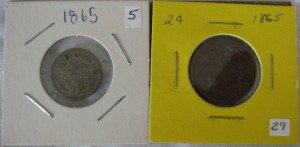
An 1865 3-cent nickel and an 1865 2-cent coin for my 2-, 3-, and 5-cent one-pager
Finally, something that was purchased relatively recently but made it to the bottom of the pile are two coins I bought to start my one-page collection of 2-, 3-, and 5-cent coins. The week after writing about this in a blog post, the coins were available in my coin club’s monthly auction. Since I plan to put the set together, I bought these 1865 2-cent and 3-cent nickel coins to begin the question. But like a number of items that ended up buried on the surface of the desk, this is where that stopped. Now that I found the coins, I am going to make note of where I am in this collection and bring the list to the World’s Fair of Money in August to see if I can fill in the holes. In fact, I will probably work on completing my one-page cent collection, too. It’s not like I will have anything else to do!
There is more but if I do not stop now I am not going to be able to finish my cleaning!
A short time ago, the American Numismatic Association announced who will serve the association on the 2013-2015 Board of Governors. Current ANA President Tom Hallenbeck announced the following:
President: Walt Ostromecki (unopposed) Vice-President: Jeff Garrett (unopposed) Governors:
Gary Adkins (3,220 votes)
Scott T. Rottinghaus (2,859)
Dr. Ralph W. Ross (2,797)
Mike Ellis (2,782)
Greg Lyon (2,723)
Jeff Swindling (2,591)
Laura Sperber (2,569)
The rest of the votes were as follows:
Tom Mulvaney (2,389)
William D. Hyder (2,095)
Oded Paz (1,916) Scott Barman (1,891)
Steve D’Ippolito (1,862)
Jeff Wuller (1,786)
Richard Jozefiak (1,543)
To everyone that supported my candidacy I want to give you a heartfelt THANK YOU. While I did not win this election, I will continue to work for the ANA to bring it technologically into the 21st century.
Congratulations to the 2013-2015 ANA Board of Governors.
S. 1105: Currency Optimization, Innovation, and National Savings Act
Sponsor: Sen. Tom Harkin (D-IA)
• To improve the circulation of $1 coins, to remove barrier to the circulation of such coins
• Introduced: June 6, 2013
• Referred to the Senate Committee on Banking, Housing, and Urban Affairs
Track this bill at http://www.govtrack.us/congress/bills/113/s1105
S. 1158: National Park Service 100th Anniversary Commemorative Coin Act
Sponsor: Sen. Mark Warner (D-VA)
• Introduced: June 13, 2013
• Referred to the Senate Committee on Banking, Housing, and Urban Affairs
Track this bill at http://www.govtrack.us/congress/bills/113/s1158
H.R. 2366: World War I American Veterans Centennial Commemorative Coin Act
On Friday, the American Numismatic Association announced that President Tom Hallenbeck will announce the results of the 2013 ANA elections online on July 3, 2013 at 4:30 P.M. Mountain Time (6:30 P.M. on the east coast). The broadcast will be over YouTube on the ANA’s YouTube channel. Walt Ostromecki, who ran for president unopposed, Jeff Garrett, who was unopposed for vice president, and the 14 members running for the remaining seven seats on the Board of Governors will participate by telephone.
For me, this will be interesting since the time is during my commute. Those who have not had the privilege of being in the Washington, D.C. metropolitan area during rush hour wonders why it is called “rush hour” since it looks like nobody is rushing and it lasts a lot more than an hour. We laugh cynically at all the reports that consistently rank this area’s traffic amongst the worst in the nation even topping Los Angeles. Even though it appears that many people will take the opportunity to go on vacation, the day before a holiday always raises the traffic levels. With it being the day before Independence Day, it should make traffic more fun!
If I cannot leave my office early, I will be on the telephone from my car—hands-free as it is the law in Maryland and the District of Columbia—probably sitting in Beltway traffic. I will probably have my favorite beverage with two additional shots while driving and on the phone. This will make the commute very interesting!
For those who missed the announcement, the following is the press release issued by the ANA:
ANA Board of Governor election results to be broadcast online
President Tom Hallenbeck will announce 2013-15 board during live broadcast
American Numismatic Association President Tom Hallenbeck will announce the winners of the 2013-15 Board of Governors election during a live online broadcast at 4:30 p.m. Mountain Daylight Time on Wednesday, July 3, 2013.
A press release announcing the newly elected board members will be issued to the ANA membership and the media immediately following the broadcast. Results will be posted on Money.org as well as on the ANA’s Twitter, Facebook, Google+ and LinkedIn accounts.
The election was conducted by Survey & Ballot Systems Inc., headquartered in Eden Prairie, Minn. For the first time ever, ANA members were given the option of voting online or with a traditional mail-in ballot.
The American Numismatic Association is a congressionally chartered nonprofit educational organization dedicated to encouraging people to study and collect money and related items. The ANA helps its 28,000 members and the public discover and explore the world of money through its vast array of education and outreach programs, as well as its museum, library, publications, conventions and seminars. For more information, call 719-632-2646 or go to www.money.org.
Earlier this month, Sen. Tom Harkin (D-IA) introduced the Currency Optimization, Innovation, and National Savings (COINS) Act (S. 1105) to transition the United States to the use of a one-dollar coin rather than a paper dollar. Harkin introduced the bill with Senators Tom Coburn (R-OK), Mike Enzi (R-WY), John McCain (R-AZ), and Mark Udall (D-CO) as co-sponsors. The bill was assigned to the Senate Committee on Banking, Housing, and Urban Affairs. Only Sen. Coburn is a member of the Senate Banking Committee.
When the coins are withdrawn from circulation (the bill calls them “sequestered”), they will be available for sale to coin dealers and can be sold to countries that use the U.S. dollar as its currency. Otherwise, these Susie B.’s will remain in legal and withdrawn by the banks when they are deposited. Although the bill does not provide explanation for these provisions, it can only be assume to prevent these coins from causing the confusion we experienced when they were released in 1979.
Aside from the circulation reporting requirements, the section encourages countries that have adopted the U.S. dollar to order coins from the Federal Reserve and for the member banks to only ship dollar coins. However, there are countries that have adopted U.S. currency as its standard that cannot afford the shipment of paper currency and have experienced a shortage of Federal Reserve notes for use in its daily commerce. The switch to coins will make shipping that much more expensive and may lead to a currency shortage in some countries.
As the Federal Reserve “sequesters” SBA dollars, the bill says that the Fed is to start replacing notes with coins but not completely. The bill allows both the notes and coins to circulate concurrently until more than 600 million coins are put into circulation or after four years, whichever comes first. Once the co-circulation trigger is met, the Fed will not be allowed to order currency for one year, thus reducing the supply of the paper note leaving people no choice but to use the dollar coin.
One interesting provision of the bill is that it does not completely eliminate the dollar note. According to the bill, the Fed may produce dollar notes “from time to time are appropriate solely to meet the needs of collectors of that denomination.” Much like the half dollar coin that does not circulate but is included in sets and made available to the collecting community, this will allow the Bureau of Engraving and Printing to produce special sets using one dollar notes in much of the same way they do with the $2 notes today.
A little noticed provision of the bill updates the handling of seigniorage that the U.S. Mint deposits into the United States Mint Public Enterprise Fund (31 USC § 5136). The revision simply allows congress to estimate the value of the seigniorage that will be deposited into the Public Enterprise Fund to be used for the budget process. Without this change, the government can only use the actual value in the account, which is the amount deposited in previous years.
It is probably not lost on these senators that since the Treasury pulled back on the production of dollar coins that the amount of seigniorage has decreased. If congress is going to force the dollar coin into circulation, it will increase the seigniorage the U.S. Mint will collect making those profits a prime target for the government to use for its own purposes. This provision will allow congress to attach those profits before being collected rather than waiting for them to be collected. Although this may not sound right, it is consistent with how congress estimates the collection of tax receipts for the current budgetary process.
Considering my recent experience in Canada using one dollar (Loonies) and two dollar (Toonies) coins, I would like to see this bill passed into law. Given the gridlock that congress has demonstrated by passing only 14 bills to this point of the 113th congress, one cannot be optimistic about congressional action.
I am back after taking two weeks off for a little travel. As part of my ventures I spent some time in Canada. My wife, whose family is from the French-speaking areas of Quebec, had me trail along while she visited relatives. Even though I cannot speak French (très peu or “very little” is my response to when I was asked) I did have a good time. My wife’s relatives are good people and it would be interesting to see some of them come to the United States to visit.
While I was in Canada I decided that it would be interesting to buy rolls of one dollar (Loonies) and two dollar (Toonies) coins and see what I can find. The process was very interesting. First, I had to find a teller who could help me in English and accept U.S. currency. Thankfully, my wife had business at a local bank and the banker she worked with introduced me to a teller I could work with.
As I was introduced to the teller, I decided to buy two rolls of Loonies and Toonies. I thought this would be a good idea since these rolls may not have many coins. After all, rolls of U.S. dollars has 25 coins and the half dollars have 40 coins. I was surprised to learn that both the one and two dollar Canadian coins contain 50 coins! Playing it cool, I pretended I was not surprised and decided that purchasing 100 of each coin would be more fun to go through.
The rolls that were handed to me were clear plastic with locking tabs to hold the coins in place. Opening the roll is as easy as pulling apart the tabs. It does not require banging the rolls on the counter or tearing apart paper. While I did not open the roll all of the way, I was able to press the tabs closed to keep the rolls together.
Since I was paying for the rolls using U.S. currency, the bank used the current exchange rate for the conversion. With an exchange rate of a fraction over 98-cents per Canadian dollar, the two rolls cost less than $150 in U.S. currency. This presented a problem trying to pay with coins. Thankfully, my wife had some Canadian currency and paid for part of the transaction and added the C$5.00 fee since I was not a customer. What was more interesting was that without one-cent coins in circulation, the change had to be rounded. In this case, the change was rounded up!
After I walked out of the bank I began to wonder how the bank balances its books? Having worked on computer systems that supports accounting with all of the auditing capabilities and the ability to balance many accounts at once, what happens when the balances do not match? Do the banks track the plus-or-minus cents in order to make the books balance?
While in Canada I had to continue with my usual coffee habit and found myself at a Tim Hortons. For the United States audience not in the northeast where there are Tim Hortons franchises, Tim Hortons was founded in 1964 by Miles “Tim” Horton, a hockey player and entrepreneur, in Ontario as a donut shop. Although Horton died as a result of a 1974 automobile accident, his namesake restaurant is the largest fast-food chain in Canada. When I am asked to describe Tim Hortons I say that it is similar to Dunkin Donuts but with a better system and better coffee. When purchasing coffee at the Tim Hortons and paid using cash, the store worker would enter the amount of money I handed over and the electronic cash register calculated the change. On the screen it noted the change and how much would be actually dispensed without the one-cent coins. When I made a $1.78 purchase and handed the cashier a toonie, the cash registers said I was owed 20-cents in change.
Even though these transactions were in my favor, I had mixed feelings about the situation. I could have paid the exact amount using a credit card, but I am not comfortable using my credit card for small transactions.
Canadians seem to be comfortable, or at least accepting, with the elimination of the one-cent coin. I noticed they are comfortable with the one and two dollar coins. In fact, I liked having the coins from change while purchasing my coffee or other items while in Canada.
I am not sure that eliminating the one-cent coin or the paper dollar is ever going to happen in the United States, but if Canadians can adapt then I do not see why we should not be able to!
Following the failure of the House of Representatives to even consider the Collectible Coin Protection Act in the 112th Congress (H.R. 5977), Representative Lamar Smith (R-TX) kept his promised and re-introduced the bill into consideration for the 113th Congress. On May 7, 2013, H.R. 1849 was assigned to the House Energy and Commerce Committee. The bill was introduced two days before the National Money Show, the current co-sponsors are Reps. Bill Cassidy (R-LA), Steve Scalise (R-LA), and Henry Waxman (D-CA). Fred Upton (R-MI) is the Chairman of the Energy and Commerce Committee and Waxman is the Ranking Member. Both Cassidy and Scalise are members of that committee.
The bill is exactly the same as H.R. 5577 that was introduced late in the 112th congress.
Rep. Steve Scalise is a new addition to this bill. He represents Louisiana’s 1st District that covers an area north and to the west of New Orleans that includes Metarie and Slidell. Scalise attended a reception at the National Money Show where he expressed his commitment to see the bill pass.
Scalise is the newly elected chairman of the Republican Study Committee (RSC), a caucus of House Republicans “organized for the purpose of advancing a conservative social and economic agenda in the House of Representatives.” In an interview during the National Money Show reception, Scalise said that would be H.R. 1849 an effective tool to help the hobby and since it is revenue neutral, he will recommend it to the 174 members of the RSC.
Currently, the Hobby Protection Act (15 U.S.C. §§2101-2106 and 16 CFR 304) does not allow for enough protection for the buyer. Aside from requiring the word “COPY” to appear on a copy, it does not allow for buyers or the government to take action against resellers, only the manufacturers.
When the Hobby Protection Act was first enacted in 1973 and updated in 1988, the online world did not exist the way it does today. It was easier to trace the manufacturers and the overseas sellers than the distribution channels are today. By the time a counterfeit coin reaches the United States, it could have been bought and purchased several times before being noticed. Then there is no remedy for those who have been duped.
Another problem is that the counterfeiters are learning to counterfeit slabs. Both NGC and PCGS have seen their slabs counterfeited or altered holding counterfeit coins. Both NGC and PCGS have the same problems with trying to protect their brands against counterfeiters.
The introduction of the bill is the result of the work of the Industry Council for Tangible Assets (ICTA) and Gold and Silver Political Action Committee (GSPAC), and the numismatic community working with key representatives to craft an effective legislation. It is also written to ensure support from congress. Benefits of the new law are as follows:
Include the distribution and sale of items not properly marked as being a COPY
Expands the provisions to include “any person who provides substantial assistance or support to any manufacturer, importer, or seller” who knowingly engages in any act or practice that violates the Act;
Expands the ability for those who were sold counterfeit items to include the counterfeiter, their agent in the United States, or anyone who knowing “transacts business” in violation of this Act;
Extend trademark violations and remedies to help third-party certification services protect against counterfeit holders.
These new provisions will allow collectors, dealers, and grading services to bring legal actions that are much more effective, with much stronger remedies than previously existed. It will allow those harmed to work with the Justice Department to bring criminal actions, where apporpriate.
WE STILL NEED YOUR HELP
The only way to ensure that H.R. 1849 becomes law, especially since we are approaching the end of this session in an election year, is to contact your member of congress will let them know that the numismatic community supports this Act and that their support is important.
To contact your representatives, visit house.gov and enter your Zip Code at the top right of the page. When you contact your representative, you should mention that H.R. 1849 is revenue neutral and will not require additional appropriations. The bill will go a long way in combating counterfeit rare coins in the marketplace, saving collectors and investors millions of dollars in fraudulent transactions.
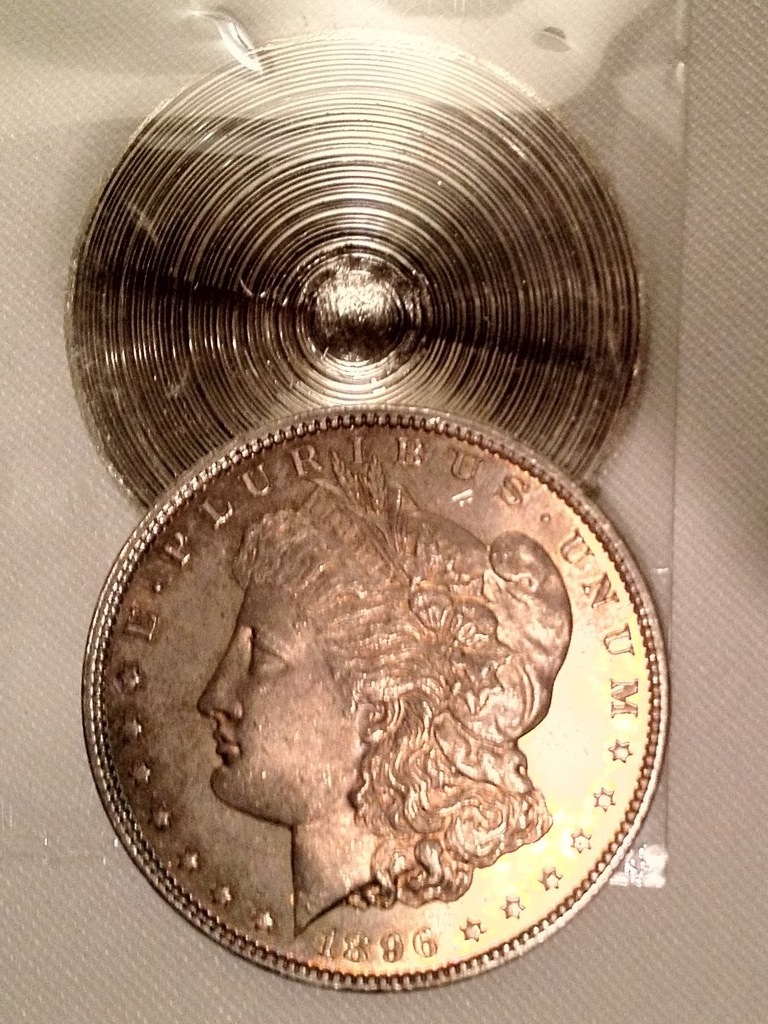
An example of a Morgan Dollar cut in half to match a date with a mintmark to have the coin appear something it is not. Coin was in a counterfeit PCGS slab and caught by one of their graders.
DISCLAIMER: I am working as Political Coordinator for the Gold and Silver PAC.
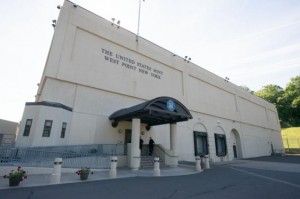
This year, the U.S. MintFacility at West Point, New York turn 75 years old. When opened in 1937, it was to be the nation’s silver bullion depository giving it the nickname “The Fort Knox of Silver.” In 1988, West Point was granted mint status.
The “W” mintmark on U.S. coins is highly prized since it is the only mint not to strike circulating coins with its own mintmark. While the West Point Mint did strike cents from 1973 through 1986, the coins produced were not struck with a mintmark.
Today, the West Point Mint only strikes precious metal coins. From commemoratives through bullion American Eagle coins, West Point produces more precious metal coins than any other Mint in the world, including the San Francisco Mint.
Located just outside the United States Military Academy, the West Point Mint does not allow visitors or tours for security reasons. However, exceptions are made. With the facility celebrating its 75th anniversary, the U.S. Mint has been allowing journalists to visit and take pictures of their operations.
The Daily News also created a two-minute video looking inside the facility. The video follows (if it begins with a commercial, it is being sent by the Daily News—the cost of embedding their video):
If you are having problems seeing the video, go here.
All images and the video courtesy of the Daily News.

 Loading ...