Jun 5, 2013 | coins, gold, history, US Mint
Franklin Delano Roosevelt was inaugurated on March 4, 1933 at the height of the Great Depression. Unemployment was over 25-percent, inflations was rampant, farm prices have plummeted so low that it was cheaper for farmers to plow under crops, and banks were failing at record numbers.
Two weeks prior to his inauguration, FDR asked his old friend and Wall Street executive William H. Woodin, to be the Secretary of the Treasury and help implement a new monetary policy. Woodin rushed to Washington to work with Ogden Mills, President Herbert Hoover’s Secretary of the Treasury, in order to understand the issues. On the day of FDR’s inauguration, Mills resigned and voluntarily stayed in Washington to help Woodin with various policy changes.
Hours after FDR’s inauguration, the Senate approved the appointment of Woodin as the Secretary of the Treasury. With his new Treasury Secretary in place, Woodin’s first act was to declare a three-day bank holiday in order to try to stop the failures.
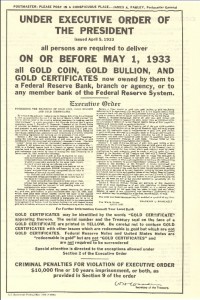
Handbill that was displayed in Post Offices calling for the recall of gold with the text of Executive Order 6102
Executive Order 6102 specifically exempted certain industrial uses of gold, art, and allowed people to keep up to $100 in face value in gold coins. It also exempted “gold coins having recognized special value to collectors of rare and unusual coins.” The protection of collectible coins was credited to Woodin since he was a collector of coins and patterns he acquired while director of the New York Federal Reserve Bank.
Although most of the country complied with the executive order, some challenged the law and started to sue the government to stop the gold recall. With the challenges mounting, on June 5, 1933, congress formally takes the United States off the gold standard by enacting a joint resolution (48 Stat. 112) nullifying the right of creditors to demand payment in gold.
For weeks after FDR issued EO 6102, the U.S. Mint continued strike gold double eagle coins because they did not have an order to stop. After receiving the stop work order, the coins were stored until they were ordered melted in 1934.
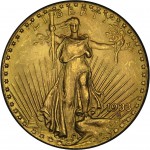
Even though the double eagles were melted, several examples of the 1933 Saint Gaudens double eagle gold coin did find its way out of the Mint. While most were tracked and confiscated, one example found its way to Egypt into the collection of King Farouk. This was the coin that eventually was sold in 2002 for $7,590,020 ($20 given to the government to monetize the coin) to a private collector. Half of the proceeds were paid to the government as part of a settlement with British coin dealer Stephen Fenton, who was arrested trying to sell the coin at the Waldorf Astoria Hotel in 1998.
-
-
-
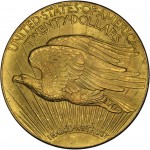
Reverse of the iconic 1933 Saint Gaudens
$20 Double Eagle gold coin
But that does not end the story of the 1933 Saint Gaudens double eagle. Since the sale of the only legal tender 1933 Double Eagle, ten coins found by the family of the late jeweler and coin dealer Israel Switt. The coins were sent to the U.S. Mint for authentication and were subsequently confiscated when they were determined to be genuine.
These coins are known as the “Langboard Hoard,” named for Joan Landbord, the daughter of Israel Switt, who claims to have found the coins while searching through her father’s old goods. On more than one occasion, Switt has been accused of being the source of the 1933 Double Eagle coins that made it out of the Philadelphia Mint.
In July 2011, a jury ruled that the 10 coins in the Langboard Hoard belong to the government. The case is currently being appealed.
The story of 1933 Saint Gaudens double eagle is truly an example of the law of unintended consequences. In an effort to rescue the economy, the cascading series of events that took the United States off the gold standard turned what was supposed to be an ordinary coin into one of the most intriguing stories of the 20th and now 21st century.
All images courtesy of Wikimedia Commons.
Jun 5, 2013 | ANA, commentary, legal
I know I have not been writing a lot as of late. Those of us in the Washington, D.C. area know the problems that sequestration has caused on government agencies. It might take another month before we regain a rhythm that will allow me to plan my time better. I have a nice To-Do list of stories I want to post including four book reviews and a few iPhone apps that are interesting.
I also do not want to use this blog as a campaign vehicle because that would be boring for you to read and for me to write. But when something as big as the most recent news comes out and I am asked for a comment, I have no choice but to use this blog to answer the many email inquiries once so we can get on with life.
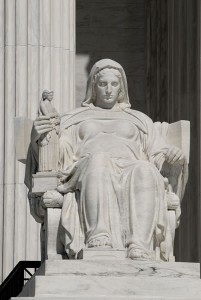
Contemplation of Justice by James Earle Fraser, outside of the U.S. Supreme Court, Washington, DC
The amended complaint is shocking and salacious. For those not familiar with the law and read that Shepherd is accusing the ANA of being a Racketeer Influenced and Corrupt Organization (RICO; 18 U.S.C. Chapter 96), it makes it look like the ANA is being compared to any number of organized crime figures you might have read about in the newspapers. Even though the RICO statutes were written to fight organized crime, using it is a common tactic by plaintiff lawyers to scare the defendants they are suing.
In order for a RICO charge to be accepted by the court, Shepherd and his lawyers will have to prove that a person as a member of an enterprise or the enterprise itself has committed to of 35 different crimes (18 U.S.C. § 1961). The crimes that Shepherd is alleging that the ANA has committed are racketeering, theft, and fraud.
Racketeering sounds like an ominous charge. Racketeering is a crime when two or more people conspire to fraudulently solve a problem. Shepherd alleges that a few employees of the ANA and members of the Board of Governors made up stories about Shepherd in order to find a way to relieve him of his duties for cause so they can invalidate his contract. The stories are salacious in nature and constitute Shepherd’s accusation of defamation that allows him to attach others to the case to show that there were more than two people involved.
The theft charge is from the guilty plea by former collections manager Wyatt Yeager. In January 2012, Yeager plead guilty to stealing items from the ANA Money Museum worth nearly $1 million. Yeager was sentenced to 27 months in a federal prison, two years of supervised probation, and ordered to pay restitution to the ANA.
With the theft charges already verified by a criminal court, Shepherd has to prove that the ANA committed fraud and at least two of the co-defendants conspired to fraudulently have him dismissed to resolve whatever issues the co-defendants perceived hurt the ANA. That would prove the case under RICO and hold the co-defendants and the ANA liable for Shepherd’s dismissal.
If you decide to read the pleading please remember that it is one side of the story. While the accusations are salacious and disturbing, we have not heard from the ANA or the co-defendants. This is a stark contrast to how they handled Shepherd’s dismissal when they could not stop talking. However, the ANA has a new general counsel who may be a little more cautious than the previous general counsel. The previous general counsel, Ron Sirna, is a co-defendant on this lawsuit.
Shepherd’s charges against the ANA and the co-defendants are disturbing. In fact, the nature of the salacious accusations is disturbing. If there is any truth in these accusations, those involved must be disciplined. Employees involved should be required to undergo remediation to keep their jobs or be dismissed if their action crossed the legal line.
According to the ANA Code of Ethics, members are required to “To base all of my dealings on the highest plane of justice, fairness and morality, and to refrain from making false statements as to the condition of a coin or as to any other matter.” Any member found to have be part of the racketeering that Shepherd’s lawsuit alleges, should be subject to an ethics review.
I was recently reminded of a quote from Inferno, the first part of Dante Alighieri’s epic poem The Devine Comedy: “The darkest places in hell are reserved for those who maintain their neutrality in times of moral crisis.” Therefore, members of the Board of Governors who did not “report any knowledge of waste, fraud, corruption or impropriety relating to the Association to all other Board members immediately upon learning thereof” (Code of Ethics, Section 12) should also be subject to an ethics review.
Shepherd is also not absolved from his part. While he may have a legitimate case, his timing is suspect. Why did he wait until the beginning of the election to amend his complaint laced with descriptions of salacious accusations at this time? Shepherd has to remember that while he makes accusations, it takes two to tango, which means that he may have had a part in acts that the pleading describes. It is also possible that Shepherd and his attorneys picked only examples that are in his favor. Until the ANA answers the charges levied by Shepherd we are left wondering what was left out?
The bottom line is that it is time to clean house. ANA members must elect a Board of Governors that will act more like a Board of Directors. People who will be professional, open, and work for the benefit of the ANA. The Board of Governors must treat the association like the $6 million business it is and set up programs for the professional office to support the association for the benefit of the members and not the benefit of the staff. While there may be a few people with issues, as described in Shepherd’s pleading, those few people are making the situation difficult for those who are doing a wonderful job.
If I am privileged to receive enough votes to be elected to the Board of Governors, I renew the promise I made previously that the first motion I will make will be to hire an executive management firm that has a verifiable background in helping non-profit organizations to review the entire ANA management structure. This stuff has to stop so that we can get on with the business of building our collections with all of the advantages the ANA can provide us, the members.
Image from Photographs from the Supreme Court’s Collection.
Jun 3, 2013 | coins, legislative, policy
H.R. 1905: Mother’s Day Centennial Commemorative Coin Act
Sponsor: Rep. David McKinley (R-WV)
• Introduced: May 9, 2013
• Referred to the House Committee on Financial Services
Track this bill at http://www.govtrack.us/congress/bills/113/hr1905
H.R. 1071: To specify the size of the precious-metal blanks that will be used in the production of the National Baseball Hall of Fame commemorative coins.
Sponsor: Rep. Richard Hanna (R-NY)
• This bill is a technical change to the National Baseball Hall of Fame Commemorative Coin Act.
• Signed by the President on May 17, 213
• This bill became Public Law 113-10
See the information about this bill at http://www.govtrack.us/congress/bills/113/hr1071
S. 1011: Boys Town Centennial Commemorative Coin Act
Sponsor: Sen. Mike Johanns (R-NE)
• A bill to require the Secretary of the Treasury to mint coins in commemoration of the centennial of Boys Town
• Introduced: May 22, 2013
• Referred to the Senate Committee on Finance
Track this bill at http://www.govtrack.us/congress/bills/113/s1011
May 30, 2013 | ANA
By now, those who are eligible to vote for the American Numismatic Association Board of Governors have either received their paper ballot or the information with instructions how to vote electronically. Please remember that all ballots are due back to the auditor by June 30, 2013.
 For previous elections, I made it a point to learn about the candidates and provided readers with my endorsements and why I endorsed those candidates. Since I am on the ballot, I will not endorse any other candidate this year. I ask that my readers consider my candidacy and those who commit to growing the ANA through honesty, integrity, and a heavy dose to technology in order to attract collectors under 50-years old. Those potential members are the association’s future.
Last night, I posted a letter to ANA members on my election website, vote4scott.info. Please read it and if you have any question, drop me a note. I will be more than happy to discuss any of your concerns.
Thank you!
May 27, 2013 | celebration, coins, history
Coin Collectors Blog supports:
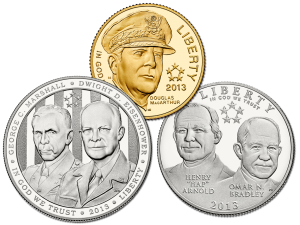 Decoration Day was first celebrated by Freedmen, freed southern slaves, May 1, 1865 in Charleston, South Carolina to honor the service of the 257 Union soldiers buried at the Washington Race Course. Today, Washington Race Course is known as Hampton Park.
The next year, southern states began their own Memorial Days to honor their soldiers who died during the war. No specific date was used but occurred in late April through June. By 1880, there was a more organized Confederate Memorial Day. These celebrations honored specific soldiers to commemorate the Confederate “Lost Cause.”
In the north, the fraternal organization of Civil War veterans The Grand Army of the Republic began organizing Decoration Day celebrations in 1868. Decoration Day was the day to honor the fallen by decorating the graves of Union soldiers with flowers and flags.
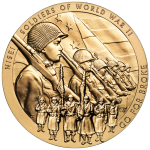
The Nisei Soldiers of World War II Bronze Medal
On this Memorial Day, I want to take this opportunity to remember those who gave the ultimate sacrifice while defending freedom at home and abroad. Whether it was wars for this country’s freedom, helping allies overseas, world wars, or helping others settle armed conflict around the globe, it is important we take this day to honor their service that helped make this country what it is today.
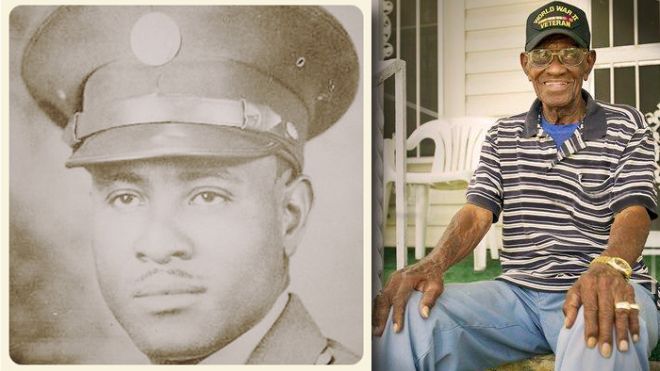
World War II veteran Richard Overton, left, is seen in his Army uniform in an undated photograph provided by the City of Austin. Overton, 107, sits outside his Texas home earlier this month. (AP/Austin American Statesman)
Coin images courtesy of the U.S. Mint.
Pictures of Richard Overton courtesy of FoxNews.com.
May 19, 2013 | ANA
Those who attended the candidates forum or watched the forum on the web or on YouTube, saw an interesting mix of candidates and a clear set of issues that will have to be addressed by the American Numismatic Association regardless of who is elected to the Board of Governors.
If you did not see it and have about three hours to spare, here is the video from YouTube. It will start 17 minutes into the recording and there is 35 seconds of “pre-production” audio before Barbara Gregory starts the session.
One of the issues that should concern ANA members is that current members of the Board of Governors admitted to violating the ANA By-laws by their statements. One of the issues that were brought up was that there was a five or seven hour closed meeting. The time differs depending on who is asked. To defend the board, current Governor Mike Ellis said that the meeting was to “Bring the day to day operations of the ANA up to speed.” Later, Vice President and Presidential candidate Walt Ostromecki said, that the board was talking about the impression it was giving and “how we as a board can mesh.” While Ostromecki called this a personnel discussion, the Board of governors are not ANA personnel. They are elected officials whose interaction is the business of the ANA community.
ANA Secretary David Sklow asked if the new candidates have read the ANA By-Laws. Not only have I read the by-laws, I made references to them during the meeting. What Mr. Sklow should have asked is why was a 5-7 hour meeting that did not involve “personnel, including the hiring, compensation, and termination thereof; contractual and litigation matters; awards,” as per Article 5 Section 7, following the by-laws?
Mr. Ostromecki called these personnel matters. However, the soon-to-be president did not characterize the discussion as “such deliberations that the Board members, after due consideration, decide merit confidentiality.” If he did, the Board is required in the same section to produce a discussion and vote about going into closed session.
I want to open the Board to the entire ANA. I want the Board to be accountable to the ANA. The Board should set the policy and not manage the ANA. Day-to-day management is what the Executive Director is supposed to do. I do not want to see this board that either wants to micromanage around the Executive Director or order the Executive Director to implement policy a certain way. If we do that, Kim Kiick will have as much success as the previous Executive Directors. This is not something I want to see.
Even if the current Board members have differing views than those responsible for the current problems, they did not call a point of order to show where there were violations in of the by-laws. Either they violated the by-laws willfully or did so by not attempting to enforce the by-laws. In either case, they cannot be trusted to run the organization properly.
Governor Greg Lyon said in his closing statement that those of us who criticize the current Board do not know the whole story. The problem is that the Board has been so secretive that it is impossible to know the whole story. This is the crux of the problems.
When you vote for the next Board of Governors, vote for candidates who will not hold five-to-seven hour private meetings unless absolutely necessary. Vote for candidates who will not hide behind rules, lawyers, and what looks like an agenda beyond the good of the ANA. Vote for candidates who will commit to broadcasting all meetings that do not have to be private so that all members can participate,.
I will be open and honest with the ANA members and the Board. I will not try to micromanage the office in Colorado Springs. In fact, if Kim Kiick came to the board to ask for assistance, I would be more than happen to ensure she had our full support. However, the Board should never usurp her authority with the staff.
The Board should work for an open and accessible ANA. The Board should invest in the technology it takes to bring the organization into the 21st century. And the Board should be the ambassador leaders for the entire numismatic community on the clear light of day and not behind closed door. In fact, I will work with the Board to use teleconferencing service that will allow members to dial in and listen to the meeting. This service will be able to ask questions during the meeting.
After this forum, I am more committed to my proposed first motion to hire an executive management firm that has a verifiable background in helping non-profit organizations to review the entire ANA management structure. You can read more about it in in this blog post.
Please consider supporting those of us who will work to change the ANA for the better, to make it more open to the members, and for candidates who want to bring more to the members rather than play the petty politics that have plagued the ANA in recent history. On June 1, I will publish my recommendation for the Board of Governors based on why I think they would work for the benefit of you, the members of the ANA.
May 16, 2013 | coin design, coins, Eagles, gold, US Mint
One of the most pleasantly surprising find at the National Money Show in New Orleans was at the U.S. Mint booth. On the right side of the booth, almost in the middle of the floor, was a single display case with a sign that read “Upcoming Products.” In the case was an example of the 2013 American Eagle West Point Two-Coin Silver Set.
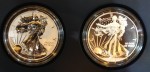
The U.S. Mint began its four week sale period on May 9, 2013, the first day of the National Money Show. All orders are being taken via their website or by telephone at 800-USA-MINT (800-872-6468). The two coin set with one American Eagle Silver Reverse Proof Coin and one “enhanced” American Eagle Silver Uncirculated Coin minted at the United States Mint at West Point. Selling price is $139.95 with shipping to begin on September 30.
This set will mark the fourth time that the American Silver Eagle will be produced in reverse proof. Prior to this year, the U.S. Mint produced the American Silver Eagle for the 2006 20th Anniversary Silver Eagle set, 2011 25th Anniversary Silver Eagle set, and the 2012 75th Anniversary of the San Francisco Mint set. As far as I am concerned, the U.S. Mint can continue to produce the reverse proof American Silver Eagle every year.
-
-
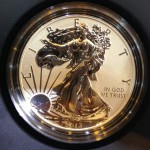
2013-W American Silver Eagle reverse proof
-
-
2013 American Eagle West Point Two-Coin Silver Set with reverse proof and enhanced uncirculated coins.
-
-
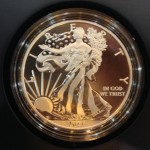
2013-W American Silver Eagle enhanced uncirculated coin
What made the set stand out what the U.S. Mint calls the “enhanced uncirculated” coin. While it looks like a proof coin, the enhanced portion are the selective frosting of elements. Introduced earlier this year, the new laser frosting technique allows the U.S. Mint to selectively apply the frosting texture to areas of the dies in a matter that leaves fine details of the coins. For the enhanced American Silver Eagles, the selective frosting leaves the folds of Miss Liberty’s skirt mirrored and is used to show off the flag she is holding. Adolph A. Weinman’s Walking Liberty image is one of the best designs every to appear on a U.S. coin. Enhancing it in this manner just makes it pop in a way Weinman could never imagine.
Even if you are “board” with the reverse proof, the set it worth purchasing just for the enhanced uncirculated coin. You will not be disappointed.
But the coin that really caught my eye was on the right side of the case. A 2013 Reverse Proof American Buffalo 24-Karat gold coin. Previously unannounced, it did not get noticed until I posted one of the first pins on Pinterest. After, it seem that the story spread around the numismatic press.
According to the U.S. Mint representatives at the show, the gold coin that was first issued in 2006 featuring the 1913 Type 1 Buffalo Nickel, will celebrate the 100th anniversary of the design by James Earle Fraser.
-
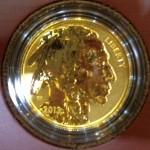
-
2013-W American Buffalo gold reverse proof obverse
-
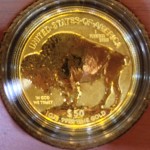
-
Reverse of the 2013-W American Buffalo gold reverse proof
As striking other reverse proof coins have been, the American Buffalo gold coin is just as striking. It could be called just plain beautiful. Aside from being my second favorite coin design behind Weinman’s Walking Liberty, it makes a big impression as a reverse proof coin.
Since the coin has not been issued, the price has not been set. Since the price is based on the market price of gold, and considering that gold closed today (May 16) at $1,395.05 per troy ounce, and using the United States Mint 2013 Pricing of Numismatic and Commemorative Gold and Platinum Products [PDF] for the regular American Buffalo gold proof coin, the coin would cost $1,740. If the price of gold continues to go down, of course the sales price will go down.
Both coins bring the U.S. Mint back into the forefront of numismatic art. These coins use the best coin designs and brings them to a new level while keeping with their classic elegance without the gimmickry of color, embedded stones, odd shapes, or any combination of extras to sell non-circulating legal tender coins at an inflated price. It would be wonderful if the U.S. Mint could use these processes to enhance future designs. Both coins should be in the running for Coin of the Year honors when they are selected next year (and awarded in 2015).
May 14, 2013 | ANA, coins, shows
Saturday in New Orleans started with my sleeping late and checking out of my hotel. After I left my bags with the concierge and picked up a cup of coffee, I walked over to the convention center.
The weather was better than Friday in that it was sunny with a little humidity. If I had hair it would have been a different problem. But it was just cool enough to be comfortable as I walked over in my sports coat that I wore for the candidates forum.
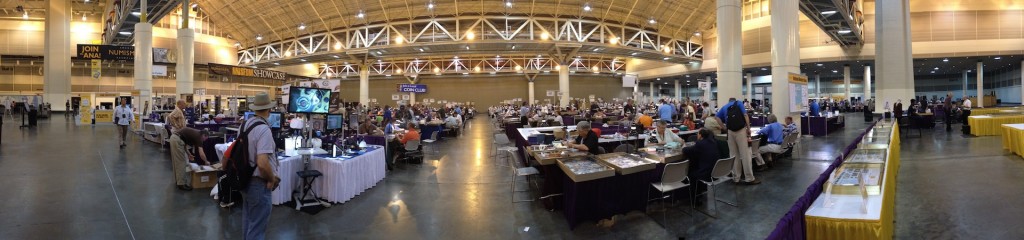
Panorama of the 2013 National Money Show bourse floor at the Ernest N. Morial Convention Center in New Orleans
I did a little looking around the floor and spoke with a few dealers. I did take the opportunity to stop by the booth of Miller’s Mint. I see Harry and Joan Miller at a number of larger shows and will see them next month in Baltimore. I did buy a few smaller items from them before the candidates forum. I will take a look at a few more items they have when I see them next month.
On my way to the candidates forum I saw people I recognized from visiting coin shows in the Mid-Atlantic region. Of course I handed them campaign material and went to the forum.
There was a good crowd at the candidates forum that included Executive Director Kim Kiick, Past President Barry Stuppler, retiring Board members Cliff Mishler and Wendell Wolka, and recently fired Executive Director Jeff Shevlin and his wife.
Just prior to the candidates forum, Jake Sherlock tweeted that the forum would be streamed live on YouTube. I wish they would have announce it sooner so that we could have ensured a larger crowd, but there seems to have been a few people watching with interest. There were two questions from the Interwebs. If we can do more of this, broadcast Board meetings, add classes, and Money Talks lectures, this would be a fantastic step forward.
One cool thing about having the Internet interaction was that during the forum, I tweeted:
Jake Sherlock, the ever diligent watcher of the Twitterverse responded:
Can you imagine if the Board can help better organize the use of technology, the ANA can reach more people and expand its education role not only for members but the public.
The candidates forum last more than three hours, longer than the scheduled two hours. A few of us had to do our summations early so that we could go to the airport to catch flights home.
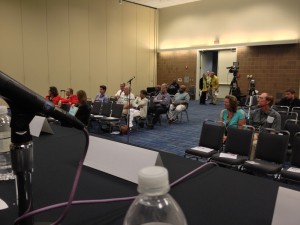
What the Candidates Forum looked like from my perspective.
After rushing out of the convention center, I quickly walked back to the hotel, collected my bags from the concierge, and caught a cab for the airport. Going through security screening is always fun, especially when your hip is made of titanium. That hip replacement guarantees that I will be patted down every time I go to an airport.
On my way to the gate I found a shop to buy coffee and headed to the gate. After typing notes on my iPad, I looked over and found Wendell Wolka waiting to board the same flight to Atlanta, where we would transfer to separate flights to head home.
After landing at the Baltimore/Washington International Thurgood Marshall Airport (BWI) and fetching my car, I arrived home at 1:00 PM with a rousing welcome from my two puggles Boomer and Tessa. Of course my wife was happy to see me!
In the next few days, I will talk about something I found and the candidates forum. For now, it is time to get some rest!
May 10, 2013 | ANA, auction, coins, currency, shows
It was a rainy day in the Crescent City but that only mattered when I tried to leave my hotel to go to the convention center. Thanks to Michael Weir, the Director of First Impression at the Hilton Garden Inn, a group of three show attendees including myself, were able to get to the convention center without being rained on. Mr. Weir gave us door-to-door service dropping us off under an overhang.
Before I continue, let me give the New Orleans visitors bureau fodder by recommending the city for your next vacation. No matter when I have come here, the people of New Orleans have been accommodating, courteous, and fun. And when you are away from home, having fun is the most important part of a visit!
After stopping to speak with ICTA’s Director Elloise Ullman, I picked up a cup of coffee before walking down to Hall G. Before entering Hall G, I went upstairs to the meeting rooms where I found I missed a talk on so-called dollars because I started to schmooze outside of the hall.
My first stop this morning was to see Steve Roach, the Editor of Coin World. We had a nice conversation where we talked about everything from the upcoming American Numismatic Association Board elections to the production of Coin World Next, their weekly publication that concentrates on one topic.
After a lively conversation with Steve and Tom Mulvaney, who is best known as the instructor of the coin photography class with the ANA Summer Seminar. Tom’s work can be seen all over the numismatic industry. Some day I will be able to take the time off to go to Summer Seminar to take his class.
I wanted to tour the bourse floor but decided to finish touring the exhibits I did not finish. While in the exhibits area I ran into Hollie Weiland, counsel for the ANA. She then introduced me to Beth Papiano. This became an interesting conversation following the criticism I wrote about her. We did talk about what I wrote and why. Hopefully, I will have another opportunity to speak with Beth again and maybe I can understand more about what happened.
Lunch was a little hole-in-the-wall poboy place where I had fried oysters before returning to the convention center to try to do more looking around and meeting people. First, I had to go back to the exhibits and see what I missed. My favorite was the Travancore Chuckram Count Counting Boards. It was an exhibit of these metal boards that were used to count small coins. These are mainly form countries in southwest Asia. There were a lot more involved with this exhibit. Hopefully, I will have a chance to spend time carefully reading the text to learn more. Otherwise, I hope the exhibitor will display it again in Chicago.
At 2 o’clock it was time for the open Board meeting. After a delay because some of the governors were caught in traffic, the meeting proceeded with thunderstorms booming in the background. I do not know if that was a message, but considering the controversies of the past few weeks, there may have been something prophetic about the scene.
But the meeting started with an interesting “ritual.” ANA Past President Barry Stuppler invited his “spiritual advisor” Zar, a Voodoo Priest, to bless, spiritually cleanse, and add good luck to Kim Kiick on her appointment as executive director. Upon the end of the “ceremony,” someone in the crowd commented that this should have been done 10 years ago—referencing the problems with executive directors over the last 10 years.
I will comment about the meeting at another time, but one of the central discussions was the ANA’s web presence and the security of the technical infrastructure. I am glad to hear that the board is taking the move to expand the ANA’s technology seriously. Yes, there was skepticism and references to age-specific issues, it does not appear that the current board will hold back progress. There still needs a few more technologically aware members of the board, which is why I am running for the board.
After the meeting, it was back to the bourse floor to shake a few more hands before going to a reception for Rep. Steve Scalise (R-LA). Rep. Scalise from Lousiana’s first district and succeeded Bobby Jindal after Jindal became governor. Scalise co-sponsored newly introduced H.R. 1849, Collectible Coin Protection Act. This is the same bill that was introduced last year.
Finally, a walk down the hall to the Stacks-Bowers auction to watch the bidding on the various auction lots. Since most of the lots were out of my price range, I watched the action. The few items I could have afforded, I decided not to be a buyer. Some of those coins were hammered at a price higher than I expected. I would have dropped out before the top bids.
After being exhausted from a long day, I availed myself of the dinner service at the auction including the coffee. Meet a few people outside of the auction room came back the hotel. I did call my wife only to listen to one of my neurotic dogs bark at the thunderstorms throughout our conversation.
Tomorrow is the last day of the show and my last day on the floor. The candidate forum will be at 12 noon Central Time. I heard that the ANA arranged to have the two-hour forum broadcast on the Internet. I urge ANA members to watch the forum. If they have a way for you to ask questions, please try to do so! It is your ANA and you have to let the Board of Governors know how you feel.
I will be flying home after the candidates forum and arrive in the Washington, DC area very late. I will have a third-day update sometime on Sunday.
May 9, 2013 | ANA, bullion, coins, gold, shows, silver
After a late arrival in New Orleans, I walked the block over to the convention center to enter the bourse floor. Hall G of the Ernest N. Morial Convention Center is a big convention center hall that does not feel “full.” Sure, the National Money Show is a smaller show than others including the World’s Fair of Money, but it does allow for a different group of people to come in and learn more about numismatics.
Since my trip to the show is largely to campaign for the Board of Governors elections, I started to meet and talk with members around the floor. I had taken the opportunity talk with a few people I know and introduce myself to others.
But that does not mean I did not do some looking around.
The biggest news I learned is that the U.S. Mint is planning on issuing a reverse proof American Gold Buffalo later this year in honor of the design’s 100th anniversary. A sample can be seen at the U.S. Mint booth at the show and, of course on Pinterest. The image was taken through the glass of the case it is being display within. On Friday, I will try to take a picture of the coin with the case open.
On seeing the reverse proof American Buffalo coin I was stunned as to how beautiful it is. It has an elegance that you cannot see in a picture. The coin will be released later this year. It will give us time to put some money aside to buy at least one version. If you buy no other gold coin this year, you should save to buy this one. I guarantee that you will not be disappointed.
Although the sales of the 2013 American Eagle West Point Two-Coin Silver Set went on sale today, the U.S. Mint only had a sample at the show. All sales are being made on line or via the telephone. You can see an image on Pinterest. I will try to take a better picture when I do one of the American Buffalo gold reverse proof since both are in the same display case.
Aside from buying a new loupe because I left mine at home, I just found a few New York-related tokens including a New York City subway token where the cutout “Y” is off-center.
One of the great things about coming to an ANA show is to see people, meet new people, and just have a great time. Some of us went to the French Quarter for dinner. After dinner, we walked a few blocks to the French Market for café au lait and beignets at Café du Monde. Thus, the tradition I started as a college student in 1980 continues—every trip I have ever made to New Orleans included a visit to Café du Monde.
Friday will be some Money Talks sessions and end with a reception for Congressman Steve Scalise (R-LA). Scalise is one of the sponsors for the newly introduced H.R. 1849, the bill to update the Hobby Protection Act. The same bill that did not get a hearing during the last session.
Keep a watch on Twitter and Pinterest for reports from the show.



 Loading ...