Jan 10, 2014 | coins, currency, shows
 There is more than Disney and Universal in Orlando. This week the Florida United Numismatists Is having their annual convention at the Orange County Convention Center. FUN is the first show of the calendar year.
If FUN sets the tone for the coming year, what I saw today was a sign for a good numismatic year. Even arriving later than expected, the bourse floor was a steady buzz throughout the day. There was a lot of activity at both the high end and low end tables.
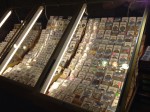
Low Country Coins out of Charleston, SC has a unique way of displaying their coins for sale.
I didn’t buy much today. I spent much of the day schmoozing and looking. Aside from looking at the sale items, I marveled at the items that were not exactly coins. There are quite a few jewelry and other antique items at the show. One thing I noticed was a lot of paper and paper money dealers. While I have seen notaphily and scripophily dealers at other shows, there seems to be quite a few here in Orlando.
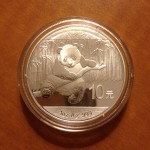
I did buy this 2014 Chinese Silver Panda. I love the Pandas!
In fact, the Heritage Platinum Night Currency auction was held before a full house. While I missed the few colonials I was interested in seeing, I found that the prices realized were well beyond even Heritage’s estimate.
Rather than stand in the back of the room of the currency auction I was not going to bid on, I went to the next room to sit and watch The Adam Mervis Large Cent Collection auction. Aside that I was watching one of the more interesting collection of large cents being broken up, I was enjoying the show being put on by the auctioneers. One of the auctioneers, Bob Merrill, had a great rapport with the audience and really made the auction interesting to watch, even for a non-bidder.
Even though the Heritage auctioneers are good, they seem to miss bids during the furor of the bidding. On more than one occasion with more than one auctioneer, bids were missed that would have significantly jumped the price. Heritage could learn a bit from the classic car and other auctions that are held at large venues and have spotters stand on the floor to help get the attention of the auctioneer. While I have seen this with the big car auctions on television, I have been to estate and bankruptcy auctions in larger places where they use spotters to ensure the bids are noticed.
Dear Heritage: you bring enough people to these auctions, why not add one or two of your people per room to patrol the floor in help the auctioneer. Or why not hire someone to do that at the show. I am sure you can find collectors interested in making a few extra dollars to feed their coin buying habit.
Those following me on Twitter at @coinsblog may have seen many of the pictures I have taken. Eventually, I will post them to Pinterest but I am having connectivity issues. If you want to see the pictures I did take, go to my iCloud Photostream to see all of the pictures, including the ones that did not make it to Twitter. For those who have never experienced an auction, there are two short videos from the large cent auction from where I was sitting.
More FUN tomorrow!
Jan 9, 2014 | coins, shows
 By the time this posts, I will be on an airplane heading to Orlando, Florida for the Florida United Numismatics (F.U.N.) Convention. This will be the first time I am attending this show. Not only am I going for the fun (pun intended), I am also attending representing the Maryland State Numismatic Association as the new president.
Of course I will be on Twitter (@coinsblog) sharing my thoughts and some pictures while at the show. Depending on connectivity and health of my device’s batteries, I will also publish pictures on Pinterest on the board “2014 F.U.N. Convention.”
Jan 8, 2014 | coins, commentary, Eagles, news, other
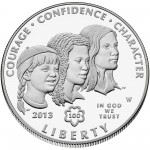
2013 Girl Scouts of the USA Centennial commemorative coin
Following the close of the year, the U.S. Mint told Coin World that the sales of the 2013-W Girl Scouts of the USA Centennial Commemorative coins was so low that it did not cover the costs of the program as required by law. U.S. Mint records show that 86,354 proof and 37,463 uncirculated coins were sold for a total of 123,817 coins. That is a little more than 35-percent of the 350,000 authorized by the law.
Sales of the 2013-W Girl Scouts of the USA Centennial Commemorative coins was to have ended on December 17, 2013 but the U.S. Mint extended the sale through December 31, 2013. By law, a commemorative coin can only be sold in the year it was struck.
The U.S. Mint cannot be faulted for this lack of interest. Information about the coin had been a fixture of the front page of the U.S. Mint’s website. Their information included a video introduction by United States Treasurer Rosie Rios and provided information in its various outreach programs. The U.S. Mint is limited on the type of advertising it is allowed to use.
Usually, the burden of advertising falls to the organization that would most benefit from the sale of the commemorative coin. Since I do not have a connection with Girl Scouts of the USA, I cannot report on their promotional experience.
This news is both sad and troubling. Although there are collectors who will buy the coin to be part of their commemorative collection, the real success or failure of a commemorative coin is based on its subject. For whatever reasons, the Girl Scouts was not a popular subject.
When a commemorative is made for an organization, purchasers want some affinity for the organization. Unless you are a collector, you are not going to buy a coin honoring that organization, especially when the price is over $50 during a recovering economy. I wonder if a clad half-dollar may have been a better idea?
While having a program to honor the centennial of the Girl Scouts of the U.S.A. was a laudable idea, maybe it was not a good one. It was a coin with a limited appeal and those in the target audience did not respond.
It is also troubling that the Girl Scouts were not able to generate more sales on its own. In coming up over 31,000 coins short of being able to receive the payout, it is time to question the diversity of the hobby—again.
Numismatics is dominated by middle-aged to older white males. While there is an outreach to young numismatists, those programs appear to succeed in recruiting mostly white boys and keeping them interested until they become 18 years old.
Consequently, there appears to be no concentration on providing opportunities to young girls and minorities. While the Boy Scouts provide one outlet, local experience shows that those troops are dominated by young white males. Surely there are girls and minorities interested in numismatics. If not, why not?
If anyone missed the point, the executive directors of the American Numismatic Association and Industry Council for Tangible Assets (ICTA) are women. I do not believe either have their jobs because they are women. They are qualified people leading an industry that happens to male dominated.
There has to be a way to appeal to the demographics that are not being represented in the hobby. Aside from women and minorities, the hobby has to figure out how to engage those older than young numismatist (YN) but younger than middle-age. There has to be a way to keep them interested if they started as a YN or grab their interest before middle age. In 2011 I addressed these issues calling potential members the “Lost Demographic.” There have been little changes since.
What will it take to expand the hobby to all sectors of society? Please feel free to let me know in the comments section below. We can all work together for the betterment of the hobby!
Jan 3, 2014 | coin design, coins, commemorative, commentary, COTY
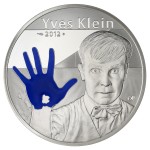
Monnaie de Paris 2012 Yves Klein commemorative was named 2014 Coin of the Year
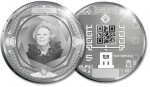
2011 Commemorative celebrating the 100th anniversary of the Royal Dutch Mint’s facilities with QR code on reverse
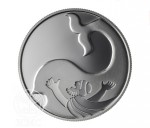
2010 Jonah In The Whale 2-New Sheqalim coin from Israel
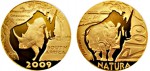
2009 White Rhinoceros 100 Rand gold coin from South Africa
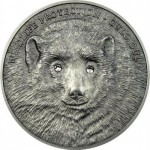
2008 Mongolia Wolverine with diamonds for eyes
Three of the last five COTY winners had design elements that were not based on the sculpture of the coin but on a design gimmick. Were these the best designs or did the gimmick influence the voting?
I have asked before whether it is wrong to include other design elements on a coin, especially non-circulating legal tender (NCLT) coins. When I ask these questions, I bring out the picture of my Somalia motorcycle or muscle car coins. I also like the Canadian 2006 Breast Cancer silver commemorative coin and the special 25-cent circulating coin the Royal Canadian Mint produced. These were not overt uses of color but almost an enhancement to emphasize the pink ribbons on the coins.
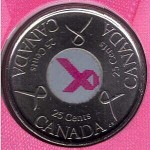
2006 Breast Cancer Quarter was Canada’s first colored circulating coin
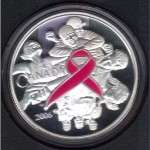
2006 Breast Cancer Silver Coin with colored pink ribbon.
But is it too much of a gimmick? After the RCM produced those coins it seems that they dove in face first into producing colored coins. It also seems that the rest of the world also has been spending its time printing coins and not minting them (see the New Zealand Mint). Although I am guilty of buying into this type of design concept, there comes a time when the concept has gone too far. In television the concept is called “Jumping the Shark.”
While others are printing coins, the Royal Mint is coming up with designs that are interesting sculptures. In fact, if you go to their website and look at their offerings you will find that the Royal Mint has nice designs, interesting packaging, but no color. Although their artists take advantage of the design elements using bi-metallic coins, they are sculptured arts and not printed designs.
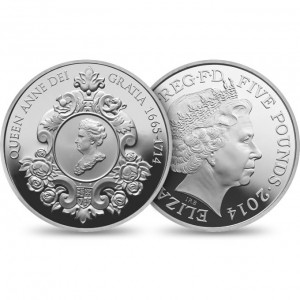
2014 £5 crown commemorating the 300th anniversary of the death of Queen Anne
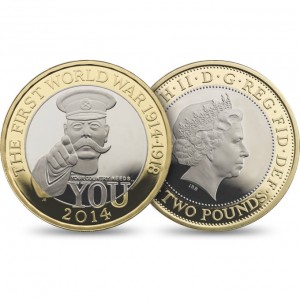
2014 £2 coin commemorating the 100 year anniversary of the start of World War I
U.S. coin designs have had the best designs over the last few years. However, the introduction of the “enhanced uncirculated” coins with the selective frosting has opened up new ways of enhancing sculpture elements on coins. It would be interesting to see what the U.S. Mint artists can do if given the free hand to design coins and using the laser to enhance the design.
Given the recent history of the COTY competition, the 2014 National Baseball Hall of Fame commemorative coin is almost a shoo-in for 2016 COTY honors. While the elements will be sculpted rather than printed and the curved planchet will be interesting, it is probably enough of a gimmick to sway the World Coin News confab when it meets to discuss the 2014 coin in December 2015.
As an aside, why do we have to wait a year for the COTY competition? With technology what it is today, why does it take a year to do the COTY competition? If the award is given in February, then why select the COTY in December or January? Does it really make sense for the 2014 COTY to be coins date 2012? Why not call it the 2012 COTY since the coins are dated 2012 and award them at the beginning of 2013—or in this case, the 2013 COTY being awarded in 2014?
The one year delay might have made sense when mail delivery was less reliable and information was delayed by the speed of the teletype and the printing press. In the information age where 2012 is not only yesterday’s news it is ancient history, it is time for Krause Publications and World Coin News to modernize their process and come up with something a little quicker than a one year delay.
Image Credits
- 2012 Yves Klein commemorative courtesy of the Monnaie de Paris.
- 2011 Royal Dutch Mint commemorative with QR code courtesy of the Royal Dutch Mint.
- 2010 Jonah in the Whale commemorative courtesy of the Israel Coins & Medals Corp.
- 2009 White Rhinoceros 100 Rand gold coin courtesy of Krause Publications.
- 2008 Mongolia Wolverine coin courtesy of the Wolverine Foundation.
- 2014 British coin images courtesy of the Royal Mint.
Jan 2, 2014 | coins, legislative, policy, US Mint
H.R. 3680: Breast Cancer Awareness Commemorative Coin Act
Sponsor: Rep. Carolyn Maloney (D-NY)
• To require the Secretary of the Treasury to mint coins in recognition of the fight against breast cancer.
• Introduced: December 9, 2013
• Referred to the House Committee on Financial Services
Track this bill at https://www.govtrack.us/congress/bills/113/hr3680
H.R. 3729: Korean Immigration Commemorative Coin Act
Sponsor: Rep. Robert “Rob” Andrews (D-NJ)
• To require the Secretary of the Treasury to mint coins in commemoration of the 100th anniversary of the beginning of Korean immigration into the United States.
• Introduced: December 12, 2013
• Referred to the House Committee on Financial Services
Track this bill at https://www.govtrack.us/congress/bills/113/hr3729
S. 1842: Pro Football Hall of Fame Commemorative Coin Act
Sponsor Sen. Robert “Rob” Portman (R-OH)
• A bill to require the Secretary of the Treasury to mint coins in recognition and celebration of the Pro Football Hall of Fame.
• Introduced: December 17, 2013
• Referred to the Senate Banking, Housing, and Urban Affairs Committee
Track this bill at https://www.govtrack.us/congress/bills/113/s1842
Jan 1, 2014 | celebration, coins, commemorative
Happy New Year!
As we begin a new year, we should look forward to better times for our hobby, our nation, and our world. I wish you and yours a Happy and Healthy 2014 and hope that you find the key coin of your dreams!
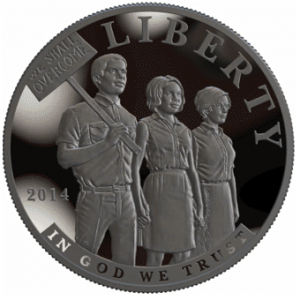
2014 Civil Rights Act of 1964 Silver Dollar obverse
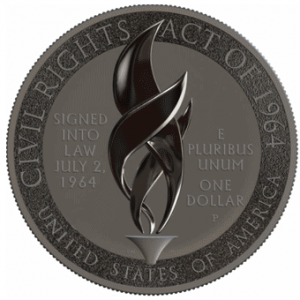
2014 Civil Rights Act of 1964 Silver Dollar reverse
Images courtesy of the U.S. Mint.
Dec 31, 2013 | coin design, coins, commemorative, US Mint
For the first time ever, the U.S. Mint will be producing a coin that is not flat. The curved coin is of the 2014 National Baseball Hall of Fame Commemorative Coin.
The National Baseball Hall of Fame Commemorative Coin Act (Public Law 112-152 [PDF]) celebrates the 75th Anniversary of the National Baseball Hall of Fame in Cooperstown, New York. The three-coin commemorative program consisting of a $5 gold coin (50,000 maximum mintage), $1 silver coin (400,000 maximum), and a clad half-dollar (750,000 maximum) struck as uncirculated coins or as proofs.
The bill required an open competition for a common obverse design “emblematic of the game of baseball.” During the government shutdown this past October, the U.S. Mint posted the announcement on their website that the winning design was submitted by Cassie McFarland of San Luis Obispo, California.
McFarland told reporters that she stumbled upon the competition while researching coins for another art project. McFarland found the U.S. Mint’s call for design two days before the deadline and submitted a drawing. Her drawing was based on an old baseball glove belonging to a relative.

Cassie McFarland
U.S. Mint Sculptor-Engraver Don Everhart will do the engraving of McFarland’s winning design. Everhart created the reverse design.
Surcharges will be $35 per gold coin, $10 per silver coin, and $5 for the clad half-dollar to be paid to the National Baseball Hall of Fame for their continuing operations. If all the coins sell out, the Hall of Fame will receive $9.5 million for ongoing operations.
Given that the selection of Coin of the Year tends to favor gimmicks (to explained in a future post), it would not be surprising that this coin wins COTY when it is considered at the end of 2015.
In the mean time, it will be interesting to see this coin in hand as this is the #1 numismatic-related story as selected by the board of the Coin Collectors Blog!
Curved coin animation courtesy of the U.S. Mint.
Dec 30, 2013 | auction, coins
 As a follow-up to #2 Records have been broken in the Coin Collectors Blog Top 10 countdown, the Professional Numismatists Guild published a “State of the Industry” report that included the list of 12 U.S. coins that sold for over $1 million. One was a private sale while the others were sold at auction.
The eleven most valuable U.S. coins purchased by winning bidders at auctions in 2013 were as follows:
- 1794 Flowing Hair silver dollar, $10,016,875 (Stack’s Bowers Galleries)
- 1804 Type I silver dollar, $3,877,500 (Heritage Auctions)
- 1913 Liberty Head nickel, $3,172,500 (Heritage Auctions)
- 1880 Coiled Hair gold $4 denomination Stella, $2,574,000 (Bonhams)
- 1796 silver quarter-dollar, $1,527,500 (Heritage Auctions)
- 1792 silver half disme (early spelling of dime) $1,410,000 (Heritage Auctions)
- 1796 silver dollar, $1,175,000 (Heritage Auctions)
- 1783 Nova Constellatio Quint Type II, $1,175,000 (Heritage Auctions)
- 1852 Augustus Humbert $10 gold coin, $1,057,500 (Heritage Auctions)
- 1792 half disme, $1,145,625 (Stack’s Bowers Galleries)
- 1879 Coiled Hair gold $4 Stella, $1,041,300 (Bonhams)
The 12th U.S. rare coin that sold for more than a $1 million in 2013 was an 1894 San Francisco Mint dime that sold for over $2 million in a private sale conducted by David Lawrence Rare Coins.
A PNG survey of auction houses showed that they sold a total of $392.8 million in U.S. rare coins in public auctions in 2013. Based on the PNG survey, the sales scoreboard is as follows:
- Heritage Auctions, $236.5 million
- Spectrum Group International (Stack’s Bowers Galleries and Teletrade), $105 million
- Goldberg Coins & Collectibles, $21.1 million
- Bonhams, $13.5 million
- Legend-Morphy Rare Coins, $7.2 million
- David Lawrence Rare Coins, $5.5 million
- Scotsman, $2.8 million
- Krueger & Krueger, $1.2 million
All prices include the buyer’s premium, if any.
This survey did not include paper money or world coins. It would be interesting to see the impact of the currency and world coin market alongside the U.S. coin market.
Dec 30, 2013 | auction, coins, currency
This past year saw the high-end market get even higher with the auction of significant rarities bringing in significant prices.
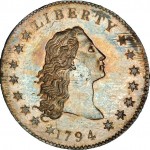
1794 Flowing Hair Silver Dollar sold for a record $10,016,875 to Legend Numismatics
Legend Numismatics’ Laura Sperber took control of the bidding when she invigorated bidding that stalled at $5.5 million when she bit $8,525,000. She called it “shock and awe.” Sperber said that she knew that a $10 million coin would create a huge buzz for the industry and went on to predict that a coin would sell for $25 million before the end of the decade.
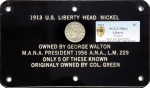
1913 Walton Specimen Liberty Head Nickel sold for $3,172,500 on April 25, 2013 to Jeff Garrett of Lexington, Kentucky and Larry Lee of Panama City, Florida.
At the 2003 World’s Fair of Money in Baltimore, a conclave of experts examined the coins for hours, debated, and determined that the coin was real. One of those involved in the marathon meeting was Jeff Garrett, the current Vice President of the American Numismatic Association.
Nearly ten years later, the coin was auctioned for the first time. Graded PR63 by PCGS, the coin sold for $3,172,500 to Jeff Garrett and his business partner Larry Lee.
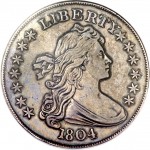
Silver dollar known as “The King of Coins” has sold for more than $3.8 million.
Maybe the discovery of the 1933 Double Eagle coins may have the 1804 dollar beat, but only one version of that coin is legal to own. There are 15 known coins dated 1804 even though they were struck later. In 1834, eight dollar coins were struck with the 1804 date to include in a special set created as a gift for the King of Siam. The set was presented to the King by President Andrew Jackson during trade missions to the Middle East and Asia.
It is known as “The King of Coins.”
The coin is designated as The Mickley-Hawn-Queller Class I Original 1804 Dollar, graded PR62 by PCGS, sold for $3,877,500 to an anonymous bidder.
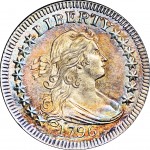
1796 25C MS67+ NGC. CAC. B-2, R.3. Ex: “Col.” E.H.R. Green. The finest certified 1796 quarter.
In case you were curious, according to the Bureau of Labor Statistics Inflation Calculator, $100 in 1931 has the same buying power at $1,533.35 today. Conversely, the $1.5 million sale price is equivalent to $99,618.57 in 1931.
The coin was sold as part of the November 13, 2013 “16 Selections from the Eric P. Newman Collection Part II Signature Auction” held in New York. Proceeds from the sale goes to support the Eric P. Newman Numismatic Education Society.
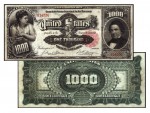
1891 Marcy $1,000 silver certificate (PMG VF25) sells for $2,600,000 by Stacks-Bowers in a private sale.
The note was graded VF25 by Paper Money Guaranty.
The note was sold as part of a collection of more than 85 large-size Silver Certificates that are the finest ever put together. Five notes were sold as part of this transaction. The other 80 went for sale at the 2013 World’s Fair of Money.
Can you imagine what would happen if the Langboard Hoard of 1933 Double Eagles ever make it to the auction block?
Image Credits:
- 1794 Flowing Hair Dollar and 1891 $1000 Silver Certificate images courtesy of Stack’s Bowers Galleries
- 1913 Walton Liberty Head Nickel, 1804 Dollar, and 1796 Quarter dollar images courtesy of Heritage Auctions
Dec 29, 2013 | Canada, coins, counterfeit, legislative, RCM
Counterfeiting coins and currency has been a problem for both the government and the numismatic industry. Government has shown it will go to extensive lengths in order to change the $100 note in order to stop currency counterfeiting. In fact, currency has had a long history of trying to fight currency counterfeiting.
For collectors of United States coins, there is a problems with the counterfeiting of classic coins primarily from China. In China, it is legal to reproduce obsolete
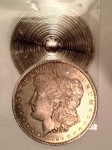
An example of a Morgan Dollar cut in half to match a date with a mintmark to have the coin appear something it is not. Coin was in a counterfeit PCGS slab and caught by one of their graders.
Those who create counterfeit coins are not making “tributes,” as has been the stance of the Chinese government. They are reproducing rarities and trying to pass them as real coins. In some cases, these counterfeiters are even trying reproduce the third-party grading service slabs in order to get them past scrutiny.
In the United States, Industry Council for Tangible Assets and the Gold & Silver Political Action Committee has been working to have congress update the Hobby Protection Act (15 U.S.C §§ 2101-2106) to provide for more protection to the buyer. Aside from strengthening the requirement to have copies appropriately marked and marketed, it allows for duped buyers and the government to take action against the resellers. Currently, the Hobby Protection Act only allows for action against the manufacturers and not anyone else in the supply chain. By opening the supply chain to prosecution it is hoped that it will choke off the supply.
This past August, the House of Representatives passed the Collectible Coin Protection Act on a unanimous voice vote.
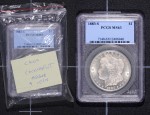
PCGS representatives showed Congressmen counterfeit U.S. coins in counterfeit PCGS holders during their recent meetings in Washington, DC. (Photo courtesy of PCGS.)
Collectible coins are not the only problem. Great Britain has been having problems since the issue of new £1 coins entering circulation starting in 2010. Even though arrests have been made, there remains an undetermined amount of counterfeit coins in circulation.
Last summer, counterfeiters were arrested in Greece and Turkey for producing fake 2 Euro coins. These counterfeits look very similar to the standard 2 Euro coin with the standard Greece reverse. A real 2 Euro coin is a bi-metalic coin that does not separate. The counterfeits will separate and are lighter than the real version.
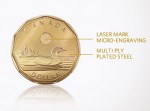
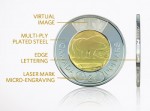
In Canada, the Royal Canadian Mint has changed the Loonie and Toonie to include micro engraving to thwart counterfeiters. The RCM has also changed the composition of the coins which will help them last longer.
Counterfeit coins and currency will continue to be a problem. Every change, no matter how small, is not only good for the economy, it is good for the hobby.
-
-
The new technology used by the Royal Canadian Mint to protect the Loonie ($)
-
-
The new technology used by the Royal Canadian Mint to protect the Toonie (C$2)


 Loading ...