Jan 28, 2018 | administrative, coins, news
 I wanted to keep this week to writing more about numismatics than commenting on something going on. Unfortunately, that changed with an alert showing up in the Federal Register that the David Ryder nomination is on hold. That put a funk on the week.
During the week I was able to pick up something for my collection and find a few cool banknotes. That helped pick me up for the week. Adding to my collection is always fun and learning is essential to keeping the mind sharp.
There was a lot of news this week. I was able to whittle the number of interesting stories down to 11. It is compelling to see how numismatics is seen from the non-numismatic media.
There was also a lot of news from the numismatic industry including the announcement of the passing of Ed Rochette. A sad loss for the community.
If you want to keep up with some of the announcements from the community, you can watch the Coin Collectors News site, the sister site to the blog. You can watch the news directly on the site, from the “Recent News” widget on the sidebar, subscribe to the RSS feed  , or subscribe to receive notices by email. If there is news, you will only see one email per day.
And now the news….

January 22, 2018
TEHRAN, Jan. 22 (MNA) – Police officials in Iranian northern city of Qa’emshahr arrested three antique smugglers who were illegally trafficking 299 antique coins of Sassanid era.  → Read more at en.mehrnews.com
January 23, 2018
Former landscape architect Ben Huang started his coin cufflink company Patinova after noticing a gap in the market. His jewellery has taken off and he’s branching out into other Chinese-themed accessories → Read more at scmp.com
January 24, 2018
Russia now has a coin commemorating the iconic Russian musician, actor, and poet Vladimir Vysotsky, who would be 80 years old on January 25 if he were still alive. → Read more at rferl.org
January 25, 2018
Business briefs from the Daily Pilot newspaper. → Read more at latimes.com
January 25, 2018
A first look at the new R5 coin celebrating the centenary of Nelson Mandela’s birth → Read more at brandsouthafrica.com
January 25, 2018
A vast selection of coins and medals is on display at the National Numismatic Exhibition, opened earlier this week at the National Museum of Archaeology in Valletta. It is being presented by Heritage Malta. “This valuable collection shows us and reminds us of our country’s eventful and rich past,… → Read more at timesofmalta.com
January 26, 2018
PJ police have managed to recover a unique Roman coin that was stolen from a religious sanctuary in Alijó, Vila Real, Northern Portugal, over 30 years ago in 1985. → Read more at theportugalnews.com
January 26, 2018
The tourist attraction lets you 'strike your own coin' → Read more at walesonline.co.uk
January 26, 2018
Melbourne company Highland Mint continues to flip out over its role in Super Bowl — making the *the* Super Bowl coin that decides who gets the ball first. → Read more at floridatoday.com
January 26, 2018
A stash of gold coins is latest clue that shipwreck 40 miles off NC is that of the steamship Pulaski. → Read more at charlotteobserver.com
January 26, 2018
One man spent £150,000 on the coins – which are now worth no more than £50,000 → Read more at nottinghampost.com
Jan 26, 2018 | currency, foreign, history
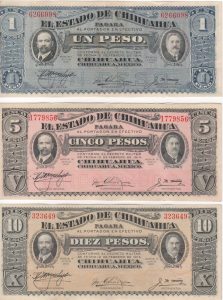 This past week, I was looking into a box I purchased from an estate and I found a plastic bag of old foreign currency. When I removed the notes, I found common notes that can usually be purchased from estate especially since he was a career military officer. There was everything from German Notgeld to several European and Asian countries.
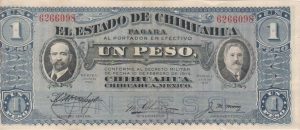
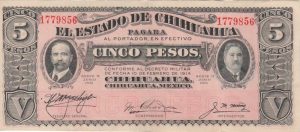
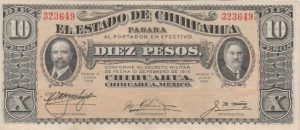
During my search, I found three notes that were intriguing. All three notes were from El Estado de Chihuahua, the State of Chihuahua. They were beautifully preserved (albeit with a fold down the center) one-, five-, and ten-peso notes with the same design but in different colors.
Under the printed denomination are the words “Conforme al Decreto Militar de Fecha Io de Febrero de 1914” (Pursuant to the Military Decree dated February 1914). I vaguely remember that was the era of Pancho Villa and his romp through the southwest United States. Time to refresh my history.
After the 35-yearlong regime of Porfirio Diaz, he was challenged in the presidential election by Francisco I Madero in 1910. Madero was in favor of reform and social justice. But Diaz fixed the election declaring he won by a landslide.
Before the election Diaz had Madero jailed and when it became obvious the election was fixed, Madero supporter Toribio Ortega formed a militia in Chihuahua to oust Diaz.
While in jail, Madero issued a “letter from jail” that declared the Diaz presidency illegal and called for a revolt against Diaz. The revolt began in November 1910. Diaz was ousted and a new election was held in October 1911 that elected Madero the 33rd President of Mexico.
Mexico was divided into districts managed by different governments and protected by rebel leaders including Pascual Orozco, Pancho Villa, and Emiliano Zapata. Eventually, they turned on Madero and assassinated him on February 13, 1913.
The United States first played a role in 1914 when Pancho Villa plundered parts of New Mexico. In 1916, Gen John J. Pershing was sent to Mexico to capture Villa but could not do so since Villa was hiding in the mountains of northern Mexico. Pershing was able to get some of the fighting to stop and, along with the Catholic Church and several affiliated political parties, forced the negotiation of the Constitution of 1917.
Although the notes were authorized in February 1914, the Chihuahua government did not have the ability to print notes. Eventually, they contracted with the American Banknote Company to produce the notes. They were issued in 1915.
To expedite production, all notes feature the same design engraved with different denominations and printed using different colored inks. Many of the elements used were standard to American Banknote’s catalog, for these notes, the portrait on the left is of Francisco I. Madero and the portrait on the right is Governor Abraham Gonzalez. Each features three signatures of the Tesorero General (General Treasury), Gobernator (Governor), and Interventor (Controller). As with many signatures, it is difficult to interpret their names from the handwriting. Please contact me if you have more information.
-
-
Chihuahua Revolutionary 1 Peso Banknote. 1915 Series L (SCWPM #PS530e)
-
-
Chihuahua Revolutionary 5 Pesos Banknote. 1915 Series N (SCWPM #PS532e)
-
-
Chihuahua Revolutionary 10 Pesos Banknote. 1915 Series N (SCWPM #PS535a)
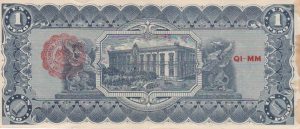
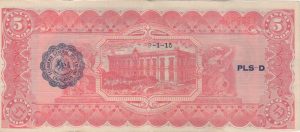
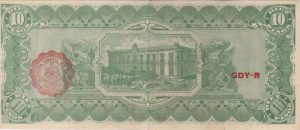
Reverse if these notes feature a framed picture of the Palacio de Gobierno do Chihuahua (Government Palace of Chihuahua) held by two griffins. When the notes were issued from the banks in Chihuahua, they received a red stamp from Tesorero General del Estado Chihuahua (General Treasury of the State of Chihuahua) along with the stamped initials of the issuing teller. When the notes were issued, the teller was supposed to stamp the date on the reverse but that was not universally practiced.
-
-
Chihuahua Revolutionary 1 Peso Banknote. 1915 Series L (SCWPM #PS530e)
-
-
Chihuahua Revolutionary 5 Pesos Banknote. 1915 Series N (SCWPM #PS532e)
-
-
Chihuahua Revolutionary 10 Pesos Banknote. 1915 Series N (SCWPM #PS535a)
In addition to the one-, five-, and ten-peso notes, the Chihuahua government issued 20- and 50-peso notes as well as a 50-centavos fractional note. Both the 20- and 50-peso notes featured the same design except the 20-peso note was printed using brown ink and the 50-peso was printed with a bright green on the front and a golden yellow on the reverse.
The 50-centavo fractional note used a different design and was smaller than the pesos. It was also printed by the American Banknote Company.
These notes were demonetized in 1917 with the signing of the new constitution.
An Educational Opportunity
Money is history in your hands. Look at what can be learned from finding three banknotes and exploring their past and how they fit into history.
Here is an idea for history teachers: you can go to any coin show and find a dealer with a junk box of foreign currency—find more than one if you can to increase the variety. Pick through the box and try to find as many different pieces of currency you can. Try to find a mix of countries, regions, and dates. You can also consider the same country but from different eras of rulers, who always wanted to see their portrait on their country’s money.
Before going to class, place each note in an envelope and place the envelope in a bag. Either pass the bag around the room or have each student come up and pick one envelope. After they pick their currency note, have them write an essay about the note and what the note represents. Have the students look up the history and put it in context of when the note was issued.
Rather than picking a topic, it is a fun way to have the students select a topic and make history come to life. The decisions as to whether the students get to keep the currency are up to you. Maybe you can talk to a local shop or club to see if they would be willing to donate the currency and come in to talk about currency collecting.
Jan 23, 2018 | commemorative, medals, personal
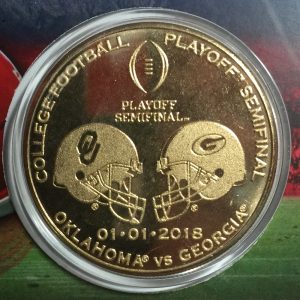
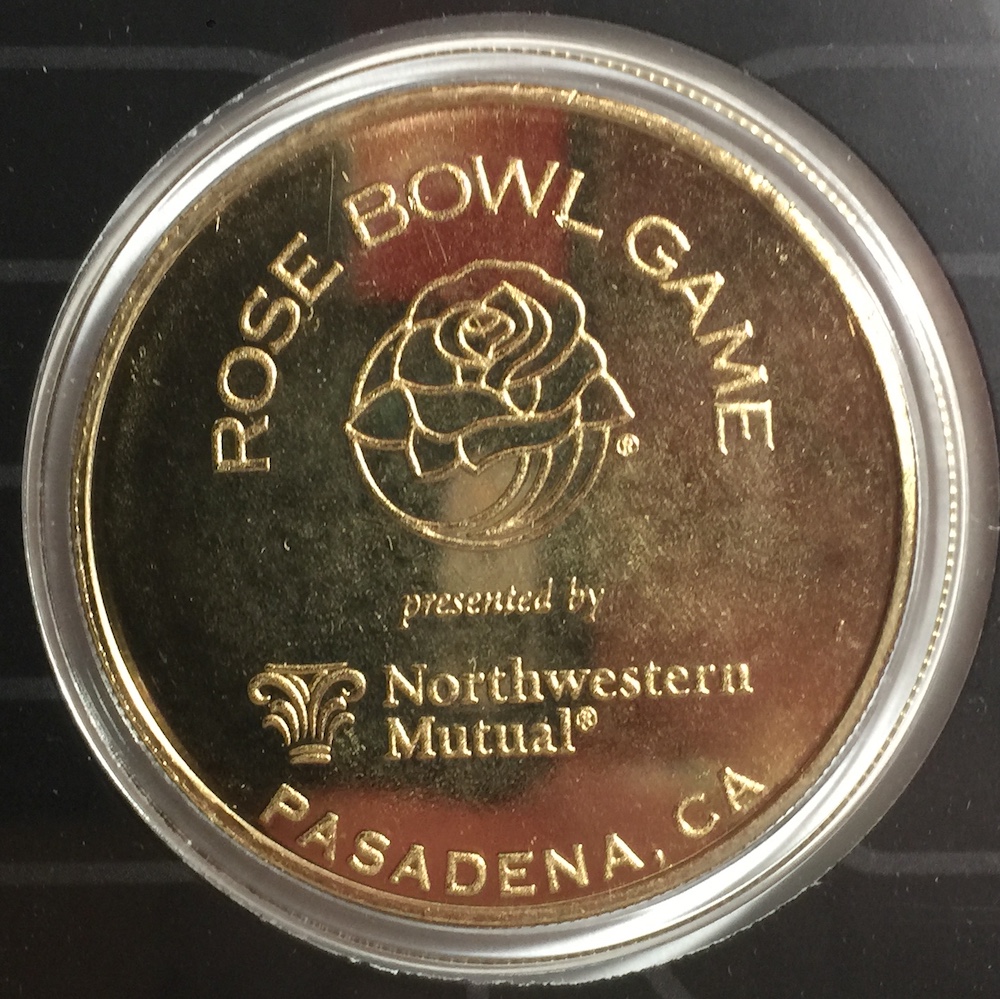
Obverse of the 2018 Rose Bowl Commemorative Medal from the Highland Mint
In 1980, it was a big deal to pack the Redcoat Marching Band into seven busses and travel to New Orleans for the sUGAr Bowl. We thought it was great to spend New Year’s Eve on Bourbon Street and then play in the Superdome, what we called the World’s Largest Mushroom.
I can only imagine what the current Redcoats felt like when they climbed aboard a chartered 757 out of Atlanta to fly cross-country to attend the Rose Bowl. In 1980 there were 300 total members including auxiliaries and support staff. Today, there are almost 300 musicians in the band.
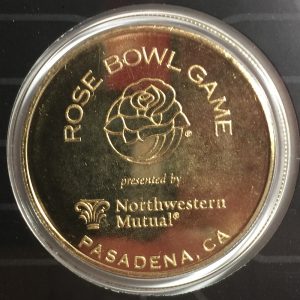
Reverse of the 2018 Rose Bowl Commemorative Medal from the Highland Mint
But that Rose Bowl game was something else. No matter who I talk with about the game, it was the most exciting game they have seen, especially for a Rose Bowl. It was the first time a Rose Bowl went to overtime. Needless to say, I was happy with the outcome!
Previously, I mentioned I was interested in obtaining a copy of the coin used in the coin toss. In the video, it appeared to be silver in a plastic capsule with the school logos on either side. When I received an answer from someone associated with the Rose Bowl committee, I was told that it was indeed a silver coin, specially struck for the game. Only a limited number are struck and given to VIPs. The game-used coin is saved as part of a Rose Bowl museum. There are no extras struck and none are for sale.
I decided to find an alternative.
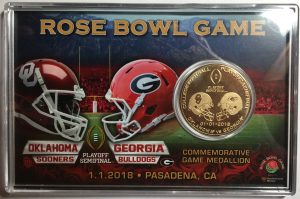
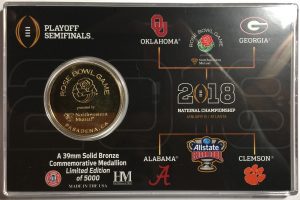
The Highland Mint, in cooperation with the College Football Playoff, struck souvenir medals for each of the games. Medals were struck in brass and placed in a plastic holder with the matchup. They also offer a silver-plated brass medal in a capsule and a velvet-covered case.
A medal in a case is pedestrian. It can be mistaken for just about any collectible, even those from the U.S. Mint. I would rather have the commemorative plastic holder with the information about the game. It makes more of a statement and can be displayed on my desk.
-
-
Front of the 2018 Rose Bowl Medal display case
-
-
Back of the 2018 Rose Bowl Medal display case
As I work to open my new business, I am planning on having this medal in my new office. It will remind everyone that if there is an early kickoff next fall, we will close on-time at noon so that I can rush home to my television and watch the game. Hopefully next year I will buy one that says National Champions!
HOW 🌹 BOUT 🌹 THEM 🌹 DAWGS!
Jan 22, 2018 | commentary, news, policy, US Mint

Sen. Chuck Grassley (R-IA)
According to the notice filed in the Congressional Record:
Mr. President, I intend to object to any unanimous
consent request at the present time relating to the nomination of David J. Ryder, of New Jersey, to be Director of the Mint,
PN1355 .
I will object because the Department of the Treasury has failed to respond to a letter I sent on September 29, 2017, to a bureau within the Department seeking documents relevant to an ongoing investigation by the Senate Committee on the Judiciary. Despite several phone calls between committee staff and Treasury personnel to prioritize particular requests within that letter, the Treasury Department has to date failed to provide any documents.
My objection is not intended to question the credentials of Mr. Ryder in any way. However, the Department must recognize that it has an ongoing obligation to respond to congressional inquiries in a timely and reasonable manner.
Charles E. Grassley is a seven-term Republican Senator from Iowa. Grassley has a history of abusing† the Department of the Treasury to make it look like he’s doing something to keep his seat in the Senate. It is common for Grassley to have something to complain about without substance regardless of the ramifications of his actions.
In the meantime, the U.S. Mint remains without a permanent director while Grassley has his hissy fit.
PN1355: David J. Ryder — Department of the Treasury
Date Received from President: January 8, 2018
Summary: David J. Ryder, of New Jersey, to be Director of the Mint for a term of five years, vice Edmund C. Moy, resigned.
Received in the Senate and referred to the Committee on Banking, Housing, and Urban Affairs. — Jan 8, 2018
Committee on Banking, Housing, and Urban Affairs. Ordered to be reported favorably. — Jan 17, 2018
Reported by Senator Crapo, Committee on Banking, Housing, and Urban Affairs, without printed report. — Jan 17, 2018
Placed on Senate Executive Calendar. Calendar No. 596. Subject to nominee’s commitment to respond to requests to appear and testify before any duly constituted committee of the Senate. — Jan 17, 2018
† If you look at Grassley’s record, he has a record of making outlandish claims and using his office against Treasury bureaus regardless of the party in the White House. In 2005, I was involved with a Treasury bureau forced to a hearing in the Senate. Even though the evidence showed the contractor was clearly derelict in the performance of their contract, Grassley did everything except put on knee pads in deference to the contractor. Outside of the hearing room, I had a confrontation with one of his staffers and offered to supply the knee pads so that Grassley could complete the job. Since that hearing, I have held Grassley in contempt for being a bully and not a representative of the interests of his constituents in Iowa.
Jan 21, 2018 | Australia, Canada, coins, commentary, news
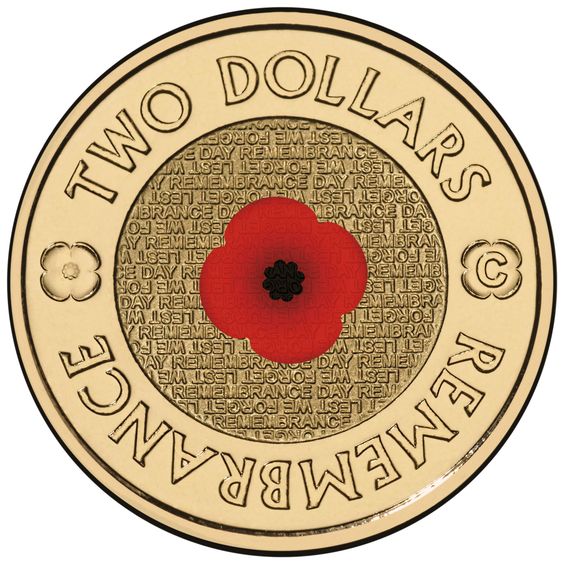
One of the more interesting news items is that the Royal Canadian Mint is suing the Royal Australian Mint.
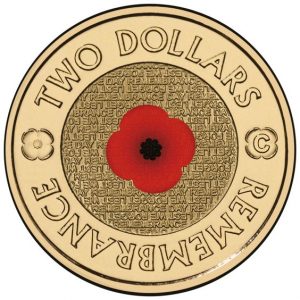
The Royal Canadian Mint alleges the Royal Australian Mint infringed on its patents when creating the 2012 Remembrance Day $2 coin.
Reports state that the two sides have tried to discuss the matter over the last two years. When no agreement had been reached, the Royal Canadian Mint decided to sue for relief. The Royal Canadian Mint is demanding that Australia hand over all 500,000 of the Remembrance Day coins struck or “destroyed under supervision.”
Since the Royal Canadian Mint is a crown corporation, it is an independent entity of the Canadian government. It has its own corporate and governance structure mandated by law. For those in the United States, it is similar to the relationship that Fannie Mae and Freddy Mac have with the United States government. On the other hand, the Royal Australian Mint is an agency in the Australian government in the same manner that the U.S. Mint is an agency in the United States government. Therefore, the Royal Canadian Mint is suing the Commonwealth of Australia.
“The applicant has suffered, and will continue to suffer, loss and damage by reason of the acts of the respondent pleaded above,” the statement of claim filed by the Royal Canadian Mint reads. Really? The Royal Canadian Mint has suffered because the Royal Australian Mint created a coin with a colored poppy for sale and distribution in Australia?
If the Royal Australian Mint infringed on the Royal Canadian Mint patent then there may be a case for relief owed for using the technology. But if the Royal Canadian Mint is trying to make a case based on the suffering of damages from sales of circulating versus commemorative coins, I think that the Royal Canadian Mint may be royally going in the wrong direction.
And now the news…
January 15, 2018
“At a time when our national debt is over $20 trillion, it is more and more difficult to find money for important things like cancer research,” – Congresswoman Carolyn Maloney. → Read more at womensenews.org
January 17, 2018
Online dealer sold 30kg of gold Tuesday, worth more than $1m Bitcoin tumbles below $10,000 for first time since December Amid the wild Bitcoin ride that’s wiped more than 40 percent off the cryptocurrency’s price in a month, a pattern may be emerging: sellers are switching out of digital gold and into the real thing. → Read more at bloomberg.com
January 17, 2018
Gold’s liquidity and stability have made it an attractive option for investors in recent years. There are many ways to invest in gold. Investopedia lists gold futures, investing in old companies, gold EFTs, gold mutual funds, gold bullion, gold jewelry, and, of course, gold coins. → Read more at newsmax.com
January 17, 2018
After more than a year, visitors to the Nevada State Museum can watch the museum's historic Coin Press No. 1 carry on a mission it started nearly 150 year ago in the same building. The venerable press — which churned out millions of dollars in silver and gold coins during stints at U.S. → Read more at nevadaappeal.com
January 18, 2018
OTTAWA — The Royal Canadian Mint is suing its Australian counterpart over the way it prints red poppies on its commemorative Remembrance Day coins. Documents filed in Australia’s Federal Court in December allege The Royal Australian Mint used without permission a printing method patented by the Canadian mint — which is now demanding that Australia’s 500,000 commemorative $2 coins, in circulation since 2012, either be turned over to them or “destroy(ed) under supervision.” → Read more at nationalpost.com
Image courtesy of the Royal Australian Mint and had to be downloaded from Internet archives since it was deleted from their website.
Jan 20, 2018 | BEP, news, policy, US Mint
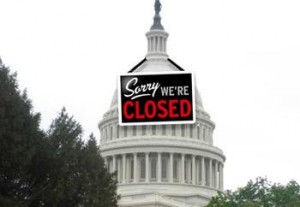 The last time the government shutdown, because Congress did not do their job, was on September 30, 2013. Over the weekend, the major impact will be the recreational-based activities including the National Parks and the Smithsonian Museums—although many of these agencies will remain mostly open using what is called “carry-over funding” which are services whose bills are paid but the agencies are owed the services. It is an accounting trick that can help some agencies up to 72-hours during a shutdown depending on the amount of money and to whom it is paid.
Thankfully, the Washington, D.C. government will pick up the trash and provide basic cleanup services on the National Mall and other areas that would normally be taken care of by the National Parks Service.
Should the shutdown last through Monday, both the U.S. Mint and Bureau of Engraving and Printing will be operational. Both organizations are funded from their profits (seigniorage) which is held in their respective Public Enterprise Funds. The only responsibility that Congress has in their funding is to authorize the spending of the money. That authorization is not impacted by the shutdown because these are not (technically) taxpayer funds.
Since the U.S. Mint and Bureau of Engraving and Printing are self-funded, they are also not subject to the debt ceiling issues.
Although the U.S. Mint and Bureau of Engraving and Printing has not made a formal announcement, it is likely that facility tours will be suspended during the shutdown. This is because the security personnel are Treasury employees and not direct employees of the bureaus. Some will be designated as “essential personnel” and continue to work to help maintain security at all U.S. Mint and Bureau of Engraving and Printing facilities.
Security for the Bullion Depository at Fort Knox, Kentucky will not be impacted by the shutdown.
Since the Federal Reserve is an independent organization and not subject to congressional appropriations, they will remain open during a shutdown. The Office of the Comptroller of the Currency (OCC) will probably also remain open. OCC is funded by the Federal Reserve to help regulate banks.
All independent government organizations not subject to congressional appropriations will continue to operate including the United States Postal Service.
Representatives of these agencies may contact me to provide additional information. Government employees who work for these agencies that want to provide additional information may also contact me. Please note that I do respect the confidentiality of all sources!
NOTE: Although I no longer work as a contractor to the federal government, my views on the government have changed only in my level of disgust with their practices. I am not a member of any political party. I am a supporter of government employees who makes up a very dedicated workforce and do not deserve the way they are treated by elected and appointed officials.
Jan 17, 2018 | coins, news, policy, US Mint
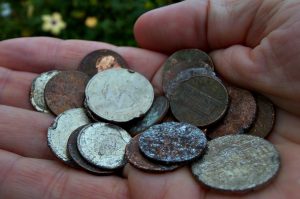
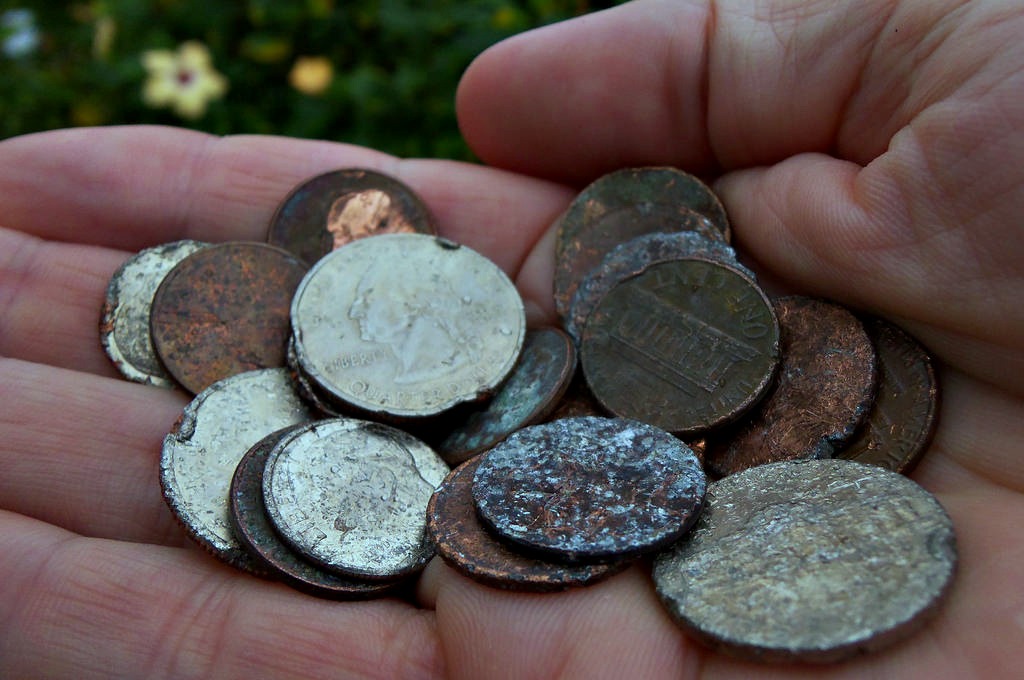
Coins found in the recycling stream.
The recycling industry has complained to the Department of the Treasury and their members of Congress over the U.S. Mint’s inaction with providing new rules to restart the program. After publishing two draft rules and making adjustments based on the comments, the Final Rule was published in the Federal Register (82 FR 60309) on December 11, 2017.
The Final Rule that makes adjustments to the regulations for “Exchange of Paper Currency and Coin” (31 CFR Part 100 Subpart C) in order to add additional clarity and oversight to the process. This includes depositing worn or heavily scratch coins in a bank or other authorized depository. Bulk submission over one pound must be separated by denomination and must be identifiable. Each denomination is considered one submission and must be over one pound (e.g., one pound of nickels and one pound of dimes and one pound of quarters, etc.). Dollar coins also have to be separated by type (e.g., Eisenhower, Sacagawea, Presidential, etc.). The updated program restricts the redemption of fused, unsorted, and unidentifiable coins. Coins made of gold and silver are not accepted as part of this program.
Those needing more detailed information should consult the “Mutilated Coin Redemption Program” webpage on the U.S. Mint website (see http://bit.ly/Mutilated-Coin).
Jan 14, 2018 | coins, commentary, news
One of my favorite quotes is from philosopher, essayist, poet, and novelist George Santayana who wrote, “Those who cannot remember the past are condemned to repeat it.” I was reminded about this quote while reading the news and stumbling over a story “Stamp Out the Sexist Legacy of the Dollar Coin” by Addison Nugent.
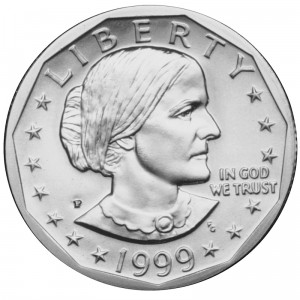
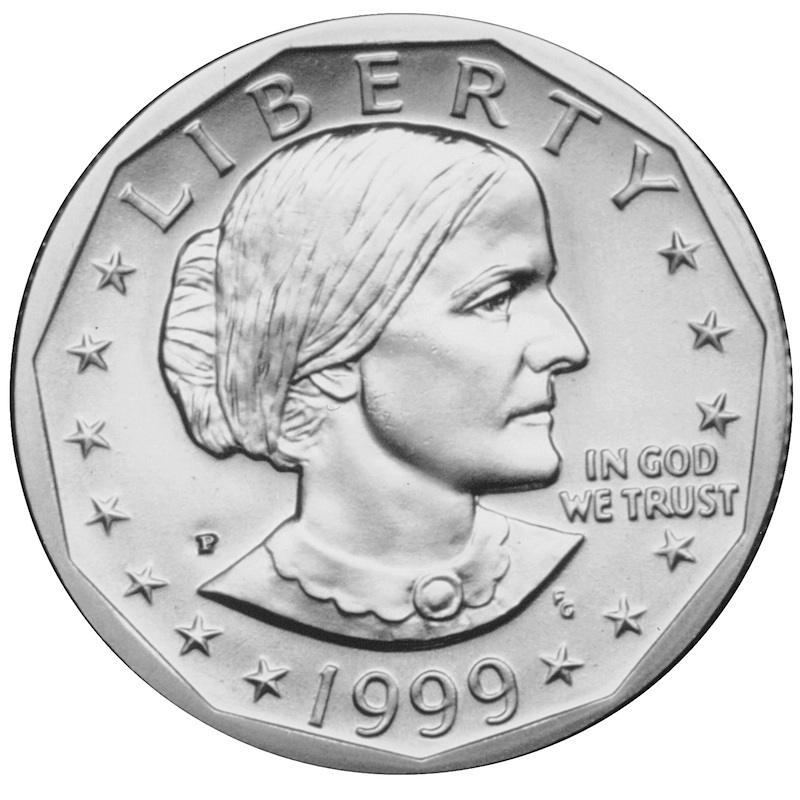
The Susan B. Anthony dollar coin was introduced in 1979 with much fanfare for being the first coin to honor a woman. The coin was a failure because it was confused with a quarter
Nugent complains that the design of the coins and the fact that they use the visage of a female as the reason these dollar coins have not been successful. What Nugent failed to do is learn from history and the facts.
The failure of the Susan B. Anthony dollar was not because the coin depicted a woman or was called the “Agony Dollars” (I had never heard this term before reading the article). The coin failed because of the decision to make it too close to the size to the Washington quarter, had reeded edges like the Washington quarter, and on a simple glance was consistently confused with the Washington quarter. The confusion made the coin very unpopular in the United States but continues to find usage in other countries whose currency is based on the U.S. dollar.
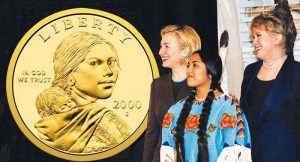
The unveiling of the Sacagawea Dollar design at the White House with (L-R) First Lady Hillary Clinton, Sacagawea Model Randy’L He-dow Teton, and Designer Glenna Goodacre.
Nugent then wrongly notes that “Sacagawea coins were pulled from circulation from 2002-2008 and from 2012 onward.” I do not know where she gets her facts from, but the reality is that the U.S. Mint, Department of the Treasury, and Federal Reserve does not recall paper currency or coins from circulation. What happens is that when there is no demand for a coin the Federal Reserve stops ordering them from the U.S. Mint.
The reason that the dollar coin does not circulate is not that it depicts a woman. The dollar coin does not circulate because the public has chosen paper over a coin. Even though studies have shown that the public can adopt and that there would be a savings to the government if the paper dollar was no longer printed (see the Government Accountability report GAO-13-164T), Congress does not have the intestinal fortitude to eliminate the paper dollar.
To add insult to the facts, Nugent does not take into consideration that the Sacagawea dollar was changed starting in 2009 to the Native American $1 Coin Program. While Sacagawea continues to appear on the obverse, the reverse honors Native American history. The last I looked the Native American population has undergone a significant negative history in the United States.
Another fact that Nugent does not acknowledge is that even though the U.S. Mint does not produce these coins for circulation they are produced for the collector market. In addition to being included in mint and proof sets, there have been special sets created with Native American coin honoring their accomplishments. Aside from being able to purchase these coins at face value in any U.S. Mint and Bureau of Engraving and Printing facility open to the public, you can also go to any bank and request they obtain a roll for you from the Federal Reserve.

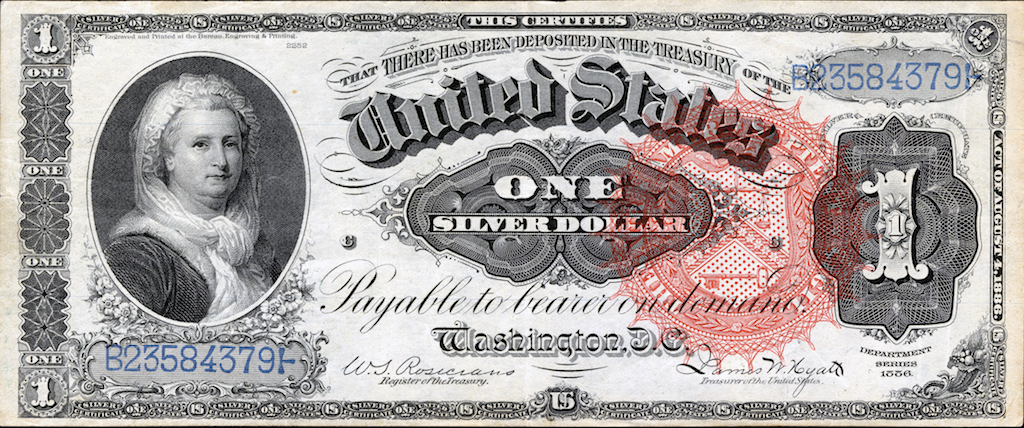
Series 1886 $1 Silver Certificate featuring Martha Washington (Fr #217)
Although I agree with Nugent that United States coins and currency should be more diverse and I am in favor of removing Andrew Jackson, who was responsible for the Trail of Tears, from the $20 note, it is difficult to side with any argument whose purpose is based on factual errors.
And now the news…
January 7, 2018
Popular online magazine Atlas Obscura recently became the latest to probe the question of how an 11th century Viking penny came to rest on the coast of Maine. In the decades since the 1957 discovery by amateur archaeologists, it’s been denounced as a hoax, validated by scholars, denounced as a hoax again and — as recently as this past November — validated by scholars again. → Read more at thinkmaine.bangordailynews.com
January 8, 2018
A similar coin sold for more than £4,000 in a 2011 auction, but Jason has gone down the correct route of declaring it as treasure → Read more at plymouthherald.co.uk
January 8, 2018
The U.S. dollar coin has been the only American currency to regularly feature women. With these leading ladies now ousted, it's time to toss the coin. → Read more at ozy.com
January 8, 2018
The United Kingdom’s round pound coin will no longer be accepted as a form of payment for services and retail purchases in shops after February 28. → Read more at iomtoday.co.im
January 8, 2018
When Eric Lawes set off for a field in Hoxne village, Suffolk on November 16, 1992, it wasn’t on a treasure hunt. The metal detector he’d received as a retirement gift was meant to find a hammer lost on the farmland. → Read more at smithsonianmag.com
January 9, 2018
JAMES Grear started selling coins with his best mate Henry when they were just 18. The pair were fed up with working as labourers on a building site in Bristol earning up to £9 per hour and decided… → Read more at thesun.co.uk
January 10, 2018
State Police are working to find the owners of a large bicentennial medallion coin. It was recovered months ago, but no one has stepped up to claim it. → Read more at mpnnow.com
January 10, 2018
Colonial Williamsburg has acquired a rare and iconic Danish abolitionist medal that commemorates a royal edict to end the slave trade. The bronze medal was struck in 1792 and is one of only a handful known to exist, according to a Colonial Williamsburg Foundation press release. → Read more at wydaily.com
January 10, 2018
By Baek Byung-yeul Organizers for the 2018 PyeongChang Olympics unveiled a new limited coin set for the Winter Games, Wednesday. At the building of Poongsan Corporation in Seoul, the maker of the PyeongChang Olympics commemorative bill, the organizing committee made public the new package. → Read more at m.koreatimes.co.kr
January 12, 2018
Grip the handle and turn the crank. Watch the roller turn. Wait for that clink, reach into the little door. → Read more at stltoday.com
Jan 13, 2018 | legislative, news, US Mint
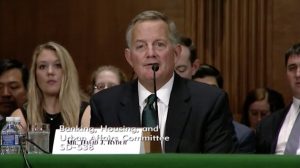
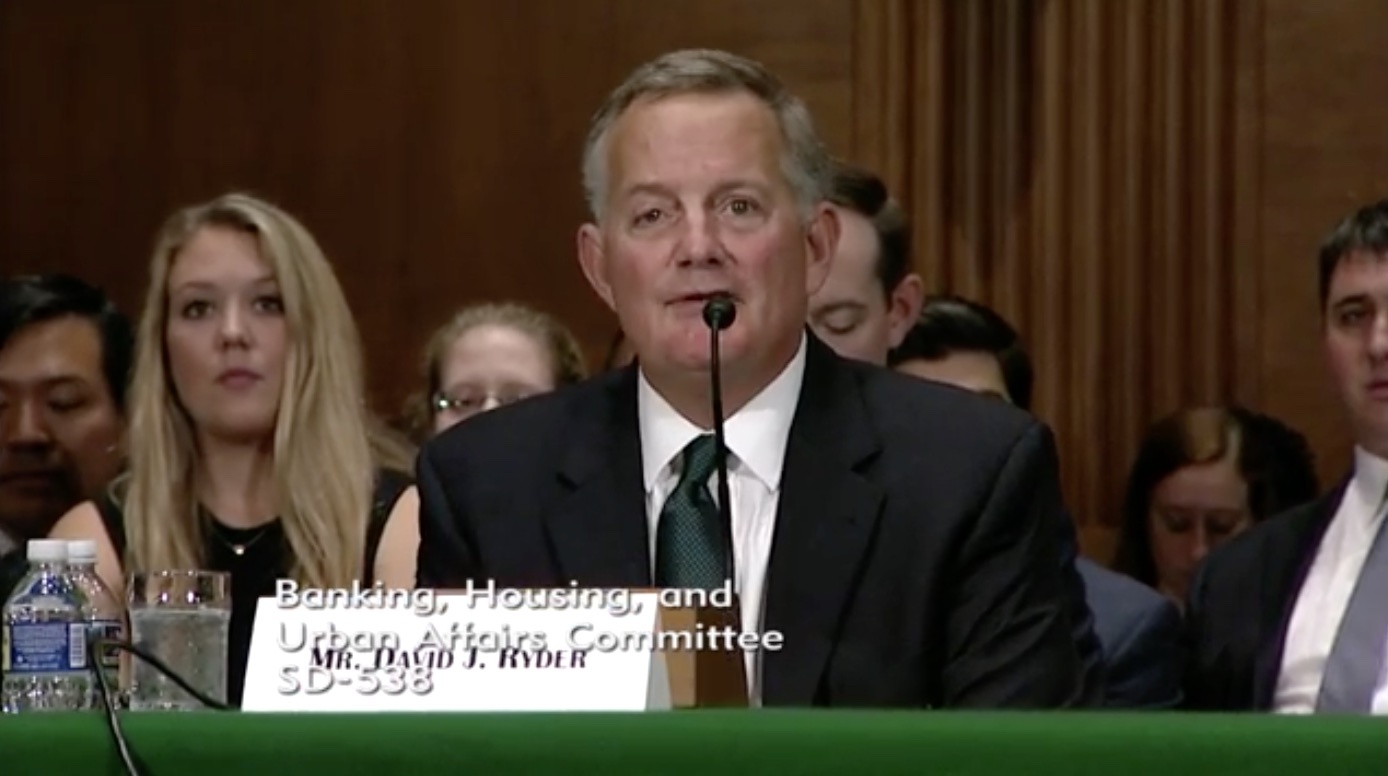
David J. Ryder at the hearing regarding his nomination to be the 39th Director of the U.S. Mint
Apparently, Ryder’s nomination was returned to remove the hold placed by Sen. Chuck Grassley (R-IA) in December. Grassley filed an intent to object to the nomination because “the Department of the Treasury has failed to respond to a letter I sent on September 29, 2017, to a bureau within the Department seeking documents relevant to an ongoing investigation by the Senate Committee on the Judiciary.” Grassley said that the objection was not intended to question Ryder’s credentials but as a punitive action against the Department of the Treasury for not answering his committee’s inquiry.
Ryder’s nomination was resubmitted by the President on January 8, 2018 (PN1355). As required, it was referred to the Senate Committee on Banking, Housing, and Urban Affairs. It is likely to be passed out of committee without a hearing. However, that does not mean Grassley or any other senator would not put a hold on the nomination.
Your government at work.
PN1355: David J. Ryder — Department of the Treasury
Date Received from President: January 8, 2018
Summary: David J. Ryder, of New Jersey, to be Director of the Mint for a term of five years, vice Edmund C. Moy, resigned.
Received in the Senate and referred to the Committee on Banking, Housing, and Urban Affairs. — Jan 8, 2019
Jan 12, 2018 | coins, commemorative, commentary, US Mint
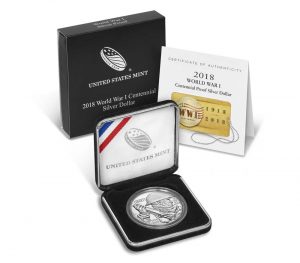
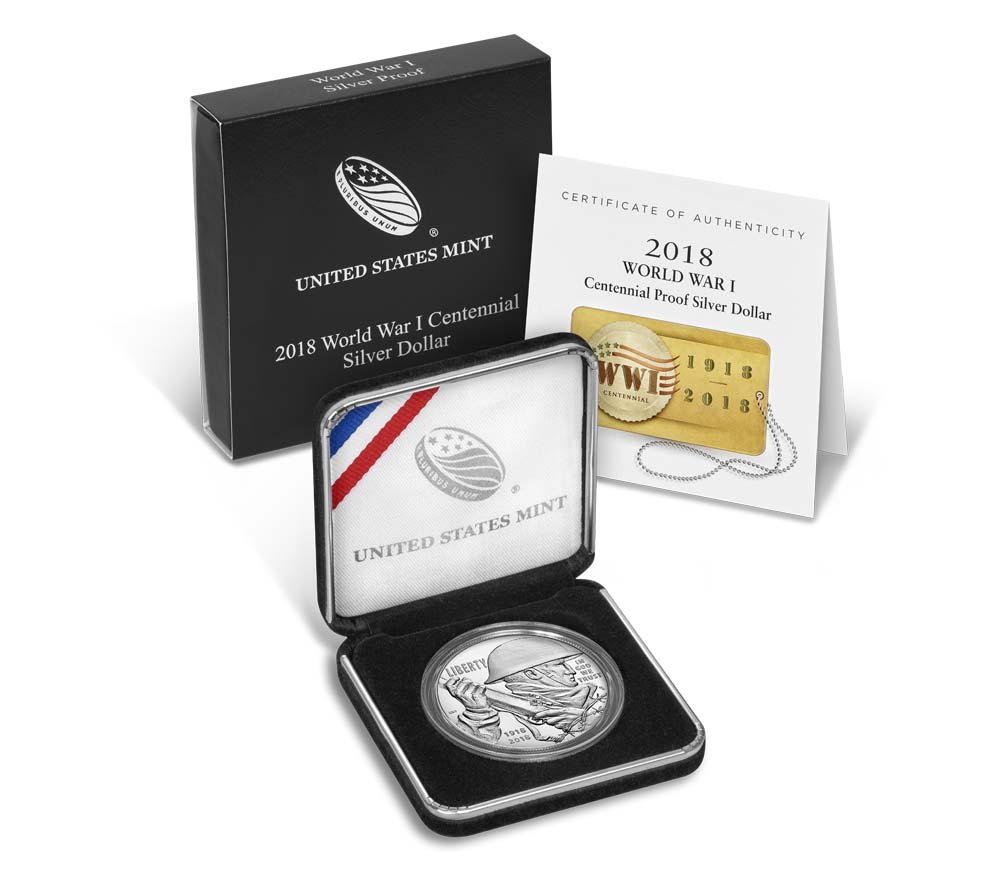
World War I Centennial 2018 Silver Dollar
Of course, the U.S. Mint will sell an uncirculated and proof silver dollar that will come in their usual display cases with a Certificate of Authenticity. These are the coins that are required under the authorizing law (World War I American Veterans Centennial Commemorative Coin Act, Public Law 113-212) that were designed by LeRoy Transfield.
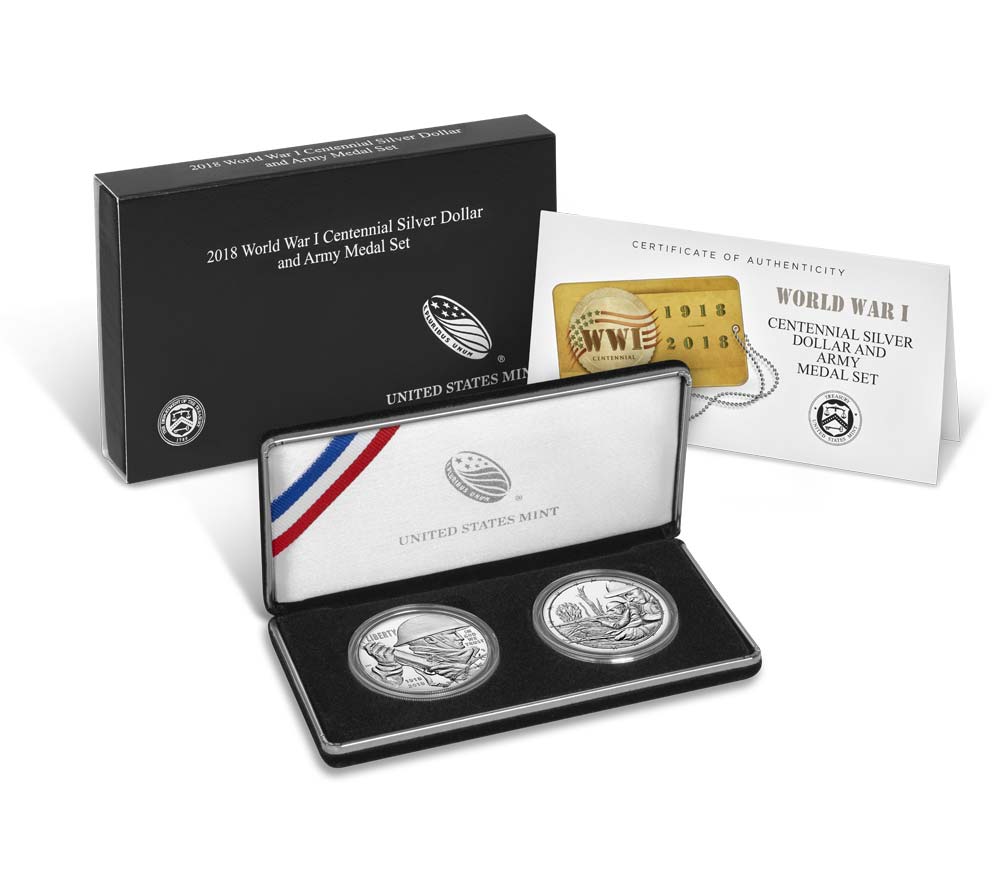
The U.S. Mint will also be selling five silver medals that will be issued in conjunction with the 2018 World War I Centennial Silver Dollar. Each medal, composed of 90 percent silver, pays homage to branches of the U.S. Armed Forces that were active in World War I: Army, Marine Corps, Air Service, Navy, and Coast Guard. Medal designs were announced last October. However, the U.S. Mint will only be selling the medals as part of a set with the silver dollar.
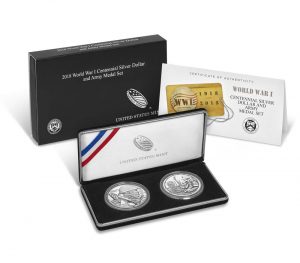
World War I Centennial 2018 Silver Dollar and Army Medal Set
Since there are no more surviving veterans of World War I, one can only assume that the commemorative coin and medal sets are being marketed to those that want to remember the service of those veterans. Creating these sets in this context makes sense. It does not make sense for the collector or for someone whose family did not serve in World War I or wants to just collect the medals.
This short-sightedness by the U.S. Mint may hinder potential sales of the commemorative coin whose proceeds are to benefit the United States Foundation for the Commemoration of the World Wars, an organization responsible for making sure we do not forget those who served.
With the decline in silver prices and the market interest in investing in silver at its lowest since before the Great Recession, a short-sighted decision like this will limit the sale of silver medals. This will lower the income and seigniorage the U.S. Mint will collect after seeing a decline in the sales of bullion-related products.
If the U.S. Mint cannot get this right, then maybe they should have a more broad community discussion so they can better understand the potential collector market because on this, they bombed!
Images courtesy of the U.S. Mint.





 Loading ...