Jan 29, 2019 | coins, education, Euro, foreign
After my last post about the Staatliche Münze Berlin, the Berlin State Mint, a few German readers provided a lesson in the political structure of Germany to understand the institution’s role in the country’s coin production.
Unlike what I wrote previously, the Berlin State Mint is a government mint but for the government of the Federal State of Berlin.
Berlin is one of two cities that is also designated as a state. The other is Hamburg. The divisions trace back to the many small states that existed in the region during the days Holy Roman Empire. In short, it was an attempt to bring unification to the region by attempting to allow each smaller states, kingdoms, principalities, cities, etc. to provide their own rule for the common good. Some reference suggests that there were over 300 individual governments with their own governing rules at the height of the Empire.
Arguments, wars, and Napolean brought about many changes where many of the smaller states merged into larger ones and others changed by conflict. Following the Treaty of Versailles that ended World War I, Germany was forced to give up territories that left the current state boundaries were mostly set as they are today.
Before I hear from our German friends, I am leaving out a lot of history on purpose. I just want enough to bring context to the discussion. If anyone wants a more detailed discussion about the history as it pertains to the German mints, I recommend reading the article “
Why Germany has Five State-Owned Mints.”
Although the Third Reich tried to unify the country around a federal government, there were a number of administrative functions left to the states including the minting of coins and printing of currency. Even Adolph Hitler learned that to keep his version of an orderly government, he had to work with each of the states.
Following World War II, the concept of the confederation of states continued with the formation of the Federal Republic of Germany (West Germany) and the German Democratic Republic (East Germany). Although the federal government has evolved with more central power, the states continue to have a degree of independence in their operations that a person with a background in United States history would consider a confederation.
As the country evolved and times mandated change, many of the mints were closed. Production consolidated with the changes in the political structure of Germany. Following the unification of Germany in 1990, only five state mints remained:
NOTE: First letter on the line is the mintmark associated with the mint.
-

-
Berlin State Mint
-

-
State Mint of Baden-Wuerttemberg, Munich
-

-
Barvarian Main Mint, Stuggart
-

-
State Mint Baden-Wuerttemberg, Karlsruhe
-

-
Hamburg Mint
When the euro was introduced, German law mandated that the minting of the euro coins would be distributed evenly among the five mints. Any production beyond the federally mandated requirement to produce the euro is between the mint and the Finance Minister of the state.
As for the currywurst coin, although it is produced by the Berlin State Mint, it is a product of that mint and not a product endorsed by the German federal government.
If you are confused you are in good company. Even after spending parts of three days looking into the history, I am not sure I am right. It is more confusing than the structure behind the U.S. Mint!
Images of the Germany state mints are courtesy of the mints via their websites.
Jan 27, 2019 | coins, foreign, news
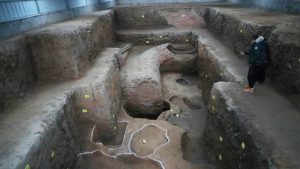
Archaeologists found fragments of ceramic coin moulds at the site when they were carrying out repairs after heavy rain in late 2017.
(Photo: South China Morning Post)
With only a portion of the facility excavated, the archeologists found nine areas that could have been used as part of coin production. There was one kiln site that was likely used to create porcelain coin molds and eight ash pits. They also found copper coins, coin mold fragments, and other items that were used as part of the coining process.
The China Numismatic Society told news sources that the inscriptions on the molds date the facility to 9-23 AD and corresponds to the reign of Wang Mang of the Han Dynasty.
Finds like this shows how the use of money and numismatics can lead to better understanding of societies what may have been lost.
And now the news…
January 18, 2019
It’s been dubbed one of the loveliest coins ever minted and, almost two centuries after it was struck, it’s making headlines again. A rare gold five pound coin, featuring an idealised image of Queen Victoria in the early years of her reign, has sold for a six-figure sum at a private auction.  → Read more at royalcentral.co.uk
January 21, 2019
Archaeologists discover fragments of ceramic moulds, copper coins and a kiln site where an ancient government office once stood → Read more at scmp.com
January 22, 2019
“There used to be this thing called money,” people will say in the future. And children will laugh. “You’re joking,” they’ll say. → Read more at bostonglobe.com
January 23, 2019
Secret Service members are reportedly exchanging challenge coins that take a jab at the ongoing partial government shutdown. → Read more at thehill.com
January 23, 2019
The best-known U.S. Mint building in San Francisco is at Fifth and Mission streets, right across the street from the Chronicle building. The Old Mint is an imposing classical structure, but it’s been retired as a money-making plant for more than 80 years. By the early 1930s, the building was too antiquated to meet the increased demand for coins. So the U.S. Treasury found a second location, at Duboce and Buchanan streets, where a natural rock promontory could function as another layer of security. A search through The Chronicle’s archive uncovered photos of the construction of the New Mint in 1936, as well as the coin production work happening inside. → Read more at sfchronicle.com
January 25, 2019
The Royal Canadian Mint has uncovered the identity of the soldier who inspired its new silver dollar coin, which commemorates the sacrifice of Canadian soldiers on D-Day. → Read more at cbc.ca
January 25, 2019
A 10-year-old Indian boy who lives in Oman has collected more than 500 coins from across 120 countries. → Read more at timesofoman.com
Jan 22, 2019 | coins, commemorative, commentary, foreign
Staatliche Münze Berlin
(photo courtesy of Wikimedia Commons)
While the story about the currywurst commemorative coin seemed like something to poke fun at, I was reminded that Staatliche Münze Berlin, the Berlin State Mint (www.muenze-berlin.de), is not an official government mint. It is a private mint that has been contracted by the German government to assist in producing coins. Their website reports that they produce one-fifth (20-percent) of all German coins.
Reports suggest that the Staatliche Münze Berlin has been under contract to Latvia to produce legal tender coins since 2014.
It appears that Staatliche Münze Berlin would be to Germany as the Pobjoy Mint is to the United Kingdom. Both a private mints that are contracted to strict legal tender coins that create their own commemorative.
This might mean we are safe from coins commemorating poutine and haggis. However, the idea of mixing curry with ketchup may be worth a try!
Jan 20, 2019 | coins, commemorative, foreign, news
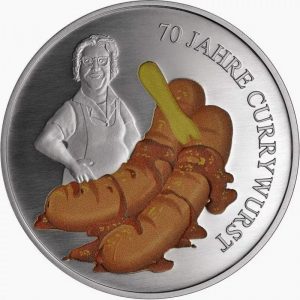
The 2019 coin commemorating currywurst has been called everything from ugly to the wurst (Image courtesy of Staatliche Munze Berlin)
Currywurst is considered the national fast food delicacy of Germany. It is a pork sausage that has been sliced part of the way through, boiled then grilled, and served smothered with ketchup mixed with curry powder. Curry powder is sprinkled on top.
According to a friend who spent time working in Germany, currywurst stands are as ubiquitous in Berlin and many other cities as hot dog stands are in New York. Depending on the stand, they can be served on buns, with sauerkraut, or fries. Since returning to the United States several years ago, he says that his family enjoys the German dish frequently.
Coins have been used to commemorate many things. Commemorating food on coins is nothing new. Coins have been used to commemorate agricultural products like wheat and corn. But aside from the (in)famous bottlecap-shaped coin, I cannot remember when a coin was used to commemorate a prepared food.
Now that the Berlin State Mint has broken this barrier, who’s next? Will the Royal Canadian Mint produce a coin honoring poutine? Or will the Royal Australian Mnt grace a coin with Vegemite? I don’t even want to think about a coin commemorating haggis!
And now the news…
January 7, 2019
Click image to enlarge MIDDLEBURY, Vt. – A coin collector from Lewiston, Maine, with no prior connection to Middlebury, has donated more than 1,000 ancient coins to the Middlebury College Museum of Art. → Read more at middlebury.edu
January 13, 2019
A German coin manufacturer has commemorated the country’s love of currywurst with a speciality coin to mark 70 years since the savoury snack was first sold in Berlin. The silver alloy coin, made by Staatliche Munze Berlin, or the Berlin State Mint, features an image of the delicacy’s inventor alongside two giant sausages drowning in curry sauce and pierced with a wooden fork, as is tradition. → Read more at expressandstar.com
January 13, 2019
A silver medal-thaler, issued by Romanian ruler Constantin Brâncoveanu in 1713, sold for USD 16,000 at a numismatic auction in New York, Profit.ro reported. Brâncoveanu, who was a prince of Wallachia between 1688 and 1714, was deposed from his throne by Sultan Ahmed III. → Read more at romania-insider.com
January 13, 2019
New Delhi: A new book traces India's numismatic history through 133 rare coins which are illustrative of the country's antiquity, ethos and traditions. In Suvarna Mohur: India's Glorious History Illustrated through Rare Coins by Arun Ramamurthy, Indian history has been divided into 20 epochs. → Read more at firstpost.com
January 14, 2019
The Maine Bureau of Veterans’ Services (MBVS) is pleased to announce the final design selection for the new State of Maine Honorable Service coin and plaque, which will honor all Maine veterans, past and present, regardless of their branch or era of service. → Read more at boothbayregister.com
January 14, 2019
SINGAPORE: The number of coins that a buyer can use in a single transaction will be streamlined and standardised to 20 coins per denomination after Parliament passed the Currency (Amendment) Bill on Monday (Jan 14). → Read more at channelnewsasia.com
January 14, 2019
Mobile coin exchange units are hitting the roads to encourage people to swap the loose change they have collected for easier to handle banknotes, so the coins can be recycled. The modified trucks, which are green and clearly marked with the Treasury Department logo, have a window along the side where the coins can be exchanged for notes of equal value. → Read more at bangkokpost.com
January 14, 2019
In Berlin, the participants of the most unusual robbery of recent years went on trial. Three young Arab migrants stole a considerable gold coin from the museum using only an ax handle, ropes, stairs, and carts. → Read more at en.crimerussia.com
January 16, 2019
Greater Houston Coin Club members have been on a mission to get kids involved in the hobby. → Read more at abc13.com
Jan 17, 2019 | advice, coins, counterfeit, errors
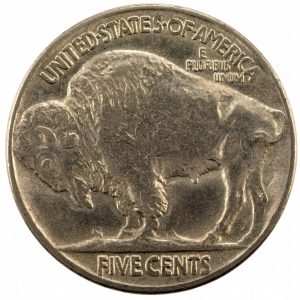 One of the more popular collector series is the Indian Head or Buffalo Nickels. Designed by James Earl Fraser, a student of Augustus Saint-Gaudens, this design was a continuation of President Theodore Roosevelt’s “pet crime” to change the look of the nation’s coinage.
Introduced in 1913, the coin features a right-facing Indian head (now called a Native American head). Although there have been claims by several tribal chiefs that they were the model, Fraser’s notes suggest the image was created using the features of several men.
The reverse features the image of a buffalo, which in reality is a North American bison. The 38 different types of buffaloes live in Africa and feature larger horns similar to a longhorn steer. Most are domesticated and are raised like cattle is in the United States. Bison are largely wild animals native to the western hemisphere. Aside from their shorter horns, they have beards hanging from their chin and heavier coats that allow them to survive in colder climates.
But that has not stopped people from referring to the coin as a Buffalo nickel. It is a design so popular that when it has been used in coinage, the available supply usually sells out.
War Nickels
Before I receive a deluge of email, the Jefferson nickels struck from 1942 through 1945 were struck on a planchet made from .560 copper, .350 silver, and .090 manganese and features a large mint mark over the image on Monticello on the reverse. This was done to reduce the use of copper and nickel needed for the war effort.
Like every five-cents coin made since the introduction of the 1883 Liberty Head or “V” nickel, the planchet is made from an alloy of 75-percent copper and 25-percent nickel. Most vending machines will not be able to tell the difference between a Buffalo nickel and a Jefferson nickel.
The coin’s ability to be used in vending machines and how a worn coin could pass the unwatchful eye of a cashier, it is possible to find a Buffalo nickel in change. Although there are very few of these coins remain in circulation, avid change hunters say they can find one every 12-16 months.
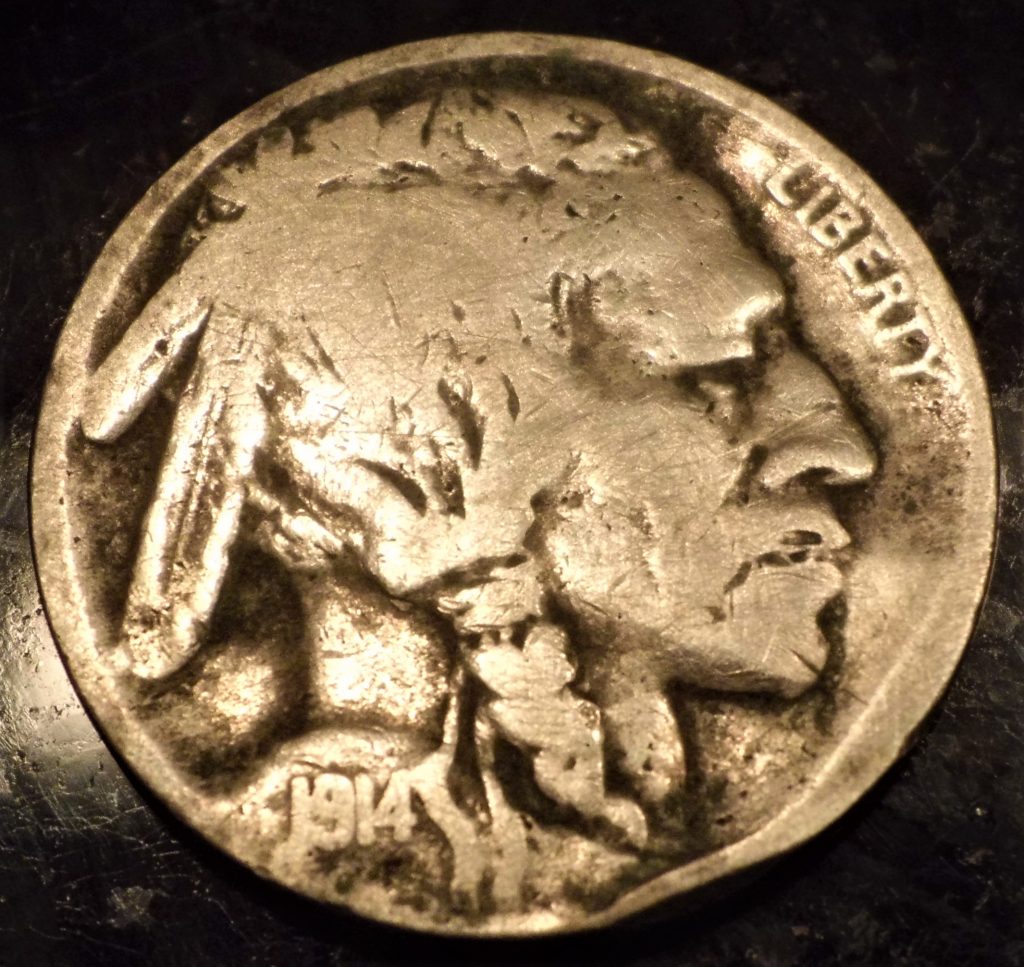
This was the case when a reader found what was thought to be a 1914-D Buffalo nickel. Although not a rare or key date, a 1914-D coin could be worth upwards of $70-80 in good (G-4) condition. Finding a Denver mint coin from that year would be better than finding a Philadelphia mint coin since a coin in good (G-4) condition would be worth $16-18.
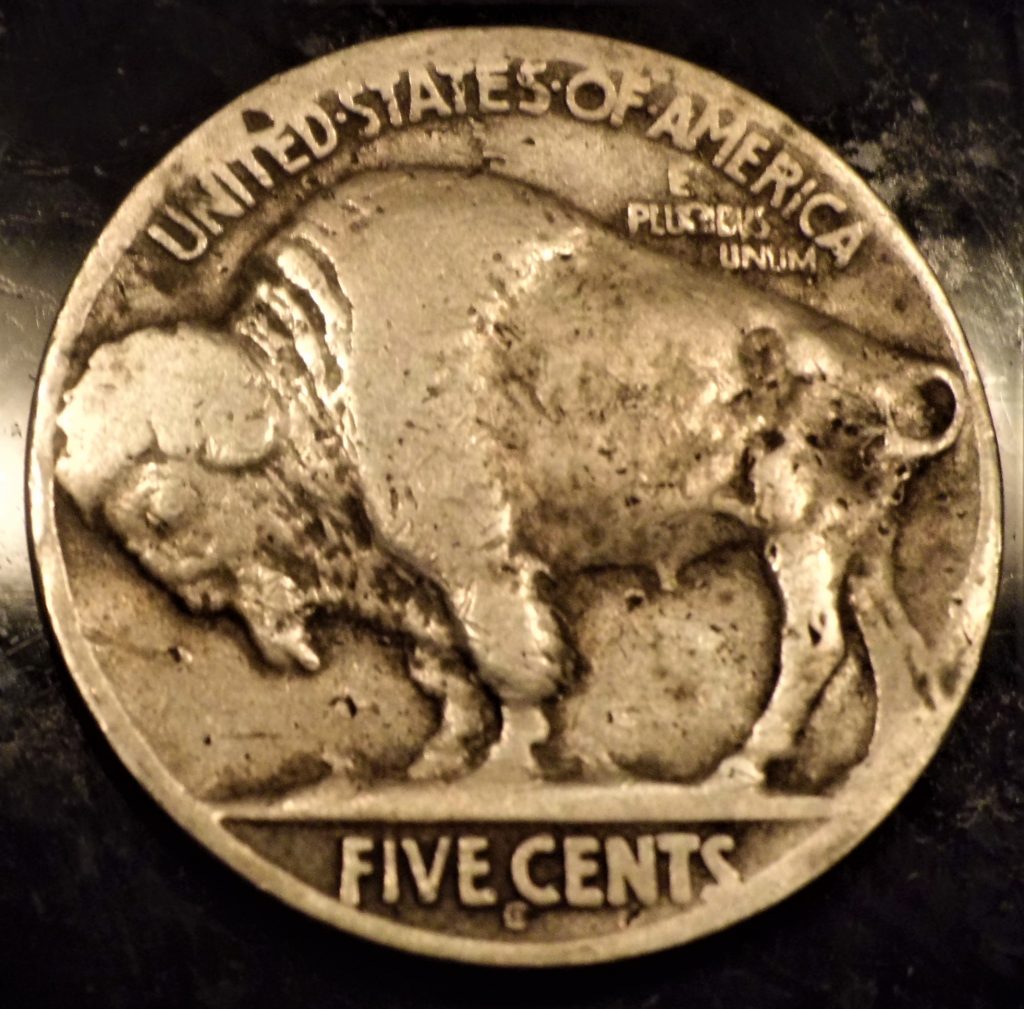
But this coin was different. Rather than having a “D” mintmark on the reverse, the “D” was backward!
-
-
The found coin, a 1914-D Buffalo Nickel (obverse)
-
-
The reverse of the found 1914-D with an alleged “Inverted D” mintmark
Prior to the U.S. Mint creating dies with mintmarks in Philadelphia, they would send dies to the branch mints without mintmarks. The coiners at the branch mint would use a punch to imprint the mintmark into the die before striking coins. Of course, this manual process was not perfect and there are cases of mispunched, repunched, overpunched, and other such errors.
There have been cases of a mintmark that was punched horizontally into the die. Those mintmarks were repunched correctly. Coins from the San Francisco mint has had errors where the “S” is punched upside down known as an inverted mintmark. This is a fun error to find because noticing this error requires a careful eye and patience along with understanding the shape of the “S” in the font used.
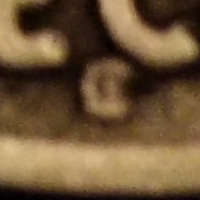
A closer look at the “inverted” D mintmark
Adding or removing mintmarks is a common method to artificially change the value of a coin. Remove the “S” from a 1921 Walking Liberty half-dollar and watch its value raise by 300-percent. Or practice adding a “D” to a 1914 Buffalo nickel to make a 400-percent profit.
After checking several references and speaking with two dealers, I sat with a box of Buffalo nickels I have to compare the mintmarks to the one on the coin. Additionally, I consulted with the images at PCGS Photograde. After all, it could be a real, undiscovered error.
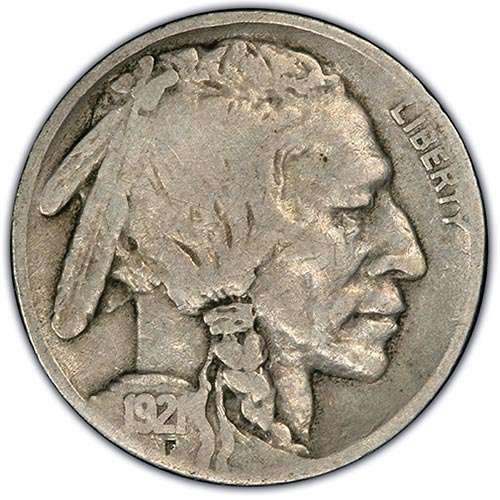
The first thing I noticed on the image and with the coins I have on hand is that the mintmark on this coin is too defined for the grade. When comparing the coin to the images on Photograde, if the coin was sent in for grading it would probably be assigned a grade of G-6 of VG-8. Because of the worn rims, this coin would not grade higher than VG-8 and could be assigned a G-4.
As I was looking at the coins, those that would grade VG-8 or lower with worn rims also had mintmarks that were almost worn into the rim. In more than a dozen examples from my box, the mintmarks on all of the low-grade coins showed the rims and mintmark worn together.
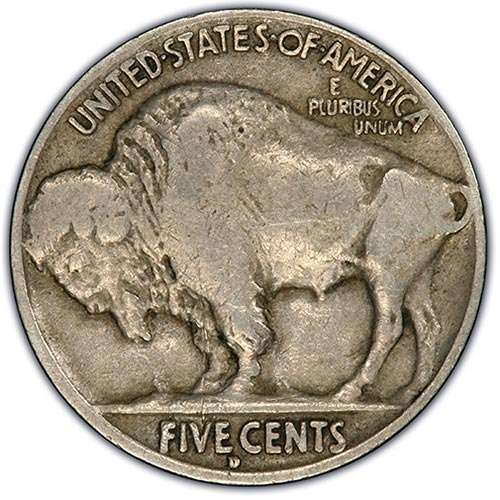
Another aspect of the mintmark that bothered me was that the “D” seemed smaller than those on the coins I was looking at. For comparison, I pulled out my album with higher grade Buffalo nickels and found that the mintmark was similar in size to those in higher grades.
-
-
According to PCGS Photograde, this 1921 Buffalo Nickel represents a VG8 grade.
-
-
Look at the “D” mintmark on this 1929-D nickel graded F12 as part of PCGS Photograde
Then there is the coloring around the mintmark. Comparing it to the examples in my box, the dirt patterns around the “D” seems off. While the coloring around all of the letters appears to be uneven, there appears to be a consistent line around the “D.” In fact, the coloring at the bottom of the “D” is inconsistent with that of the other letters around it.
If I had the coin in hand, I would be able to examine it closer with a 15x loupe. I would even attempt to pick at it with a toothpick to see if the “D” would fall off. However, given all of the issues with the coin based on the images alone, I am reasonably certain that the “D” was added by someone outside of the U.S. Mint.
Of course, if you have your own theories then please post them as a comment, below.
PCGS Photograde images courtesy of PCGS and can be found
here.
Jan 13, 2019 | Australia, coins, commemorative, news, US Mint
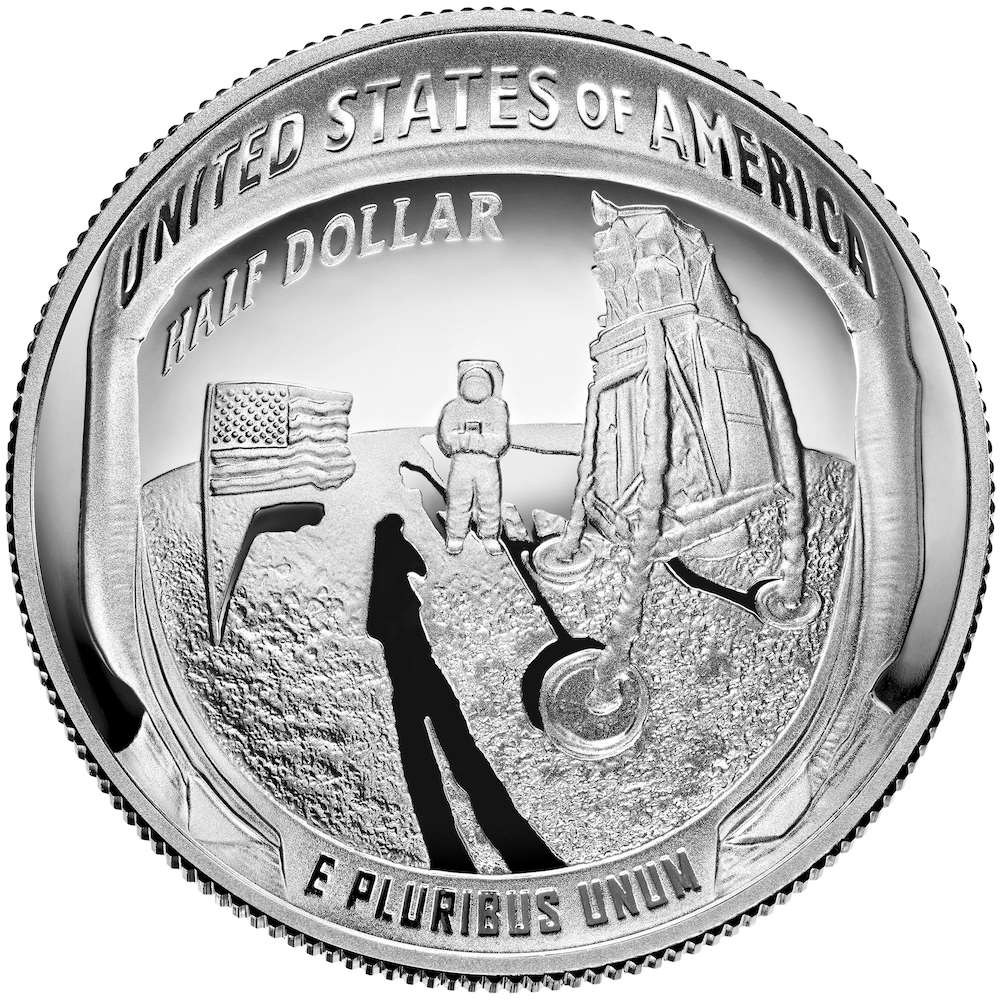 Pairing U.S. coins with a foreign coin for sale has been done in the past by the U.S. Mint. In 2002, the U.S. Mint offered the “Legacies of Freedom” This week, the U.S. Mint announced a collaborative project with the Royal Australian Mint to produce a commemorative coin set in celebration of the 50th Anniversary of the Apollo 11 Moon landing. The set will feature a U.S. Apollo 11 50th Anniversary Half Dollar paired with an Australian 50th Anniversary of the Moon Landing 1 oz. $5 Silver Coin.
The announcement noted that the set will be produced and sold by the Royal Australian Mint with marketing help from the U.S. Mint who will put a link on their website.
set. A limited edition of 50,000 sets that included an uncirculated American Silver Eagle $1 coin and a £2 Silver Britannia from the Royal Mint. These sets were created and marketed by the U.S. Mint with a price of $49.88 per set, noting that the spot price of silver was $6.39 per troy ounce.
Prior to that, the U.S. Mint produced the 2000 Leif Ericson Millennium Commemorative Set that included a 2000 Leif Ericson Proof Silver Dollar and a 1000 Kronur proof silver coin produced by the U.S. Mint for Iceland. It was the last coin the U.S. Mint produced for a foreign government. The U.S. Mint sold 86,136 sets at a price of $63 per set.
Since the set will be produced by the Royal Australia Mint, there are questions regarding the opportunities that may be missed by the U.S. Mint to do the same. For example:
- The press release says that it will be a “limited production set” but does not specify how many sets will be produced.
- Other than the legal requirements that the U.S. Mint shall not lose money on a commemorative coin program and that the half-dollar includes a $5 surcharge, what are the financial arrangements between the two government mints?
- Who will handle the fulfillment of orders from the United States? Those who have purchased items from Australia and New Zealand know that the because of shipping and customs restrictions, items can take 6-8 weeks to enter the United States before it can be given to the Postal Service for delivery.
These questions will be addressed to the U.S. Mint as soon as Tuesday. Even though the U.S. Mint continues to operate during the shutdown, offices in Washington, D.C. will be closed on Monday because of 8-12 inches of snow that covers the region.
And now the news…
January 5, 2019
Coins expected to bring increased security to economies of British territories and dependencies → Read more at theguardian.com
January 9, 2019
A penny that a Massachusetts teenager found in his change from lunch money could be worth as much as $1.65 million (£1.3 million) when it is auctioned off. → Read more at foxnews.com
January 9, 2019
My grandfather was a numismatist. William Evans Mullan II died over the weekend. The coin collection lives on. → Read more at djournal.com
January 10, 2019
Don Lutes Jr. kept the 1943 copper penny he stumbled upon in his high school cafeteria seven decades ago in a safe behind a wall in his Massachusetts home. → Read more at cnn.com
January 11, 2019
Jim Cramer shares his favorite ways to add gold to a portfolio and encourages investing in the precious metal if you’re nervous about 2019. → Read more at cnbc.com
January 11, 2019
BERLIN — Four young men have gone on trial over the brazen theft of a 100−kilogram Canadian gold coin from a Berlin museum. → Read more at manitobapost.com
Jan 7, 2019 | commentary, gold, news
Sorry for the one day delay, it was a busy weekend!
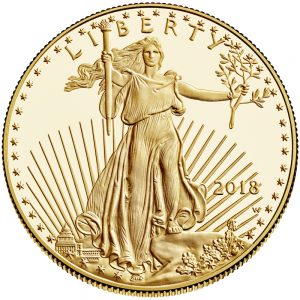 The important news is not being reported in the numismatic press nor by those who are supposed to watch over the industry. The important news is the government shutdown and its potential effects on the economy as a whole.
Market performance is like a disease. When one part gets infected the rest of the organism will follow. The part the economic organism that is getting infected is the Washington, DC area. Home to 15 companies in the Fortune 500 including government-sponsored Fannie Mae and Freddie Mac, The Washington Post is reporting that 174,800 people have been furloughed in the Washington, DC-area because of the shutdown.
When that many people are not getting paid they are not spending money and the economy gets stagnant. When a region as significant in size becomes stagnant, it is only a matter of time before it spreads to other areas including those where the federal government has the most impact including Alaska, Montana, and New Mexico. Farming states could also feel the impact since the U.S. Department of Agriculture is closed and cannot process subsidy (welfare) checks for farmers hurt by the trade war with China, potentially affecting the price of food.
Since the markets do not like uncertainty, investors tend to seek refuge in precious metals, primarily gold and silver. The problem is that there is so much news that timing the markets has given the market watchers whiplash as the uncertainty seems to force the professional investors (gamblers) to treat the market like they are playing the hokie-pokey: a little bit in, a little bit out, panic a little and shake all about the next news cycle.
The dollar is strong but that is because the Federal Reserve did not raise rates in December. While that averted a panic, the Fed may not be able to hold back if the shutdown continues and puts inflationary pressure on the economy.
With news cycles that could change at the drop of a Tweet, it does not make sense to try to time the market. However, if the price of gold climbing as a result of those in the equity markets looking for a safer haven, you may want to tell your representatives in Congress to work to end this shutdown. Although some would love to see $2,000 per ounce gold prices, it could negatively impact the economy and your ability to collect.
And now the news…
December 31, 2018
Have you ever wondered what happened to all the old, round £1 coins after they were removed from circulation? We just found out → Read more at mirror.co.uk
December 31, 2018
Chain restaurants Sweetgreen and Dig Inn in the US have already stopped accepting cash. Starbucks and UK pubs are also moving towards card and contactless. → Read more at dailymail.co.uk
January 1, 2019
U.S. Mint sales of American Eagle gold and silver coins dropped to their lowest … → Read more at reuters.com
January 2, 2019
Editor's Note: Kitco News has officially launched Outlook 2019 – Rush To Safety – the definitive reference for precious metals investors for the new year. We chose this year's theme as financial markets face growing uncertainty. → Read more at kitco.com
January 3, 2019
PolicÃa Nacional has issued a warning after a rise in reported cases of members of the public receiving the wrong currency in their change. Instead of being handed back euros, unsuspecting holidaymakers and expats are being short-changed with coins of much lower value compared to the euro. → Read more at express.co.uk
January 5, 2019
KIND-hearted shopkeepers are helping an Inverness youngster with her coin collecting hobby by setting aside specially-minted versions of 50p and £2 coins produced to commemorate historic occasions. A Girl Guides centenary 50p sparked the interest of Cradlehall Primary’s Isla Macdonald, who now has 40 special 50p coins and 30 differently designed £2 coins. → Read more at inverness-courier.co.uk
Jan 3, 2019 | coins, commemorative, legislative
 It should come as no surprise to anyone that the 115th Congress left unfinished business. As we start the new year, 25-percent of the executive branch does not have the legal funding to operate. Those with leftover funds operated as long as they could but are now closed pending congressional action.
As with previous shutdowns, the U.S. Mint and the Bureau of Engraving and Printing are not affected. Both agencies are self-funded from their profits (seigniorage) which is held in their respective Public Enterprise Funds.
The 115th Congress is constitutionally scheduled to end at 12:00 noon on January 3, 2019, when the 116th Congress will begin. Congress will take up the new funding bills as part of the opening session.
When the new Congress gavels into session, any bill pending from the 115th Congress will be removed from the docket. It will be said that these bills will die in committee.
In reviewing December’s legslation update, there was the passage of one bill:
H.R. 1235: Naismith Memorial Basketball Hall of Fame Commemorative Coin Act
Summary: (Sec. 3) This bill directs the Department of the Treasury to mint and issue not more than 50,000 $5 coins, 400,000 $1 coins, and 750,000 half-dollar coins in recognition and celebration of the Naismith Memorial Basketball Hall of Fame.The coins shall be in the shape of a dome, and the design on the common reverse of the coins shall depict a basketball. Treasury shall hold a competition to determine the design of the common obverse of the coins, which shall be emblematic of the game of basketball.(Sec. 7) The bill requires all sales of such coins to include specified surcharges, which shall be paid by Treasury to the Hall to fund an endowment for increased operations and educational programming.
Message on Senate action sent to the House. — Dec 19, 2018
Presented to President. — Dec 19, 2018
Passed Senate without amendment by Voice Vote. — Dec 18, 2018
Senate Committee on Banking, Housing, and Urban Affairs discharged by Unanimous Consent. — Dec 18, 2018
Received in the Senate and Read twice and referred to the Committee on Banking, Housing, and Urban Affairs. — Sep 26, 2017
Motion to reconsider laid on the table Agreed to without objection. — Sep 25, 2017
On motion to suspend the rules and pass the bill, as amended Agreed to by voice vote. — Sep 25, 2017
DEBATE – The House proceeded with forty minutes of debate on H.R. 1235. — Sep 25, 2017
Considered under suspension of the rules. — Sep 25, 2017
Mr. Barr moved to suspend the rules and pass the bill, as amended. — Sep 25, 2017
Referred to the House Committee on Financial Services. — Feb 27, 2017
The Naismith Memorial Basketball Hall of Fame Commemorative Coin Act was sent to the White House for presidential signature on December 19, 2018. The president has ten days to act on the bill. He can sign the bill, which there is no indication that he has, and it becomes law. He could veto the bill to prevent it from becoming law.
But what if he does not sign the bill? If Congress was still in session then the bill automatically becomes law. If Congress adjourned then the bill does not become law. That is called a pocket veto.
Because of the shutdown, Congress did not adjourn while trying to resolve the issue. There were pro forma sessions, meaning that a representative gaveled in the House and Senate only to adjourn for the day. If the president did not sign or veto the bill, it has become public law. However, since the Government Printing Office (GPO), the official publisher of the U.S. government, is closed because of the shutdown, they cannot publish the results of legislation passed or vetoed. Therefore, we do not know whether this bill is now the law.
Previous administrations would announce bill signings in their regular news streams. This White House has chosen to discontinue that practice leaving us at the mercy of the currently closed GPO.
In December, the Senate passed the National Law Enforcement Museum Commemorative Coin Act by a voice vote. Although the bill was sent to the House for consideration it never left the committee and will die in committee when the 116th Congress is gaveled into session.
S. 2863: National Law Enforcement Museum Commemorative Coin Act
Held at the desk. — Dec 19, 2018
Received in the House. — Dec 19, 2018
Message on Senate action sent to the House. — Dec 17, 2018
Passed Senate without amendment by Voice Vote. — Dec 13, 2018
Senate Committee on Banking, Housing, and Urban Affairs discharged by Unanimous Consent. — Dec 13, 2018
Read twice and referred to the Committee on Banking, Housing, and Urban Affairs. — May 16, 2018
Finally, Rep. Bruce Poliquin (R-ME), whose district includes Kennebunkport, introduced the President George H. W. Bush and Barbara Bush Dollar Coin Act. Essentially, this would have extended the Presidential $1 Coin program to include President George H.W. Bush and First Lady Barbara Bush. This bill, like many others, died in committee.
H.R. 7257: President George H. W. Bush and Barbara Bush Dollar Coin Act
Referred to the House Committee on Financial Services. — Dec 11, 2018
A full review of the 115th Congress will be published shortly after the government reopens and the GPO resumes its publishing operations.
Jan 1, 2019 | administrative, celebration

As we begin a new year, we should look forward to better times for our hobby, our nation, and our world. I wish you and yours a Happy and Healthy 2019 and hope that you find the key coin of your dreams!
-
-
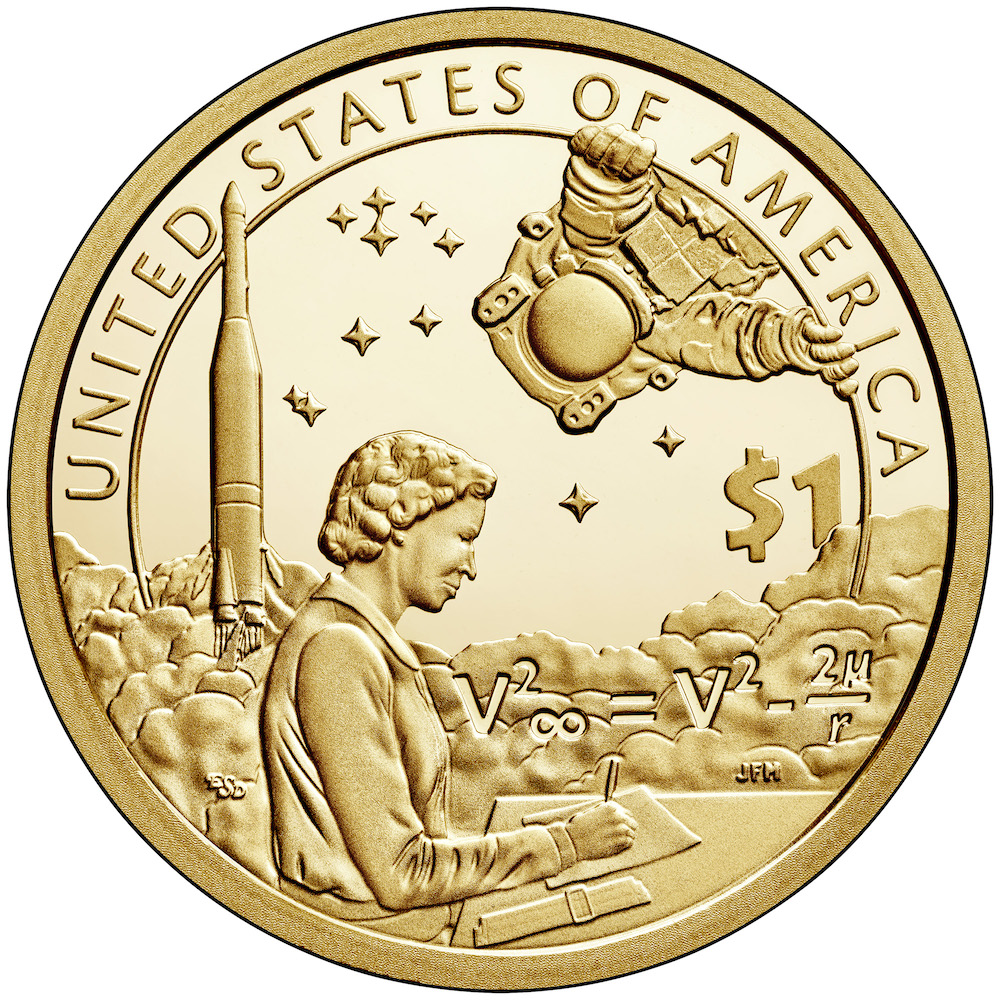
2019 Native American $1 coin — American Indians in the Space Program.
-
-
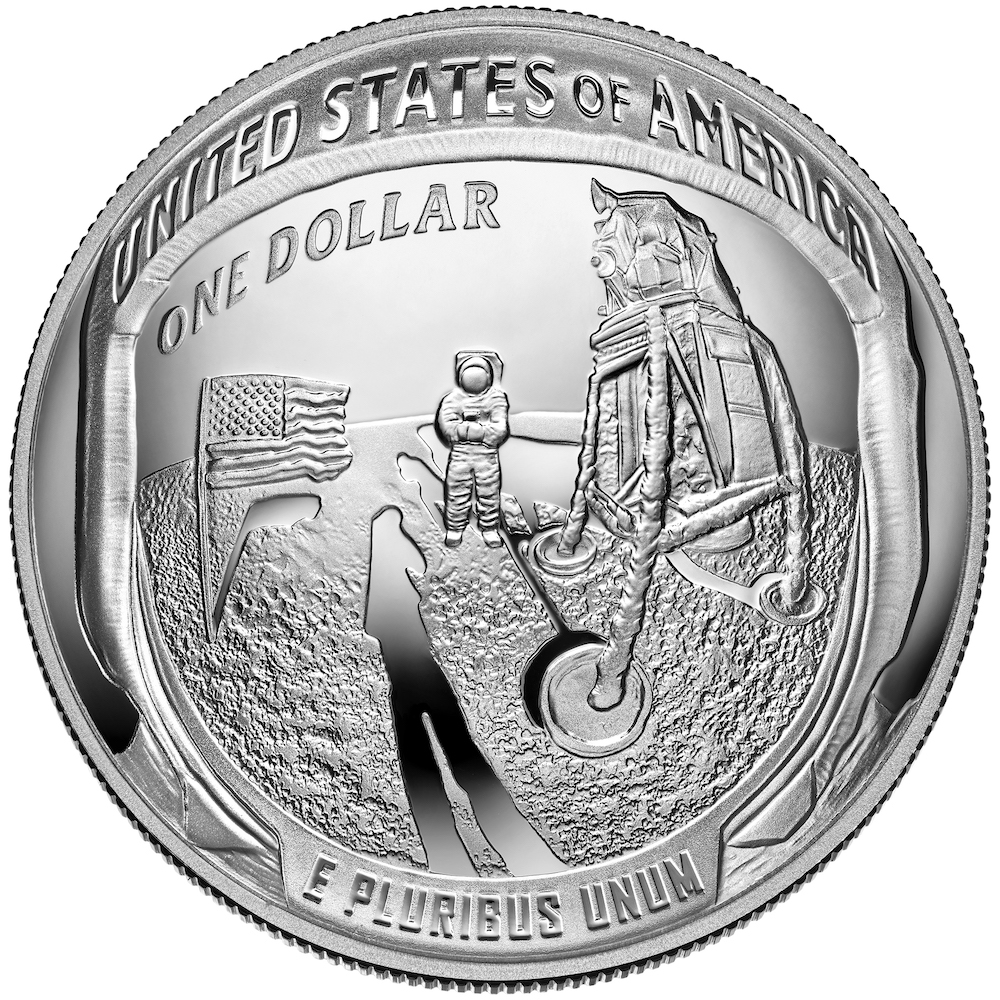
2019 Apollo 11 50th Anniversary Commemorative Silver Dollar




 Loading ...