
Weekly World Numismatic News for August 2, 2020
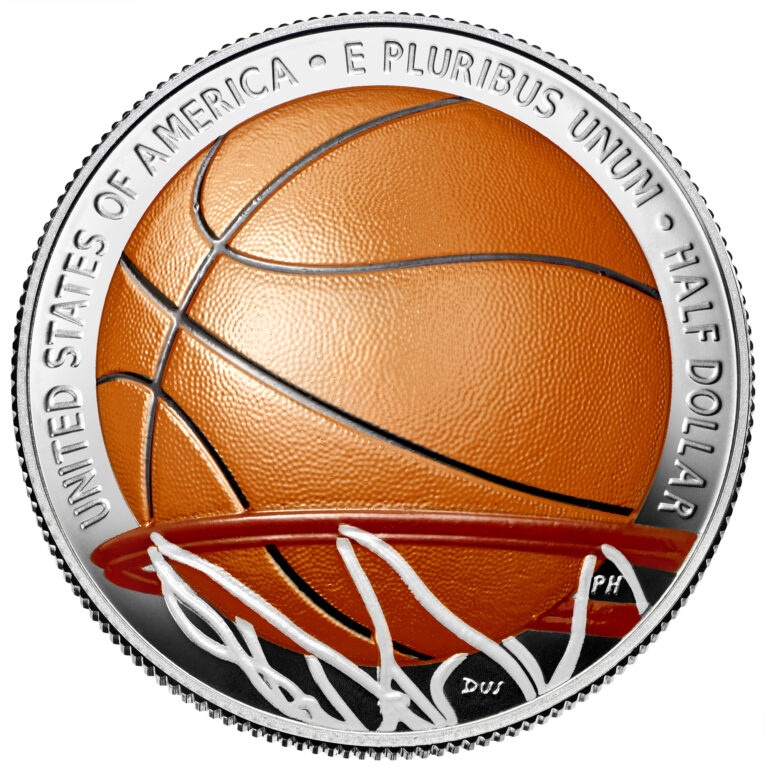
Colorized Basketball Hall of Fame Half Dollar Clad Coin (Image courtesy of the U.S. Mint)
People invested in a tradition are afraid to change. It has always been that way and was successful, then why change?
At some point, change is necessary, or the tradition will stifle growth. Two areas where tradition is holding back activities are baseball and numismatics.
Hardcore baseball fans are the most traditional fans. They are the people who can tell you who was on deck when Bobby Thompson hit “the shot heard around the world,”† the nuance of the double switch, or why on-base percentage is a better statistic than batting average.
While trying to have a season amidst the COVID-19 pandemic, baseball had to look tradition in the face and calmly walk in another direction. Aside from adding the designated hitter (DH) in the National League was placing a runner on second base when the games go into extra innings. The purpose is to shorten games, especially those that go to extra innings.
We are used to the DH. When games are played in an American League Park, all teams use the DH. But putting the runner on second base who did not get a hit to be there is very different.
But the move seems to be working. In the first week of the new season, four games went to extra innings, and all of the games ended in the 10th inning. It is an unorthodox move for a sport bound in tradition.
Numismatics is the same in many respects. The U.S. Mint strikes real coins, not trinkets. To be a real collector, you have to collect all of the best stuff, including the highest grade versions of the most popular coins. Finally, coins have to be a good value.
A “real coin” is money that an issuing authority legally monetizes for a market. The market may be for collecting purposes, but the issuer has assigned a face value. Even though the U.S. Mint has issued commemorative coins that are not intended to circulate, the traditionalists have determined the new colorized coin is something less than a real coin.
Traditionalists may not want to hear that a general collector community has reacted favorably to the colorized Naismith Hall of Fame Commemorative Coins. On message boards where collectors discuss their collections, they are now beginning to realize that the U.S. Mint has issued other sports-related commemorative coins. In a recent discussion, some started to ask about the National Baseball Hall of Fame commemorative coins.
These collectors are not interested in Morgan Dollars, Standing Liberty Quarters, or Buffalo Nickels. They want the coins to add to their sports collections. A fan of Dr. J, Julius Erving, said that he plans to buy the colored and non-colored coins for his collection.
When it comes to numismatics, what defines a good value? How does one tell a person who may have inherited coins why a dealer would buy a coin for $20 but sell it for $45 or $50?
This past week, Michael Taylor, a financial writer for mysanantoinio.com, wrote the article, “Coin collecting a fine hobby, but not a good investment.” His fundamental question was, why is the spread between the bid and ask prices of coins so vast.
Briefly, Taylor acquired coins from his elderly father and tried to figure out their value. His mother had taken the small hoard to a coin shop and was offered about half of their retail value. As part of Taylor’s investigation, he used the Red Book (A Guide Book of United States Coins) and the Blue Book (Handbook of United States Coins) to understand pricing.
Taylor concluded that coins were not a good investment based on his analysis of the pricing differences found in both books.
Taylor is a published financial professional with many years of understanding markets. Most markets are very understandable that professionals who predict markets can do so with reasonable certainty. They can mitigate risks for wrong predictions and still make a good living.
Based on analyzing the Red and Blue books, how does one do that in the coin market? The problem is that there is so much more to the market that these books do not cover. A lot is based on tradition, unwritten lore, and irresponsible perceptions.
The general public has a better understanding of the automobile market than they do of the numismatic markets.
If you want to fix the hobby, it is time to look at these traditions, lore, and perceptions and act responsibly. Otherwise, the collectors may only be one-time coin buyers, and the hobby will continue to stagnate.
And now the news…
 July 26, 2020
 → Read more at spectrumnews1.com
July 28, 2020 → Read more at bloomberg.com
July 29, 2020 → Read more at mysanantonio.com
July 30, 2020 → Read more at nytimes.com
August 1, 2020 → Read more at markets.businessinsider.com
August 1, 2020 → Read more at weartv.com
August 1, 2020 → Read more at bbc.com
→ Read more at spectrumnews1.com
July 28, 2020 → Read more at bloomberg.com
July 29, 2020 → Read more at mysanantonio.com
July 30, 2020 → Read more at nytimes.com
August 1, 2020 → Read more at markets.businessinsider.com
August 1, 2020 → Read more at weartv.com
August 1, 2020 → Read more at bbc.com
More than Cheesesteaks in Philly
Today began with a start later than expected when I get a text from home telling me that one of the air conditioners died and then from work saying the systems I am working on died. After I told my wife who to call for service, I didn’t have to worry about my wife handling the home situation while my work problems will be waiting for me on Monday.
So it was down the elevator, down the block a little, across the street, and I stride into the convention center just before the bourse opens to the public. While waiting for my table coverage, I walked over to the exhibits.
If you are following me on Pinterest, you would have seen quite a few pictures from the exhibits area. Not following the pack, I was drawn to the first set of cases on the right, even though that was the tenth case of the exhibit. It was full of chocolate. Not just chocolate but chocolate in the shape of coins. Coins, medals, and tokens from the United States and around the world. Chocolate notes, boxes of chocolate coins, a “million dollar” case of chocolate coins. Ten cases of chocolate.
There were some very interesting exhibits but two really stood out. One was a complete collection of Confederate currency that included a rare $1,000 note. The beginning showed that the exhibit was well researched and the collector did a great job finding the notes, but it needed something extra. It needed to do more than show off the notes. There needed to be more information interspersed with the notes rather than all up front. It would have made the exhibit more engaging.
The presentation was a problem with an exhibit that had National Banknotes representing all of the county of Pennsylvania. While the cases were divided by regions, there needed to something more than the notes and a sliver of paper describing the note. Maybe a little history, something about the region, anything.
But the best exhibit, in my opinion, were the pre-Civil War notes from Chattanooga, Tennessee. Chattanooga grew up as a port town and then as a train stop, the exhibit not only presented the notes nicely with descriptions, and informative and fun. I was told that the exhibitor tried this before and took criticism from the judges seriously and improved his presentation. It was an excellent job.
The rest of my day was dealing with meetings, catching up with the ANA Technology Committee looking to help the ANA upgrade their IT technology to help serve the membership better, making sure the Maryland State Numismatic Association table is watched, and filling in at the last minute for Barry Stupper for his Money Talks discussion about the need for a political action committee.
In between running around, I was able to glance at a few tables. I’ve noted some people I want to visit in the process. I think I found someone with Maryland Colonial Currency who might have something I am looking for. The dealer said she would look in the stack of notes for me and I will drop by in the morning. I am also looking at some other foreign currency for an idea I have to do my own exhibit. I found a dealer who has a nice selection of early 20th century foreign currency who I also have to visit at some point.
Continue to follow me on Twitter and the pictures on Pinterest to see what comes up on Friday.
My First Day in Philly
Robert Burns wrote in his poem To A Mouse “The best laid schemes of mice and men/Go often awry” describes how I tried to leave early yet something always gets in the way. Such was my journey this morning when I tried to leave before my morning note posted. But after a stop at a local coffee shop, I was able to take to the road to Philadelphia.
With traffic, the drive to Philadelphia was 2 hours and 45 minutes with a stop to refill the coffee cup. I made such good time that I was too early to check in. So I left my luggage with the concierge and walked across the street to the Pennsylvania Convention Center.
I know I should not compare facilities because each city builds a convention center for its own purposes, but it seems that this facility was not as big as I thought it would be. Maybe I am not seeing the entire facility. But it is a nice place. It is well laid out, decently lit in the bourse area, and nicely positioned in downtown Philadelphia.
Every city has its charm, especially the old cities in the northeast corridor. Their growth, problems, and gentrification reflect the character of the city and how the city wants to show itself. Philadelphia seems to want to balance between the history of the colonial city while maintaining its melting pot atmosphere. The problem is that Philadelphia was so successful that it has made supporting services, such as hotels and parking, more expensive.
While I am not a fan of the American Numismatic Association’s decision to hold the World’s Fair of Money in the suburbs of Chicago, I am not sure they could sustain other shows in the downtowns of major cities. While I like Philadelphia, costs and the economy suggest a more cost effective location.
Maybe it is the cost and the economy why I was a little disappointed when I entered the bourse area of the World’s Fair of Money. Maybe the halls are bigger than they seem, but the show does not take up the entire hall. The back area is very open and there are sections blocked off so the show does not take up the entire hall.
The last time I attended the World’s Fair of Money was the 2008 show in Baltimore where they took up three halls in the Baltimore Convention Center and had a waiting list. While I have missed a few since (should have had my hip replaced sooner!), the differences are drastic.
Regardless of the size, the one thing you have to give to the ANA is that they know how to put on a show! The schedule is packed with interesting lectures, meetings, and other activities. They get the U.S. Mint, Bureau of Engraving and Printing, and a few world mints here including the Royal Canadian Mint, Perth Mint, Holy Land Mint, and the Polish Mint—which are only the ones I saw today. I think there are others I will explore tomorrow.
When I arrived, I did make a dash to the U.S. Mint and BEP areas. At the U.S. Mint I was able to purchase the 2012 Making American History Coin and Currency Set, saving the $4.95 shipping costs. The set includes a 2012-S Proof American Silver Eagle and a Series 2009 $5 Federal Reserve Note from the Federal Reserve Bank Branch of San Francisco with the serial number beginning with “150.” The set looks like the U.S. Mint used the same supplier for this packaging as they have for other products. I like the set and glad I bought it.
At the BEP area, aside from taking pictures of their display (see my Pinterest board for images), I purchased the $10 Generations Set. This set contains a Series 1995, 2001, and 2009 $10 Federal Reserve Note from the Federal Reserve Bank in Philadelphia showing the evolution of the note. What is really great is that all three notes have matching serial numbers. My three have serial number “0527.” Now if I would have understood that the sticky note on the cover was the serial number, I would have asked for something more interesting. At least I have the lowest available.
The packaging of the $10 Generations set is phenomenal. Inside the box is a binder with a booklet showing the history of the $10 note slipped in the pocket, the $10 FRNs in two pages with an intaglio print of Independence Hall on the second page. With only 3,333 to be produced, I am glad I purchased a set.
Comparatively, the BEP can teach the U.S. Mint a little something about packaging—although the wood boxes used for the Eagles and 2009 High Relief Gold Coin were pretty nice, too! But the $10 Generations set looks better than the Making American History Set.
While I did do some walking around and shmoozing, I did spend time at the Maryland State Numismatic Association table. I will be there off and on during the week and at the Gold and Silver Political Action Committee table right across the aisle. I will also try to attend some of the meetings and talks.
Before I forget, I found out there is a group called the Society of Bearded Numismatists who will meet at the show. I was told that they have been inactive for a while and this is the first time they will meet in many years. Well, since I qualify, I want to check this out. They are meeting at 3:00 PM at the World Mint Stage. This should be fun!
Otherwise, if anyone is in the area, come say hello. Whether you are in Philadelphia or watching from afar, watch Twitter (@coinsblog) and my board on Pinterest to see what I find.
Off to Philly
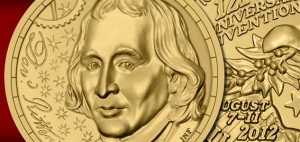
2012 World’s Fair of Money Medal
(image courtesy of the ANA)
While I do plan a few trips around the bourse floor, visit the exhibits, try to attend some of the Money Talks (formerly Numismatic Theater) session, and get a Rosie dollar autographed by Treasurer of the United States Rosie Rios, a good bit of the time you can find me either at the table for the Maryland State Numismatic Association (1159) or at the Gold and Silver Political Action Committee table (1155). I will be at the MSNA table Wednesday afternoon.
If you cannot make it to Philadelphia, you can follow me on Twitter (@coinsblog) and see what images I capture and pin to Pinterest. On Pinterest, I created a board for my images from the show. If I am not worn out, I will try to write about what I find here on the blog.
Whether you visit with me in Philadelphia (“On the whole, I would rather be in Philadelphia,” once quipped W.C. Fields) or follow online, it should be a fun week!
Stay tuned!
The story behind the 1792 Half Disme
Video courtesy of the ANA.
Review: The Official 2013 Blackbook Price Guide to United States Coins
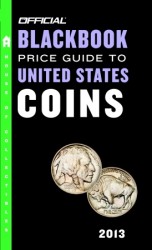 Regular readers know that I am an advocate of the electronic world, especially when it comes to references that should be available in a more portable manner than paper. While dead tree editions will continue to be produced, certain references deserve to be provided in electronic form for portability.
In the collecting world, price guides are great to have in electronic form. You can carry them on your smart phones or tablets when you go to shows to have some idea what your potential purchase is worth. Understand that printed price guides are not the best source for prices. Prices can change daily, even hourly depending on market conditions including the costs of metals. At least the price guides will provide a general idea of the item’s value.
Price guides have more value than the prices. Some have very good and even excellent numismatic information. We know about the usual suspects in this area, but a reference to look at is The Official 2013 Blackbook Price Guide to United States Coins. The Official Blackbook is now in its 51st Edition.
I was provided an electronic review copy by the publisher with the only condition that I write this review.
Starting with the format, I cannot argue with that it is available as an e-book and complies with the full EPUB standard where the contents work, is searchable, allows bookmarks, and works well even on the iPad’s pedantic e-reader. Because e-book readers do not handle tables well, they have to be embedded as images (EPUB 3, which is still in development, should change this). However, The Official Blackbook does it in a way that makes it easy to resize them on smaller devices like the iPhone.
E-book usability issues should not be taken lightly. It is easier for publishers to publish e-books as PDF files or using other tricks that does not take advantage of the electronic formats. House of Collectibles, an imprint of Random House Reference, should be commended for doing this right.
One nice feature added by the publisher is the “Fast-Find Coin Reference Index.” This is a list of coin types, like Colonial Coins, and the name of the coin (e.g., Brasher Doubloons) that are clickable links back to the text. My only complaint is that this is the last entry in the Table of Contents and could be missed by the reader. Even though it is toward the end, I would move the entry near the top because it is that useful.
As a price guide, it is as good as any on the market with multiple price points, showing the differences between types, and mintages for each year. The tables do carry over the check box from the print edition that could be used to mark coins owned, but that is of limited usefulness in the electronic version.
After the price guides are very useful chapters about the contents of U.S. coinage. The chapters, “Primary Metals,” the silver and gold coin value charts, and the weights and measures are very good references. While other books have them interspersed within their pages, I like having this information in their own chapters.
Each section starts with a 2-3 page description on each coin type noting history, major varieties, and some design information. Where there are interesting subtleties between types, the authors provide images for the reader as a reference. Some references do this inline with the price guide, I like the idea of showing the images first and leaving the price tables as clean as possible.
At some point, the authors need to consider updating some of the numismatic writing and think about how to make it a better reference than just a series of articles. For example, the chapter “Coin Auction Sales” needs to be updated to include how most auction houses now offer Internet bidding, some are exclusively Internet bidding, and that the section’s author, Q. David Bowers, has not worked at Bowers and Merena in quite some time—I believe it was 2003 when he sold is interest in the company which since 2010 has become part of Stack’s Bowers.
The chapter “Expert Tips on Buying and Selling Coins” has some good information but needs to be updated to include buying over the Internet, using online auctions, and to separate the section on grading. In fact, the section about grading could be greatly enhanced as a standalone chapter and provide a better service to readers.
One chapter that either has to be rewritten or deleted from future books is the “Mobile Computing…” chapter. Aside from being seriously out of date with today’s online and mobile world, it is heavily slanted to support the business model of section author’s company. While it would not be bad for the author to include a blurb about their company at the end of the chapter, the entire chapter reads like one of those worthless white papers that I receive from computer vendors on a daily basis.
The two chapters that make the book worth buying is are the chapters “Erros and Varieties” and “Civil War Tokens.” Both chapters are very well written, informative, and if you do not learn something from either chapter, then you are not reading carefully. Although the author is not listed with the chapter, Mike Ellis s listed as a contributor. For those who are unfamiliar with Ellis, he is currently the CONECA Vice President and a leading expert in variety and errors. Having heard him speak in the past, having this chapter written by him is a great addition to the book and worth reading.
I also thought the chapter “Civil War Tokens” by Dale H. Cade was phenomenal. I never really thought about Civil War Tokens and their impact on commerce because of the coin shortages, but it was a fascinating read. In fact, I am re-reading this chapter because I know I missed some things while reading it for this review. I know I will now look at Civil War tokens in a different light.
There are other areas like Civil War tokens that the authors/editors of the book should consider adding as well as other impacts on U.S. coinage.
The bottom line is that after 51 years, it may be time to find a new editor to update this book and make it more reflect modern references. It has some great information, some good information, some information that is just plain useless, and there is information that could be added to enhance the book. But the great really shines while the good needs a little updating to make it great. For these reasons, I give the book a grade of MS62 with hopes that the 52nd edition will be better. I think that a proper refresh could make The Official Blackbook rival its red-colored counterpart.
Baseball Hall of Fame Commemorative Now the Law
 The White House announced today that President Obama signed the National Baseball Hall of Fame Commemorative Coin Act into law (H.R. 2527). The law calls for the U.S. Mint to commemorate the the National Baseball Hall of Fame in Cooperstown, New York with a three-coin commemorative program consisting of a $5 gold coin (50,000 maximum mintage), $1 silver coin (400,000 maximum), and a clad half-dollar (750,000 maximum) struck as uncirculated coins or as proofs.
The bill requires an open competition for a common obverse design “emblematic of the game of baseball” with a $5,000 minimum prize for the winning design. The common reverse will “depict a baseball similar to those used by Major League Baseball.”
Surcharges will be $35 per gold coin, $10 per silver coin, and $5 for the clad half-dollar to be paid to the National Baseball Hall of Fame for their continuing operations. If all the coins sell out, the Hall of Fame will receive $9.5 million for ongoing operations.
The bill was sent to the White House on July 25, 2012 and was signed today.
National Baseball Hall of Fame logo courtesy of the National Baseball Hall of Fame.
Support the Coin Collectors Blog
 Buy me a coffee
Thank you for your support!
Let Me Know What You Think
Are you going to the World's Fair of Money
Total Voters: 17
 Loading ...