
Weekly World Numismatic News for May 3, 2020
 This past week has been interesting for the precious metals markets. When the market seems like it will take off, prices modulate and lay flatter than a pancake. Predictions as what the markets will do are all over the place without a consensus answer from analysts.
It reminds me of the quote attributed to President Harry S. Truman, “Give me a one-handed Economist. All my economists say; ‘on one hand…,’ then ‘but on the other….’”
This past week, the Anti-Counterfeiting Educational Foundation (ACEF) weighed in with another problem in this market: COUNTERFEITING!
Counterfeiting is not a new problem. What makes the problem more pronounced is that with much of the country staying home and Internet usage increasing, the number of websites trying to scam people out of money has risen. ACEF has been monitoring the problem and has reported over 100 websites selling counterfeit coins and bullion to government enforcement agencies.
Many of these counterfeiters create slick websites. Not only is it easy to create professional-looking sites with modern tools, but it is easy to copy information from one website to another. Once the scammer has the information they want, it is easy to repurpose it to scam people. They also copy the text from legitimate websites, especially if English is not their first language. It is easier to steal the text than have to create their own.
- If the price is too good to be true, it is probably a scam. Check a site like kitco.com for the current Bid/Sell price. If the offer price is below the current Bid, be wary of the seller.
- Many scammers do not include real information about their location. Beware of the seller if they do not have a physical address. I know that there are exclusively online dealers that work from home but use post office boxes, so they do not publicize their home address. For those dealers, you will have to do more investigations. However, if the dealer is using a private postal box, you may want to avoid their offers. Private postal box services have fewer verification checks than the Post Office. Also, if something happens with a Post Office Box, you will have a stronger case when you complain to the Postal Inspection Service.
- Nearly everything said about addresses can apply to telephone numbers. Telephone numbers can be faked, rerouted, sent to a pay-as-you-go phone that some people call a “burner phone,” and so many more options. The problem also exists for toll-free telephone numbers but with an additional issue: when you call a toll-free telephone number, the owner of the number will get the phone number of the telephone you used to call. Since the recipient is paying for the call, they have the right to know where the call originated.
“But Scott,” you ask. “How do I figure out if this information is real?”
Let your favorite search engine be your friend.
Use your favorite search engine and type the address into the search bar. What information comes up for that address? Is the address a business? A private home? A private mailbox service?
Use an online map service that shows street views, like Google Maps. Search for the address found on the website. What can you learn from looking at the street view?
You can also enter the telephone number as a search term. In many cases, you will find one of the many “is it a scam” websites. These sites rely on users to enter data about their experiences with the telephone number. Click on a few to see what others have said about the telephone number in question.
With those essential tools, you should be able to avoid most scammers. Unfortunately, the professional scammers know their way around these issues. Then again, some of those scammers work out in the open. They run legally but use emotion, patriotic-sounding buzzwords, and extremist rhetoric to convince buyers to overpay for their products.
If you think you have been scammed or there is a question about a dealer, contact the ACEF (www.acefonline.org) and ask for assistance.
Finally, if you are in the market to buy precious metals, you should consider working with a member of the Accredited Precious Metals Dealer program (www.APMDdealers.org).
And now the news…
 April 27, 2020
 → Read more at bloomberg.com
April 29, 2020 → Read more at newzhook.com
April 29, 2020 → Read more at finance.yahoo.com
May 1, 2020 → Read more at moneyweek.com
→ Read more at bloomberg.com
April 29, 2020 → Read more at newzhook.com
April 29, 2020 → Read more at finance.yahoo.com
May 1, 2020 → Read more at moneyweek.com
EyeNote: Identify US Notes Using Your iPhone
 The Bureau of Engraving and Printing will announce today that they have developed EyeNote,™ an app for iOS devices (iPhone, iPod Touch, iPad) that will help the assist the blind and visually impaired determine the value of the U.S. currency they are holding.
According to the press release received this morning, EyeNote uses image recognition technology to determine a note’s denomination. The mobile device’s camera requires 51 percent of a note’s scanned image, front or back, to process. In a matter of seconds, EyeNote can provide an audible or vibrating response, and can denominate all Federal Reserve notes issued since 1996. The app will be updated as new notes are issued.
“Research indicates that more than 100,000 blind and visually impaired individuals currently own an Apple iPhone,” according to the BEP.
The EyeNote app is one of a variety of measures the government is working to deploy to assist the visually impaired community to denominate currency, as proposed in a recent Federal Register notice. These measures include implementing a Currency Reader Program whereby a United States resident, who is blind or visually impaired, may obtain a coupon that can be applied toward the purchase of a device to denominate United States currency; continuing to add large high contrast numerals and different background colors to redesigned currency; and, raised tactile features may be added to redesigned currency, which would provide users with a means of identifying each denomination via touch.
The app is only available for iOS devices. According to a representative from the BEP, “Future phone offerings cannot be definitely specified at this time, but there are tentative thoughts to make EyeNote available on other phones from other vendors once the iOS effort is launched.”
REVIEW After downloading the free app from the iTunes App Store, it was installed on my iPhone and I tried it. I had two notes nearby, a $20 note and a torn $1 note. When the app starts, there is a page with brief instructions. Interestingly, for an app that is supposed to help the visually impaired, the instruction text is a bit small that cannot be expanded using the iPhone pinch motion. For those who cannot read it, it says:
Tap to begin. After beep, steady note 6 to 8 inches in front of the camera. Tap; shutter clicks; await result. Double tap to replay. Swipe left of right for spoken or privacy mode. In Voice OVer, single tap is double; double tap is triple. Switch out of VoiceOver to change spoken of privacy…
It seems the BEP needs to fix the grammar a bit.
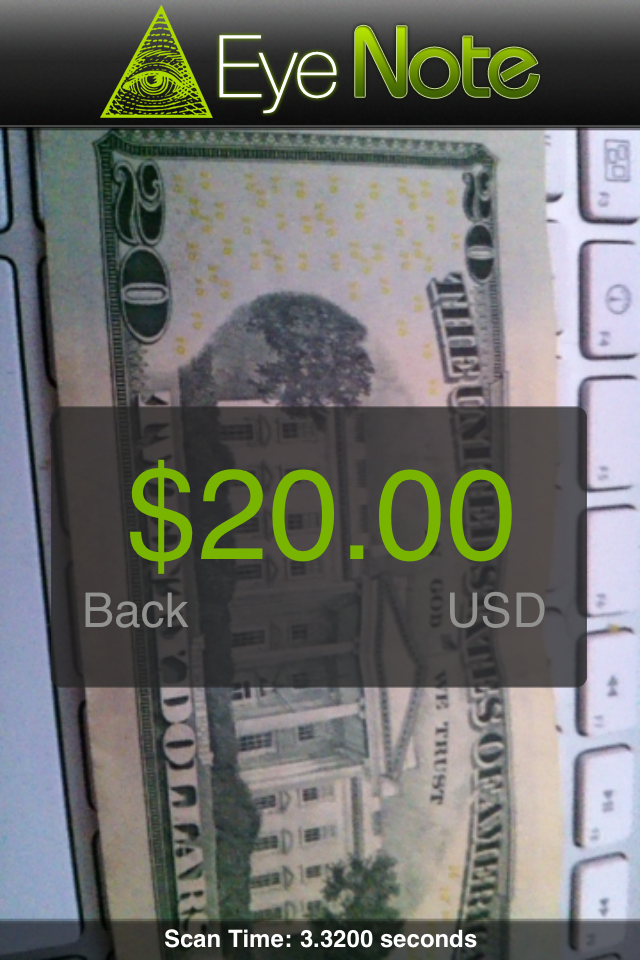 On my iPhone 4, the LED flash was turned on, I positioned a $20 note reverse in front of the camera, tapped the display, and the camera sound played as it took the picture. After a few seconds, a woman’s voice told me that it saw the back of the $20 note. I found a $10 and $50 note. Both were identified on both sides with no problems.
 After passing those tests, I tried the only $1 note I had: one that was used as a chew toy by one of my dogs. No matter how I positioned the camera, the app could not identify the note. While the app is impressive it would have been amazing if the app could have identified my torn note!
It is very rare that an app’s first release is as impressive as EyeNote. However, it is not perfect. The opening screen needs to either have a voice over or larger text. The instruction text needs work and the controls need to be better explained. I grade this app MS68+*. Yes, it gets the plus rating for being excellent in what it does and the star because once you figure out the controls, it has great eye appeal. I am very impressed with the effort. I hope the BEP fixes the issues I found.
Click on any picture to see a larger version. Use your browser’s back button to return to the blog page.
Should The US Stop Producing $100 Notes?
Should the United States stop producing $100 bills? According to Timothy Noah, a senior writer at Slate and contributor to CBS Sunday Morning, thinks so. Here is the report that Noah filed for CBS Sunday morning on April 3, 2011:
While a compelling argument but it is not a viable one. Because the U.S. Dollar is the most stable currency even considering our current economic situation, $100 notes will be hoarded overseas and will continued to be counterfeited. It has been reported that rogue nation states like North Korea have successfully counterfeited the $100 note which is why the Bureau of Engraving and Printing is working on its redesign. Having these note continue in circulation could endanger the U.S.
Further, it is doubtful the European Union will discontinue the $euro;500 note even though it is nicknamed “the Bin Laden.” The EU central bank would love to have the euro become the standard currency, the currency all economies are based. It would give more clout in the world markets and provide more incentives for the EU bankers to convince the worldwide commodity markets to price their goods and trade in euros, not dollars.
It is a different world from 1969 when the U.S. government ceased production of the $500 note. Between new counterfeiting measures and the technology to better investigate criminals, the U.S. Secret Service is better able to bring counterfeiters to justice and work with other law enforcement organizations to stop criminals. It is not a perfect system, but making any move that could lower the U.S.’s financial status with the rest of the world will not be well received in Washington.
The E-Sylum App
 Speaking of apps, The Numismatic Bibliomania Society has created an app for its electronic newsletter, The E-Sylum.
For those who have not heard of The Numismatic Bibliomania Society, NBS promotes the use and collection of all types of numismatic literature. The E-Sylum is their weekly electronic newsletter sent to email subscribers interested in numismatic literature and other topics of interest. It can be best described as eclectic with news, reviews, interesting numismatic tidbits, and discussions from a broad range of numismatists, authors, and collectors. It is worth subscribing or reading the issues on line.
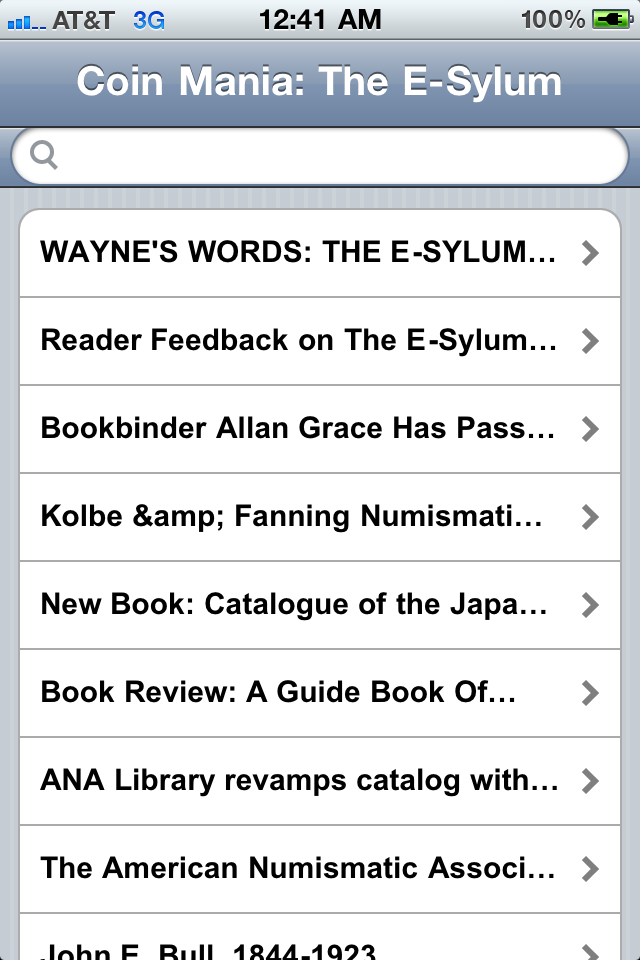 While catching up with reading back issues, I found the announcement and immediately downloaded the free app from iTunes App Store. After a quick sync, the application was on my iPhone and ready to use.
As with many apps, it opens with a splash screen with the NBS logo. After a few seconds, the app presents a list of articles from the most recent edition. So far so good as I tapped on the entry for the reader feedback on the app. I was then presented a page with the title of the article and a link that says “Read More.” I am not sure why the app does this. It should open the page with the text of the story. For me, this type of interface tends to become monotonous and turns me off to the app.
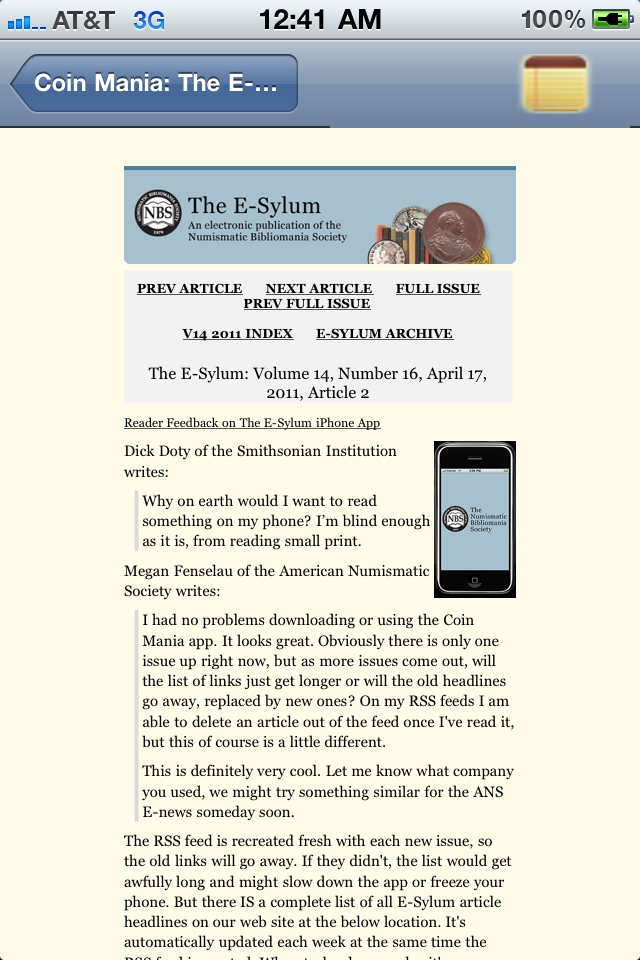 After pressing “Read More” I open up the web page from the NBS site with the story. The problem with this is that the article’s formatting is for a webpage to be read on the computer. This makes the text smaller and requires additional manual manipulation in order to read the article. I know it is possible for a website to tell what type of device is reading it. NBS should consider updating the style of the page to display better for the smaller phone screen when being read by the app.
Another element I found curious is that the upper-left corner of the reading pane has what looks like a Notepad icon. I was not sure what it did so I pressed it. The article pane slid over revealing a light blue page with “Back” and “Save” buttons at the top of the screen. I am not sure what this does, but the screen stays blue and the “Save” button does not seem to do anything. At least the “Back” button slides the reading pane back into view.
I asked The E-Sylum editor Wayne Homren for his comment about my review. Wayne said, “I had a company plug our feed into one of their standard app configurations and publish it. I agree that the navigation could be (greatly!) improved. My goal would be to have an app that works more like The New York Times app I use every day, with an easy way to flick from story to story with a swipe of your finger.” It has the feel of a first version (“1.0”) app.
I really wanted to like this app but these issues may prevent me from using it on a regular basis. I hope that these issues will be fixed in a future release. Right now, I would give the app a grade of AU-58, just short of being mint state because of that blue screen that does not seem to do anything. I hope that NBS fixes the app because I really want to like it!
Here are the screen images of the app I saved from my iPhone:


Coin World Is Now Digital
 Coin World has announced the available of their app for the iPad. “The free app offers rich content such as the News and Marketplace features that are available at Coin World’s website.” The app is free and can be downloaded from Apple’s iTunes App Store.
As part of the release, Coin World announced that Coin Values and Making the Grade are available as an in-app purchase. Coin Values, sometimes referred to as “Trends,” is their comprehensive value guide of more than 65,000 U.S. coins. It will cost $4.99 to purchase in the app. At this time, it may be the only price guide for mobile platforms.
Making the Grade is the electronic version of their popular grading guide book. It provides color image grading for 50 of the most widely collected U.S. coin series. The app leverages the iPad capabilities to zoom in on the images and adds the information about wearing for a coin. The book lists for $39.99 but will sell for $9.99 as an in-app purchase.
The Coin World app is only available for the iPad leaving those of us with only an iPhone out. iPhone users can download the PCGS Photograde app for the iPhone. Hopefully, Coin World will port this app to be used by the iPhone.
I will review the app when I purchase an iPad.
Book Review: Coins: Questions & Answers
 Recently, I was sent a copy of Coins: Questions & Answers, Fifth Edition, by Cliff Mishler. Mishler is the current president of the American Numismatic Association.
Coins: Questions & Answers can best be described as a Frequently Asked Questions (FAQ) of coins with sections for paper money, Civil War era money whose section is entitled “Money of the War Between the States,” exonumia, and foreign coins. Each section covers the questions every collector should know about and even bring tidbits that escape even the most seasoned collected. For example, I learned that the word “Liberty” has been used on every coin except the Flying Eagle Cent and the Shield Nickel. It was thought the eagle and the union shield would satisfy the requirement.
For each coin type, the book seem to cover the basic information and some other fun facts about U.S. coins, including my favorite: which is the only coin with the portrait of the same person on the obverse and reverse? If you did not answer the Lincoln Memorial Cent, last struck in 2008, then maybe you should pick up a copy of the book!
One area that the book falls short is in the sections after the coins. There is a history of currency and questions I have seen on public forums that are not covered in this book. Some of the questions that are in the FAQ Library one the Bureau of Engraving and Printing website has some additional items that should appear in the book. One question that I people send me is what all the elements are on the U.S. Federal Reserve Note. These are not intuitive elements and I even forgot what each means (I use this page). An idea would be to produce a similar book for currency, separate from the coins.
Other sections do have enough information for a general purpose book. I am sure that there will be collectors looking for the more information on those topics. For those, Whitman does point to other books in its collation for more information. While they do this for the currency section, I think that currency is more mainstream that expanding this section would make the book more complete.
My one complaint is that the book does not have an index. While the reader can find the general area of their question using the table of contents, it would make a better reference if it included a fully referenced index.
Coins: Questions & Answers should not be your only reference, especially without an index, but it should be one of the books on your shelf. The answers are clear, concise, and those that require more than a paragraph are well written. For this book, I grade it MS66* giving points off for not having an index and the need to beef up the currency section. But like any coin with a star grade, it has good eye appeal and worth adding to your collection.
Book image courtesy of Whitman Publishing.
Support the Coin Collectors Blog
 Buy me a coffee
Thank you for your support!
Let Me Know What You Think
Are you going to the World's Fair of Money
Total Voters: 17
 Loading ...