
Weekly World Numismatic News for January 19, 2020
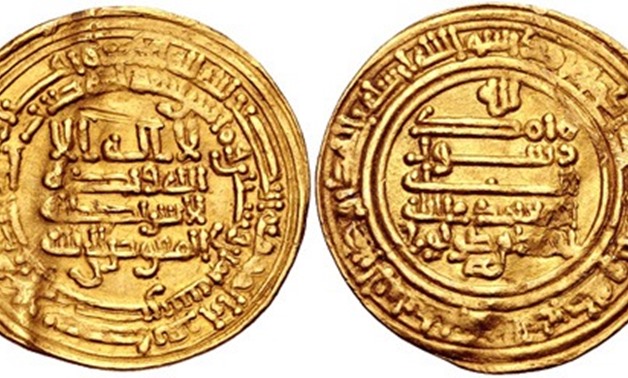
Abbasid coins of the late ninth century
(via Egypt Today)
The Ottoman Empire was the last of the significant conquering empires of Europe. By the late 19th century, modernization and uprisings forced the Empire to consolidate around the area of modern-day Turkey and the Middle East. Even though the Empire was declining, that did not stop the government from trying to exert influence.
After Great Britain left Egypt in 1914, the Ottomans stepped in and demanded Egypt pay tribute in the form of gold coin to the Empire. After the fall of the Empire and the formation of modern-day Turkey, they continued to demand tribute. Egypt stopped paying the tribute on the establishment of the Republic in 1953.
The lawsuit claims that the Ottomans and Turkey illegally removed the coins from Egypt and demands their return.
In one report, the brief cites the provisions of the UNESCO convention as authority for demanding their return by declaring the coins as cultural property.
If allowed through their courts and if the suit is successful, it becomes precedent for Egypt to claim any item as cultural property and demand their return. Aside from coins, exhibits at museums around the world would have to prepare for similar requests. In the United States, the Brooklyn Museum has one of the most extensive Egyptology collection in North America. Their holding is second to the British Museum, who will also face the same questions.
Ancient Egypt did not have a monetary system as we know it today. Since they did not have silver mines and gold was scarce, they traded goods and services. Taxes were paid by people providing products or working for the government.
There are known bronze coins from early periods, but several references noted that they were used for a limited amount of trade.
The first known coins of Egypt came during the Ptolemaic Empire of ancient Greece. By that time, the Egyptian Empire moved up the Nile River from the area near modern Cairo to modern-day Alexandria. As a weakened Empire, Ptolemy I was able to conquer these areas of the Middle East following the death of Alexander the Great.
It was a time of great fortune that included education, the arts, and modernization of the old Egyptian Empire. Silver and gold were brought as the economy soared. Ptolemaic coins are considered Greek coins for many collectors of ancient coinage.
Those who enjoy collection ancient coins should carefully watch this case as it winds through the Egyptian courts. The wrong outcome will affect collectors and be another attack on the hobby.
And now the news…
 January 13, 2020
 → Read more at frbatlanta.org
January 15, 2020 → Read more at romania-insider.com
January 15, 2020 → Read more at ottawacitizen.com
January 16, 2020 → Read more at cbc.ca
January 18, 2020 → Read more at cnn.com
January 18, 2020 → Read more at egypttoday.com
January 19, 2020 → Read more at dailyrecord.co.uk
→ Read more at frbatlanta.org
January 15, 2020 → Read more at romania-insider.com
January 15, 2020 → Read more at ottawacitizen.com
January 16, 2020 → Read more at cbc.ca
January 18, 2020 → Read more at cnn.com
January 18, 2020 → Read more at egypttoday.com
January 19, 2020 → Read more at dailyrecord.co.uk
Admin Note on Comments and Advertising
Over the last few weeks some people have been trying to leave comments containing links to commercial web sites. In the blogging world, comments thinly disguised as advertisements are called “comment spam.” I have also received criticism for configuring this blog to moderate comments and requiring the entry of a captcha. Unfortunately, when I turn off the captcha requirement the blog is inundated with automated comment attempts from Asia—I think they are written in Chinese. I was deleting 5-10 of these messages daily.
I hate to place restrictions on posting comments because I want to know what you have to say. But I have to prevent the blog from becoming an place for spam. Therefore, I will keep the moderation and captcha policies in place. I will continue to allow anonymous comments but reserve the option to disallow them if they contain inappropriate material. All comments that contains a link, reference, or a URL to a commercial-related web site will be rejected regardless of how cogent it may be.
Rather than trying to fight comment spam, I decided to accept a limited amount of advertisement. It is my intention to make the advertising visible, but not intrusive to my readers. Therefore, if you want to advertise on this blog, the terms are as follows:
| Advertisement Type | Format | Costs for Six Months | Additional Information |
|---|---|---|---|
| Text Link | 14 point, 140 displayed characters | $25.00 | Formatting options include changing font (serif or sans-serif), changing font color, and adding a background color. Add any or all options for a flat $5 fee. |
| Display Advertisement | 225 × 225 pixels | $50.00 | No annimated GIFs. Width is a fixed size. Height longer than 225 pixels but not longer than 450 pixels will be an extra $50. |
| Banner Advertisement | 650 × 90 pixels | $200.00 | I will only accept one banner ad that will appear at the top of the text column. No annimated GIFs. |
My common sense conditions are as follows:
- All advertisements must be related to numismatics.
- Advertisements for bullion and related products will be accepted.
- Advertisements for multi-level marketing schemes will not be accepted.
- Advertisements will be added to the blog template and will appear on every page. As I write this there are over 560 blog entries.
- The number of readers of this blog can be found in the widget on the left column under the title “RSS Feeds.” Google’s AdSense reports 75-100 more readers than the widget. The RSS widget counts access through the RSS feed and the AdSense service counts impressions of the AdSense banner in the right column.
- All advertisements must be paid for in advance using PayPal (account information will be provided to advertisers).
- Any dispute filed with PayPal will result in immediate cancellation of your current and future advertisement. Rather, contact me first and we can discuss any issues like reasonable adults.
- Advertisements will appear for six months and are renewable.
- Advertisements may be cancelled on request of the advertiser or if multiple users complain. Don’t worry, I will discuss the complaints with you before taking action.
- There will be no refunds for early cancellations.
- I reserve the right to reject any advertisement for any reason.
- If there are content-related issues, I will request changes to make it acceptable for posting.
- Advertisement space will be limited. The limit will be based on size and my discression.
- Advertising on this site does not imply endorsement of your product or service.
If this is acceptable then please contact me via email to discuss your advertisement. Thank you.
A Note About This Blog
The Coin Collectors Blog is a labor of love. I love numismatics. I love to collect various numismatic items. I love to write and I love to write about what I do numismatically. Entries on this blog range from my experiences, to news about numismatics, to my opinions. It is one person speaking from one corner of the numismatic world.
In real life, I am an expert in information security which I use to help the federal government keep their systems safe. It is a difficult job but gratifying when the systems I work on are hardened to prevent the issues you might have read about in the newspapers. I have been working professionally with computers for over 30 years and spanned quite a bit of interesting computer history—but that will be the topic of another blog (stay tuned). Numismatics and learning about numismatics is an enjoyable hobby that I used to escape from the bits and bytes of my working life.
Recently, someone came across my July 22, 2008 post Paper v. Coin Dollars where I make the case for the US to cease production of the paper $1 federal reserve note. The reader did not like what I said and posted an anonymous comment that began “The whole dollar coin scheme is a leftist globalist scheme anyway.”
Excuse me? If this commenter thought that post was leftist, I wonder what that person would think of my Reforming America’s Currency series?
The posts I make to this blog are purposely non-political. Everything I write on this blog are either reporting the news or observations. Editorial content has no political slant or agenda. It is what I feel is the best for the hobby and country.
I do not mind if readers disagree with me. In fact, I would love to hear from more people who disagree with me because it provides a different point of view that I can learn from. But please do not accuse me of having a political agenda because my only agenda on this blog is numismatics.
Kicking off 2010
The start of the new year was met with a lot of work. While I should be happy to be busy, I would like some time to continue to write this blog. It is relaxing and I enjoy sharing my numismatic experience, thoughts, and other stories with my readers. I thank you for reading and hope to pick up the pace on my writing soon.
For now, here are a few short items that have been on my mind.
Starting the last week of the year, I have been seeing more of the 2009 Lincoln Bicentennial Cent in circulation, particularly the Formative Years or Log Splitter cents. During one shopping trip, a cashier opened a new roll of cents and included three new Log Splitter cents in my change.
I have also been seeing a few of the DC and Territories Quarters. Most of the quarters I have received in changed honor The Northern Mariana Islands. Its distinctive latte stone makes it very distinctive to notice at a glance. Interestingly, I have yet to receive a DC Quarter in change from stores in the DC area.
 The US Mint has released the new Native American $1 Coin. This year’s theme is “Government–The Great Tree of Peace” featuring five bound arrows and the Hiawatha Belt. The design looks much better in hand than in the images I have seen, even those from the US Mint. It must be the gold color of the manganese, but the design seems to have a bold yet artistic feel that the US Mint should consider submitting for the next Coin of the Year competition.
Over the past few weeks I have read a few interesting numismatic books that I would like to report on. One of those books is Fascinating Facts, Mysteries & Myths About U.S. Coins by Robert R. Van Ryzin. I thought it was pretty good book but I have a caveat that I will report on in the near future.
It seems that numismatics is one of the last industries to fully embrace technology. There have been some advancements that I want to talk about. One of them are the electronic books by Krause Publications. Whether you download their information or purchase a CD or DVD of their books, the people at Krause have taken an interesting step into electronic publishing. Also, some have also embraced the iPhone as a platform for bringing numismatic information to the masses. I recently downloaded a numismatic-related iPhone application that I will write about after I crash it a few times!
As an aside, I am going to use my new 27-inch iMac to write a few iPhone applications of my own. Stanford University has a course teaching how to program the iPhone. The course is available through the iTunes store and sample code from the course’s website. I hope to use what I learn to create my own apps. I also hope that other readers who have a technical background and access to an Intel-based Mac to follow along with the course and create other apps for numismatists.
I hope everyone had a good holiday season. Now let’s get to collecting!
It’s 2010!
As 2009 turns into 2010, we should look forward to better times for the hobby, our nation, and the world. I wish you and yours a Happy and Healthy 2010 and hope that you find the key coin of your dreams!
What is in that Gold
On the NGC Forums, there was a discussion about collecting gold dollars where someone asked about their composition. Being curious, I looked up the composition information. What I found was that there were different compositions that was tied to the evolution of US coinage.
After posting the basic information, I thought it would be interesting to look up which series of gold coins were made from each of the different compositions. The rest of this posting is what I found after consulting a few references.
The Coinage Act of 1792, the First Coinage Act, set the standard for gold coinage to be .9167 fine with the balance of silver and copper. Gold coins struck 1792-1834 were made of this composition. These coins include:
- Turban Head $2½ Quarter Eagles (1796-1807)
- Capped Bust $2½ Quarter Eagles (1808-1834)
- Capped Bust to the Right $5 Half Eagles (1795-1807)
- Capped Bust to the Left $5 Half Eagles (1807-1812)
- Capped Head to the Left $5 Half Eagles (1813-1834)
- Capped Head to the Right $10 Eagles (1795-1804)
The Coinage Act of 1834, the Second Coinage Act, set the price of gold at $20.67 and changed the composition to .8992 fine with the balance of silver and copper. Gold coins struck from 1834-1839 were made of this composition. These coins include:
- Classic Head $2½ Quarter Eagles (1834-1939)
- Classic Head $5 Half Eagles (1834-1838)
The Coinage Act of 1837, also called the Bland-Allison Act, put the US on a bimetal monetary standard mostly to help the silver industry following the Panic of 1873. Originally, President Rutherford B. Hayes vetoed the bill only to have congress override the veto. Gold coins struck from 1839-1933 were made of .9000 gold and the balance was silver and copper. These coins include:
- Liberty Head One Dollar (1859-1854)
- Indian Princess Dollar (1854-1889)
- Liberty Head $2½ Quarter Eagles (1840-1907)
- Indian Head $2½ Quarter Eagles (1908-1929)
- Indian Princess 3 Dollars (1854-1899)
- Liberty Head $5 Half Eagles (1839-1908)
- Indian Head $5 Half Eagles (1908-1929)
- Liberty Head, No Motto Above Eagle $10 Eagles (1838-1866)
- Liberty Head, Motto Above Eagle $10 Eagles (1866-1907)
- Indian Head $10 Eagles (1907-1933)
- Liberty Head $20 Double Eagles (1849-1907)
- Saint-Gaudens $20 Double Eagles (1907-1933)
All gold commemoratives, both prior to 1933 and since 1982, are struck using .9000 gold. Commemorative struck before 1933 was filled with 1-part silver and 2-parts copper. Commemorative coins struck since 1982 use a 2-part copper to 1-part nickel filler.
The $4 Stella patterns were an attempt to create a standard coinage composition for international trade. The composition called goloid was made of 6 grams of gold, 0.3 grams of silver, 0.7 grams of copper. A Flowing Hair and Coiled Hair Liberty Head patterns were struck in 1879 and 1880.
American Gold Eagle bullion and proof coins are .9167 gold (22 carat). The one ounce gold Eagle contains one troy ounce of gold plus .0909 troy ounces of filler consisting of 2-parts nickel to 1-part copper.
The American Buffalo gold coin contains one troy ounce of .9999 fine gold (24 carat) with copper as the filler.
I hope someone finds this useful.
Support the Coin Collectors Blog
 Buy me a coffee
Thank you for your support!
Let Me Know What You Think
Are you going to the World's Fair of Money
Total Voters: 17
 Loading ...