
Weekly World Numismatic News for May 5, 2019
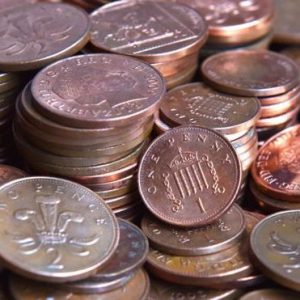 In midst of the growing sentiment to rid society of low denomination coins, Britain’s Chancellor of the Exchequer Philip Hammond announced that that the country will continue to produce 1 penny and 2 pence coins.
A study by the British Treasure estimates that 2.2 million people in the U.K. continue to rely on cash for daily commerce. An independent report in the U.K. estimated that more than 8 million people rely mostly on cash. That review concluded, “Poverty is the biggest indicator of cash dependency, not age.”
It is the same argument that is presented in the United States when discussing cash versus electronic payments. Those that would be hurt the most by moving to a cashless society would be the poor, elderly, anyone of modest means, and rural communities. Areas that are not as well served by technology, even in eastern states, will be hurt by the move to a cashless payment model.
Another difference between the United Kingdom and every other country versus the United States is that every other country is not afraid to make changes to protect its change. Countries around the world make a change to their coinage without everyone going into a panic. Although the British went through a row when converting from the round pound to the new 12-sided coin, they forged through the process. Even the mention of a potential change in the composition of U.S. coinage leads to predictions of economic doom and gloom for many sectors of the economy.
The last I looked, the U.K., Canada, and the entire European Union made significant changes in their circulating coinage in the previous 20 years that has not caused a disaster. Change seems to scare many Americans who will do anything to hold on to the past no matter how much it hurts to maintain the status quo. You can look no further than the fuzzy math produced by the Government Accountability Office whose report on the coin versus paper money is an exercise in proving “Figures will not lie, but liars figure.”
And now the news…
 May 2, 2019
Turkish security forces confiscated more than 2,500 Roman and Hellenistic-era coins along with several other historical artifacts in an anti-smuggling…  → Read more at dailysabah.com
May 5, 2019COLUMBUS — The latest budget plan unveiled by Ohio House Republicans would kill a sales tax exemption for investments in coins and precious metal bullion … → Read more at toledoblade.com
May 5, 2019The Treasury decides to continue with copper coins and sets a plan to ensure people have access to cash. → Read more at bbc.com
COMMENTARY: Manley v. Kagin
Numismatic publications have been writing about the case of Dwight N. Manley versus Donald Kagin. Manley is a sports agent who represents big-name NBA players is also a rare coin collector and investor. Manley is a major benefactor of the ANA. Manley accused Kagin of trying to broker a deal that involved a rare Blake & Company gold assay bar that was recovered from the S. S. Central America that was stolen from Manley’s home. Manley claims that Kagin knew the bar was stolen and failed to help in its recovery. Manley filed the complaint to have Kagin dismissed from the ANA for violating the ANA’s Code of Ethics.
Kagin runs the family’s firm in Tiburon, California. Kagin holds a Ph. D. in numismatics and is a member of the ANA Board of Governors. He asserts that the bar was not reported as stolen and when he was informed that it was stolen, he worked with Manley and the police to have the thief arrested. A public hearing was held on May 29, 2007, at the Long Beach Coin Expo.
The ANA released their findings the next day taking no action against Kagin but suggesting that he consider performing a bit more due diligence on future transactions. The following day, Manley’s attorney said that his client is considering further actions against Kagin.
Of all the evidence presented at the hearing was the one that said the bar was not reported stolen. Kagin claimed that he checked whether the bar was stolen through some sources, but did not find any information. Manley claims that Kagin knew Manley was the anonymous purchaser of the bar at an auction in 2000. He said that he sold many of the bars and has sold the bar in question shortly after its recovery.
So let me get this straight… Manley sold some of the bars, did not report that this bar was stolen, and expected Kagin to know that Manley still owned this bar that was bought six years prior? I do not understand Manley’s logic. Without a report that the bar was stolen, how was Kagin supposed to know?
The numismatic value of the Blake & Company gold assay bar has increased along with the price of gold. If Manley subsequently sold the bar at a higher price than it would have sold earlier, Manley was not what the lawyers call “injured” in this action. Manley probably benefited by the delayed sale.
By Manley and his attorney, Christopher L. Pitet, considering “further action” suggests that Manley does not respect the Code of Ethics that he accuses Kagin of violating. By continuing to pursue actions against Kagin, Manley is attempting to “impair the prestige of the membership therein.” Manley must “base all of [his] dealings on the highest plane of justice, fairness and morality, and to refrain from making false statements as to the condition of a coin or as to any other matter” as prescribed by the ANA bylaws.
I am not defending Kagin, but unless Manley can show that he was injured in any way by Kagin, which the ANA Board of Governors said he was not, then Manley should be thankful that his property was returned and move on. Going further will only injure Manley’s reputation with the ANA membership. Or as we said when I was younger: GET OVER IT!
Coin of the Month: 1915 Pan-Pac $50 Commem
Every month, the US Mint’s History In your Pocket (H.I.P) program chooses one coin to feature and provides education materials for teachers to use in teaching history using numismatics. This month’s coin is the 1915 Panama-Pacific $50 commemorative coin.

 Minted to commemorate the 1915 Panama-Pacific Exposition in San Francisco that celebrated the opening of the Panama Canal and rebuilding of San Francisco following the Great Earthquake of 1906. The Mint created five different commemoratives for the exposition including an octagonal gold coin with a $50 face value. Its unusual shape makes it intriguing.
Robert Aitken, a New York artist born in San Francisco, was selected to design the fifty dollar round and octagonal coins. The obverse is based on the Roman goddess Minerva and an owl on the reverse to symbolize wisdom. Although the coin was ridiculed as not having American symbols. But the designs are well executed and appreciated by collectors today.
Happy 90th Mr. Kennedy
As our 35th President, John Fitzgerald Kennedy became the youngest person to ever be elected as President and the first Roman Catholic. At 43, Kennedy was the promise of a new future; a new vision that would have the United States leading the world in fighting the “common enemies of man: tyranny, poverty, disease, and war itself.” In his inaugural address, he called the nation to arm when he said, “ Ask not what your country can do for you, ask what you can do for your country.”
From standing up to the Soviet Union’s Nikita Khrushchev, to the success of the Cuban Missile Crisis, to the failures of the Bay of Pigs, the starting of the Peace Corps, and challenging the United States’ resolve using the space program by proclaiming, “We choose to go to the Moon in this decade and do the other things, not because they are easy, but because they are hard.” In over two years, Kennedy made an impact on this country in such a short period of time that one can wonder what would had happened if….
 A few days after Kennedy’s assassination on November 22, 1963, US Mint Director Eva Adams, Chief Engraver Gilroy Roberts reported that there was discussions about putting Kennedy’s portrait on a silver coin. Since Jacqueline Kennedy did not want to replace Washington’s portrait on the quarter, it was decided to use the half-dollar. Roberts used models from the inaugural medal for the obverse design and Assistant Engraver Frank Gasparro prepared the reverse design using the Presidential Seal.
Since the law stated that coinage design could not be changed more often than 25 years, and that the Franklin Half was only 15 years old, it required Congress to authorize the change. The Act of December 30, 1963 allowed the design to be changed.
When the coin was released in 1964, the 90-percent silver coin was saved by a grieving nation wanting something that represented the fallen President. Over 273 million coins were struck in Philadelphia and 156 million in Denver. The composition was changed in 1965 with the introduction of clad coinage. Half dollars consisted of 40-percent silver that included a core made from 79-percent copper and 21-percent silver. In 1971, the composition was changed to current copper-nickel clad that is in use today.
 There has been one design change to the coin and that occurred in 1975 and 1976 in honor of the American Revolution Bicentennial. A special reverse depicting Independence Hall in Philadelphia was designed by Seth G. Huntington. For both years, the obverse featured the dual date 1776-1976 in celebration.
On what would have been Kennedy’s 90th birthday, we salute this great president with the coin minted in his honor. Happy Birthday, Mr. President from a grateful nation.
150 Years of Small Change
People lined the streets in front of the Philadelphia Mint on May 25, 1857 so that they can trade their foreign coins for newly minted Flying Eagle small cents. The scene must have pleased Mint Director James Ross Snowden, whose push for the coinage law passed by congress on February 21, 1857 allowed him to drive out all foreign coins from circulation.
When Snowden became Mint Director in 1853, he was faced with the issue that the price of copper and the increasing labor costs were making the large cent uneconomical to make. Snowden also knew that for the nation to continue to thrive, the lower denomination foreign coins that were still being used in the United States had to be removed from the economy. Aside from the large cent not being popular with the public, Snowden also believed that the value of subsidiary coinage can be based on trusting the government as the issuing authority and not necessarily the intrinsic value of the metals used.
 Snowden tasked James B. Longacre with designing a smaller coin to replace the large cent. Longacre borrowed the Christian Gobrecht/Titian Peale design that was used on pattern dollars twenty years earlier to create a unique obverse. For the reverse, Longacre adapted the wreath he made for the 1854 one and three dollar gold coins. Snowden ordered 1,000 of these 1856 Flying Eagle Cents to struck in order to distribute to congress and other politicians as part of his lobbying effort to allow for their regular production.

 At least 634 of these pattern coins were distributed amongst official Washington. Although many of the politicians liked the coins, it did not produce immediate action. Snowden continued to lobby congress for the new coin and the demonetization of foreign coins circulating in the United States until the coinage law was passed.
Without waiting for the bill to be singed by President Franklin Pierce, Snowden ordered news dies to be made and a large number of coins to be struck. Although the exact number ordered is lost to history, it is estimated that between two or three million Flying Eagle cents were struck.
On May 25, 1857, the Mint constructed temporary wooden teller windows to trade the new cents for subsidiary foreign coins that were demonetized by the new law. The new coins were a success and the Mint went on to strike over 42 million of these coins driving all demonetized foreign coinage out of the market.
Longacre’s design was difficult to strike because of the relief and the placement of the eagle over the reverse elements. So the Flying Eagle design lasted two years with attempts at a die change in 1858. Snowden changed the design in 1859 to the Indian Head cent claiming the relief was too high and the design was not accepted by the public. Although the explanation has been disputed, Snowden was successful with introducing a coin that was accepted by the public and driving out foreign coins—150 years ago today.
Longacre portrait courtesy of uspatterns.com
A Little Educational Fun
Yes, I know the John Adams Dollar was released this week. But Real Life™ got in the way and I was not able to go downtown Washington to buy first day of issue coins. For now, I will by pass talk of the Adams Dollar in favor of some fun.
The Futures Channel is an online video service that creates multimedia content to bridge the gap between the Real World™ and the subjects students are learning in school. It is a great idea with interesting results. Two videos that I thought would be of interest to numismatists, collectors, and hobbyists are First American Coins and Printing Money.
Although First American Coins does not mention where it was taped, there are mentions of the ANA World’s Fair of Money that was held in Denver the Summer of 2006. Amongst the video’s vignettes is a picture and discussion of the Brasher Doubloon as the first US gold coin and the half dismes as the first silver coins made from George and Martha Washington’s silver.
Printing Money also has images from the ANA World’s Fair of Money in 2006, but also has what appears to be stock footage that is rumored to have been provided by the Bureau of Engraving and Printing. Still, it is an interesting video.
Both videos make an attempt to tie the content back to mathematics in order to provide benefits for the students. For the rest of us, it just interesting.
Support the Coin Collectors Blog
 Buy me a coffee
Thank you for your support!
Let Me Know What You Think
Are you going to the World's Fair of Money
Total Voters: 17
 Loading ...