When I returned to the hobby, the first show I attended was the Baltimore Coin Show. Back then, it was privately run by an area dealer who grew the show to something that required a facility the size of the Baltimore Convention Center to hold for a twice per year show. I remember walking into the hall at the time and being overwhelmed with the rows of tables and starting my adventure. Even when the show occupied only Halls A and B was really a sight to see.
Then Whitman bought the show and propelled it to levels greater than its previous owner, which did not seem possible. Not only has Whitman done a great job, but they expanded the show to three times per year and expanded the number of dealers to include Hall C. Hall C also includes Whitman’s own booth along with providing space for a Kids Corner, exhibits, services, and some numismatic organizations. In many ways the size and scope exceeds last summer’s World’s Fair of Money in Philadelphia.
New Campaign Button
I arrived at the Baltimore Convention Center mid-afternoon on the Ides of March to take in the show and meet with my fellow board members of the Maryland State Numismatic Association for a scheduled meeting. Before the meeting I was able to get through about a quarter of the bourse talking with people and handing out my new buttons for my campaign.
Since the MSNA president could not get away from work, I presided as the organization’s vice president. I kept the meeting under 45 minutes while still getting a few things done. We set a new meeting, adjourned, then went to the elevator for the two floor descent to the main level and the bourse.
I did not buy much at this show since I did not take my usual inventory before going. I did look for New York-related tokens and medals and for Maryland colonial currency. But I did not find anything that intrigued me.
Later in the day, I did go by the table of Butternut Coins and COL Steve Ellsworth. This is not the first time I have spoken the Steve but every time I do I find him a very intriguing and engaging person. Ellsworth is a specialist in Early American Copper Coin along and the Civil War. It was his expertise in Early American Coppers that I was interested in.
As I was looking through his cases, I told Steve about my One Page Collection idea where I would fill a single 20 coin pocket page with nice coins for around $50-100. Since I posted it, I wanted to put the collection together and plan to talk about it at the upcoming National Money Show in New Orleans. He gave me suggestions as to what to look for based on my price and condition guidelines and found two coins that will be added to the collection.
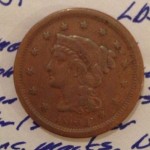
1851 Braided Hair Large Cent obverse
The first coin I found was an 1851 Braided Head large cent that his holder has marked as VF30. It is not a rare coin but a nicely preserve coin with a smooth brown color, nice details still remaining, very clear “Liberty” in the headband, and the signs of slightly weak strike on the reverse that does not detract from the look of the coin.
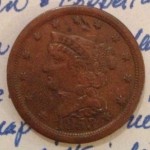
1853 Braided Hair Half Cent Obverse
The other coin is a 1853 Braided Hair half cent that his holder has marked VF35. Again, this is not a rare coin but one that is really beautiful. The coin shows some streaks of red and I asked whether it might have been cleaned at one time. Remember, it was a common and acceptable practice to clean coins to bring out their shine and color. But Steve did not think so and that the streaks of color may be original toning. Even if the coin is naturally recolored from a previous cleaning, the coloring does not detract from the beauty of the coin.
Both coins were well within budget and will be included in my one page collection. I appreciate the help that Steve provided in my search.
Now that I decided to present these ideas at a Money Talks program in New Orleans, you will have to come to the show to hear about different ideas I have.
In the mean time, if you are in, near, or can get to Baltimore on June 20-23, it is a good way to spend a day or even the weekend. And let me know, we can sit down for coffee at the stand on the third level.
Merriam-Webster’s online dictionary defines almanac as “a usually annual publication containing statistical, tabular, and general information.” Almanacs have been around for a while in various forms from the earliest times of writing to today. Early almanacs were simply calendars of coming events and records of past events. They included holidays, phases of the moon, and significant dates that related to the weather for the farming community.
Although there have been many almanacs that bridged into the modern era, none had been as famous as Poor Richard’s Almanack written by Benjamin Franklin writing under the pseudonym Richard Saunders. Franklin published Poor Richard’s Alamanck from 1733-1758. Amongst the surviving almanacs include The Old Farmer’s Almanac that has been published continuously since 1792, the Farmer’s Almanac that has been published continuously since 1818, and The World Almanac and Book of Facts published since 1868. These are the almanacs that all others are judged against.
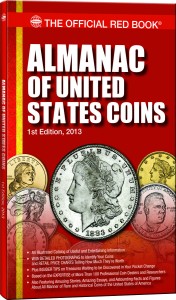
Although I read the description, I did not read it carefully because when I opened the package sent to me by Whitman, I found a skinny trade paperback-sized book. I reread the Whitman press release and it said the book was 192 pages. Initially, I felt disappointed in my hopes that there would be a competitor on the market to the Coin World Almanac since competition makes everyone better. So I can get over my initial reaction, I put the book down for a while to overcome my initial reaction to give the book a fair review.
After two weeks, I find I cannot hide my disappointment especially when I place the book next to the Coin World Almanac. Now in its eighth edition, the Coin World Almanac is 688 pages of numismatic reference that is a worthy comparison to any almanac in any industry. The problem with the Coin World Almanac is that it is updated every ten years. Having purchased the last two, the seventh edition seemed stale by 2004. I suspect the eighth edition will begin to feel stale by the end of this year if not by mid-2014. Maybe Coin World should consider shortening their update cycle.
Coin World does not have to worry about competition from Whitman. For as much as Whitman has invested in creating content across their “Official Red Book Series” from the many great authors, their Almanac of United States Coins is so lacking in content that it is many years away from being able to compete.
The only complement I can offer Whitman for this book is that many of the coin images are superb. I do like the images showing the relative grading of the individual series but wish it was expanded to include a few more grades. One example that would help collectors is that the difference between a VF-20 and MS-65 Walking Liberty half dollar is so vast, that having at least two intermediate grades (e.g., EF-40 and AU-50) would be helpful.
Whitman’s Almanac v. Coin World’s Almanac: In this case, size matters!
If had had to compare the Almanac of United States Coins, I would call it a light version of A Guide Book of United States Type Coins. The problem is that the Type Coins guide book, now in its second edition, is a better book even though it is not an almanac.
Whitman is going to have to learn that every numismatic reference book does not have to be a price guide. If they want to include type set-like guides, then do not make it look like a major component of the book. Otherwise, I would recommend people read A Guide Book of United States Type Coins instead. Thus the first improvement I would make is either eliminate the price guide information or find a way to minimize it as a central focus of each section. After all, an almanac is supposed to be about the content and the fact. Price guides are opinions that change with market forces that changes from the end of the editorial cycle until the book is published.
I know Whitman wants to sell books and has to find a way to make this book unique over their other offerings so they do not cannibalize sales, but they have to consider that they may never sell some of these books to certain people anyway. And if Whitman drops the pricing information, that still leaves their other books as an option for the reader. After all, Whitman can include a line at the end of each coin’s section that if they want in-depth information, the read can “consult” Whitman’s other book on the coin.
It is interesting how Whitman included a list of the authors for all of their books as credits but did not print the name of the editor of this book. However, Whitman’s press release named publisher Dennis Tucker as the editor.
Now that Whitman has disappointed me, they need to look at the content they have already invested in with their current books. They can start by taking whatever information is in the Red Book (A Guide Book of United States Coins), the Red Book Professional Edition, and the Blue Book (Handbook of United States Coins) and bring the content together to improve the current almanac. Just doing this would greatly improve this book. Then, it is a matter of an editor either convincing Whitman’s other authors to build on the chapters or distill the information in their other books to something suitable for an almanac.
I really wanted to like this book to the point that I put it aside in order to see if I could get over my first impression. Instead, I started to read another Whitman book that deserves the good review I will write in the near future. But I could not get over the disappointment. The text has no depth, facts that should be in an almanac are missing, and it seems like a glorified coin type price guide. Maybe they should market this as something for the very beginner, even for someone under the age of 12. Therefore I give this book a grade of F-12. The only factor that prevents this book from grading lower are the images. It is not a book I can recommend.
DISCLOSURE: Whitman Publishing provided the copy of the book I reviewed. I will not add this book to the library. It will be donated to my coin club’s annual charity auction in December with the proceeds going to the local Boys and Girls Club.
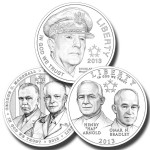
On March 21, the U.S. Mint is scheduled to start selling the 2013 5-Star Generals Commemorative Coins. The program commemorates the United States Army Command and General Staff College (CGSC) by commemorating the 5-star generals who attended or taught at the college. The generals that will be depicted on the coins are Douglas MacArthur, George C. Marshall, Henry “Hap” Arnold, Dwight D. Eisenhower, and Omar N. Bradley. General Bradley was the last to hold the rank General of the Army.
The 5-Star Generals Commemorative Program includes a $5 gold coin, silver dollar, and clad half-dollar that will be offered in proof and uncirculated options. The U.S. Mint will also offer a three-coin proof set. Surcharges of $35 for each gold coin, $10 for each silver coin and $5 for each clad coin sold will to go the CGSC Foundation to support the college. With mintage limits of the 100,000 for the gold coin, 500,000 silver dollars, and 750,000 clad half-dollars, the program can raise a maximum of $16 million for the CGSC Foundation.
Do you plan to buy any of these commemorative coins? This week’s poll asks which, if any, of these commemoratives you will buy.
Do you plan to buy any of the 2013 commemorative coins?
I don't plan to buy any of these commemorative coins (38%, 13 Votes)
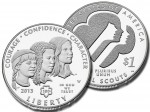
2013 Girl Scouts of the USA Centennial Proof Silver Dollar (12%, 4 Votes)
A few weeks ago, I wrote about a one page collection starting with the one cent coin. The set also included an example of a half-cent to cover the lowest denomination of coins produced by the U.S. Mint.
The concept of the one-page collection is to create a meaningful collection using a single 20 pocket page that holds 2×2 holders. Using this format, I can create any type of collection without being bound to the albums and folders that are published by the numismatic press. I can also personalize the collection with information I find and other stories, some that I write.
When creating a one page collection, I am looking at ungraded coins that could be graded Fine or better and costs under $100 each. While I try to keep purchases under $50, having the ability to go over for certain coins gives me a little flexibility while staying closer to affordable.
I was asked what I used as a price guide to determine affordability. For full disclosure, I had been consulting the NumisMediaOnline Fair Market Value Price Guide of collector coin. The site is free, updated monthly, and is the same information printed in their monthly publication. The NumisMedia Online Dealer Price Guide as well as their printed version requires a subscription.
Since my first one-pager was of the lowest denominations, I will move up a bit and put together a collection of 2, 3, and 5-cent coins.
The first coin struck by the newly created Mint was the half disme in 1794. As one of the original coins designated by the Coinage Act of 1792, legend has it that the coins were struck using silver donated by Martha Washington. Although there is no proof that our first First Lady donated her silver, it makes for a good story.
The first half-dismes were really not struck for circulation but over 86,000 coins of the 20.8 grains (1.35 grams) of .8924 fine silver were delivered to Secretary of State Thomas Jefferson (under the First Coinage Act, the Mint was placed under the Department of State). Originally designed by Robert Scot, the early Flowing Hair and Draped Bust half-dimes (the “s” was dropped in 1796 since it was silent anyway). Production ceased in 1805 with the shortage of silver.
Production picked up again in 1829 with the Capped Bust design by William Kneass and continued until 1837. After the passage of the Act of January 18, 1837, the weight of the coin was reduced to 20 5/8 grains (1.34 grams) and the fineness raised to .900 silver. For this change, Christian Gobrecht’s Seated Liberty design was used for the new coin.
This is where the series gets interesting. First, there was a change in design in 1838 to add stars to the obverse. In 1853, to show that the size and weight was change, arrows were added to the date from 1853 through 1855 before being removed in 1856 when the weight was returned to the old standard. In 1860, the legend was move to the obverse replacing the stars and the reverse laurel leaves were made larger.
The silver half-dime was made through 1874 after the successful release of the copper-nickel coin we call the Shield nickel. Nobody is sure when the coin started to be called a nickel, especially since it is made of only 25-percent nickel. It has been speculated that it was called a “nickel” because of the composition while it circulated along side the silver half-dime.
The U.S. nickel is unique in that it is the only coin that has been made of the same .750 copper and .250 nickel composition since its introduction in 1866 except for the silver alloy used during World War II from 1942-1945.
Starting this collection with an easy to find 1865 3¢ Nickel
Two and three cent coins were conceived out of the coin shortages during the mid-19th century. The three-cent coin, nicknamed the trime, was conceived in 1851 for better handling by the post office for buying postage. The silver three-cent coin was struck between 1851 and 1873. However, when silver became expensive and people were hoarding the coins for their silver content, congress authorized the striking of copper-nickel three-cent coins where were called to as three-cent nickels. Mint engraver James B. Longacre designed both coins that used a Roman numeral “III” on the reverse.
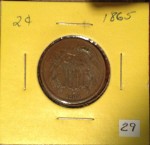
Bought this 1865 2¢ coin from my coin club’s auction
During the Civil War, the silver shortage caused hoarding of coins. The only circulating coins were the copper large cents. In order to produce more coins that would circulate, congress passed the Coinage Act of 1864 that eliminated the silver half-dime, the silver three-cent piece (trime), and authorized the production of the bronze two-cent coin. The Longacre-designed coin featured a shield on the front and the denomination “2 CENTS” on the reverse between two wheat stalks.
Beginning with the Liberty Head “V” nickel, most of the coins should be easy to find and not cost a lot of money. In fact, it may be easier to find an 1883 Liberty Head nickel without the “CENTS” on the reverse, also called the Racketeer Nickel, than an 1883 nickel with the “CENTS” in Fine to Very Fine grades. It may be easier to find a 20th century version that would fit this collection nicely.
For the rest of the series, you can find nice coins at all grades without problems. Just be aware of the major varieties, such as the two types of Buffalo nickels, and the modern changes in the Jefferson nickel. It should be fun to complete this set:
✓ 1964-1873 Two Cent piece: When I started to look for a an example of a two-cent coin, I was surprised as to how many I could find that were nicely preserved and affordable. Most VF-XF coins in this series can be purchased for $40-60 or even less if you find a dealer having a good day.
✓ 1851-1873 Silver Three Cent piece (trime): It will be difficult to find silver three-cent coins from 1863 through 1872 because most were melted in 1873. One of the best examples I have seen were the 1852 coins. Not only are they affordable but the mintage of over 18 million make them the most available coins of the set.
✓ 1865-1889 Nickel Three Cent piece: After the two-cent coin, this was the other coin minted in reaction to the hoarding during the Civil War. Early dates are easily found because of their mintage figures in the millions and for affordable prices. It should not be difficult to find a nice Extra Fine coin for around $40.
✓ 1829-1837 Capped Bust half-dimes: If you want a real challenge, put together a typeset of all half-dime types. Part of the problem with that is the Flowing Hair half-dimes will cost thousands of dollars, if you can find them. For the average collector, I suggest a Capped Bust half-dime to start the five cent part of this set. Based on the price guides and what I have seen at dealer tables, you should be able to buy a nice one graded around Fine for $60-65. This should be a good representative start of the five cent series.
✓ 1837-1873 Seated Liberty half-dimes Types 3 & 4: No collection is complete without a representation of Christian Gobrect’s Seated Liberty design. Inspired by the similar image of Britannia, Gobrect posed Miss Liberty in the same manner except holding a union shield and a phrygian cap on a pole that signifies liberty and the pursuit of freedom. For this set, I recommend the 1853-1855 “Arrows at Date” (Type 3) variety. Aside being affordable at $60-70 in XF, the arrows tell the story of how the composition was changed while the coin was being used. The “Legend on the Obverse” (Type 4) variety is an interesting change and would be even more affordable. For the “Arrows at Date” variety, you may want to consider finding one with the “O” mint mark from the New Orleans mint to keep it interesting. “Legend on the Obverse” varieties from San Francisco are affordable and would make for an interesting addition to this collection.
✓ 1866-1833 Shield nickel: Rather than worry about the “Rays” versus “No Rays” types, I decided on the “No Rays” to keep this coin around $40. However, it is your collection and if you what to spend about $100 for a VF-XF Shield Nickel with Rays, go ahead since it will give your collection a little more depth.
✓ 1883 Liberty Head nickel “Without Cents” When Charles Barber designed the coin, his idea was to use a Roman numeral “V” on the reverse and not include the word “CENTS.” Since the three-cent coins used the Roman number “III” it was a logical progression. However, since the coin was about the same size of the $5 gold-half eagle, the Liberty Head nickel was gold plated in an attempt to pass them off as the $5 gold coin. These coins were then nicknamed Racketeer Nickels. It was then decided to add “CENTS” to the bottom of the reverse. After this decision was made, people thought that the coins would be recalled and started to save them, thus making it easier to find the 1883 without CENTS nickel than it is to find an 1883 with CENTS coin.
✓ 1883-1912 Liberty Head “V” nickel: Most XF coins in this series will be around $40 each, if you can find them. It is easy to find very worn coins and very expensive to find the higher grades. In fact, if you can find a nice XF 20th century issue, that would make a nice entry in this collection and only cost around $30.
✓ 1913 Type 1 Buffalo nickel: This iconic American design by James Earle Frasier ranks as one of my favorite. While it is a great design, the coin did not wear well and it is possible to find a lot of coins where the dates have been worn flat. On the reverse, Fraser designed the coin where the buffalo (actually, an American Bison) is standing on a grassy mound. On the mound was the denomination and mint mark. This high surface wore easily in circulation. It was later changed to remove most of the mound for a line. You can find nicely preserved Type 1 Buffalo nickels from Philadelphia for around $25. Spend as little as $10-15 more for an example from Denver. San Francisco coins will be $40 more.
✓ 1913-1938 Type 2 Buffalo nickel: Basically, the mound was hollowed out leaving the buffalo standing on what looks like a line. While not as aesthetically pleasing, it did preserve the denomination and mint mark on the reverse from wear. Best bet for this collection is to find a late 1930s example for $10-15. If you spend a little more, you can own an uncirculated 1935 or 1936 with a mint mark for $35-40. These make stare-worthy coin in any collection.
✓ 1938-1942,1946-2003 Jefferson nickel: Jefferson nickels come in four types with the left-facing portrait being the dominant coin of the series. With the exception of the 1939-D, you can find an uncirculated example for under $10. If you want an example with the mintmark on the reverse, select a coin from 1964 and earlier since the mint marks were move to the obverse starting in 1968 and no coins had mint marks from 1965 through 1967. Maybe you would want to add a 1970-S coin which was the last year the nickel was produced in San Francisco and had an obverse mint mark.
✓ 1942-1945 Wartime Silver Nickels: to reduce the amount of copper and eliminate the nickel that were need for the war, the Mint produced nickels using an alloy of .560 copper, .350 silver, and .090 manganese. To distinguish these coins from regular nickels, the Mint added a large mint mark over Monticello on the reverse. It was the first time the Mint used a “P” mint mark on any coin. Since the mint mark makes them unique, one from each mint would make a nice example. Maybe one from each year with each on representing one Mint. You can find nice uncirculated examples for an average of $5 each without looking too hard.
✓ 2004-2005 Westward Journey Nickel Series: After the success with the start of the 50 State Quarters series, to honor the 200th anniversary of the exidition by Meriwether Lewis and William Clark in the newly purchase Louisiana Territory and westward, congress authorized this two-year four coin series to commemorate the journey. These modern circulating commemoratives are readily available and the four should not cost a lot of money, even as uncirculated coins. Make sure you find all four coins: 2004 coins with the left-facing portrait with the Peace Medal and Keelboat designs on the reverse. The 2005 coins had a wonderful obverse portrait designed by Joe Fitzgerald that included the word “Liberty” reproduced from Jefferson’s writing. The reverse included the American Bison and “Ocean in View.”
✓ 2006-Present Front Facing Portrait: With the return of Monticello on the reverse, a new front-facing portrait by Jamie Franki based on the 1800 portrait painted by Rembrant Peale and includes the “hand written” version of “Liberty” on the obverse.
An interesting aspect of this collection is that the coins are of all the basic metals used in non-gold coins. The 2-cent pieces were made from copper while the 3-cent coins had one type made in silver and anther in nickel. While most of the 5-cent coins were made of copper-nickel, the wartime composition removed the nickel and lowered the copper content by adding silver and manganese. It is a good representation of coinage metals circulating in the United States.
This is one set where it was difficult to think about how to keep it to 20 coins. Depending on where you shop, your patience, and your budget, this is a collection that can easily be expanded.
If you decide to use this guideline for your set, do not limit yourself to my suggestions. Consider other options. Consider adding another page. Make it personal. Make it yours.
Bibiana Boerio nomination to be the Director of the U.S. Mint was returned by the Senate.
The U.S. Mint continues to be without a permanent director and the prospects for a director being appointed any time soon does not look promising. During the opening session of the Senate on January 3, 2013, the Senate moved under unanimous consent to return the nomination of Bibiana Boerio to the President under the provisions of Senate Rule XXXI, paragraph 6 of the Standing Rules of the Senate. This rule states that nominations not acted upon during the session are returned to the President. Since Boerio’s nomination was not acted upon during the 112th congress, the Senate is required to return the nomination.
President Obama has the option of resubmitting any nominations. Thus far, the president has not re-sent Boerio or any other nomination for Director of the U.S. Mint to the Senate for confirmation during the 113th congress.
The U.S. Mint has been without a permanent director since the resignation of Edmund Moy in January 2011. Since his resignation, the U.S. Mint has been lead by the Treasurer of the United States Rosie Rios with day-to-day operations being lead by Deputy Director Richard A. Peterson as Acting Director.
It was reported in the numismatic press but not formally announced by the U.S. Mint that they filed a notice that appeared in the Federal Register (78 FR 11954) raising precious metal prices. The new prices, which are as much as 30-percent higher than the previous became effective as of noon (ET) on Wednesday, February 27, 2013.
It was noted in the U.S. Mint’s annual report that seigniorage on precious metal products were lower in 2012 than in years past. This move appears that the U.S. Mint is trying to make up for that lost revenue.
This month’s list includes one late entry that was missed from January.
S. 203: Pro Football Hall of Fame Commemorative Coin Act
A bill to require the Secretary of the Treasury to mint coins in recognition and celebration of the Pro Football Hall of Fame.
Sponsor: Sen. Robert “Rob” Portman (R-OH)
• Introduced on January 31, 2013
• Senate Banking, Housing, and Urban Affairs Committee on January 31, 2013
Track this bill at http://www.govtrack.us/congress/bills/113/s203
H.R. 627: National Park Service 100th Anniversary Commemorative Coin Act
Sponsor: Rep. Erik Paulsen (R-MN) To provide for the issuance of coins to commemorate the 100th anniversary of the establishment of the National Park Service, and for other purposes.
• Introduced: February 13, 2013
• Referred to the House Financial Services Committee on February 13, 2013
Track this bill at
This week’s poll I want to know what kind of collector do you consider yourself to be?
I am not asking what you collect but how. I want to know if you buy raw coins and save them in an album or does your collection have to be only graded coins or coins that will be grade.
Do you pick from pocket change or do you go to the bank and buy rolls to search for something interesting?
For this poll, I thought of ten different categories of collectors. If you have a different strategy that is not in the list, add it to the comments below. Since there is no “right way” to collect, I would like to hear what other people do. Let me know what suits you best!
What kind of collector are you?
I buy raw coins and put them in albums. (41%, 9 Votes)
I am a change picker. (18%, 4 Votes)
I only buy graded coins or coins to be graded. (14%, 3 Votes)
I am a currency collector (graded and ungraded) (14%, 3 Votes)
I go to shows and search dealers' junk boxes. (9%, 2 Votes)
I am a roll hunter. (5%, 1 Votes)
I collect tokens and medals. (0%, 0 Votes)
I collect other items like Hobo Nickels, Love Tokens, etc. (0%, 0 Votes)
I hunt for old coins using a metal detector. (0%, 0 Votes)
I am a hoarder, saving every old coin I find. (0%, 0 Votes)
Total Voters: 22
Loading ...
Yes, that is my set of Somalia Motorcycle coins. I bought them from a dealer at a Baltimore show.
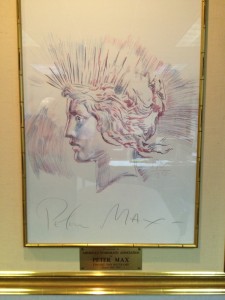
Drawing of Peace Dollar Liberty by Peter Max (1983)
Those of us that are a certain age remember growing up to with the artwork of Peter Max. His paintings and neo-expressionism posters are iconic representations of the pop culture of the 1960s. His vibrant colors made complex designs look simple as they some seemed to pop off the page. While times have changed and Max has worked on contemporary scenes, his style remains unique with an appeal that still brings a smile to my face.
Did you know that the American Numismatic Association owns a Peter Max original? While I was in Colorado Springs the week of February 19, I met briefly with Executive Director Jeff Shevlin in his office. Hanging on the wall across from his desk is a drawing of Liberty based on the design from Anthony de Francisci’s Peace dollar.
The picture looks like it was done in charcoal on paper. It is hand signed by Max and dated 1983. The picture is mounted on a fame that would have been contemporary to 1983 and has a plaque under the glass that reads:
Presented to American Numismatic Association by PETER MAX VINCENT VAN ROTTKAMP August 20th, 1983
As a fan of the Peace Dollar and Peter Max, this is a fantastic picture.
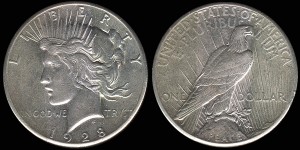
1928 Peace Dollar is a classic and under-appreciated design
Someone in the ANA offices said that this picture was the inspiration for the Peace dollar logo that used to be the official ANA logo. Remember, it was Farran Zerbe who helped push the idea of Peace dollar with his paper at the 1920 ANA convention in Chicago entitled “Commemorate the Peace with a Coin for Circulation.” In the paper, Zerbe wrote:
I do not want to be misunderstood as favoring the silver dollar for the Peace Coin, but if coinage of silver dollars is to be resumed in the immediate future, a new design is probable and desirable, bullion for the purpose is being provided, law for the coinage exists and limitation of the quantity is fixed—all factors that help pave the way for Peace Coin advocates. And then—we gave our silver dollars to help win the war, we restore them in commemoration of victory and peace.
Does anyone know why Max did this drawing? Who Vincent Van Rottkamp was and what was his association with this picture?
Maybe, we can convince Jeff to display the picture at an upcoming show for all members to enjoy.
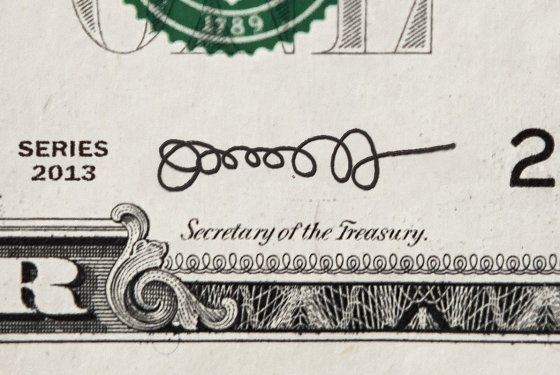
Aside from being in charge of the department that includes the U.S. Mint and the Bureau of Engraving and Printing, currency collectors now get to look forward to the addition of Lew’s “Lewpty” autograph on United States currency. When Lew was nominated to succeed Tim Geithner, it was joked that Lew’s autograph resembled a series of loops or the icing decoration on the Hostess Cupcake. There was even a petition on the White House website to “Save the Lewpty-Lew” autograph on U.S. currency (the petition ended and can no longer be found on the White House’s website).
Given the realities of the Treasury and our current economics, we wish Jack Lew well in his new position. We also hope he does not follow through on the promise he told Sen. Max Baucus (D-Montana) he made to the president “to make at least one letter legible.”
Please Mr. Secretary, Save the Lewpty Lew!
A mock-up of what Jack Lew’s signature would look like on a one-dollar note
Credits
Picture of Jack Lew courtesy of Wikipedia.
Dollar Bill mock-up with Lew’s Loops courtesy of New York Magazine.

 Having grown up with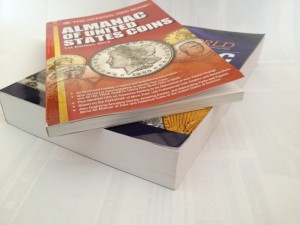
 Loading ...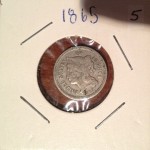

 It was reported in the numismatic press but not formally announced by the
 ![[PDF]](http://coinsblog.ws/library/images/pdf.png) or you can find a printable version at on the
or you can find a printable version at on the