Oct 22, 2012 | coins, exonumia, fun, other, personal, tokens
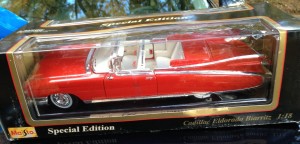
My dream car… in model form!
Saturday was the 2012 Rockville Antique and Classic Car Show, a yearly show supported by 25 local and regional car clubs. When I arrived around 1 o’clock I saw a field with more than 500 antique and classic cars. Although I was not interested in some cars, there were others that were absolutely stunning. While I did not find a 1959 Cadillac, there were a few cars that I would love to own. You can see some of the cars I found and a quick video of the inside of a Volkswagen Bus visit on my page at Photobucket.†
While the 1959 Cadillac is my dream car, my nostalgic car is a 1973 Plymouth Gold Duster. While it was not my first car, it ranks one of my favorites from my early days. This Gold Duster was “sunshine yellow” with the brown snake-skin three-quarter covered vinyl top. The 225 Hemi Slant 6 engine output 145 horsepower but was more than enough for this car especially since it did not have air conditioning! My father bought it as a new car in 1973 and I “inherited” it in 1980 while in college. Unfortunately, it met its demise on a rainy road while trying to avoid hitting a dog.
To satisfy my nostalgia, I was looking at the wares of the flea market dealers in the adjacent lot when I came across a brochure for the 1973 Gold Duster. “Get Ready to Stake Your Claim” screams the headline on the front cover. Open the brochure and it tells you that “You’ve Discovered Gold Duster.” While admiring the picture that reminded me of my youth, I noticed the coin image at the bottom right corner that said:
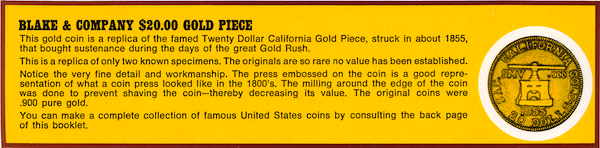
If you cannot read the image, it says:
BLAKE & COMPANY $20.00 GOLD PIECE
This gold coin is a replica of the fame Twenty Dollar California Gold Piece, struck in about 1855, that bought sustenance during the days of the great Gold Rush.
This is a replica of only two known specimens. The originals are so rare no value has been established.
Notice the very fine detail and workmanship. The press embossed on the coin is a good representation of what a coin press looked like in the 1800’s. The milling around the edge of the coin was done to prevent shaving the coin—thereby decreasing its value. The original coins were .900 pure gold.
You can make a complete collection of famous United States coins by consulting the back page of this booklet.
Interested in what this collection can be, I turned over the brochure see a 1973 advertisement for 12 “authentic replicas” of the Chrysler-Plymouth “Old West” Coin Collection. The collection appears to be replicas of various assay tokens from the famous gold assayers of the time. For $7.75 per set (or $40.39 today), you could have ordered a full set along with a vinyl/velour folder.
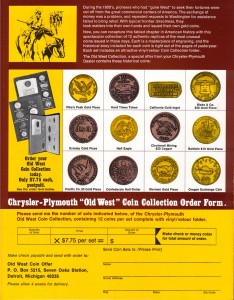
Chrysler-Plymouth “Old West” Coin Collection Order Form from 1973 Plymouth Gold Duster Brochure
At the intersection of cars and numismatics I found fascinating piece of automotive advertising history with a numismatic slant. I do not know if a version of this set has survived—an Internet search yielded more copies of the brochure—but it would be interesting to find a set.
† At the time this is posted, I have not labeled the images on Photobucket. I hope to finish that sometime this week.
Oct 11, 2012 | Baltimore, coins, commemorative, news, US Mint
On the heels of their success in the London 2012 Olympic Games, Michael Phelps and other Olympic athletes from Maryland including Katie Ledecky of Bethesda and Suzanne Stettinius of Parkton were presented with a Star-Spangled Banner Commemorative Coin at a celebration held on Monday, September 10, 2012 at Baltimore’s Inner Harbor.
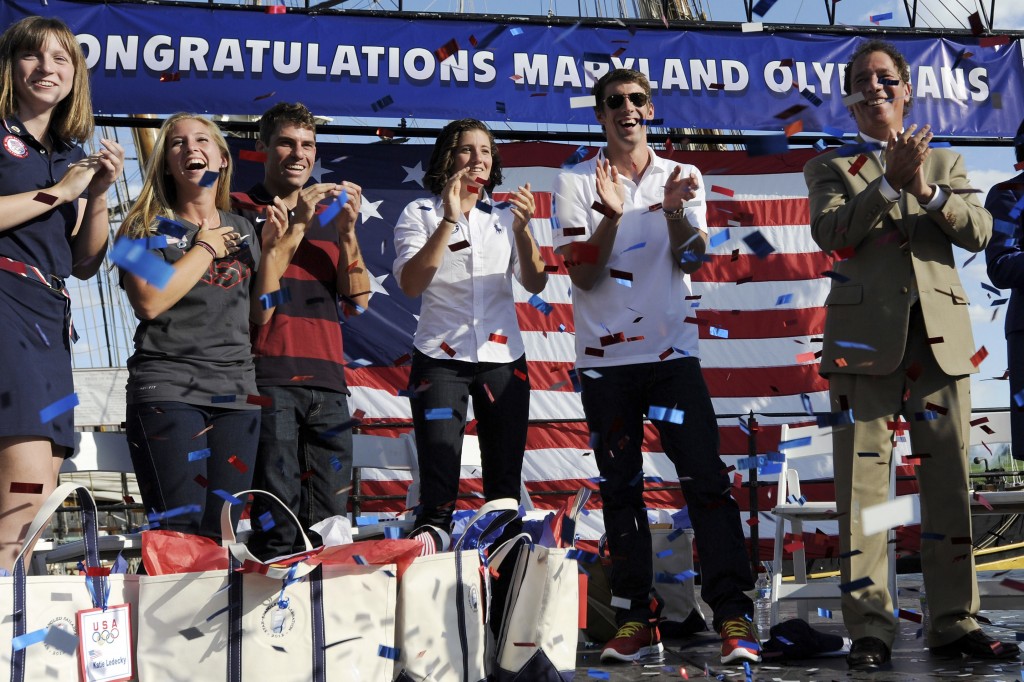
Michael Phelps, second from right, joins other Olympic athletes from Maryland, including Katie Ledecky, left, windsurfer Farrah Hall, second from left, and Suzanne Stettinius, third from right, and Baltimore County Executive Kevin Kamenetz, right, during a celebration of the achievements of Maryland Olympians. (Steve Ruark/AP Photo)

Olympian Michael Phelps shows his Star-Spangled spirit and receives a new piece of “metal” from Maryland Governor Martin O’Malley.
“Our Maryland Olympians’ resolve to work hard, train and excel embodies the spirit of our state,” said Gov. Martin O’Malley. “It’s only fitting that we honor them with these 2012 Star-Spangled Banner Commemorative Coins, which pay tribute to Maryland’s vibrant people and extraordinary history.”
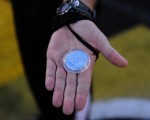
Star-Spangled Banner Commemorative held by the referee that was used at the Ravens-Browns game on September 10, 2012.
“As we celebrate a variety of sports on Monday, the Star-Spangled Banner Commemorative Coin will serve as a symbol to our local athletes of Maryland’s historic tie in defending our freedom during the War of 1812,” said Ann Beegle, executive director of Star-Spangled 200 Inc., the non-profit affiliate of the Maryland War of 1812 Bicentennial Commission prior to the game. “Baltimore is home to the Star-Spangled Banner and we are pleased to recognize these athletes’ dedication with a historic symbol of our state.”
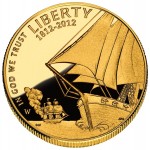
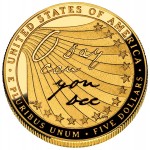
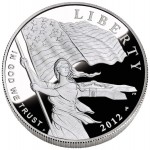
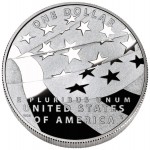
The 2012 Star-Spangled Banner Commemorative Coins, created in honor of the bicentennial of the War of 1812, exemplify the Star-Spangled Banner flag and Francis Scott Key’s poem, “The Defence of Fort McHenry” that became our national anthem. These are two of America’s most enduring icons. Coin sales will continue through December 17 and are only available through the United States Mint. The Star-Spangled Banner Commemorative coins can be purchased through the United States Mint website, at United States Mint kiosks in Washington, DC (Union Station, 50 Massachusetts Ave. NE and United States Mint Sales Counter, 801 9th Street NW) and at the Baltimore Visitor Center located at 401 Light Street, Baltimore, MD 21202.
Proceeds from the sales ($35 for each gold coin and $10 for each silver coin) to support the Maryland War of 1812 Bicentennial Commission. The commission will use these funds to support its bicentennial activities, educational outreach, and preservation and improvement of the sites and structures related to the War of 1812. Help support the commission’s activities by purchasing a commemorative coin today!
Scott’s coin:
Credits
- AP photo courtesy of reachforthewall.com.
- O’Malley/Phelps and Referee Coin images are courtesy of Star-Spangled 200, Inc.
- Coin images courtesy of the U.S. Mint.
- Image of Scott’s coin is owned by the author and covered under CC BY-NC-ND 3.0 license.
Oct 3, 2012 | coins, commemorative, legislative, policy
The following is a summary of the coin-related legislation whose status was changed in September 2012:
H.R. 2139: Lions Clubs International Century of Service Commemorative Coin Act
Sponsor: Rep. Peter Roskam (R-IL)
Passed the House On Motion to Suspend the Rules and Pass, as Amended 9/10/12
Passed the Senate by unanimous consent 9/22/12
Presented to the President 9/25/12
Track this bill at: http://www.govtrack.us/congress/bills/112/hr2139
H.R. 2453: Mark Twain Commemorative Coin Act
Sponsor: Rep. Blaine Luetkemeyer (R-MO)
Passed the Senate with amendments by unanimous consent 9/22/12
Message on Senate action sent to the House 9/24/12
Track this bill at: http://www.govtrack.us/congress/bills/112/hr2453
S. 3612: Commemorative Coins Reform Act of 2012
Sponsor: Sen. Jim DeMint (R-SC)
A bill to prohibit the payment of surcharges for commemorative coin programs to private organizations or entities.
Introduced and referred to the Committee on Banking, Housing, and Urban Affairs 9/21/12
Track this bill at: http://www.govtrack.us/congress/bills/112/s3612
Sep 30, 2012 | coins, fun, medals, shows, tokens
On Saturday I had the pleasure of attending the Virginia Numismatic Association Annual Show in Fredericksburg, Virginia. Fredericksburg is about half-way between Washington, DC and Richmond. After a late morning start, I ate a quick breakfast and climbed into the old X3 and hit the road to make my first stop to honor National Coffee Day at a nearby coffee shop.
With hot java in the accessible coffee holder, the X3 was pointed to the highway and we headed south to Fredericksburg. For the most part, it was a pleasant trip except for the last 12 miles where I found myself in what was called a usual traffic delay to the Rappahannock River. Along the way, I was able to use the new iOS 6 maps program with GPS capabilities with no issue. For those who heard the alleged “horrors” of Apple’s map program, I found that for daily use I have had no problems. I think most people who do not try to find obscure addresses (i.e., like trying to map an weird address near a park) will find that it is a quite adequate app.
Relieved of the frustration caused by I-95 traffic, I exited at Route 3 and let the GPS guide me to the Fredericksburg Expo & Conference Center. It is a nice facility with nearby hotels and a large shopping area. Travelers who might have forgotten something would not have to travel far to find a replacement.
Interestingly, the USA Fencing Virginia 2012 KickOff Classic Circuit Fencing Tournament was being held in a different part of the center. It made for a good mix of numismatists and fencers walking in the parking lot. However, it was a little disconcerting when a gentleman was walking toward me in the parking lot carrying four fencing foils!
I registered at the front door and spoke with a number of the VNA people. I met a few of their officers and talked while I wrote my name on a few raffle tickets. Each hour, the VNA raffles of something. There were books, coins, tokens, and medals in the case that showed what was part of each hour’s raffle. You do not have to be present to win, but I did have to write my name and telephone number on 11 tickets which I purchased for $10. Once done, I walked by a Stafford County police officer and entered the bourse floor.
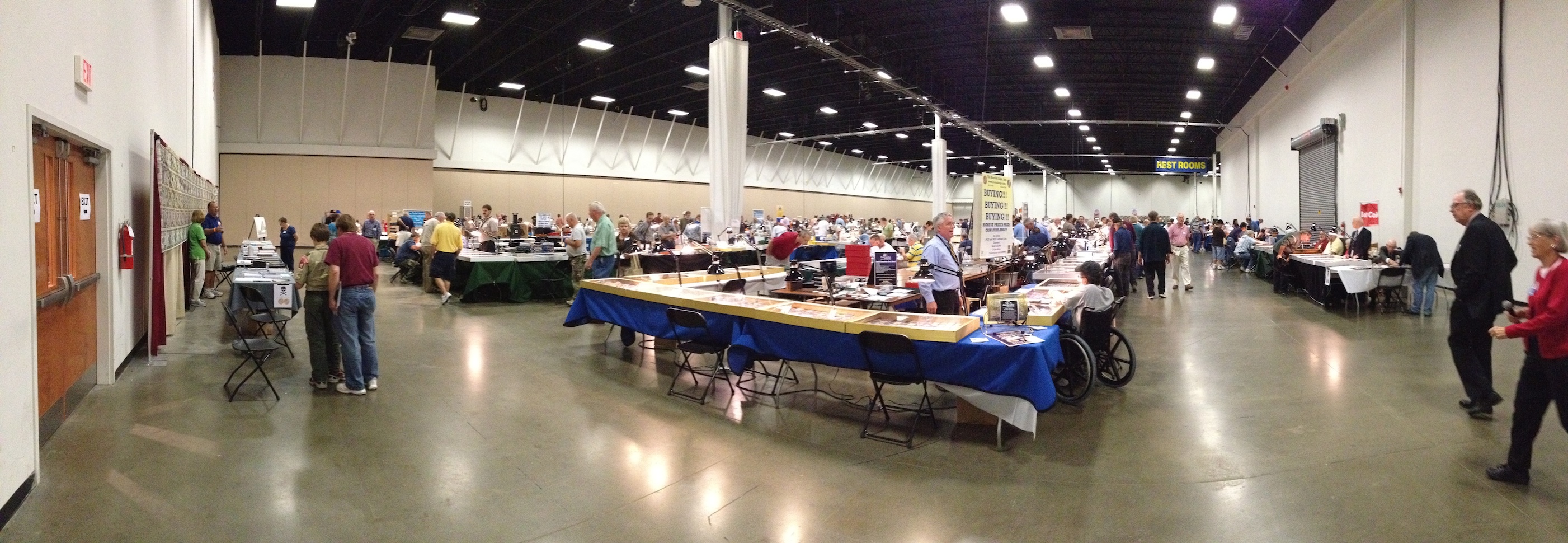
The show was in a pretty large hall with about 50 tables. There seemed to be a slight din of activity but nothing too overwhelming. As I walked around the floor looking at the items on a number of tables, I spoke with quite a few people. There were even a few I had met at other shows like the Whitman Baltimore show. Some said that Saturday was a bit slow, especially as compared to previous years. After a while, I asked some of the Virginia-based dealers if the nice weather and the college football games, specifically the Virginia Tech-Cincinnati game that was played at FedEx Field in Landover, Maryland (home of the Washington Redskins) and the Virginia-Louisiana Tech game in Charlottesville (both Virginia schools lost).
It has been a long time since I have been to a smaller show (under 100 tables). Even with the large venue, the fewer tables and with dealers I have never met before from areas of Virginia and North Carolina, it made for a relaxing atmosphere. Many of these dealers also had a different way of handling their inventory such as currency dealers who did not have everything graded and many of their lower quality but desirable series in books in the table for collectors to browse. For the collector on a budget who wants to consider notes with character, being able to flip through a book of these notes is a great idea and, even if you are not a currency collector, a lot of fun just to look. I liked having this type of accessibility and it was refreshing.
There were not many exhibits at this show. I did capture two pictures of exhibits I thought were interesting (see my Pinterest board), but I wish there were more.
At the end of the aisles in the center was an exhibit of philately (stamps) along with pictures that were about Virginia and the its role in the Civil War and after. This exhibit has a few great, vintage pictures of General Ulysses S. Grant (before he became president) including one where his portrait is aside one of General Robert E. Lee. Unfortunately, the pictures had take did not come out well (and I forgot to try again after being distracted).
After four hours of looking and schmoozing, I went back to the X3, plugged in my iPhone, and found that the game was being streamed by CBS through their iPhone app. After a stop to make sure I supported National Coffee Day again, I plugged in the iPhone and listened to the broadcast during the drive home. I am not sure which was worse, the traffic or the lack of defense during the game!
I arrived home in time to see the fourth quarter and make sure the final score was at least in my favor. Feeling better for the win, I was able to reflect on the good time I had at the VNA Convention while having dinner with my wife.
Congratulations to the Virginia Numismatic Association for putting on a good show.
-
-
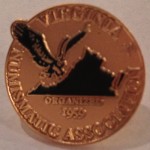
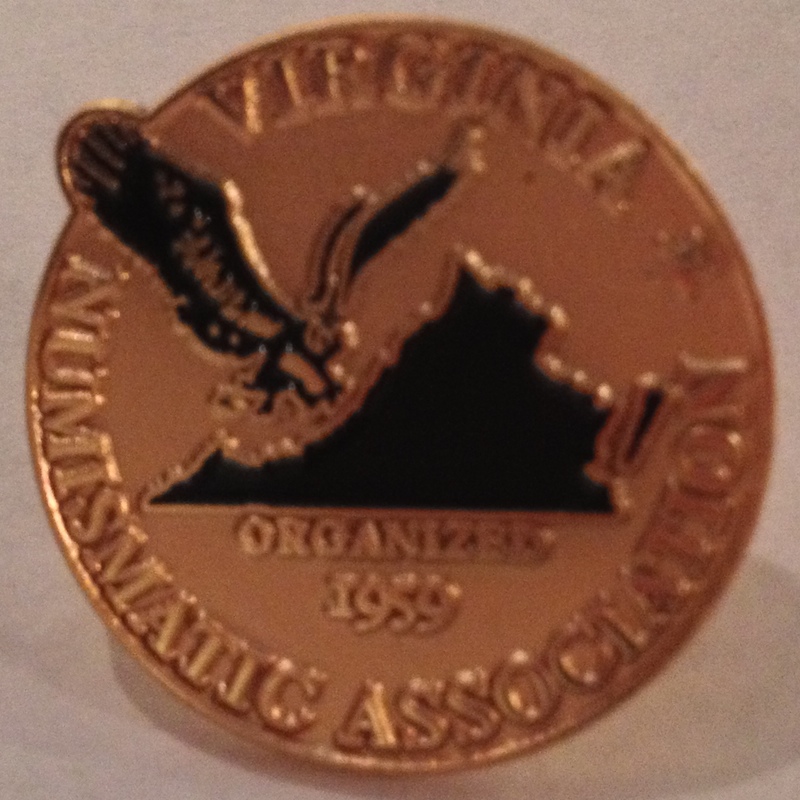
Virginia Numismatic Association pin that I purchased at the table where I also purchased raffle tickets.
-
-
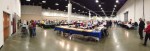
A panorama view of the bourse floor at the 2012 VNA Convention
-
-
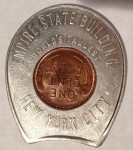
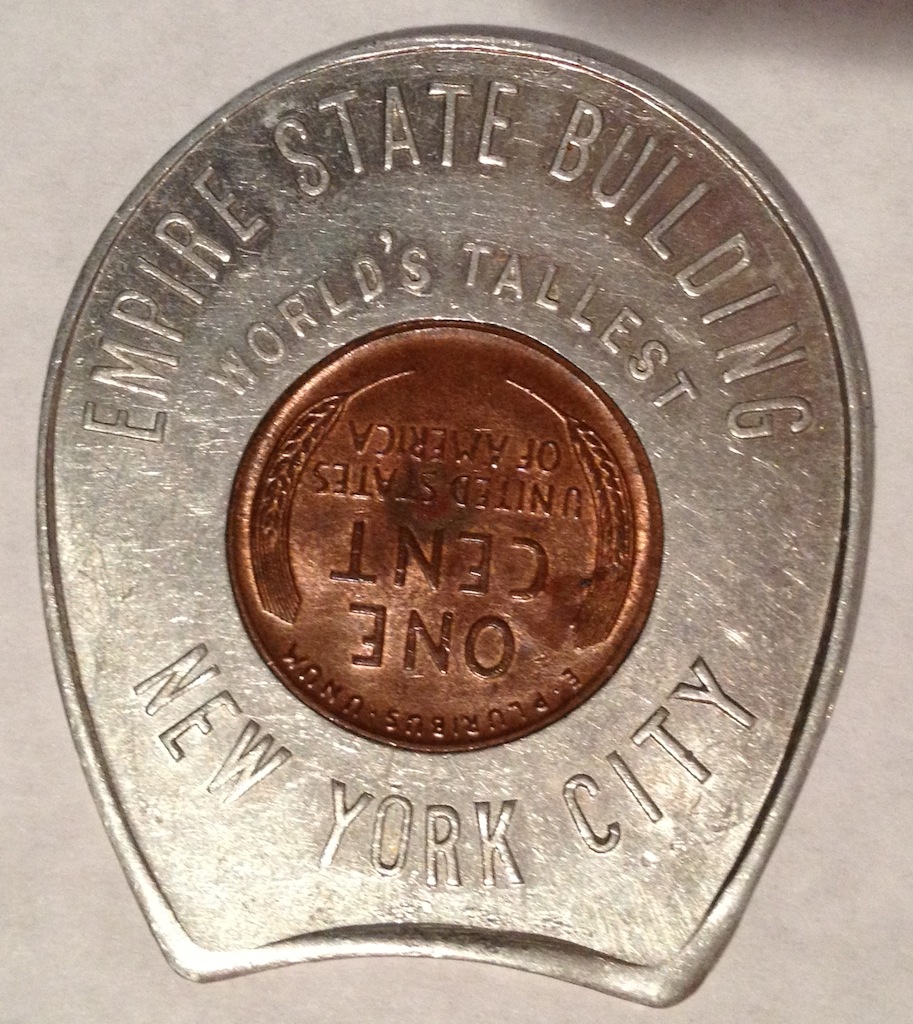
1949 Empire State Building Encased Cent announcing it as the “World’s Tallest Building,” which it was in 1949.
-
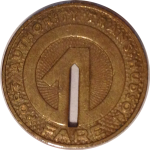
-
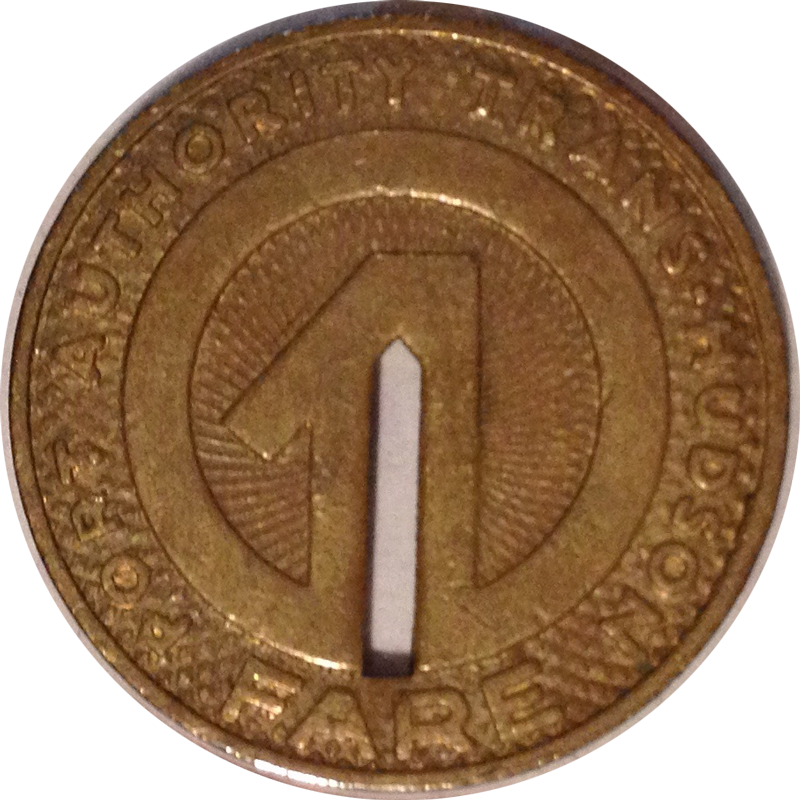
Token to ride the Port Authority of the Trans-Hudson subway system. PATH ties New Jersey to New York and is run by the Port Authority, the same people who own the World Trade Center.
-
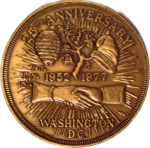
-
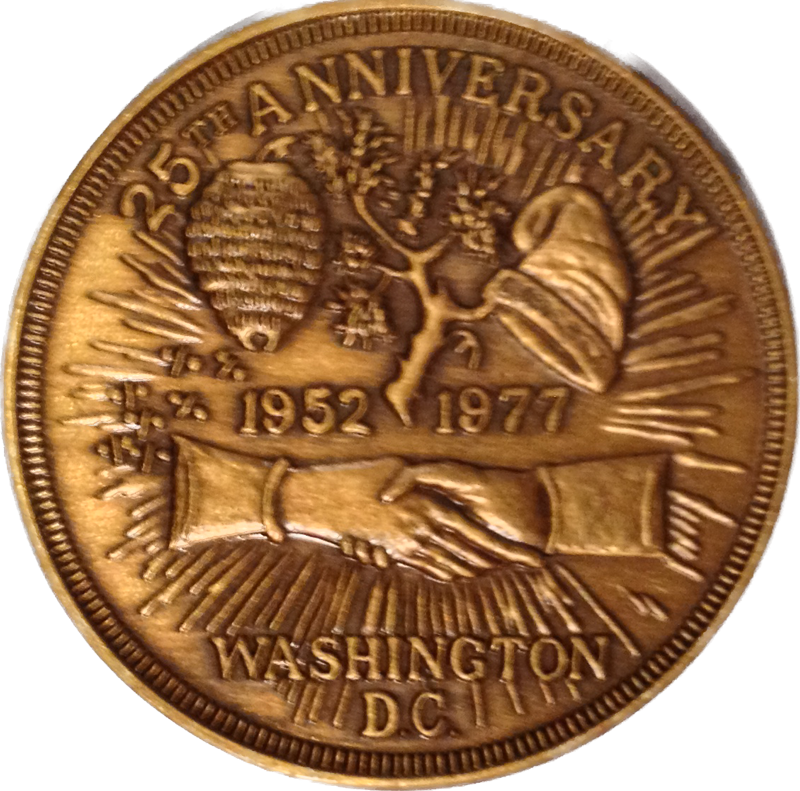
25th Anniversary Middle Atlantic Numismatic Association Medal from 1977. MANA is now defunct but used to be an umbrella organization for the Washington, DC metro area.
-
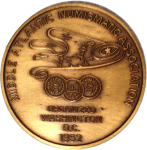
-
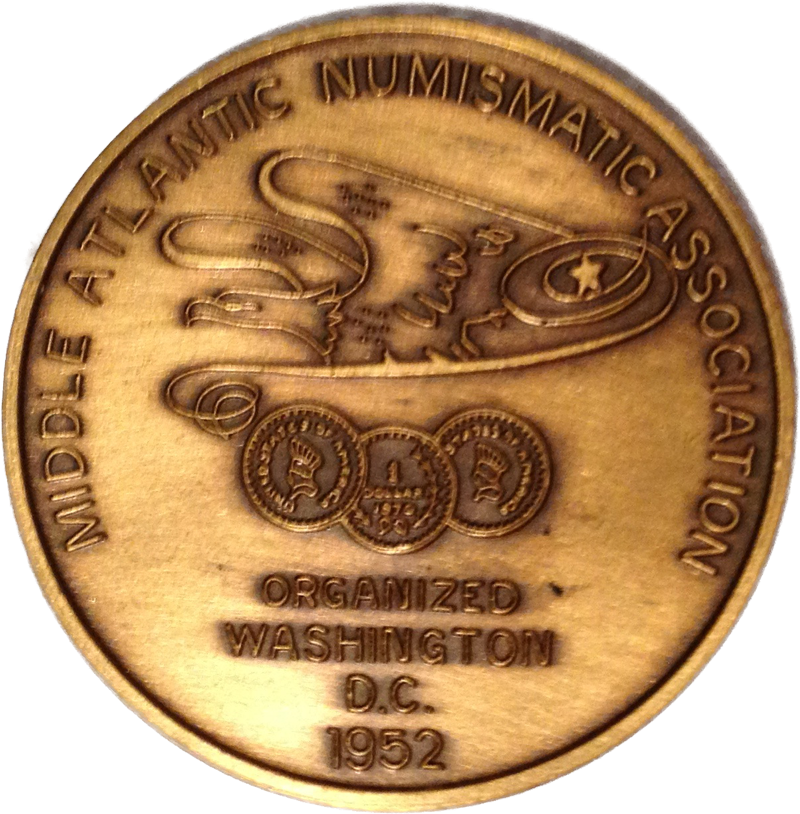
Reverse of the 25th Anniversary Middle Atlantic Numismatic Association Medal.
-
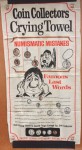
-
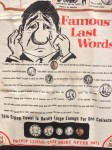
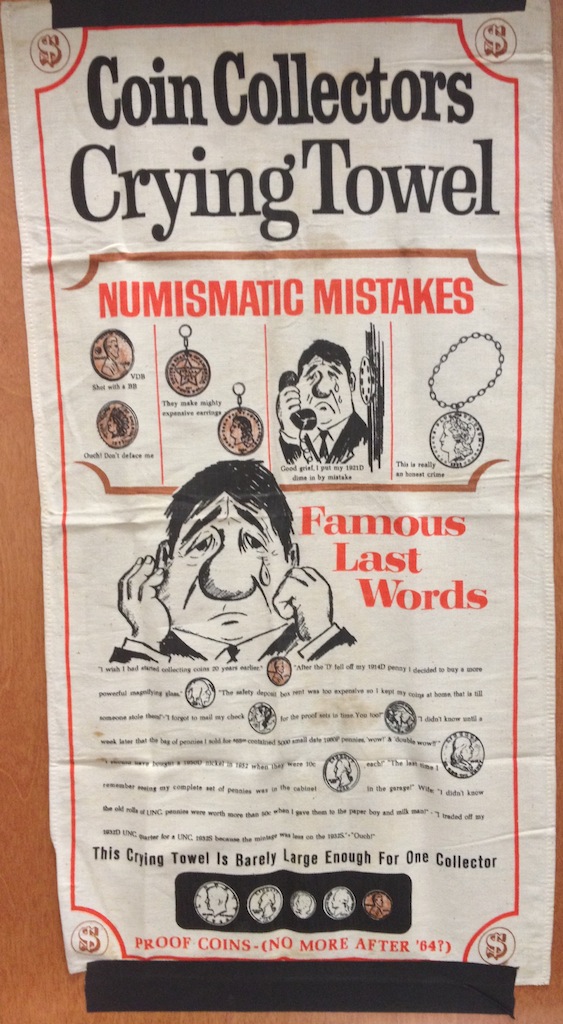
This was hanging on the door leaving the convention hall. Based on the last line regarding no more proofs after 1964, I think this was produced in either 1964 or 1965.
-
-
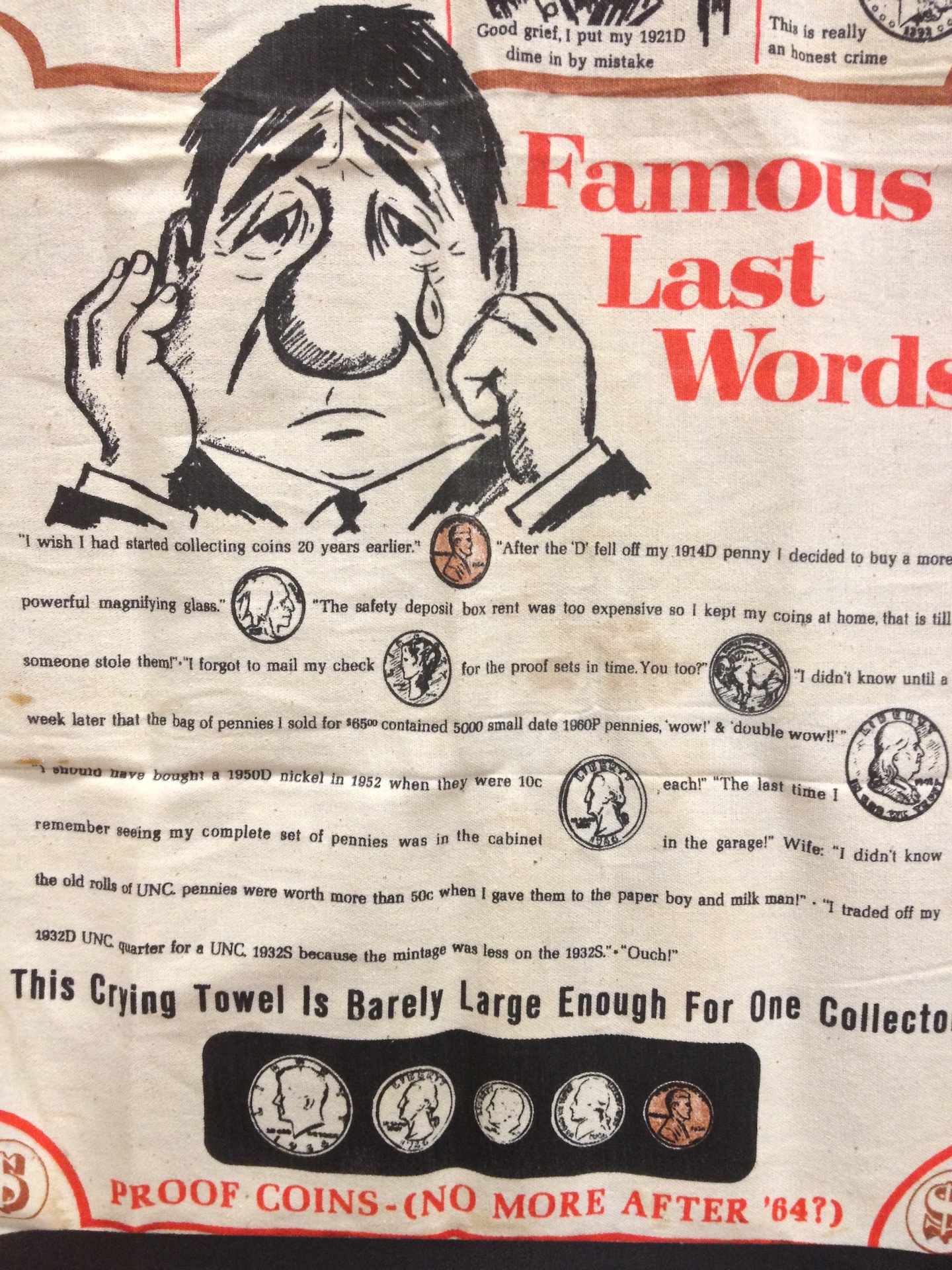
Close up view of the text on the Coin Collector’s Crying Towel
Sep 28, 2012 | BEP, coins, currency, economy, Federal Reserve, legislative, policy, US Mint
Those of us here in the Washington, DC area who work with or for the Federal Government knows that this week is the home stretch to the end of the fiscal year. Many of us who work for the government are not directly involved with the political infighting that makes the national news. Federal employees are prohibited to be involved with politics by law and contractors usually have employer policies that limit their political activities.
One thing we worry about is the funding issues that have not been resolved. Although the news reported that congress has passed a continuing resolution to fund the government for six months, what the reports did not say is that the continuing funding are only at the levels negotiated last year which rolled back funding to Fiscal Year 2007 (FY07) levels. FY07 dollars do not have the same buying power as today’s dollars and the amount of work required by the laws passed by congress have increased.
You might have heard about the budget “sequestration.” Sequestration is the mechanism that was instituted as part of the Budget Control Act of 2011 to force congress to negotiate a budget or automatic, across the board cuts totaling $1.2 trillion will go into effect on January 1, 2013. Sequestration has made a lot of people in the DC area nervous because it will cause contractors to cut jobs. In fact, with the uncertainty of sequestration, large contractors, like Lockheed-Martin, are providing 90 day layoff notices they are required to give employees when defense and other security-related contracts are ended early.
For the money manufacturing operations under the Department of the Treasury, there should not be any problems from sequestration because the U.S. Mint and the Bureau of Engraving and Printing are profitable agencies that uses their profits for operations. If there are shortfalls in providing funding for operations, the Secretary of the Treasury is allowed to withdraw funds from the Public Enterprise Funds (the accounts where the profits are deposited).
Problems remain for both agencies. The most significant of the issues are the problems with printing the new $100 Federal Reserve Notes. BEP continues to report that the new notes have folding issues that have delayed their release for two years. Inquiries by numismatic industry news outlets have reported that the problems are still under investigation and that no new release date has been set.
The U.S. Mint recently reported striking problems with the First Spouse Gold Coins. Apparently, the design caused metal flow problems in trial strikes that caused delays in releasing the coins. While the U.S. Mint has said they rectified the problems, the coins have not been issued.
In addition to the coining problems, the U.S. Mint also suspended its attempt to update its technology infrastructure. After receiving the responses from a formal Request For Information (RFI), the U.S. Mint pulled back on its attempt to update its infrastructure and online ordering services to re-examine the requirements and the business processes that would be part of that contract. The U.S. Mint press office said that they had no further information other than what has been published. They did confirm that the RFI responses will not be released because they contain proprietary information that is protected from public release.
It is difficult to know whether the federal budget situation will effect the U.S. Mint and BEP or whether the attempt to reduce costs in order to ensure they do not access more money from their respective Public Enterprise Funds. This is because money in excess of budgeted operations plus a reserve must be withdrawn from these Public Enterprise Funds and deposited in to the general treasury accounts at the discretion of the Secretary of the Treasury (31 U.S.C. § 5136 for the U.S. Mint and 31 U.S.C. § 5142 for the BEP). It is reasonable to question the management of these funds in the light of the federal budget situation.
Right now, the way the BEP and the Federal Reserve has handled the situation with the new $100 note suggests there is more to that issue than meets the eye. Nether the BEP or the Fed are answering question and the BEP did not issue an annual report for 2011 which would have to report on the production of the $100 notes. Inquiries to the BEP were returned with a reply that the report “is not ready.”
The annual reports for both these bureaus will make for interesting reading, if the BEP produces one for 2012.
Sep 24, 2012 | advice, coins, counterfeit, legislative, policy
It was reported that the third-party grading service ANACS has found a counterfeit 1934 Peace Dollar. Although the coin appears to be made with a genuine planchet, indications of heavy polishing and other flaws seen under high magnification has ANACS questioning the coin’s authenticity.
Senior ANACS Numismatist Michael Fahey was interviewed for the Coin World article does not believe that the counterfeiters used a previously struck coin and that the dies were made using a transfer process.
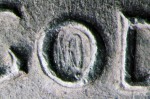
NGC discovered the “Blundered O” not included in the VAM references.
Regardless of whether one point is valid or not, the fact of the matter is that the ANACS staff who examined the coin found a lot of evidence that leads them to believe the coin is counterfeit. Finding counterfeit coins that get by experienced dealers and nearly fools the graders is a serious matter for the hobby. This is why the Hobby Protection Act needs to be strengthened so that we can stop something like this from hurting the hobby.
I will remind everyone that it is not too late to write to your representative and ask him or her to support H.R. 5977 the Collectible Coin Protection Act. In short, the Collectible Coin Protection Act will allow collectors, dealers, and grading services to bring legal actions that are much more effective, with much stronger remedies than previously existed. It will allow those harmed to work with the Justice Department to bring criminal actions, where appropriate.
The only way to ensure that H.R. 5977 becomes law, especially since we are approaching the end of this session in an election year, is to contact your member of congress will let them know that the numismatic community supports this Act and that their support is important. It can be worked on during the lame duck session and members of the Industry Council for Tangible Assets (ICTA) and the Gold and Silver Political Action Committee are working to see this law passed.
WE STILL NEED YOUR HELP!
There are only 11 co-sponsors of this bill as I write this post. We need more co-sponsors to get the attention of the House leadership.
First, see if your member of congress is not a sponsor of this legislation. The best way is to visit govtrack.us, scroll down and and select the “show cosponsors” link. If your representative is not there, here is a sample note to send them (complements of the ICTA):
As your constituent, I urge you to sign on as a co–sponsor of HR 5977, “The Collectible Coin Protection Act.” The bill was introduced on June 12 by Representatives Lamar Smith and Fred Upton, chairs of the Judiciary and Energy & Commerce Committees, respectively.
HR 5977 provides a means whereby US citizens can take legal action against purveyors of the high-quality counterfeit US coins entering our marketplace from China by expanding enforcement power of the Hobby Protection Act. The Hobby Protection Act has been in effect since its passage in December, 1975, but lacks enforcement power that HR 5977 now provides.
HR 5977 is revenue neutral and contains no controversial issues.
Please contact me if you have any questions or if I can provide any additional information. Thank you for your action on this.
Even though the House is not in session, members can still contact the Clerk of the House and ask that their name be added as a co-sponsor. The more names added, the better the chance that the bill will see action in the lame duck session.
Please take this opportunity and contact your representative today!
ADDED: If you do contact your representative, please leave a note here and let me know who you contacted. THANKS!
Image courtesy of NGC.
Sep 18, 2012 | coin design, coins, commemorative, poll, US Mint
Every week, Heritage Auctions sends out an email newsletter from their various auctions. Saturdays, they send out a newsletter about their coin auctions. While the newsletter is mostly about their upcoming auction and tips for using their website, there are some interesting tidbits that make it worth reading. One of the interesting features is the interactive section toward the end of the note.
Up until recently, the interactive section was more of a numismatic trivia-type of section where they asked two questions. You selected your answers and clicked through to their site to see how you did compared to others. Recently, Heritage changed the section to be a poll. This week’s question (copied so you can participate):
This got me thinking as to why were these coins chosen out of all of the possible modern commemoratives. Two are based on classic designs: 1999 George Washington Commemorative $5 gold coin was based on the design that Laura Gardin Fraser submitted for the design of the 1932 Washington Quarter that was turned down by then Secretary of the Treasury Andrew Mellon, a known misogynist; the 2001 American Buffalo Commemorative Silver Dollar was based on James Earle Fraser’s Type 1 Buffalo Nickel design. James Earle Fraser and Laura Gardin Fraser were husband and wife.
The 1992 Olympic Silver Dollar features a baseball pitcher that is similar to the image of Nolan Ryan that appeared on the 1991 Fleer baseball card. Although designer John Deecken denied the connection, the coin is sometimes referred to as the “Nolan Ryan Commemorative.”
One of the significant attributes of the 1999 Dolley Madison Silver dollar is that the coin was designed by Tiffany & Co., the famous jewelry company, whose moniker “T&Co” appears on the coin as the designer. It marks the first time that a private company’s name appears on a United States coin.
Finally, the 2000 Library of Congress $10 Bimetallic Commemorative Coin is the only coin featuring this type of bimetallic composition. The coin features an outer ring made of gold surrounding a center made from platinum.
As I looked at the list, I knew that the 2001 Buffalo Dollar would be the most popular even though I think the 2000 Library of Congress Bimetallic commemorative is the most unique. But why these coins? The U.S. Mint has issued a lot of commemorative coins with great designs since restarting the commemorative coin program with the 1982 George Washington Half Dollar with the 2012 Star Spangled Banner coins being the most recent.
Since I am not a collector of commemorative coins, I was thinking that if I had to choose five coins what would I have chosen and why. Here is my list (in date order):
- 1982 George Washington Half Dollar because it is the first of what we consider the modern commemorative period.
- 2000 Library of Congress $10 Bimetallic Commemorative Coin because it is the only bimetallic coin of its type made by the U.S. Mint.
- 2001 American Buffalo Commemorative Silver Dollar because it is similar to the design of the Buffalo nickel, one of my favorite coins.
- 2008 Bald Eagle Half Dollar with the obverse showing two baby eaglets and an egg in an eagle’s nest with the reverse an image of the Bald Eagle “Challenger.” This coin shows the continuing of the Bald Eagle like the continuing of the nation. I love the symbolism.
- 2012 Star Spangled Banner Silver Dollar screams “United States of America!”

I do own a 2012 Star Spangled Banner Proof Silver Dollar.
Sep 12, 2012 | coins, dollar, grading
Numismatic Guarantee Corporation will go retro with a limited edition 25th Anniversary Holder to celebrate “25 years and 25 million coins.”
The announcement made on September 11, 2012 said that NGC will offer the Limited Edition holder with a black core and special label for Silver Eagles, Sacagawea, and Presidential Dollars for coins submitted between October 1 and December 31, while supplies last. Coins submitted for retro holders must be submitted at the Modern Special tier or higher ($20 per coin, five coin minimum) with no extra fee for special holder. Invoice must be marked “RETRO HOLDER” and no cross-overs allowed. Please read NGC’s announcement for more information.
NGC was founded in 1987, by John Albanese after co-founding Professional Coin Grading Service. For their first month, NGC encased coins they graded in a holder with a black core (see image to the left). The black core was only used for about a month before NGC switched to the white core we know today. Because coin grading was very conservative in 1987 as compared with today, it was common for the coins in the black holders to be cracked and the coins resubmitted in hopes to have the coin grade higher. As a result, fewer coins have survived in those black holders making the holder a collectable unto itself.
This is an interesting gimmick by NGC. Not only have they found another way to get around the “buy the coin, not the holder” sentiment, but without announcing how many holders they will release, could be fueling speculation on the value of the holder as a premium over the coin. No doubt it will add to the continuing discussion as to collectibility of special holders and labels from the third-party grading services.
Sep 8, 2012 | Carson City, cents, coins, errors, fun, gold, silver
I was reading the article “How to follow the money in rare-coin collecting” at MarketWatch.com about the basics of collecting rare coins when I noticed that it pointed to a page withe a slideshow, “The $1 million penny and 7 more famous coins.”
The list has only one “reasonably priced” coin—that is a coin that someone with a little means could afford. It lists the an 1850 Double Eagle at $13,000. That started me to think about the potential to actually owning a few rare collector coins with value and something more align with my tastes. After thinking about this I came up with a list of my “10 Most Desired Coins Within Reason.” In this case, I defined reason as not being so rare that it could only be bought with the help of a good dealer and would not require bidding on it at a once-in-a-lifetime auction. I also set a limit of $5,000 on the price of any coin. I know this may limit the inventory to lower grade for some coins, but those lower grades could give the coin character.
Mostly in denomination and date order, here are Scott’s 10 Most Desired Coins Within Reason:
- 1793 Flowing Hair Chain Cent with AMERI. in Legend is basically amongst the first legal tender coins produced by the U.S. Mint. I know that there was an earlier run of half-dismes, but they were not real production runs. If I am going to produce a list like this, I am going to pick the coin I like and break one of my rules because even at its lowest grade, the coin will probably cost more than $10,000.
- 1909-S Indian Head Cent in Mint State Red. Even though the 1908-S was the first Indian Head cent struck in San Francisco, I am choosing the rarer of the two S-mint Indian Heads in Mint State Red. Of course, this may also break my budget but it would be no fun otherwise.
- 1909-S VDB Lincoln Cent may not be the most expensive Lincoln Cent (the 1914 is), but it is the first of the iconic series and part of the controversy started because of the “V.D.B” initials on the reverse. Fortunately, I already own one graded as VF-30BN by NGC.
- 1955 Double Die Obverse Lincoln Cent is the coin that sparked the interest in error collecting. It is remarkable to think that one coin, a mistake, created a new segment of the hobby. For me, I already own one graded AU-58BN by NGC that I really like.
- 1937-D 3-Legged Buffalo is a very cool coin. Aside that the Buffalo Nickel is one of my favorite coin designs, there is something intriguing about the story behind this coin. Fortunately, the one I own was graded VF-25 by NGC and the last of the ones I already own on this list.
- 1917 Type 1 Standing Liberty Quarter is a compromise because the 1916 would be too expensive. In order to add a type 1 design (with breast exposed), the 1917 version is more reasonably priced in higher grades.
- 1921 Walking Liberty Half Dollar would be the coin I would point to on this list as being my favorite design. For me, only the Saint-Gaudens Double Eagle come close to Adolph Weinman’s design. It should not surprise anyone that Weinman was one of Saint Gaudens’ students. The 1921 half dollars were almost an afterthought as the U.S. Mint was rushing to produce silver dollars and the 1921 fits the criteria to buy one in higher grades.
- 1878-CC Morgan Dollar in the GSA Holder because it is interestingly historic. The Morgan Dollar was authorized by the Bland-Allison Act that required the Treasury Department to buy silver from western mines and put them into circulation as silver dollars. It was passed after the Coinage Act of 1873, sometimes referred to as the “Crime of ’73,” demonetized silver and set the standard for gold as the backing of the national currency. Not only do you get the collectible from a western state near a western mine, but the GSA Holder is from the historic sales of the 1970s after the GSA started pulling coins out of storage in buildings long forgotten.
- 1908 Indian Head Gold Half-Eagle because if you make a list like this, there has to be some gold on it. If I am going to do a gold coin, I want the only coin whose design is incuse to the coin. Bela Pratt Lyon’s incuse Indian Head design is unique and nicely available in its first year of mintage.
- 1907 No Motto Saint Gaudens Double Eagle because this list cannot be complete with the other of the two most iconic designs ever made for a circulating coin. Since 1907 is the first year, this is the most affordable of the three types made that year and is more available than the high-relief versions.
Do you have a similar list? Add it to the comments below.
Sep 2, 2012 | coins, commemorative, news, policy
The following is a summary of the coin-related legislation whose status was changed in August 2012:
Public Law No. 112-169: National Infantry Museum And Soldier Center Commemorative Coin Surcharges
H.R. 3187: March of Dimes Commemorative Coin Act of 2012
H.R.4104: Pro Football Hall of Fame Commemorative Coin Act
S.3517: Panama-Pacific International Exposition and Panama Canal Commemorative Coins Act
H.R. 6331: Panama-Pacific International Exposition and Panama Canal Commemorative Coins Act





 Loading ...