Aug 24, 2012 | cents, charity, coins, fun
On a lighter note, after saving pocket change for nearly two years, I was able to fill a one galling container and an old beer pitcher. Using all the strength left in my aging arms, I carried the container and pitcher to the local bank that offers free coin counting for customers. Even though I am not a customer, my wife is and I deposited the results into her account to save money on the fees.
During the counting process, two of the bags in the machine filled and the teller had to replace them. But after a little more than a half-hour of feeding coins into the machine and checking the rejection bin, all the coins that were countable were counted and I came up with the following totals:
| Coin Type |
Quantity |
Value |
| Dollar coins |
18 |
$18.00 |
| Quarters |
1405 |
$351.25 |
| Dimes |
1247 |
$124.70 |
| Nickels |
793 |
$36.95 |
| Cents |
2108 |
$21.08 |
| Total |
$551.98 |
While I am not surprised that there were more cents than any other coins, I was a bit surprised as there were less than one thousand nickels. Over the next few days I carefully looked at the amount of change and figured out that most of the time, I am receiving quarters and dimes for most transactions ending with a 5. Change of 25, 35, and 45 cents does not require a nickel to be used while change of 55-cents adds a nickel to two quarter—of course I could have received 3 dimes and a quarter, but that was not the case while I was watching carefully.
Of 5,571 coins counted, 38-percent were the lowly Lincoln Cent that represented 3.8-percent of the total value. Although I still maintain that the United State should not end the coin’s production, seeing these results can lead to an interesting discussion. And before you do respond, an informal conversation at the Royal Canadian Mint during the World’s Fair of Money that they are delaying the buy back of their one-cent coins because of social issues brought up by merchants and many citizens. It appears that while many say they were for the elimination of the one-cent coin, when it really happened there are some significant objections being heard. We can discuss this further in the spring after the RCM begins their buy-back program.
There were several rejected coins including six wheat-back Lincoln cents from the 1950s. Somehow a steel cent ended up in the pile—but that may have happened when my cleaning people picked up a stray coin I may have dropped and added it to my pitcher. I also found several foreign coins including Canadian Cents (sorry, I am keeping those), two one-cent coins from Jamaica, a penny from the United Kingdom, a Canadian 5-cent coin, a 5 Eurocent coin with a French reverse, and two 1976 Bicentennial Quarters. There were also three buttons and a $1 note buried in the pitcher.
Proceeds are being donated to three different charities as well as being used for a nice dinner out with my wife. A special donation (on top of divided donation) of the $21.08 from the proceeds of the cents will be donated to Common Cents, creators of the Penny Harvest and the “Official Charity” of the Coin Collectors Blog.
Aug 11, 2012 | ANA, coins, currency, shows
Friday at the World’s Fair of Money was my shopping day. I spent a lot of time walking the bourse floor looking at the various tables thinking about my current goals.
I am working on a special set of currency that will be used for a future exhibit, so I made a beeline to a few currency dealers. I met Steve from Florida. He was formerly from northern New Jersey but moved to Florida a few years ago to get away from the rat race. I had a great time going through the currency at his table. When I explained what I was looking for, Steve was great in showing me items that would fit my theme.
All the dealers I visited were wonderful. I was even able to take a close look at a note I want but cannot afford. I love the $10 Buffalo note that was issued in 1901 (sorry, I forgot the Pick or FR number). The dealer I spoke with said that he would show it to me but I would have to give him the chance to sell me one when I was ready to buy. It was a deal I could not pass.
Now that I had some currency and some coins, I went on a trading binge. I was able to make some trades to upgrade some of the notes and pick up new ones. At one point I found a Morgan Dollar that I recognized was a significant variety in a slab that was unattributed. Even though I am far from being an expert in Morgan Dollar VAMs, I remember reading something about it during my travels. After a quick trip to the NGC table to verify what was in their unattributed slab, I found a dealer interested in VAMs and sold the coin at a nice profit.
So with that money, I was off to the Royal Canadian Mint booth to buy their Philadelphia souvenir set, a gift for my wife, and to other booths where negotiating is difficult to non-existent.
In the middle of the day, the good people at Krause Publications cut a cake celebrating their 60th Anniversary. Doing the honors was former Editor and Publish Cliff Mishler and the current Editor-in-Chief of Numismatic News Dave Harper. While I opted out of a piece of cake, I was given a special KP 60th Anniversary token and an S-Mint quarter as their special giveaway.
I did miss the announcement while shmoozing around the floor that United States Treasurer Rosie Rios was in the area between the U.S. Mint and the Bureau of Engraving and Printing booths autographing currency. Rather than keeping her head down and autographing currency, Treasurer Rios was smiling and engaging to the people getting autographs. It looked like she was genuinely enjoying meeting the people and signing their currency. I have read interviews with Treasurer Rios who said that she is humbled by the attention and enjoys meeting the people. Too bad I didn’t think about it earlier to get on line.
On Friday, I was told I forgot about the revival of the Society of Bearded (S.O.B.) Numismatists that was held on Thursday—and I would qualify as a member! I have to figure out how to join this group!
In the evening I attended the American Numismatic Association Banquet. I sat next to a very nice family and a couple from Lancaster County, Pennsylvania in town to volunteer at the show. I was also at the table with the YN Exhibit Award Winner Morgan Fatora. To say Morgan was happy would be an understatement.
Saturday is the last day. I am only staying part of the day before heading home. Continue to follow me on Twitter and the pictures on Pinterest for the short time I will be at the show.
Aug 7, 2012 | books, coins, iPad, review, values
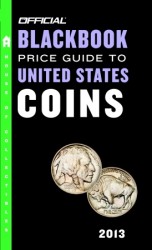 Regular readers know that I am an advocate of the electronic world, especially when it comes to references that should be available in a more portable manner than paper. While dead tree editions will continue to be produced, certain references deserve to be provided in electronic form for portability.
In the collecting world, price guides are great to have in electronic form. You can carry them on your smart phones or tablets when you go to shows to have some idea what your potential purchase is worth. Understand that printed price guides are not the best source for prices. Prices can change daily, even hourly depending on market conditions including the costs of metals. At least the price guides will provide a general idea of the item’s value.
Price guides have more value than the prices. Some have very good and even excellent numismatic information. We know about the usual suspects in this area, but a reference to look at is The Official 2013 Blackbook Price Guide to United States Coins. The Official Blackbook is now in its 51st Edition.
I was provided an electronic review copy by the publisher with the only condition that I write this review.
Starting with the format, I cannot argue with that it is available as an e-book and complies with the full EPUB standard where the contents work, is searchable, allows bookmarks, and works well even on the iPad’s pedantic e-reader. Because e-book readers do not handle tables well, they have to be embedded as images (EPUB 3, which is still in development, should change this). However, The Official Blackbook does it in a way that makes it easy to resize them on smaller devices like the iPhone.
E-book usability issues should not be taken lightly. It is easier for publishers to publish e-books as PDF files or using other tricks that does not take advantage of the electronic formats. House of Collectibles, an imprint of Random House Reference, should be commended for doing this right.
One nice feature added by the publisher is the “Fast-Find Coin Reference Index.” This is a list of coin types, like Colonial Coins, and the name of the coin (e.g., Brasher Doubloons) that are clickable links back to the text. My only complaint is that this is the last entry in the Table of Contents and could be missed by the reader. Even though it is toward the end, I would move the entry near the top because it is that useful.
As a price guide, it is as good as any on the market with multiple price points, showing the differences between types, and mintages for each year. The tables do carry over the check box from the print edition that could be used to mark coins owned, but that is of limited usefulness in the electronic version.
After the price guides are very useful chapters about the contents of U.S. coinage. The chapters, “Primary Metals,” the silver and gold coin value charts, and the weights and measures are very good references. While other books have them interspersed within their pages, I like having this information in their own chapters.
Each section starts with a 2-3 page description on each coin type noting history, major varieties, and some design information. Where there are interesting subtleties between types, the authors provide images for the reader as a reference. Some references do this inline with the price guide, I like the idea of showing the images first and leaving the price tables as clean as possible.
At some point, the authors need to consider updating some of the numismatic writing and think about how to make it a better reference than just a series of articles. For example, the chapter “Coin Auction Sales” needs to be updated to include how most auction houses now offer Internet bidding, some are exclusively Internet bidding, and that the section’s author, Q. David Bowers, has not worked at Bowers and Merena in quite some time—I believe it was 2003 when he sold is interest in the company which since 2010 has become part of Stack’s Bowers.
The chapter “Expert Tips on Buying and Selling Coins” has some good information but needs to be updated to include buying over the Internet, using online auctions, and to separate the section on grading. In fact, the section about grading could be greatly enhanced as a standalone chapter and provide a better service to readers.
One chapter that either has to be rewritten or deleted from future books is the “Mobile Computing…” chapter. Aside from being seriously out of date with today’s online and mobile world, it is heavily slanted to support the business model of section author’s company. While it would not be bad for the author to include a blurb about their company at the end of the chapter, the entire chapter reads like one of those worthless white papers that I receive from computer vendors on a daily basis.
The two chapters that make the book worth buying is are the chapters “Erros and Varieties” and “Civil War Tokens.” Both chapters are very well written, informative, and if you do not learn something from either chapter, then you are not reading carefully. Although the author is not listed with the chapter, Mike Ellis s listed as a contributor. For those who are unfamiliar with Ellis, he is currently the CONECA Vice President and a leading expert in variety and errors. Having heard him speak in the past, having this chapter written by him is a great addition to the book and worth reading.
I also thought the chapter “Civil War Tokens” by Dale H. Cade was phenomenal. I never really thought about Civil War Tokens and their impact on commerce because of the coin shortages, but it was a fascinating read. In fact, I am re-reading this chapter because I know I missed some things while reading it for this review. I know I will now look at Civil War tokens in a different light.
There are other areas like Civil War tokens that the authors/editors of the book should consider adding as well as other impacts on U.S. coinage.
The bottom line is that after 51 years, it may be time to find a new editor to update this book and make it more reflect modern references. It has some great information, some good information, some information that is just plain useless, and there is information that could be added to enhance the book. But the great really shines while the good needs a little updating to make it great. For these reasons, I give the book a grade of MS62 with hopes that the 52nd edition will be better. I think that a proper refresh could make The Official Blackbook rival its red-colored counterpart.
Aug 3, 2012 | coins, commemorative, legislative
 The White House announced today that President Obama signed the National Baseball Hall of Fame Commemorative Coin Act into law (H.R. 2527). The law calls for the U.S. Mint to commemorate the the National Baseball Hall of Fame in Cooperstown, New York with a three-coin commemorative program consisting of a $5 gold coin (50,000 maximum mintage), $1 silver coin (400,000 maximum), and a clad half-dollar (750,000 maximum) struck as uncirculated coins or as proofs.
The bill requires an open competition for a common obverse design “emblematic of the game of baseball” with a $5,000 minimum prize for the winning design. The common reverse will “depict a baseball similar to those used by Major League Baseball.”
Surcharges will be $35 per gold coin, $10 per silver coin, and $5 for the clad half-dollar to be paid to the National Baseball Hall of Fame for their continuing operations. If all the coins sell out, the Hall of Fame will receive $9.5 million for ongoing operations.
The bill was sent to the White House on July 25, 2012 and was signed today.
National Baseball Hall of Fame logo courtesy of the National Baseball Hall of Fame.
Aug 2, 2012 | coins, US Mint, video
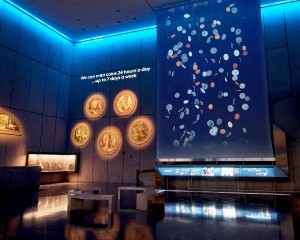
The new visitor lobby at the Philadelphia Mint
Eleven members of the media were invited to see the new tour area, access to the Mint floor, Mint employees, and other areas of the Mint not accessible by the public.
Tom Jurkowsky, Director of Public Affairs, was sure to point out that the project was, “on time and on budget.”
Finally, the Philadelphia Mint held an opening ceremony to 250 invited guests and Mint employees. Speaking at the ceremony included Associate Mint Director Dick Peterson and Treasurer of the United States Rosie Rios. The ribbon was cut by Rios flanked by Peterson and Jurkowsky.
You can download the brochure A Handbook to the Self-Guided Tour of the United States Mint [PDF] from the U.S. Mint’s website.
The U.S. Mint recently provided a video about the opening of the new tour area. You can watch it here:
Anyone attending the World’s Fair of Money next week in Philadelphia may want to consider taking the new tour and adding your comment about it here!
Jul 30, 2012 | BEP, coins, currency, education, legislative, policy, US Mint
There has been a lot of legislation passed by Congress that affects the coin and currency production in the United States. While some of it has been as mundane as changing the composition of coins or the approval of a commemorative coin, there are some that has had a significant impact on coin and currency production. Here is a list of those laws that had a major impact.
- Coinage Act of 1792
- The first coin-related law passed by congress and signed by President George Washington on April 2, 1792, establishes a mint, says that congress is the regulating authority of coins, and establishes the dollar as the unit of money. It made the United States one of the first countries to use a decimal system for currency and established legal tender laws. It is the foundation for the creation of the money production in the United States.
- Act of April 10, 1806
- This act regulates the legal tender value of foreign coins used in the United States.
- Act of April 21, 1806
- This act establishes the penalty for counterfeiting coins to be between three and five years of hard labor. Although there was no law regarding counterfeiting coins before this act, it was assumed that penalty was death because of the statements printed on colonial currency.
- Coinage Act of 1834
- This act changed the ratio of silver-to-gold weight from 15:1 that was established in the Coinage Act of 1792 to 16:1, setting the price of an ounce of gold to $20.67. This was done to strengthen the financial system after the Panic of 1833 and stem the tide of paper currency in favor of “hard money.” President Andrew Jackson signed this bill into law on June 27, 1834.
- Coinage Act of 1849
- Signed into law by President James K. Polk as one of his last acts as president on March 3, 1849, it established the use of gold for a $1 coin and the $20 gold double eagle coin. This act also refined the variances that were permissible for United States gold coinage. This act came largely because of the California Gold Rush.
- Coinage Act of 1857
- Signed into law by President Franklin Pierce February 21, 1857, this act repealed the legal tender status for foreign coins in the United States. It required the Treasury to exchange foreign coins at a market rate set by Treasury. This act discontinued the half-cent and reduced the size of the one-cent coin from 27mm (large cent) to the modern size of 19.05mm (small cent) that is still being used today.
- National Bank Act of 1863
- Originally known as the National Currency Act and signed into law by President Abraham Lincoln on February 25, 1863, it created a single currency standard for the United States where the notes would be backed by the United States Treasury and printed by the federal government. The result of this act lead to the establishment of the National Currency Bureau which was later rename to the Bureau of Engraving and Printing.
- Coinage Act of 1864
- This act changed the composition of the one-cent coin to bronze (0.95 copper, 0.05 tin and zinc) from 0.88 copper and 0.12 nickel. It authorized the minting of the two-cent coins with the motto “In God We Trust” to appear the first time on a United States coin. President Abraham Lincoln signed this act into law on April 22, 1864.
- Coinage Act of 1873
- Sometimes referred to as the “Crime of ’73,” demonetized silver and set the standard for gold as the backing of the national currency. This act placed the U.S. Mint under the jurisdiction of the Department of the Treasury and officially established four branch mints at Philadelphia, San Francisco, Carson City, and Denver. Two assay offices were established in New York and Boise City, Idaho. The act also ended the production of the half-dime, silver three-cent piece, and two-cent coin. President Ulysses S. Grant signed this act on February 12, 1873.
- Bland-Allison Act
- Named for Rep. Richard P Bland (D-MO) and Sen. William B. Allison (R-IA), the act required the Treasury Department to buy silver from western mines and put them into circulation as silver dollars. The act authorized the striking of the Morgan Dollar. President Rutherford B. Hayes vetoed the bill but congress overrode his veto on February 28, 1873.
- Sherman Silver Purchase Act
- Signed into law by President Benjamin Harrison on July 14, 1890 and named for Sen. John Sherman (R-OH), the law increased the amount of silver the government was required to purchase from western silver mines.
- Federal Reserve Act of 1913
- President Woodrow Wilson signed the Federal Reserve Act into law on December 23, 1913 that allowed the creation of the Federal Reserve System as the central bank of the United States. It also granted the Federal Reserve authority to issue Federal Reserve Notes and Federal Reserve Banknotes.
- Pittman Act
- Named for Sen. Key Pittman (D-NV) and signed into law by President Woodrow Wilson on April 23, 1918 authorized the conversion of up to 350 million silver dollars into bullion for sale or to be used to strike subsidiary coinage. The act required the government to buy all silver mined in the United States at a fixed price of $1 per ounce above market rate.
- Gold Reserve Act of 1934
- Even though Franklin D. Roosevelt as part of Executive Order 6102 ordered the withdrawal of gold from the economy on April 5, 1933, there was one challenge and one reissue of the executive order. Congress felt that the executive order needed codification and passed this act on January 30, 1934. Roosevelt signed the law the same day. The law withdrew all gold and gold certificates from circulation and outlawed most private possession of gold with the exception of some jewelry and collector coins. This act established the nominal price of gold to $35 per troy ounce.
- Public Law 84-851 (70 Stat. 732, H.J.Res. 396)
- On July 30, 1956, this law established the national motto of the United States to be “In God We Trust.” While the motto appeared on most coins of the time, the Bureau of Engraving and Printing phased it in on currency between 1957 and 1965.
- Coinage Act of 1965
- In response to the coin shortages caused by the rising silver prices, the act eliminated silver from circulating dimes, and quarters while reducing the amount of silver used to strike half-dollars from 90-percent to 40-percent for five years. After five years, the half-dollar would be struck using the same copper-nickel clad composition as the lower denominations. The act forbade the striking of silver dollars for five year ending an experiment with the striking of Peace Dollars in 1964. Finally, the act made all coins and currency produced in the United States and certain bank issues as legal tender–which reversed the 1876 demonetization of the Trade Dollar. Signed into law on July 23, 1965 by President Lyndon B. Johnson, it is seen as the dividing line between “classic” and “modern” coinage.
- Hobby Protection Act or 1973
- Signed into law by President Richard Nixon on November 29, 1973, this act requires that replica collectibles, including coins, be marked “plainly and permanently” with the word “COPY” to indicate that the item is not genuine. This act grants the Federal Trade Commission permission to take action against suppliers who violate this act.
- Statue of Liberty-Ellis Island Commemorative Coin Act—Title II: Liberty Coins
- Signed by President Ronald Reagan on July 9, 1985, Title II of this act allowed for the U.S. Mint to establish the American Eagle Silver Bullion Program.
- Gold Bullion Coin Act of 1985
- A few months after the passage of the act to allow for silver bullion coins, this act was enacted on December 17, 1985 that lead to the establishment of the American Eagle Gold Bullion Program.
- 50 States Commemorative Coin Program Act
- Considered one of the most significant act affecting circulating coinage since the Coinage Act of 1965, this act lead to the very successful 50 State Quarters Program. Section 4 of the act, named the “United States $1 Coin Act of 1997” changed the composition of the one dollar coin to be “golden in color” which lead to the creation of the Sacagawea “Golden” Dollar. President Bill Clinton signed this bill into law on December 1, 1997.
Jul 22, 2012 | coins, currency, fun, web
If you are not following me on Twitter or Pinterest you are missing some interesting extras that may not make it to the blog. While I can include Twitter updates on this page (see the right column), pins to Pinterest are a little more elusive unless I remember to click the box to post the pin to Twitter.
My newest pins on Pinterest came from the U.K.’s Daily Mail Online from a story about Evan Wondolowski, an artist who uses currency and coins to make portraits of politicians and celebrities. These portraits are made using shredded Federal Reserve Notes on newspaper. He make a portrait of President Obama using Lincoln Cents including 1943 Steel Cents.
Wondolowski is the Creative Director and co-owner of Mozaiks, and artist-based clothing company. His art can be see at his website The Art of E and usually depicts images of greed and politics.
Below are the images from the Daily Mail Online article. If you want to see the full images, visit Wondolowski’s online gallery.
If you are not on Pinterest and would like an invite so you join, drop me a note and if I have any invites I will send you one.
Jul 13, 2012 | coins, education, history, US Mint
A mintmark is part of the coin design that tells which mint the coins were produced. Using mintmarks to identify where coins were made began in ancient Greece. Coins that were released into circulation were required to have a “Magistrate Mark,” a distinct mark representing the magistrate in charge of producing the coin. If a coin was to have problems, whether by accident or on purpose, the government knows who the responsible party was.
Mintmarks were first used in ancient times as a quality control mechanism. If a coin did not fit the specifications (under or overweight, not the right metal, etc.) it was easy to identify where the coin was made.
Another type of mark made on non-United State coin is a privy mark. A privy mark is a small design added to the coin to identify the where the coin was made, the coiner responsible for the coin, or some other aspect of the coin’s production for quality control purposes. Privy marks fell out of favor in modern times and countries with multiple branches use lettered mintmarks. Some mints use privy marks to differentiate different types of non-circulating legal tender coins.
Mintmarks used on United States coins are as follows:
P: Philadelphia, Pennsylvania (1793-present)
The U.S. Mint was formally founded with the passage of the Mint Act of 1792. David Rittenhouse, the first Mint Director, was able to find a building in Philadelphia and begin operations in 1793. The first mint building served the country until 1833. The second mint building served from 1833-1901 and was demolished in 1902. The third mint was in service from 1901-1969. The building is now part of the Community College of Philadelphia. The fourth mint, located two blocks from the location of the first mint building, was opened in 1969 and continues to be used today. Up until 2009, it was the largest mint building in the world. However, no other mint in the world produces more circulating coinage than the Philadelphia mint.
All coins struck in Philadelphia from the founding of the Mint in 1793 until 1980 did not include a mintmark. The exception was the Type 2 Jefferson Nickels minted using the wartime alloy from 1942-1945. Coins struck using the silver-copper-manganese alloy feature a large mintmark above Monticello, including a “P” for Philadelphia.
In 1979, Susan B. Anthony dollars struck in Philadelphia included the “P” mintmark.
Beginning in 1980, all coins struck in Philadelphia, except for the Lincoln Cent, includes the “P” mintmark.
C: Charlotte, North Carolina (1838-1861)
Charlotte became the first branch mint outside of Philadelphia. Authorized in 1835 following the gold strike at the Reed Gold Mine, it first became operational in 1838. The Charlotte branch mint was closed when the building was seized by the Confederacy during the Civil War in 1861. It was not reopened after the war. The Charlotte Mint’s “C” mintmark only appears on gold coins.
D: Dahlonega, Georgia (1838-1861)
The Dahlonega Branch Mint was authorized by congress in 1837 after the Georgia Gold Strike. It opened for production in 1838. Like the Charlotte Mint, the Dahlonega Mint was seized by the Confederacy during the Civil War in 1861 and was never reopened. Gold coins dated 1838-1861 with the “D” mintmark were struck in Dahlonega. Coins with the “D” mintmark starting in 1906 were struck in Denver.
O: New Orleans, Louisiana (1838-1861 and 1879-1909)
The branch mint at New Orleans was authorized by congress in 1836 as part of a discussion to make New Orleans a central trading gateway to the Midwest. This branch mint struck all denominations with the “O” mintmark. In 1861, the building was seized by the Confederacy and used by the Confederate government to strike coins. The Union Army recaptured New Orleans and the building in 1862. Unlike Charlotte and Dahlonega, the New Orleans Mint was eventually reopened. Its second life began as an assay office in 1876. With the passage of the Bland-Allison Silver Act of 1878, the building was refurbished to bring it back to coining standard and was used to strike silver coins, mostly dollars, until 1909. It was closed for the last time in 1909 with production down and Denver taking over the production load.
S: San Francisco, California (1854-1955 and 1968-present)
The San Francisco branch mint was opened in 1854 to assay and coin gold discovered during the California Gold Rush. The first building, known as the “Granite Lady,” was one of the few buildings to survive the Great San Francisco Earthquake of 1906. During the aftermath of the earthquake, Superintendant Frank Leach helped local residents by allowing them to use the grounds as a refuge. A new building was opened in 1937 and celebrated its 75th anniversary in 2012. Today, the Granite Lady is being refurbished as the Museum of San Francisco.
San Francisco produced circulating coins with the “S” mintmark until 1955 when production was suspended and the facility was “downgraded” to an assay office. Production of proof coinage was transferred to San Francisco in 1968 and they began to strike some coinage for circulation until 1974. Since 1975, San Francisco produced only proof coins along with cents without mintmarks to supplement production from Philadelphia. It is not possible to distinguish from no mintmark cents from either mint. San Francisco also produced circulating Susan B. Anthony dollars 1979-1981 with the “S” mintmark. They were granted mint status in 1988.
CC: Carson City, Nevada (1870-1893)
After the major discovery of silver as part of the Comstock Lode in what is Virginia City today, politicians lobbied congress for the formation of a branch mint to assay and strike coins. Congress authorized a mint in 1868 for nearby Carson City and the building was opened for production in 1870. The Carson City branch mint struck silver and gold coins but in lesser amounts than the other mints, making their coins highly collectible and more expensive because of their rarity. The “CC” mintmark is the only two-character mintmark used on U.S. coins.
Production ended in 1893 with the reduced production from nearby silver mines. Starting in 1895 the building served as an Assay Office until the gold recall of 1933. The building was sold to the State of Nevada in 1939 and was turned into the Nevada State Museum.
D: Denver, Colorado (1906-present)
During the Pikes Peak Gold Rush, congress authorized the opening of a Denver assay office in 1863. Congress authorized the building of a branch mint in 1896 and construction began in 1898. Operations from the assay office were transferred to the new building in 1904 and the mint started to strike circulation coins in 1906. Denver struck gold coins until 1933 when gold was recalled. All coins with the “D” mintmark struck since 1906 were minted in Denver. Earlier gold coins dated 1838-1861 were struck in Dahlonega, Georgia.
W: West Point, New York (1976-present)
In 1937, the Treasury built a facility on the northern part of the campus of the U.S. Military Academy to store silver. Originally, it was called the West Point Bullion Repository and was nicknamed as “The Fort Knox of Silver.” From 1968-1973, West Point produced cents without a mintmark in order to supplement the production from Philadelphia. They also produced Bicentennial and Washington Quarters 1975-1979 without mintmarks.
The “W” mintmark first appeared on the 1983 Olympics Commemorative Coins. West Point produces coins for the American Eagle Bullion program without mintmarks but produces collectable versions of the American Eagle with the “W” mintmark. Other commemoratives have been struck at West Point that includes the “W” mintmark.
The same bill that returned the San Francisco branch mint back to mint status in 1983 granted mint status to the West Point branch mint.
M: Manila, Philippines (1920-1941)
After the Philippines became a colony of the United States, the U.S. Mint established a branch mint in Manila. It is the only branch mint outside of the continental United States. The mint opened in 1920 and produced coins in one, five, ten, twenty, and fifty centavo denominations. Coins struck by this mint bear either the “M” mintmark or no mintmark.
Jul 9, 2012 | coins, counterfeit, grading, policy
I attended the event sponsored by the Gold and Silver Political Action Committee (GSPAC) on June 27, 2012 to lobby them for passage of the Collectible Coin Protection Act (H.R. 5977) introduced last month by Rep. Fred Upton (R-MI), Chairman of the U.S. House Energy and Commerce Committee, and Lamar Smith (R-TX), Chairman of the U.S. House Judiciary Committee. This is a bill that everyone in the numismatic committee should support and ask their member of congress to support.
For now, I will let the folks at PCGS tell you their experiences at the event (their press release follows). I will follow up at some point with my own thoughts and commentary on the topic. Also, while the press release has one picture, there are three more that I posted to Pinterest that I think are more interesting, including a Morgan Dollar that was cut in half to marry a specific date with a mintmark that was placed in an altered PCGS holder and sent to PCGS for verification. It is fascinating what some people will do and what they get away with.
PCGS Gives Congressmen A Close Look At Counterfeiting Problems
(Washington, DC) – During June 27, 2012 meetings with numismatic leaders in Washington, DC, influential U.S. Congressmen and congressional staff members learned about rare coin authentication and were shown examples of counterfeit coins from the Professional Coin Grading Service (www.PCGS.com) reference collection and examples of counterfeit PCGS encapsulation holders. PCGS has detected over 5,500 counterfeit coins submitted in the last 12 months, a higher number by far than in any previous 12-month period.
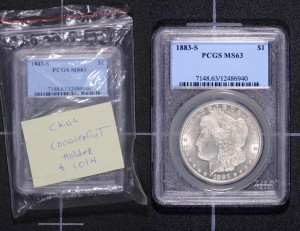
PCGS representatives showed Congressmen counterfeit U.S. coins in counterfeit PCGS holders during their recent meetings in Washington, DC. (Photo courtesy of PCGS.)
Vartian met with Rep. Fred Upton (R-Michigan), Chairman of the U.S. House Energy and Commerce Committee, Lloyd Doggett (D-Texas), a member of the House Ways and Means Committee and staff members for other Congressmen including Howard Berman (D-California), the second ranking Democrat on the House Judiciary Committee.
“It was a very successful series of meetings. The Congressmen and staff members focused on the items we brought; actual counterfeit coins and counterfeit holders, and heard about the on-going efforts by PCGS to combat dealers who sell fake coins and holders. We also talked about educating collectors and dealers. But now the numismatic community must come together and urge other members of Congress to support and approve changes to the law.”
Those proposed changes are in HR5977, the Collectible Coin Protection Act of 2012, a bill that would amend and significantly strengthen the Hobby Protection Act of 1973. The Washington meetings were aimed at educating members of Congress about the counterfeiting problems and the need for stronger laws.
“Every collector, every dealer, should personally contact their Congressional representatives now and specifically request they support HR5977,” Vartian emphasized.
“There are several very positive elements in the bill (HR5977) for PCGS and for all collectors and dealers who buy and sell PCGS-certified coins. One provision provides for triple damages for counterfeiting third-party holders such as the patented, sonically-sealed PCGS tamper-evident holders,” said Don Willis, PCGS President.
HR5977 was introduced on June 20 by Congressman Lamar Smith (R-Texas), Chairman of the U.S. House Judiciary Committee, and co-sponsored by Congressman Upton.
The Washington meetings were organized by the Gold & Silver Political Action Committee. In addition to PCGS, representatives of the Industry Council for Tangible Assets (ICTA), the Professional Numismatists Guild (PNG) and Numismatic Guaranty Corporation (NGC) also attended along with former Louisiana Congressman Jimmy Hayes, a long-time collector.
The Hobby Protection Act, first enacted in 1973 and amended in 1988, requires manufacturers and importers of imitation numismatic items to mark them plainly and permanently with the word, “COPY.” The Collectible Coin Protection Act would expand and strengthen the consumer protections to provide remedies against sellers of such items and others who substantially assist them. It also would increase penalties for fake coins fraudulently sold inside counterfeit grading service holders.
Barry Stuppler, Chairman of the Gold & Silver PAC, said if approved by Congress and signed into law by the President the new law would:
- Include not only the distribution but also the sale in commerce of prohibited items;
- Add a provision expanding the Hobby Protection Act to include “any person who provides substantial assistance or support to any manufacturer, importer, or seller” knowingly engaging in any act or practice that violates the Act;
- Expand the venue for legal action to include not just having an agent present, to include “transacts business” — or wherever venue is proper under section 1391 of Title 28, United States Code;” — and
- Add a section on Trademark violations specifically written to include the certification services and adds remedies to the Hobby Protection Act that currently exist under the Trademark Act of 1946 (U.S.C. Title 15, Sections 1116-1118) for violations of the Hobby Protection Act.
In a statement prior to the meetings, Willis stated: “Chinese counterfeiting is the most serious challenge faced not only by the collectibles markets and brand name products, but also by the United States Treasury. Entire industries have sprung up in China to manufacture virtually anything made in America including U.S. Government issued coins. These factories and industries operate in the open and with the full support of the Chinese government. By its lack of action to stop the activities, the Chinese government endorses the counterfeiting of U.S. coins.”
“Even worse, Customs and the U.S. Government do little to stop counterfeits from entering the U.S. Once in the US little effort is made to arrest and prosecute individuals selling counterfeit material. Consequently the U.S. has been flooded with counterfeit products, including coins, resulting in the loss of billions of dollars in revenue each year,&rdquo Willis explained.
Jun 28, 2012 | apps, Baltimore, coins, news, shows, technology, web
Although I usually do not post press releases verbatim, timing and relevance to the Whitman Baltimore Coin & Currency Expo this weekend makes this an exception. Besides, it is about technology and I am for any personal tech that will improve numismatics. I will be attending the show on Friday and will provide a full review thereafter.
Find Coins Fast With Collectors Corner CoinSearch™, m.collectorscorner.com, at June 2012 Baltimore Expo
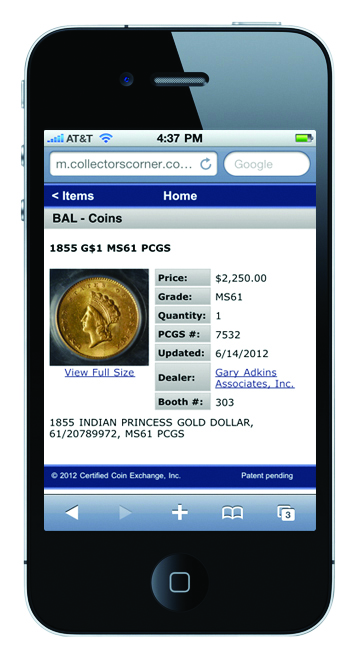
(Baltimore, Maryland) – The first mobile application of its kind for collectibles, Collectors Corner CoinSearch™, will be available free during the upcoming Whitman Baltimore Coin & Collectibles Expo. The unprecedented mobile app will let collectors instantly locate specific coins they’re looking for at the show, June 28 – July 1, 2012.
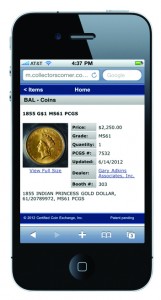
The free Coin Collectors Corner CoinSearch™ mobile app lets users see photos and information about specific coins available at the Baltimore Expo.
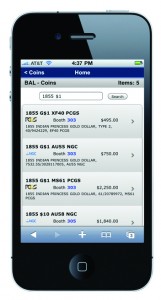
Collectors and dealers can use the free Collectors Corner CoinSearch™ mobile app to instantly locate Baltimore Expo dealers who have specific coins in inventory.
“The app was successfully beta tested with great results at the recent Long Beach Expo, and we’re now offering it for collectors and dealers at the Baltimore show,” said Cassi East, President of CCE, a division of Collectors Universe, Inc. (NASDAQ: CLCT).
“Coin buyers will be able to use their smart phones, iPads or other mobile tablet devices to find the exact coins they’re seeking during the Baltimore Expo, and even prior to the show. They»ll also be able to immediately pinpoint the exact bourse floor locations of the dealers who have those specific coins in their inventory.”
Before the show, dealers can list coins in their Collectors Corner inventories that they’ll have at their Baltimore tables. Collectors and other dealers then can use the Collectors Corner CoinSearch mobile app to easily locate any coins they’re seeking.
The ability to post Collectors Corner listings in the Baltimore Expo CoinSearch data base at m.collectorscorner.com will be available for all CCE member dealers at no additional charge as part of their CCE membership.
“CCE members can call us at (800) 733-6623, and we’ll walk you through the easy download mechanics,” explained East.
“This is an incredible, free service for collectors to locate exactly what they’re looking for. Everyone can use it,” said David Hall, President of Collectors Universe. “Mobile apps are the future, and this is a great collaboration between dealers, collectors and show promoters to bring together buyers and sellers.”
Additional information about the Whitman Baltimore Expo is available at www.whitman.com/expos.
Additional information about the Collectors Corner CoinSearch app m.collectorscorner.com is available by calling Collectors Corner at (888) 469-2646 or by visiting www.collectorscorner.com/marketnews/?name=CoinSearch.
Images courtesy of Collectors Universe, Inc.





 Loading ...