We do not follow maps to buried treasures and X never ever marks the spot.
Professor Indiana Jones could have been talking to coin collectors in 2014 instead of his 1940s-era archaeology class at the mythical Marshall College in “Indiana Jones and the Last Crusade.”
Those watching the coin-related news on both sides of the Atlantic Ocean (“the pond”) may have noticed that finding buried treasure appears to be a consistent theme. Even though some dealers and grading services have complained about the lack of fresh inventory to excite collectors, could new era of coin collecting be fueled by treasure hunters?
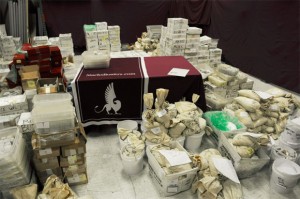
This week, Stack’s-Bowers announced they have been searching through a hoard they call the West 57th Street Collection. Stack’s has reported that the 30-ton hoard could be worth $15-20 million and includes coins of all types including nearly 10,000 1909 VDB Lincoln cents. Coins will be sold by Stack’s-Bowers via their online auctions with the rarities being sold at their larger events like the auction at the Whitman Baltimore Expo and American Numismatic Association World’s Fair of Money.
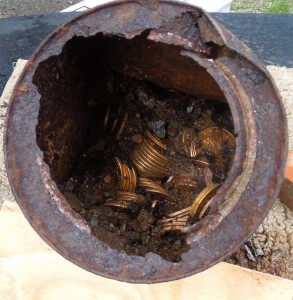
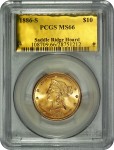
Two weeks ago, Kagin’s made public the finding of the Saddle Ridge Hoard, a hoard of 1,427 gold coins found in cans buried under a tree somewhere in California. Although the names of the finders of the coins is being kept secret, it was reported that the tin cans filled with 19th century gold coins were found by a couple walking their dog.
A man from Victoria Island, British Columbia found an English shilling from around 1551 using a metal detector. It is the oldest coin found on the west coast of Canada. Local experts theorize that the coin was brought to the area by Sir Francis Drake who was sent on a secret exploring mission in 1557. Allegedly, Drake gave the coins to the native peoples as proof the English laid claim to the land. The man who discovered the coin is recently retired who took up metal detecting hunting as a new hobby.
Another metal detector enthusiast in found a 1700-year-old Roman gold coin in Wiltshire, England. The coin was struck for Emperor Licinius I in AD 313 and struck in Trier in Germany, the site of the main mint of the western Roman Empire. The coin was to be sold at auction in December somewhere in London and estimated to bring £30,000 (approximately $48,000). Unfortunately, there have been no follow-up news reports regarding the sale of this coin.
In June 2013, it was revealed that a man found 159 gold coins 20 minutes into his first ever outing with a metal detector. The hoard was found in a field near St. Albans in Hertfordshire, England buried about 7-inches below the surface in October 2012. Publicity for the hoard came on the day a formal inquest was held to determine the ownership of the coins as required by British law. Inquests are publicly announced so that claims may be made. Anyone who can prove a legal claim to the hoard may challenge the ownership. As with most cases of ancient coin finds, only the press comes to gawk at the new found fortune.
What makes this a remarkable story is that the man who found the coins was 20-mintues into his first metal detector hunt. Not sure he wanted to take up metal detecting as a hobby, the man purchased a low-end model recommended for people exploring the hobby or families doing casual metal detecting. For this man, it paid off when he found an ancient Roman solidus estimated to be about 1,600 years old just 7-inches below the surface. The hoard is estimated to be worth £100,000 (approx. $156,000).
With the exception of the West 57th Street Hoard, the other treasures were accidental finds. Whether you are a couple out walking your dog or taking your metal detector out for the first time, it appears that buried treasure still exists.
This does not even account for the finding of sunken treasure like the $77 million of silver found Odyssey Marine discovered at the bottom of the Atlantic Ocean in July 2013. The silver was found on what is supposed to the British steamship SS Gairsoppa, a ship that was sunk by a torpedo from a German U-boat while transporting the silver from England to India in 1941. As with most large finds, this discovery is tied up in court proceedings.
Does this mean that there are no treasures for others to find? That is difficult to say because we do not have maps and, with the exception of the movies, X does not mark the spot.
If you want to try to find a treasure, you need to consider what the world was like in years past and not today. Was the area you are searching once a forest that was not inhabited or was the area that is a park or forest today once a village, town, or small city? Is there a trail that was one a well-travelled trade road or could that trade route be buried under your neighborhood?
A friend who goes out regularly with a metal detector says that most of the finds are not made by dumb luck. Successful metal detector hobbyists take the time to research the areas which they are interested to understand what was once in that location. Before going on a search, they will go to libraries or town halls to look at past records. This gives an insight into what was once in the area they want to search so that they can concentrate their limited time to get the best reward.
Although we are interested in finding coins, metal detectors will find anything metallic including old tools, pottery that was glazed with metal-based enamel, weapons, spent bullets, armament, and anything else made of metal. The friend mentioned above found a lost town in the Midwest. It appears to have been the proverbial waterhole along the railroad, a stop along the tracks for the steam engines to refill their water tanks. The town died after diesel locomotives made the need for a water stop unnecessary. They did find coins but many were unremarkable or common for the period but kept with the town that has been turned into a tourist attraction.
If you decide to do some treasure hunting and find something, let me know. I would love to bring the story to the community.
One of the cans found as part of the Saddle Ridge Gold Coin Hoard
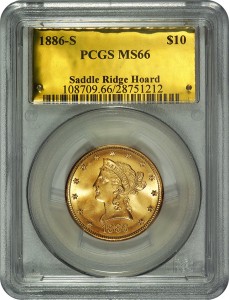
One of the 1,427 “Saddle Ridge Hoard” buried treasure gold coins certified by PCGS.
Image of the West 57th Street Collections (Image courtesy of Stack’s-Bowers)
One of the cans found as part of the Saddle Ridge Gold Coin Hoard
Anyone following the main stream media has heard of the Saddle Ridge Hoard, the 1,427 gold coins found in cans buried under a tree somewhere in California. The couple who found the coins and their location has been kept confidential to prevent potential prospectors on their property. Reports have surfaced that the find has opened a new gold rush in California.
This is not to say that treasures can only be found in California. As someone who has started a business dealing with collectibles, I have found interesting items at good prices in the most unexpected places. The concept is not to start digging where someone else made their discovery but look for clues to new finds elsewhere. Chances are that the next find will not be the same area.
One of the more interesting aspects of the Saddle Ridge Hoard story is the speculation of where the coins came from and why were they buried in that location. The most entertaining was the story that these coins were stolen in 1901 from the U.S. Mint in San Francisco. Even though it sounds plausible, the details of what would have happened based on historical record does not support this theory.
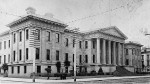
The old San Francisco Mint building built in 1874
Based on the response of David McCarthy, senior numismatist for Kagin’s, the firm working with the family, the two factors that debunks the theory that the coins were stolen from the Mint is that the coins in the hoard were mixed dates with the latest being six years prior to the theft and many of them were circulated. If they were stolen from the Mint, they would be all uncirculated, one date, and all with S-mintmarks.
Also, the U.S. Mint is not a bank. It does not save inventory. Records† show that over the years, the U.S. Mint loathes keeping inventory for long periods of time. These sources report a revolving inventory suggesting that only the 1933 Double Eagles may have been kept in the vaults longer than other coins while the policies about gold coins were being settled.
Anticipating the question about the GSA Hoard of silver dollars, those coins were not stored by the U.S. Mint. Those dollars were delivered to the Department of the Treasury to use as backing for silver certificates. The storage areas where the coins were found were either facilities used or leased by Treasury. Coins that were melted under the Pittman Act for sale to the British to help them fund their defense in World War I were coins held by the Treasury. Coins struck to replace the melted coins were then stored in Treasury facilities.
When the General Services Administration (GSA) worked to consolidate and reduce office space in the 1960s, millions of mostly Morgan dollars struck in Carson City were found in several buildings including in storage areas off the historic cash room in the Treasury Building in Washington, D.C. Coins were sold the public by sealed bid over five auction sales between 1972 and 1974 with one final sale in 1980.
Up until 1964, anyone could trade a silver certificate for silver coin at par (e.g., $1 silver certificate for one silver dollar). This ended when silver rose in price making the price of silver more expensive than par value.
One of the 1,427 “Saddle Ridge Hoard” buried treasure gold coins certified by PCGS
Even though the Treasury issued gold certificates, the gold backing were stored in limited vaults—and eventually Fort Knox. While there was some trading of gold certificates for gold coin, which is where the problems of the 1930s came from, gold was handled differently. The U.S. Mint had a cash operation where they would trade gold for coin (after it was assayed) and gold certificates for coins. This type of trade could also be accomplished at assay offices. But banks of the time were not required to make the trade. While many did as a service, with a service fee of course, there is no record of the government hoarding gold coins in the way silver dollars were hoarded.
Saying that the Saddle Ridge coins were once stolen from the Mint makes for a good headline. Good headlines makes for page views and page views translates into more advertising dollars for those blindly reproducing the erroneous story without checking the facts. Unfortunately, the truth cannot be explained on a bumper sticker or in a sensational headline—but that does not mean I will not try!
See the Saddle Ridge Hoard at Whitman Baltimore
It is being reported that Don Kagin will bring many of the coins in the Saddle Ridge Hoard to the Whitman Expo that will be held March 27-30, 2014 at the Baltimore Convention Center. If you need an excuse to come to Baltimore aside from attending the largest coin and currency show that is not run by the American Numismatic Association, coming to see the Saddle Ridge Hoard before it is broken up and sold later this year.
† A good reference for U.S. Mint statistics is a government-produced publication named Domestic and Foreign Coins Manufactured by the Mints of the United States: 1792-1965. It has been scanned several times and can be found on one of the many archive sites. The problem is that I found only one good scan, and it is not the best, but forgot where I downloaded it from. Printed copies are even more difficult to find.
Credits
Image of the can of gold coins from the Saddle Ridge Hoard courtesy of Kagin’s.
Image of the old San Francisco Mint courtesy of Wikipedia.
Image of the graded eagle courtesy of Professional Coin Grading Service.
The production and circulation of currency in the United States have been largely unchanged for decades, despite the growth in electronic financial transactions. Treasury is undertaking a comprehensive review of U.S. currency, including a review of both the production and use of coins, in order to efficiently promote commerce in the 21st Century. These studies will analyze alternative metals, the United States Mint facilities, and consumer behavior and preferences, and will result in the development of alternative options for the penny and the nickel.
Some of this has been ongoing for the last few years. As part of the Coin Modernization, Oversight, and Continuity Act of 2010, (Public Law 111-302 [PDF]), the U.S. Mint performed and Alternatives Metals study that was completed in August 2012 and then reported to Congress in December 2012.
The problem with the study is the politics written into the law which the report addresses in the executive summary. Key to the problem is the provision written into the law that gives too much consideration to the vending and coin-operated industry. Rather than find the best metals possible while considering the factors that would have to be changed to make new coins work in devices like vending machines, parking meters, and other machines that take coins for payment, the law is written as if the vending industry has veto power over the choices.
Reading the alternative metals report is like taking a college course in metallurgy. When reading the report, it is apparent that there is no perfect solution. Either the coin sizes and weights will have to change in order to meet electromagnetic signature (EMS) requirements to make new coins similar enough to provoke fewer changes to existing equipment or the EMS of the coins will have to change and the machines reprogrammed. In either case, something will have to change.
In short, the EMS is the waveforms that are sensed when a coin is exposed to low frequency radiation (harmless to humans). The waveforms are read by sensors and compared with a programmed baseline to verify that you dropped a real coin into the machine and not a slug.
As part of the alternative metal study, the U.S. Mint is holding a stakeholders meeting. Interested members of businesses, industries, and agencies will meet with the U.S. Mint study group to share their perspectives on the impacts of alternative metal compositions on circulating coins. This meeting will be held Thursday, March 13, 2014, from 10:30 a.m. to 3:30 p.m. (EDT) at the U.S. Mint Headquarters located at 801 Ninth Street NW, Washington, D.C., 2nd floor. Attendance is by invitation only. Anyone interested in attending can contact Leslie Schwager, Office of Coin Studies at OfficeofCoinStudies@usmint.treas.gov, or by calling 202–354–6600 no later than Monday, March 10, 2014 to request an invitation and obtain additional meeting information.
You can read the full announcement about this meeting in the Federal Register 79 F.R. 6672. [PDF]
Because of the recent storms and closing of the federal government, my work requirements have shifted making it difficult for me to attend. Anyone who will attend this meeting is invited to contact me. I would be interested in hearing all perspectives about the meeting.
Given the political nature of both the budget process and the law behind the alternative metals study, it is reasonable to believe that nothing will be accomplished by the president’s budget recommendation or the meeting at the U.S. Mint. In fact, since congress has to approve any changes to U.S. coinage and that this congress has been the least productive in history, do not expect change in your pocket change any time soon.
Last week, when the U.S. Mint announced a meeting of the Citizens Coinage Advisory Committee will be held on February 11, they included an agenda item mentioning a discussion regarding a 24-karat gold Kennedy half-dollar special product for 2014.
No further information is available from the U.S. Mint prior to the CCAC meeting.
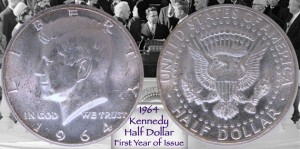
Shortly after Kennedy’s, U.S. Mint Director Eva Adams and Chief Engraver Gilroy Roberts reported that there was discussions about putting Kennedy’s portrait on a silver coin. Since Jacqueline Kennedy did not want to replace Washington’s portrait on the quarter, it was decided to use the half-dollar. Roberts used models from the inaugural medal for the obverse design and Assistant Engraver Frank Gasparro prepared the reverse design using the Presidential Seal.
Since the law stated that coinage design could not be changed more often than 25 years, and that the Franklin Half was only 15 years old, it required Congress to authorize the change. The Act of December 30, 1963 allowed the design to be changed.
When the coin was released in 1964, the 90-percent silver coin was saved by a grieving nation wanting something that represented the fallen President. Over 273 million coins were struck in Philadelphia and 156 million in Denver.
This year, the Kennedy half-dollar will celebrate its 50th anniversary. It appears that as part of that anniversary, the U.S. Mint will use the authorization it has to strike 24-karat gold Buffalo coins and use it to create a Kennedy half-dollar tribute.
Today’s poll asks if you like the idea of a gold tribute coin and whether you would buy one?
What do you think about the idea that the U.S. Mint will produce a 24-karat gold tribute to the 50th anniversary of the Kennedy half-dollar?
I like the idea and will buy at least one of the coins. (40%, 28 Votes)
I like the idea but gold is too expensive for me. (24%, 17 Votes)
Why don't they strike a silver half-dollar like the silver coin that came out in 1964? (21%, 15 Votes)
i do not like the idea (7%, 5 Votes)
Where's the reverse proof? I want a reverse proof! (6%, 4 Votes)
It doesn't matter what the U.S. Mint does. I don't buy any of their products! (1%, 1 Votes)
The PNG-ANA Numismatic Trade Show will be Saturday through Monday, August 2-4, 2014. The World’s Fair of Money will be held Tuesday, August 5 through Friday, August 9, 2014.
Doing this eliminates PNG Day(s) prior to the World’s Fair of Money and will extend the entire show week to eight days.
It was my understanding the PNG Day was for PNG members to buy and trade amongst themselves to prepare inventory for future sales. Inventories were bolstered by wholesale dealers or dealers who would rather sell to other dealers rather than staff a table at the World’s Fair of Money. While it was closed to the public, it was possible to either buy your way into the PNG show or get an invitation from a PNG member dealer.
What may have been the driver of this decision is that it was getting easier to obtain an invitation from a PNG dealer. Citizens of some of the popular coin forums would be able to download an invitation posted by member dealers to use for PNG day. A friend who attended PNG Day in 2013 said that non-members clearly outnumbered members by a large margin.
Where I question the decision is that it makes the show eight days long—emphasis on long. While some dealers will not attend both shows, there are many dealers who will be there all week. Those of us who are buyers know that some dealers can get surly toward the end of a show like the World’s Fair of Money. Can you imagine how prickly these dealers will be by August 8?
With the show ending on a Friday, a day that will attract local attendees, will the long show, cranky dealers, and the inevitable empty tables turn the World’s Fair of Money into a bad showing for the ANA?
As part of the PNG-ANA show, there will be a daily give away of a Double Eagle gold coin that will be donated by a PNG member dealer. There will also be an auction by Stacks-Bowers Galleries.
There will be no similar give away for the World’s Fair of Money. Both Stacks-Bowers and Heritage Auctions will combine to be the official auction of the World’s Fair of Money.
Since Numismatic Guarantee Corporation is the official grading service of both organizations, they will be present for the entire week. Good luck keeping staff motivated!
This decision brings back the concept of a pre-show that was discontinued because it was poorly attended and made the week too long. It also has the possibility of up staging the ANA and the World’s Fair of Money.
Since most collectors work people outside of the numismatics industry and Rosemont is not exactly a destination location for families, this will increase the attendance during the weekend of the ANA-PNG show rather than during the week for what should be the premier show, the World’s Fair of Money. Casual collectors who have to arrange for travel and time off from work will be more attracted to the co-branded show on the weekend rather than the ANA show.
The ANA should not give up its premier status to share the stage with PNG.
While the ANA should work with PNG and other organizations, the ANA should not play second fiddle to any other organization regardless of the organization. If the ANA wants to be the premier numismatic organization, the one that anyone wanting to learn about and be about numismatics, this type of partnership that has been clearly driven by PNG is not the right way to be premier.
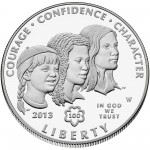
2013 Girl Scouts of the USA Centennial commemorative coin
For the first time the U.S. Mint’s history, an organization did not receive a payout from a commemorative minted for them.
Following the close of the year, the U.S. Mint told Coin World that the sales of the 2013-W Girl Scouts of the USA Centennial Commemorative coins was so low that it did not cover the costs of the program as required by law. U.S. Mint records show that 86,354 proof and 37,463 uncirculated coins were sold for a total of 123,817 coins. That is a little more than 35-percent of the 350,000 authorized by the law.
Sales of the 2013-W Girl Scouts of the USA Centennial Commemorative coins was to have ended on December 17, 2013 but the U.S. Mint extended the sale through December 31, 2013. By law, a commemorative coin can only be sold in the year it was struck.
The U.S. Mint cannot be faulted for this lack of interest. Information about the coin had been a fixture of the front page of the U.S. Mint’s website. Their information included a video introduction by United States Treasurer Rosie Rios and provided information in its various outreach programs. The U.S. Mint is limited on the type of advertising it is allowed to use.
Usually, the burden of advertising falls to the organization that would most benefit from the sale of the commemorative coin. Since I do not have a connection with Girl Scouts of the USA, I cannot report on their promotional experience.
This news is both sad and troubling. Although there are collectors who will buy the coin to be part of their commemorative collection, the real success or failure of a commemorative coin is based on its subject. For whatever reasons, the Girl Scouts was not a popular subject.
When a commemorative is made for an organization, purchasers want some affinity for the organization. Unless you are a collector, you are not going to buy a coin honoring that organization, especially when the price is over $50 during a recovering economy. I wonder if a clad half-dollar may have been a better idea?
While having a program to honor the centennial of the Girl Scouts of the U.S.A. was a laudable idea, maybe it was not a good one. It was a coin with a limited appeal and those in the target audience did not respond.
It is also troubling that the Girl Scouts were not able to generate more sales on its own. In coming up over 31,000 coins short of being able to receive the payout, it is time to question the diversity of the hobby—again.
Numismatics is dominated by middle-aged to older white males. While there is an outreach to young numismatists, those programs appear to succeed in recruiting mostly white boys and keeping them interested until they become 18 years old.
Consequently, there appears to be no concentration on providing opportunities to young girls and minorities. While the Boy Scouts provide one outlet, local experience shows that those troops are dominated by young white males. Surely there are girls and minorities interested in numismatics. If not, why not?
If anyone missed the point, the executive directors of the American Numismatic Association and Industry Council for Tangible Assets (ICTA) are women. I do not believe either have their jobs because they are women. They are qualified people leading an industry that happens to male dominated.
There has to be a way to appeal to the demographics that are not being represented in the hobby. Aside from women and minorities, the hobby has to figure out how to engage those older than young numismatist (YN) but younger than middle-age. There has to be a way to keep them interested if they started as a YN or grab their interest before middle age. In 2011 I addressed these issues calling potential members the “Lost Demographic.” There have been little changes since.
What will it take to expand the hobby to all sectors of society? Please feel free to let me know in the comments section below. We can all work together for the betterment of the hobby!
While the products that the U.S. Mint can offer are restricted to what congress allows them to do by law, it does not mean that congress controls how the U.S. Mint markets and sells its numismatic products. To try to get more people to buy its products, the U.S. Mint has made a series of announcements,
Free is still better
U.S. Mint’s Black Friday and Cyber Week sale of FREE SHIPPING for items sent via standard shipping that was supposed to end at 5:00 PM ET today, December 6th, has been extended to5:00 PM ET on December 17th. The U.S. Mint cited they are doing this for holiday “shoppers seeking online deals and discounts.” December 17 is also the first day of sale of the 2013 Teddy Roosevelt Coins and Chronicles set. Those interested in the Coins and Chronicles set can have it shipped free if they order the set on December 17.
New brick and mortar storefront
Last month, the U.S. Mint “partnered” with the Bureau of Engraving and Printing by cross advertising each other’s products on their websites. Essentially, these Department of the Treasury bureaus created a page on their respective websites pointing to each other.
Bureau of Engraving and Printing Washington, D.C. Headquarters
In a move that those of us with experience working with the Department of the Treasury considers astounding, the public store at the Bureau of Engraving and Printing on 14th Street SW in Washington, D.C. will now sell U.S. Mint products. Selling coins and medals at the Bureau of Engraving and Printing store will add a news sales outlet after closing the kiosk at Union Station earlier this year. Visitors to BEP will be able to purchase all of their current numismatic products after taking the fascinating tour of the world’s largest paper currency manufacturer.
Credit for this move can probably be given to Deputy Director and Acting Director of the U.S. Mint Richard Peterson, Director of the Bureau of Engraving and Printing, Larry Felix, and Treasurer of the United States Rosie Rios. What makes this interesting is that Peterson and Felix are career government employees and were not appointed by the President.
Peterson began his work with the U.S. Mint in 2009 when he was hired as their Associate Director of Manufacturing.
Felix, a long-term professional employee of the Bureau of Engraving and Printing, has been the bureau’s Director since January 2006.
Although Rios was appointed by President Obama and took office in August 2009, has not been the prototypical political appointee. Rios has been outspoken in her support of the numismatic community and seeks out ways to participate. She is a staple at coin and currency shows autographic Series 2009 $1 Federal Reserve Notes that bear her signature—something she calls “Rosi notes.&rdquots; It would not be surprising to learn she was instrumental in making this cross-bureau initiative happen.
Get your Rosie Dollars autographed
Treasurer of the United States Rosie Rios
Speaking of Treasurer Rosie Rios, she will be at the Bureau of Engraving and Printing Washington Visitor Center on 14th Street at the corner of C Street. Rios held an autograph session on December 6 and will hold another on Friday, December 20 from 10:00 AM to noon. Although the announcement sent to the press did not mention limits, those managing her appearances usually limits autograph requests to two notes per person.
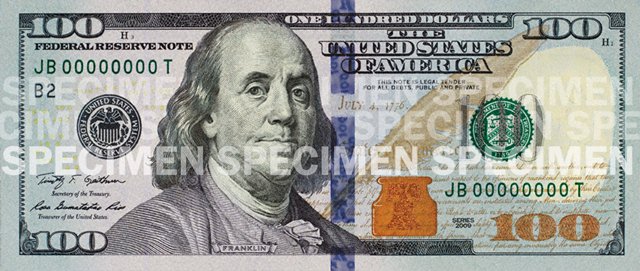
The BEP will allow visitors to exchange notes on site and have a supply of new $100 Federal Reserve Notes to purchase for Rios’s autograph. Having a $100 note autographed by Rios would be interesting. Many people may not spend $100 to set aside for this type of collectible making it possible that it could increase in value. How many speculators will there be at her next autograph session?
Fourscore and seven years ago our fathers brought forth on this continent a new nation, conceived in liberty and dedicated to the proposition that all men are created equal.
Now we are engaged in a great civil war, testing whether that nation or any nation so conceived and so dedicated can long endure. We are met on a great battlefield of that war. We have come to dedicate a portion of that field as a final resting-place for those who here gave their lives that that nation might live. It is altogether fitting and proper that we should do this. But in a larger sense, we cannot dedicate, we cannot consecrate, we cannot hallow this ground. The brave men, living and dead who struggled here have consecrated it far above our poor power to add or detract.
The world will little note nor long remember what we say here, but it can never forget what they did here. It is for us the living rather to be dedicated here to the unfinished work which they who fought here have thus far so nobly advanced. It is rather for us to be here dedicated to the great task remaining before us—that from these honored dead we take increased devotion to that cause for which they gave the last full measure of devotion—that we here highly resolve that these dead shall not have died in vain, that this nation under God shall have a new birth of freedom, and that government of the people, by the people, for the people shall not perish from the earth.
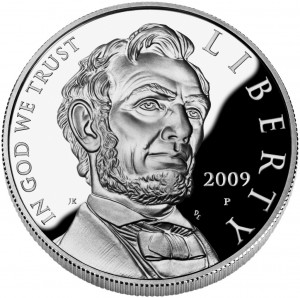
Obverse of the 2009 Abraham Lincoln Commemorative proof coin
Ironically, everyone was not enamored with Lincoln’s brief speech. The Patriot-News of Harrisburg, Pennsylvania did not like the speech. In an editorial published a week after the speech on Tuesday, November 24, 1863, The Patriot-News editorial board added the following paragraph about the ceremony:
We pass over the silly remarks of the President. For the credit of the nation we are willing that the veil of oblivion shall be dropped over them, and that they shall be no more repeated or thought of.
On November 14, 2013, almost 150 years later, The Patriot-Newspublished a retraction to their editorial:
In the editorial about President Abraham Lincoln’s speech delivered Nov. 19, 1863, in Gettysburg, the Patriot & Union failed to recognize its momentous importance, timeless eloquence, and lasting significance. The Patriot-News regrets the error.
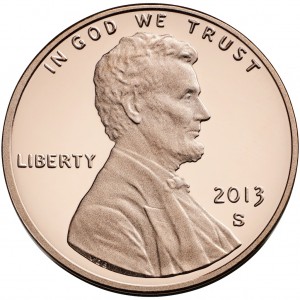
Obverse of the 2013-S Lincoln proof cent. Lincoln’s portrait, designed by Victor D. Brenner in 1909, is the longest running design of any United States coin.
The Maryland State Numismatic Association held its annual meeting on Saturday, November 9, 2013 during the Whitman Expo at the Baltimore Convention Center. Following the meeting, the new officers were inaugurated for 2014. Receiving the gavel of the presidency was your favorite coin blogger.
While I would like to say that it was a tough race, I was nominated because I was the previous vice president and elected by a unanimous vote of five people. Truth be told, I forgot to vote! In either case, I accept the honor and trust of the MSNA and hope to expand the organization’s outreach. My first duty will fix the MSNA website that “broke” when my template stopped working properly with the underlining content management system. I hope to fix it by the end of the month.
I do plan to reach out to the member clubs to expand the work of MSNA throughout the state and hopefully grow numismatic participation. We also have a Young Numismatist fund earmarked for a yet to be determined program. If we come up with something good, I will share it with everyone so we can help other numismatic organizations grow.
2014 President Scott Barman accepts the MSNA gavel from outgoing president Frank Murphy
2014 MSNA Officers (L-R): Secretary Bryce Doxon, President Scott Barman, Vice President Jack Schadegg, and Treasurer Simcha Kuritzky
If you like my tie (click on one of the images to see a larger version) you can buy your own version on Zazzle. Those who have seen me at the last few show have seen the tie. It gets quite a reaction. If you buy the tie, $5 will be added to the MSNA YN fund I spoke about earlier.
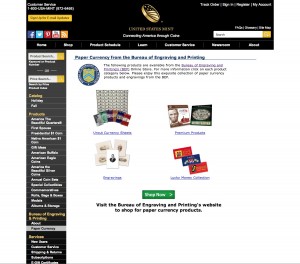
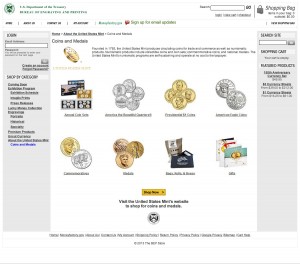
On Friday, the U.S. Mint and the Bureau of Engraving and Printing announced that they would be cross-promoting each other’s products. As one of the few agencies in full operation, the U.S. Mint and BEP updated their website with two pages, one provides information about the other agency and the other points to their online store.
This probably would have gone unnoticed except for the email announcement sent by the Bureau of Engraving and Printing to subscribers. It was sent in such haste that the link they provided to the U.S. Mint’s site is broken.
Promoting BEP’s Currency at the U.S. Mint
Promoting U.S. Mint’s coins at the BEP
Click on the preview to visit the site.
I bet you thought there was no good news to come out of Washington, D.C. last week!

 Loading ...
 According to a