Feb 11, 2015 | ANA, commentary, news

Larry Shepherd in 2014
In June 2013, Shepherd filed a lawsuit claiming that the ANA violated the Racketeer Influenced and Corrupt Organization (RICO) laws alleging that the ANA has committed are racketeering, theft, and fraud. Shepherd also alleged that a few employees of the ANA and members of the Board of Governors made up stories about Shepherd in order to find a way to relieve him of his duties for cause so they can invalidate his contract
Early in January, Mike Ellis resigned from the Board of Governors while the ANA continued to wrestle with this lawsuit. As part of the reporting, ANA President Walt Ostromecki was quoted as saying, “He realized he had made a mistake and chose to step down from the board.”

Mike Ellis
The source was not sure whether Ellis initiated this or it was initiated by the ANA employees involved, but it was alleged that Ellis was the ring-leader from the Board’s perspective. It was also alleged that while Ellis was the most active it was suspected that other members of the Board had knowledge of his actions.
The same source also alleged that Ellis participated in creating the environment that caused Shepherd’s successor, Jeff Shevlin, to be fired using the same approach.
According to the source, the crux of the issue is that there allegedly was a faction at the ANA Colorado Springs Headquarters who did not want to work. Both Shepherd and Shevlin tried to reorganize the headquarters staff in order to create efficiencies that were not met with positive reactions. While the list of allegations were pretty comprehensive, it included claims that employees worked flexible hours against workplace policies, abused other workplace policies, and used ANA equipment for personal business including for outside income.
Ellis was only part of the problem. If the source is true, there are employees in Colorado Springs that should be disciplined for their part in creating the hostile environment for both Shepherd and Shevlin. We may never know what changes will be made in Colorado Springs because of both federal and Colorado employment privacy laws. However, the ANA Board of Governors should be open with the membership regarding how they are dealing with the ANA permanent employees.
While it appears the situation has settled with Kim Kiick as the Executive Director, the ANA has over 20 years of problems with Executive Directors. Maybe it is time for operations at the ANA Headquarters be revamped into a more professional organization with workplace rules and policies rather than being a club where people get paid.
Larry Shepherd image courtesy SIMCO Numismatics as published on
YouTube.
Mike Ellis image courtesy of Numismatic News.
Jan 10, 2015 | bullion, counterfeit, gold, legal, news, scams
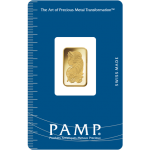
PAMP Gold Ingot
Traveling Suspects Arrested
Two suspects have been arrested for selling fake Suisse Pamp carded gold bars (2.5gm, 5gm,10gm and 1 ounce) at a coin shop in Greenwood, Indiana. Search of the suspects vehicle revealed multiple identification cards, business and pamphlets from different coin shops and an additional 250 fake gold bars and coins. Based upon receipts located in the vehicle the suspects had been selling the fake gold to shops in Illinois, Kentucky, Tennessee and Indiana since September, 2014.
The suspects were driving a silver Ford Focus with Missouri license plates. The suspects are being held for Theft by Deception.

Aaron Taylor
Western Union, IL
Second suspect was identified as Nelson Hernandez (No photo available) alias Benjamin Wade.
Anyone having been in contact with either of these subjects should contact:
Doug Davis, 817-723-7231,
Doug@numismaticcrimes.org
If you have information, please contact Doug Davis. Let’s keep the hobby for both collectors and investors safe!
Jan 9, 2015 | news, US Mint

Rhett Jeppson (second from the left) will be joining the U.S. Mint as Principal Deputy Director
In making the announcement, Rios thanked Peterson for his service as Deputy Director. She noted that Peterson will continue to be a part of the team moving forward through the many important issues and initiatives the Mint will tackle this year.
Dick Peterson, the current Deputy Director, will return to the position of Deputy Director for Manufacturing and Quality, the job he was in prior to becoming Deputy Director.
Jeppson and Peterson are members of the Senior Executive Service (SES), the program that helps the U.S. government maintain a vibrant executive management system. As part of the SES program, government executives must take a new management position every three years. This way they maintain strong management skills and managers do not become entrenched and complacent in their jobs. Although SES guidelines encourage members to change agencies or major departments within the agencies, SES members can elect to stay in the same job with permission from the appointed executive who supervises their work.
Since the U.S. Mint does not have an appointed Director, Jeppson will be responsible for the day-to-day operation of the bureau—essentially, the U.S. Mint’s chief operating officer. Treasurer Rios remains the government equivalent of the Chief Executive Officer.
The U.S. Mint has not had a director since Edmund Moy resigned in January 2011. Given the current political climate, it is unlikely that the president will nominate a new director or, if he tries to nominate another candidate, the senate would confirm his nomination.
Jan 7, 2015 | BEP, currency, legislative, news
As congress convenes for its 114th session there are questions as to what the new Republican majority would do with their power. For numismatists waiting for congress to authorize the U.S. Mint to do anything, there may not be many changes from the last congress. Since financial bills are constitutionally required to start in the House of Representatives and since the House only increased its Republican majority, it is unlikely attitudes would significantly change. After all, in two years, the 113th congress passed only one commemorative coin bill.

Larry R. Felix, the 24th Director of the Bureau of Engraving and Printing
Felix, who was born in Port of Spain, the capital of Trinidad and Tobago, was raised in New York City where he attended New York City College of Technology (City Tech) and City College of New York. He has been working for the BEP since 1993 and became the bureau’s director in 2006.
Felix was 24th director of the BEP and was the first African-American to be the Director.
Under Felix, the BEP introduced the next generation of currency designs in conjunction with the Federal Reserve and the U.S. Secret Service to make it more difficult to counterfeit U.S. currency including the new $100 Federal Reserve Note that has been recognized as the most difficult note to counterfeit. As part of the upgrade in production capabilities, Felix lead the BEP into a transition that made the bureau more technologically advanced and made their production more efficient.
Recent accomplishments include working with groups representing the visually impaired to make currency more accessible as part of a program called Meaningful Access. As part of that effort, the Meaningful Access program produced Eyenote for iOS and IDEAL Currency Identifier for Android to allow smartphone users to identify currency with their phone’s built in camera. They also are making iBill available for free to qualified visually impaired people. IBill is a pocket device that can be used to read U.S. currency and audibly identify its denomination that does not require a smartphone.
More recently, the BEP began to print one-dollar Federal Reserve Notes in sheets of 50 notes. During the production cycle, one-third of the notes being produced are $1 notes where more than 80-percent of the notes produced are used to replace worn currency. To meet the demand and lower the production cycle, this 38-percent per sheet increase in production will reduced the number of printing cycles required better meeting the demands of the BEP’s primary customer, the Federal Reserve.
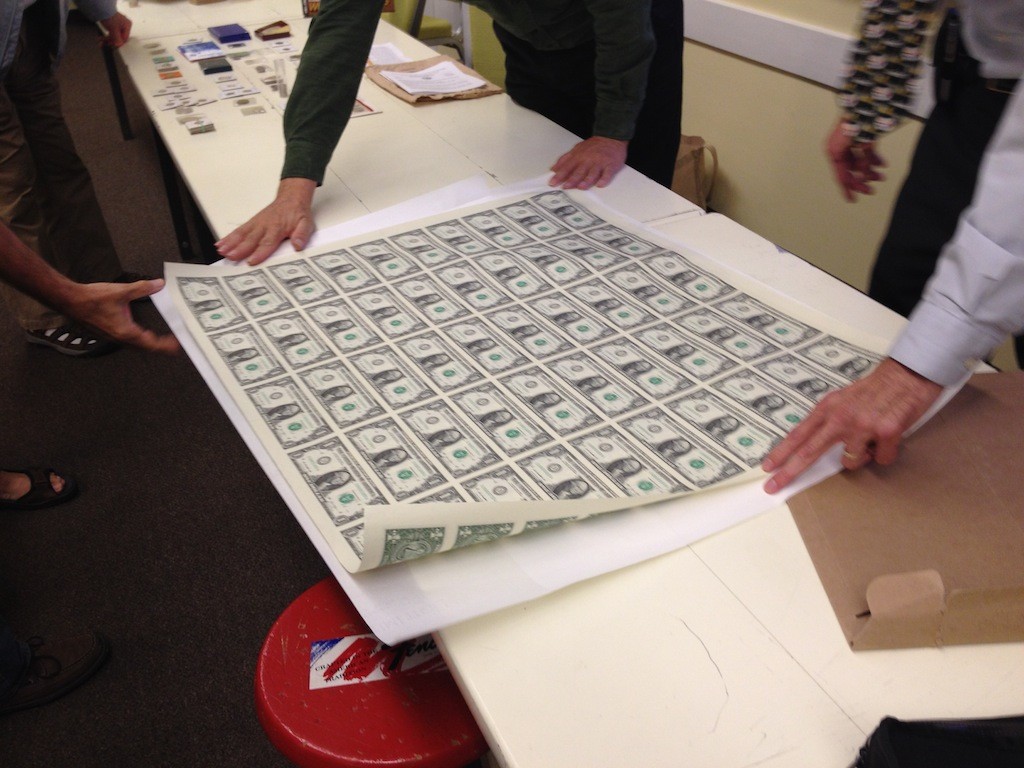
A view of the 50 Note Sheet of $1 Federal Reserve Notes.

BEP Deputy Director Len Olijar speaks to the Montgomery County Coin Club during their September 2014 meeting.
Unlike the U.S. Mint, the Director of the BEP is a career employee of the United States Government. BEP directors are members of the Senior Executive Service (SES), a program established as part of the Civil Service Reform Act of 1978 to “ensure that the executive management of the Government of the United States is responsive to the needs, policies, and goals of the Nation and otherwise is of the highest quality.”
Although most SES members are career employees, the government can hire qualified executives from outside of the government. These special appointments to the SES are renewable terms from three-to-five years where the appointee can only serve two appointments in the same position.
Since SES members are employees of the United States government, they are not subject to the Senatorial confirmation process political appointees must undergo. However, it is the job of the Secretary of the Treasury Jack Lew to appoint a new permanent director. It is likely Lew will make the appointment based on the recommendation of Treasurer Rosie Rios. Both Lew and Rios are political appointees whom have been confirmed by the Senate.
As an aside, the U.S. Mint has not had a director since the resignation of Edmund Moy in January 2011. Since the Director of the U.S. Mint is a politically appointed position, the U.S. Mint is legally managed by Treasurer Rosie Rios who has assigned Deputy Directory Richard A. Peterson to manage the day-to-day operations. Peterson, who is probably doing a better job than an appointee, is a career government employee and a member of the SES.
Image of Larry Felix courtesy of the Bureau of Engraving and Printing.
Dec 11, 2014 | BEP, legislative, news, US Mint
In a normal world, the United States congress will pass twelve different budget bills by August or September in time for the beginning of the federal government’s fiscal year, which begins on October 1. Anyone who has followed congress over the last 20-or-more years knows that the world they live in is not normal. Rather than pass real budget bills, congress has learned the irresponsible habit of voting on continuing resolutions and omnibus funding bills.
A continuing resolution (CR) is a bill that says to take the previously passed budget and extend it to a specific date. CRs can either continue the spending or make certain adjustments, such as reducing spending by a percentage. Omnibus, from the Latin “for everything,” are bills that are loaded with every bit of budget information in one very long bill.
Within the Omnibus budget bill are provisions to provide funding for the government’s money manufacturing operations. But this is different type of bill. It is an omnibus spending bill that covers most of the government through the end of this fiscal year (September) and a CR for the Department of Homeland Security so that the new congress can fight with the president over other policy matters. Reporters have been calling this a CRomnibus bill—which should never be confused with a cronut which is a very sweet treat! According to NBC News:
And the Washington word of the week is: “Cromnibus.” It’s the love child of a “continuing resolution” (CR) and “ omnibus” spending bill, two inside-the-Beltway terms for measures Congress has approved to keep the government funded.

TASTY!
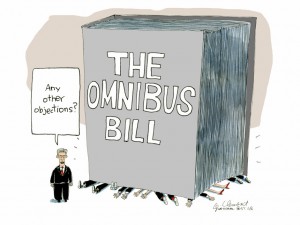
Not so tasty!
For the U.S. Mint, the bill recognizes that their funding is provided by its seigniorage that is deposited in the United States Mint Public Enterprise Fund (31 U.S.C § 5136) and does not receive appropriations from the general Treasury. Congress can limit the amount that the U.S. Mint can spend from the Public Enterprise Fund. In the Omnibus Budget Bill waiting for congress to vote on, the U.S. Mint is limited to spending $20 million.
In the grand scheme of the U.S. federal government, $20 million is not a lot of money. However, it may be more than enough for the U.S. Mint to operate. According most fiscal year 2013 (FY13) annual report from the U.S. Mint, the latest report available when this is written, the U.S. Mint spent $11.89 million for FY13 and $12.03 million in FY12. If the cost cutting measures implemented by Deputy Director Richard Peterson this past year further reduces costs, the $20 million could be twice as much as the U.S. Mint needs to operate.
Appropriation for the Bureau of Engraving and Printing has a few different provisions. Although it does recognize that the BEP has what the bill calls an “industrial fund,” (31 U.S. Code § 5142), the bill does not place many limits on what the BEP can use. The bill says that the BEP cannot use the monies to redesign the $1 Federal Reserve Note making it the second oldest design used on U.S. money.
For double-extra brownie points, what is the oldest design used on U.S. money?
The other limit is that the BEP can use only up to $5,000 for “official reception and representation expenses.” Essentially, the BEP can only spend up to $5,000 for conferences and conference attendance. Does this mean that the BEP will not be at shows like the World’s Fair of Money because it would cost more than the $5,000 to bring their exhibit to Rosemont, Illinois next August? If the BEP does not attend the World’s Fair of Money or other shows, tell your representatives in congress that their short-sightedness is hurting the hobby!
Finally, the bill says that the money appropriated “may be used to consolidate any or all functions of the Bureau of Engraving and Printing and the United States Mint without the explicit approval of the House Committee on Financial Services; the Senate Committee on Banking, Housing, and Urban Affairs; and the Committees on Appropriations of the House of Representatives and the Senate.” In other words, if someone figures out that the BEP and U.S. Mint can become more efficient and further save money by combining certain functions they have to go to congress and ask for permission.
I wonder what congress would say if the BEP and U.S. Mint were to propose to consolidate their online and brick-and-mortar retail operations? Instead of two different operations, how much could be saved if these bureaus under the Department of the Treasury would have one fulfillment contractor or a combined storefront in their current locations?
Of course this is contingent on congress passing this budget. As I write this, the government is a few hours away from running out of money with no signs of being able to pass this bill. However, if the government shuts down the U.S. Mint and BEP will continue operating since they are self-funded organizations.
UPDATE: (12/12/14 00:45) The CRomnibus bill passed the House about 10:00 PM on Thursday but still needs to be passed by the Senate before it can be signed by the President into law. The House passed a stop-gap bill to give the Senate until this weekend to pass the CRomnibus bill. Crisis averted, but the money manufacturing process continues.
Image of the Cronut courtesy of
Dominique Ansel Bakery, where it was invented.
Cartoon about the Omnibus bill is actually Canadian by Gary Clement and appeared in the
National Post. Who cares if it’s Canadian. It’s fitting!
Oct 16, 2014 | CCAC, coins, First Spouse, gold, news, US Mint
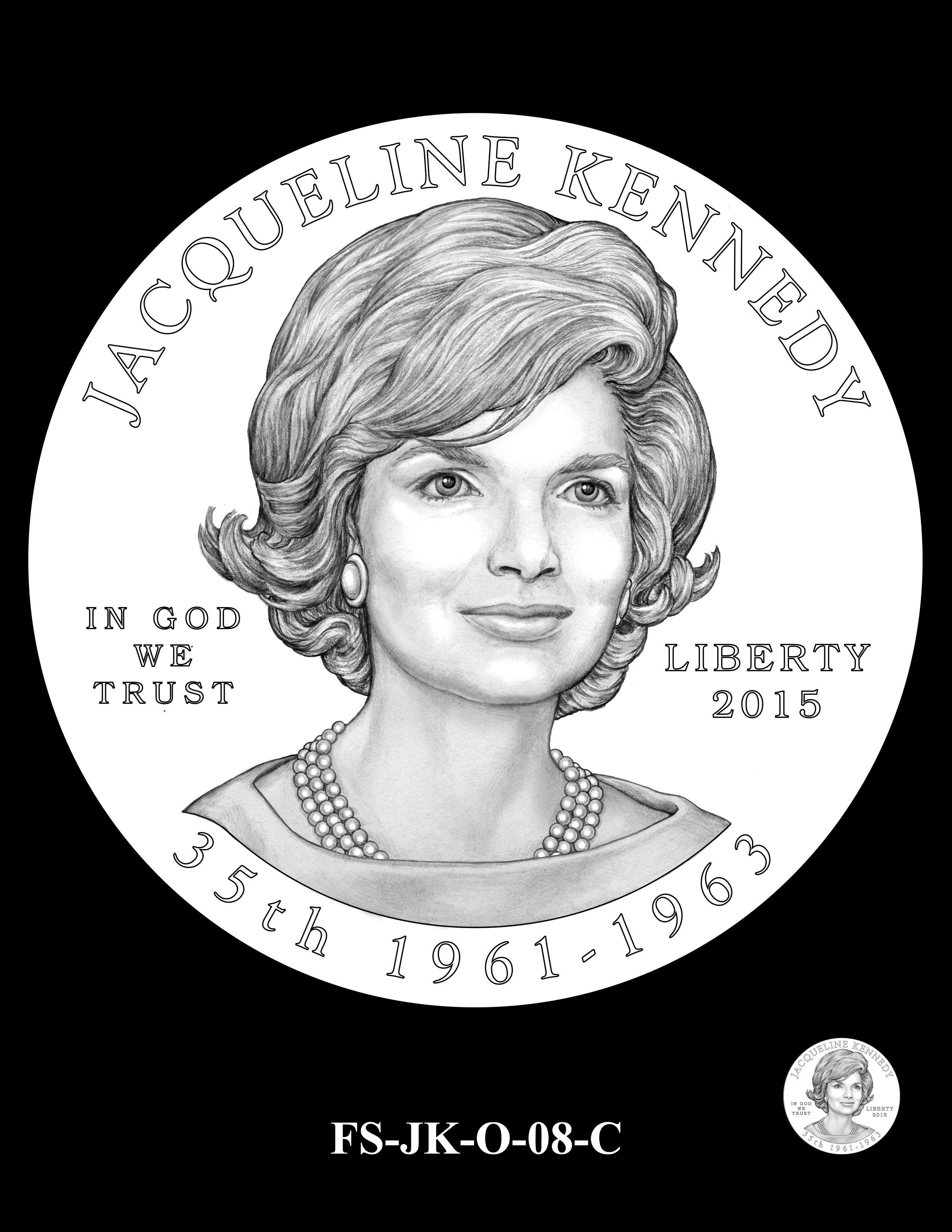
The obverse design selected by the CCAC for the Jacqueline Kennedy First Spouse Gold Coin
For Kennedy, in addition to being renown, the release of the 2014 50th Anniversary Kennedy Half-Dollar Gold Proof Coin may cause a sharp increase in demand from customers seeking to make special Kennedy gold sets using both the 2014 50th Anniversary Kennedy Half-Dollar Gold Proof Coin and the 2015 Jacqueline Kennedy First Spouse Gold Proof Coin. To account for this potential variable, we believe a maximum issuance of 30,000 coins would allow flexibility to increase production should customer demand exceed forecasted sales volumes for the other designs. These maximum mintage limits will be divided between coins with proof and uncirculated finishes based on consumer demand.
The Mint is not obligated to mint, and will not mint, to the maximum mintage limits unless it is supported by public demand. The production process and maximum mintages give us flexibility should there be a surge in demand over previous years.
Sep 11, 2014 | history, medals, news, US Mint
Congressional Gold Medal Awarded to the Fallen Heroes of September 11, 2001
WASHINGTON – Three Congressional Gold Medals were awarded today in honor of the men and women who perished as a result of the terrorist attacks on the United States on September 11, 2001. The ceremony took place in Emancipation Hall in the U.S. Capitol Visitor Center.
The United States Mint prepared and struck the three gold medals—one each for the World Trade Center, the Pentagon, and Flight 93 in rural Pennsylvania—in accordance with the authorizing legislation, Public Law 112-76, the Fallen Heroes of 9/11 Act. Each medal bears a unique design.
The New York Medal
The medal’s obverse (heads side) features an abstract representation of two towers. The abstract lines flowing downward symbolize loss while the lines moving upward represent rising above, hope, and deliverance from that loss. This configuration also suggests the World Trade Center’s Twin Towers. The numbers 93, 77, 175, and 11 represent the four planes involved in the tragic events of 9/11 and are positioned as if on a clock, representing the times of the crashes. The words “Always Remember” are set upon a stone wall similar to the wall that bears the names of the victims at the memorial.
The reverse (tails side) features a single rose protruding from an edge at the top, an echo of the memorial in New York where a white rose is placed through the name of each victim on his or her birthday. The inscription reads: WE HONOR THE THOUSANDS OF INNOCENT PEOPLE FROM MORE THAN 90 COUNTRIES LOST AT THE WORLD TRADE CENTER IN THE ATTACKS THAT SHOOK THE WORLD ON SEPTEMBER 11, 2001. MAY THEIR MEMORY INSPIRE AN END TO INTOLERANCE. The design also includes a bald eagle standing sentinel and clasping branches of laurel signifying an eternal honoring of those who perished in the tragedies.
The obverse of the World Trade Center Fallen Heroes’ medal was designed by Artistic Infusion Program artist Joel Iskowitz and executed by United States Mint Sculptor-Engraver Jim Licaretz. The reverse was designed and executed by United States Mint Sculptor-Engraver Phebe Hemphill.
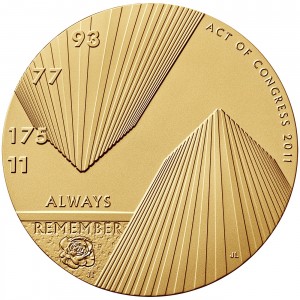
Obverse of the New York Fallen Heroes Medal designed by Joel Iskowitz and engraved by Jim Licaretz

Reverse of the New York Fallen Heroes Medal designed and engraved by Phebe Hemphill
The Pentagon Medal
The medal’s obverse depicts the rebuilt façade of the Pentagon where Flight 77 crashed. The angle of view is the angle of the flight path. A single candle and a small bouquet of flowers and greens signify a sacred memorial at the site. The American flag flies overhead in a united and patriotic embrace.
The reverse features 184 stars on a raised border around the edge of the design, one star for each of the victims of the tragedy. The inscription reads: WE HONOR THOSE ON FLIGHT 77 AND THOSE IN THE PENTAGON WHO PERISHED ON SEPTEMBER 11, 2001. WE WILL NEVER FORGET THEIR SACRIFICE AS WE UNITE IN MEMORY. The design also features a bald eagle standing sentinel and clasping branches of laurel signifying an eternal honoring of those who perished in the tragedies.
The obverse and reverse of the Pentagon medal were designed and executed by Ms. Hemphill.
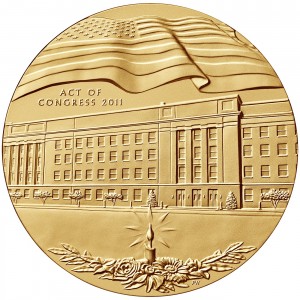
Obverse of the Pentagon Fallen Heroes medal designed and engraved by Phebe Hemphill
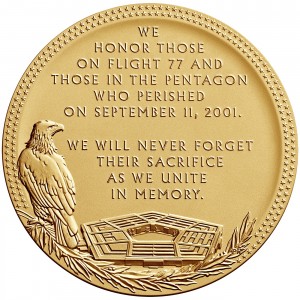
Reverse of the Pentagon Fallen Heroes medal designed and engraved by Phebe Hemphill
The Flight 93 Medal
The medal’s obverse features the hemlock groves behind the boulder at the Flight 93 Memorial, a simple reminder of loss and healing.
The reverse features 40 stars on a raised border around the edge of the design, one star for each victim. The inscription is WE HONOR THE PASSENGERS AND CREW OF FLIGHT 93 WHO PERISHED ON A PENNSYLVANIA FIELD ON SEPTEMBER 11, 2001. THEIR COURAGEOUS ACTION WILL BE REMEMBERED FOREVER. The design also features a bald eagle standing sentinel and clasping branches of laurel signifying an eternal honoring of those who perished in the tragedies.
The obverse of the Flight 93 medal was designed and executed by United States Mint Sculptor- Engraver Joseph Menna, and the reverse was designed and executed by Ms. Hemphill.
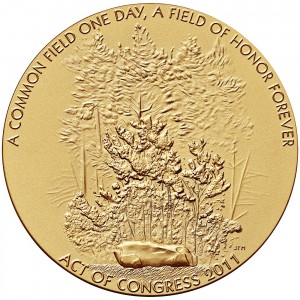
Obverse of the Flight 93 Fallen Heroes medal designed and engraved by Joseph Menna

Reverse of the Flight 93 Fallen Heroes medal designed and engraved by Phebe Hemphill
Public Law 112-76, which requires the United States Mint to strike the Fallen Heroes of 9/11 Congressional Gold Medal, also authorizes the bureau to strike and sell bronze reproductions of the medals. The medals will be available for purchase beginning noon Eastern Daylight Time (EDT) Sept. 11, 2014, via the bureau’s online catalog at http://www.usmint.gov/catalog and at 1-800-USA- MINT (872-6468). Hearing and speech-impaired customers with TTY equipment may call 1-888-321-MINT (6468). The three-inch medals—product codes FH1 (New York Medal), FH3 (Flight 93 Medal), FH5 (Pentagon Medal)—will be priced at $39.95.
Images and text courtesy of the U.S. Mint.
Sep 5, 2014 | ANA, coins, news, US Mint
 When the calendar flips to August, my wife begins to complain about the humidity and wanting to go “home” to Maine where she grew up. For me, the kid from south Brooklyn, August begins the last push to the end of the federal government’s fiscal year. With congress out of town, many agencies stop worrying about policy shifts and prepare for the new fiscal year. August is the calm before the policy storms.
This year has been unusual in that the weather has been more moderate than usual and world events have changed the tenor for those of us who work for the federal government. These events are not limited to areas of conflict. Those of us working in computer security have noticed an uptick in online criminal activity beyond what you read in the headlines.
With nothing happening on Capitol Hill, let’s look at the news generated by the U.S. Mint.
Following the issues during the sales at all locations for the Kennedy Half-Dollar gold tribute coin, the U.S. Mint suspended sales early and will re-evaluate their process for over-the-counter sales of coins. Sources at the U.S. Mint were surprised with the reaction since there are no mintage limits on the coin.
Subsequently, American Numismatic Association Executive Director Kim Kiick announced that sales of newly released coins by the U.S. Mint would be suspended indefinitely because of security concerns.
As an interesting side note, the price of gold has dropped and is close to the price that would lower the purchase price if ordered from the U.S. Mint.
Later in the month, the U.S. Mint announced that the Philadelphia facility broke a single day production record by producing 42.44 million coins for circulation. They beat their previous record of 32.28 million coins set in October 2013. The U.S. Mint produced a total of 1.33 billion coins for circulation in July with more than half of those being produced in Philadelphia.
The branch mint in Philadelphia is the world’s largest coin factory. No other mint in the world can produce the number of coins that can be struck at Philadelphia. The second largest coin factory is the branch mint in Denver.
Record production is more than an accomplishment for the U.S. Mint. They are being struck to fulfill orders for circulating coins from the Federal Reserve. This means that the Fed needs the coins to place into circulation which is a good sign for the economy. If the economy was slower, as it was a few years ago, the demand for coins would have slowed to where the U.S. Mint would have to reduce production.
The U.S. Mint has hired Naxion Research of Philadelphia to poll customers “to share [their] insights on new U.S. Mint products for 2015.” Customers were chosen at random to participate. Those who ordered products from the U.S. Mint via their website were sent an email invitation to take the survey. A separate group who ordered products by the telephone or by mail order was sent a paper survey form.
Survey results are due by September 15, 2014 regardless of the format used.
May 27, 2014 | BEP, currency, dollar, education, news, video
Time has come that there is once again change coming to the money in your pocket. This one is so subtle that you may not even notice the difference.
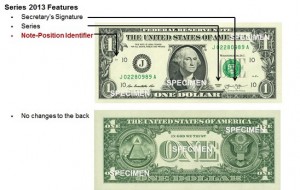
Changes to the $1 Note
For those who do not collect currency, the note-position identifier is the little letter followed by a number that identifies where on the sheet the note was printed. On the $1 FRN, the note position identifier is on the left side of the front of the note under the “1” and next to the Federal Reserve branch number.
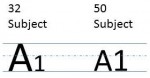
Change in the Note Position Identifier
As part of this change, the BEP is also changing the position identifier code mechanism. On the 32 note sheets, the notes printed four-across and eight-down were divided into four eight-note blocks (or quadrants). Each block was given a number in columns where the top-left quadrant was #1, the bottom left was #2, top-right was #3, and bottom-right was #4. Within the quadrants, the note positions were lettered A-D in the first column and E-H in the second column. If you found a note with the note-position code of H3, the note would have been printed in the fourth row and fourth column of the sheet.
The new 50 note sheets simplifies the note-position numbering by assigning a letter to each of the 10 rows (A-J) and a number to each of the five columns. On this sheet, H3 would now be located on the eighth row and third column.
Position Identification layout of 32-note sheet
| A1 |
E1 |
A3 |
E3 |
| B1 |
F1 |
B3 |
F3 |
| C1 |
G1 |
C3 |
G3 |
| D1 |
H1 |
D3 |
H3 |
| A2 |
E2 |
A4 |
E4 |
| B2 |
F2 |
B4 |
F4 |
| C2 |
G2 |
C4 |
G4 |
| D2 |
H2 |
D4 |
H4 |
Position Identification layout of 50-note sheet
| A1 |
A2 |
A3 |
A4 |
A5 |
| B1 |
B2 |
B3 |
B4 |
B5 |
| C1 |
C2 |
C3 |
C4 |
C5 |
| D1 |
D2 |
D3 |
D4 |
D5 |
| E1 |
E2 |
E3 |
E4 |
E5 |
| F1 |
F2 |
F3 |
F4 |
F5 |
| G1 |
G2 |
G3 |
G4 |
G5 |
| H1 |
H2 |
H3 |
H4 |
H5 |
| I1 |
I2 |
I3 |
I4 |
I5 |
| J1 |
J2 |
J3 |
J4 |
J5 |
BEP has begun to deliver the new notes to the Federal Reserve currency distribution operations in all 12 Federal Reserve district branches. These new notes will enter circulation as per the policies of each branch. BEP has not said whether they will sell the 50-note sheets as part of their uncut currency products.
The $1 FRN is the first note to be printed on 50-note sheets. Over time, the BEP will transition the printing of other notes to 50-note sheets with the only design change being the subtle change in the note-position identifier.
As part of this change, the Federal Reserve created a video explaining the changes. You can watch the video here:
Images courtesy of the Bureau of Engraving and Printing.
Mar 20, 2014 | celebration, coins, news
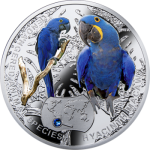
Niue 2014 One Dollar Hyacinth Macaw—Endangered Species of Animals ½ Oz Proof Silver Coin
For those of us in the United States, this has been a brutal winter. Whether you have been buried in snow, had to endure droughts that have not been seen in over 100 years, or record cold temperatures, there are many who would like to forget this past winter. Then there are people like me who would like to see their snow measured in feet and not inches!
Whatever your feelings are regarding the Vernal Equinox, it officially occurred at 4:57 PM UTC (or 12:57 PM on the United States east coast). Maybe you can try the semi-annual tradition of balancing an egg on its end. Good luck!


 Loading ...