
Numismatic Legislation Review for the 116th Congress
 Since the 117th Congress just convened and other work has taken their time, there have been no numismatic-related bills introduced. So let’s take the time to review the numismatic-related legislation from the 116th Congress.
Political analysts describe the 116th Congress as frantic and chaotic. When looking at the numismatic-related legislation, this congress was very active. Since tracking numismatic-related bills for the last five congressional sessions, the 116th Congress introduced more numismatic-related legislation than previous sessions.
Representatives introduced two unique bills, one of which resulted in a law with wide-ranging changes. The Route 66 Centennial Commission Act would have created a commission to honor the centennial of the famed Route 66. The law allowed the commission to recommend commemorative coin programs that would have likely led to fundraising efforts for the route’s preservation. The Route 66 Centennial Commission Act (H.R. 66) passed in the House but died in the Senate.
The United States Semiquincentennial Quarter Series Act would have created a quarters series to celebrate the nation’s 250th anniversary. Along with several others, this bill was combined into the Circulating Collectible Coin Redesign Act of 2020 (Public Law No. 116-330). What sets this law apart is that it creates changing circulation coin designs for the next ten years.
Numismatic Laws
The following were passed by Congress and signed by the President. Some of these laws have lead to new commemorative issues by the U.S. Mint, like the Women’s Suffrage Centennial Commemorative Coin Act.
- S. 239: Christa McAuliffe Commemorative Coin Act of 2019
Sponsor: Sen. Jeanne Shaheen (D-NH)
Summary: (Sec. 3) This bill directs the Department of the Treasury to mint and issue not more than 350,000 $1 silver coins in commemoration of Christa McAuliffe, a teacher tragically killed in the Space Shuttle Challenger Disaster. (Sec. 4) The design of the coins shall bear an image and the name of Christa McAuliffe on the obverse side and a design on the reverse side that depicts the legacy of McAuliffe as a teacher. (Sec. 5) Treasury may issue the coins from January 1-December 31, 2020. (Sec. 7) All surcharges received by Treasury from the sale of the coins shall be paid to the FIRST robotics program for the purpose of engaging and inspiring young people, through mentor-based programs, to become leaders in the fields of science, technology, engineering, and mathematics.
LAST ACTION: Signed by the President and became Public Law No: 116-65. — Oct 9, 2019
- H.R. 2423: Women’s Suffrage Centennial Commemorative Coin Act
Sponsor: Rep. Elise M. Stefanik (R-NY)
Summary: (Sec. 3) This bill directs the Department of the Treasury to mint and issue up to 400,000 $1 silver coins that are emblematic of the women who played a vital role in rallying support for the 19th Amendment to the U.S. Constitution. (Sec. 5) Such coins may be issued during the period beginning on January 1, 2020, and ending on December 31, 2020. (Sec. 7) All surcharges received from the sales of such coins shall be paid to the American Women’s History Initiative of the Smithsonian Institution.
LAST ACTION: Signed by the President and became Public Law No: 116-71. — Nov 25, 2019
- H.R. 1865: Further Consolidated Appropriations Act, 2020
Sponsor: Rep. William J. Pascrell (D-NJ)
Summary: The National Law Enforcement Museum Commemorative Coin Act is buried in this law.
LAST ACTION: Signed by the President and became Public Law No: 116-94. — Dec 20, 2019
- S. 457: President George H.W. Bush and First Spouse Barbara Bush Coin Act
Sponsor: Sen. John Cornyn (R-TX)
Summary: President George H. W. Bush and First Spouse Barbara Bush Coin Act This bill requires the issuance of- $1 coins bearing the image of President George H.W. Bush for a one-year period beginning on January 1, 2020, and
- bullion coins bearing the image of First Spouse Barbara Bush during that same period.
LAST ACTION: Signed by the President and became Public Law No: 116-112. — Jan 27, 2020
- H.R. 4104: Negro Leagues Baseball Centennial Commemorative Coin Act
Sponsor: Rep. Emanuel Cleaver (D-MO)
Summary: This bill directs the Department of the Treasury to mint and issue up to 50,000 $5 gold coins, 400,000 $1 silver coins, and 400,000 half-dollar clad coins in commemoration of the 100th anniversary of the establishment of the Negro National League, a professional baseball league that was formed in response to African-American players being banned from baseball’s major leagues. The design of the coins shall be emblematic of the Negro Leagues Baseball Museum and its mission to promote tolerance, diversity, and inclusion. Only during a one-year period beginning on January 1, 2022, may Treasury issue coins minted under this bill. All surcharges from sales of these coins shall be paid to the Negro Leagues Baseball Museum to fund educational and outreach programs and exhibits. Treasury shall develop and execute a marketing, advertising, promotional, and educational program to promote the collecting of these coins.
LAST ACTION: Signed by the President and became Public Law No: 116-209. — Dec 4, 2020
- H.R. 1830: National Purple Heart Hall of Honor Commemorative Coin Act
Sponsor: Rep. Sean P. Maloney (D-NY)
Summary: This bill directs the Department of the Treasury to mint and issue $5 gold coins, $1 silver coins, and half-dollar clad coins emblematic of the National Purple Heart Hall of Honor. The bill limits the issuance of such coins to the one-year period beginning on January 1, 2022. The bill prescribes surcharges for coin sales, which shall be paid to the National Purple Heart Honor Mission, Inc., to support the mission of such organization, including capital improvements to the National Purple Heart Hall of Honor facilities.
LAST ACTION: Signed by the President and became Public Law No: 116-247. — Dec 22, 2020
- H.R. 6192: 1921 Silver Dollar Coin Anniversary Act
Sponsor: Rep. Andy Barr (R-KY)
Summary: (Sec. 3) The Department of the Treasury shall mint and issue $1 coins in recognition of the 100th anniversary of completion of coinage of the Morgan dollar and the 100th anniversary of commencement of coinage of the Peace dollar. (Sec. 5) Treasury may issue such coins beginning on January 1, 2021. (Sec.6) Treasury must sell such coins at a price equal to the sum of their face value and the cost of designing and issuing the coins and may make bulk sales of the coins issued at a reasonable discount.
LAST ACTION: Signed by the President and became Public Law No: 116-286. — Jan 5, 2021
- H.R. 1923: Circulating Collectible Coin Redesign Act of 2020
Sponsor: Rep. Barbara Lee (D-CA)
Summary: Women’s History and Nineteenth Amendment Centennial Quarter Dollar Coin Program Act This bill requires the Department of the Treasury to mint and issue quarter-dollar coins in commemoration of the ratification of the Nineteenth Amendment granting women the right to vote. The design on the reverse of each coin shall be emblematic of the accomplishments and contributions of a prominent woman who was a resident of a state, the District of Columbia, or a U.S. territory. Such coins shall be issued in alphabetical order of the area represented, starting with the state of Alabama. Treasury shall- initiate a program to promote collection of the coins and recognition of their subjects, and
- strike and make available for sale silver bullion coins that are the exact duplicates of the coins.
LAST ACTION: Signed by the President and became Public Law No: 116-330. — Jan 13, 2021
A previous post described the full impact of Public Law No. 116-330.
Passed by the House
The following bills were passed by the House of Representatives but died in committee in the Senate.
- H.R. 66: Route 66 Centennial Commission Act
Sponsor: Rep. Rodney Davis (R-IL)
Summary: This bill establishes the Route 66 Centennial Commission to honor Route 66 on the occasion of its centennial anniversary. The Department of Transportation shall prepare a plan on the preservation needs of Route 66.
Passed the House of Representatives — Feb 6, 2019
LAST ACTION: Received in the Senate and Read twice and referred to the Committee on Environment and Public Works. — Feb 7, 2019
- H.R. 7995: Coin Metal Modification Authorization and Cost Savings Act of 2020
Sponsor: Rep. Mark E. Amodei (R-NV)
Summary: This bill authorizes the United States Mint to modify the metallic composition of circulating coins (including by prescribing reasonable manufacturing tolerances with respect to those coins) if a study and analysis conducted by the Mint indicates that the modification will- reduce costs incurred by the taxpayers;
- be seamless, which shall be determined by verifying that the coins will work interchangeably in most coin acceptors using electromagnetic signature technology; and
- have as minimal an adverse impact as possible on the public and stakeholders.
The Mint must notify Congress before making the modification and provide a justification for the modification.
Passed the House of Representatives with amendments — Dec 2, 2020
LAST ACTION: Received in the Senate and Read twice and referred to the Committee on Banking, Housing, and Urban Affairs. — Dec 3, 2020
Passed by the Senate
The following bill was passed by the Senate but died in committee in the House of Representatives.
- S. 1235: Women’s Suffrage Centennial Commemorative Coin Act
Sponsor: Sen. Marsha Blackburn (R-TN)
Summary: (Sec. 3) This bill directs the Department of the Treasury to mint and issue up to 400,000 $1 silver coins that are emblematic of the women who played a vital role in rallying support for the 19th Amendment to the U.S. Constitution. (Sec. 5) Such coins may be issued during the period beginning on January 1, 2020, and ending on December 31, 2020. (Sec. 7) All surcharges received from the sales of such coins shall be paid to the American Women’s History Initiative of the Smithsonian Institution.
Passed the Senate with amendments — Jun 4, 2019
LAST ACTION: Held at the desk. — Jun 5, 2019
It is common for members in both chambers to submit the same bills on both sides of the capitol. These bills are usually non-controversial and increase the chances of passage. The version of the bill that gets passed depends on politics and timing. S. 1235 was superseded by H.R. 2423 that became Public Law No. 116-71.
Died In Committee
The following bills were introduced but were never acted upon. They are called bills that died in committee. If a member wants the 117th Congress to consider their bill, they are required to submit it again.
- H.R. 61: Carson City Mint 150th Anniversary Commemorative Coin Act of 2019
- H.R. 500: Christa McAuliffe Commemorative Coin Act of 2019
- H.R. 636: Muhammad Ali Commemorative Coin Act
- H.R. 1089: Monetary Metals Tax Neutrality Act of 2019
- H.R. 1173: President George H.W. Bush and Barbara Bush Dollar Coin Act
- H.R. 1257: United States Coast Guard Commemorative Coin Act of 2019
- H.R. 1805: Tomb of the Unknown Soldier Centennial Commemorative Coin Act
- H.R. 1982: National Women’s Hall of Fame Commemorative Coin Act
- H.R. 2558: To define the dollar as a fixed weight of gold.
- H.R. 2559: Gold Reserve Transparency Act of 2019
- H.R. 2630: Cash Always Should be Honored Act
- H.R. 2650: Payment Choice Act of 2019
- H.R. 3155: 75th Anniversary of the End of World War II Commemorative Coin Act
- H.R. 3483: Integration of Baseball Commemorative Coin Act
- H.R. 3757: 1921 Silver Dollar Commemorative Coin Act
- H.R. 4332: Paul Laurence Dunbar Commemorative Coin Act
- H.R. 4681: National World War II Memorial Commemorative Coin Act
- H.R. 4940: Texas Ranger Division’s 200th Anniversary Commemorative Coin Act
- H.R. 5537: Conan Commemorative Coin Act
- H.R. 5873: Harriet Tubman Bicentennial Commemorative Coin Act
- H.R. 6555: United States Semiquincentennial Quarter Series Act
- H.R. 6923: Coronavirus Front-Line Responders Commemorative Coin Act
- H.R. 8242: National Women’s Hall of Fame Commemorative Coin Act of 2020
- S. 509: United States Coast Guard Commemorative Coin Act of 2019
- S. 639: Tomb of the Unknown Soldier Centennial Commemorative Coin Act
- S. 1300: National Law Enforcement Museum Commemorative Coin Act
- S. 1794: CENTS Act
- S. 1954: Integration of Baseball Commemorative Coin Act
- S. 2042: National Purple Heart Hall of Honor Commemorative Coin Act
- S. 2427: Women’s History and Nineteenth Amendment Centennial Quarter Dollar Coin Program Act
- S. 2815: National Purple Heart Honor Mission Commemorative Coin Act
- S. 4006: Coin Metal Modification Authorization and Cost Savings Act of 2020
- S. 4326: 1921 Silver Dollar Coin Anniversary Act
- S. 4663: Coin Metal Modification Authorization and Cost Savings Act of 2020
- S. 4730: Circulating Collectible Coin Redesign Act of 2020

A Festivus Half-Dollar Festival
Arriving in time to celebrate Festivus was my order from the U.S. Mint. The sense of timing was interesting since December 23rd was also the seventh day of Chanukah and the last of the eight candles would be lit that night and the day before Christmas Eve. Call it a celebration in a box!
In this order were my 50th Anniversary Kennedy Half-Dollar products. I first opened the 50th Anniversary Kennedy 2014 Half-Dollar Uncirculated Coin Set. Shrink wrapped, the set that sold for $9.95 was in a nice folder with a card containing two uncirculated coins in capsules embedded in the card. The half-dollars, one from Philadelphia and the other from Denver, are well struck and if I were to have them graded would probably be assigned a high grade.
Some people may balk at spending $5.00 for a half-dollar, but the presentation makes it a nice collectible even for the budget conscious.
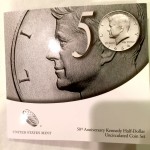
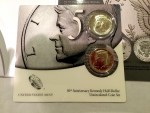
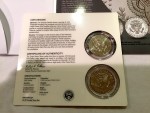
Next was the 50th Anniversary Kennedy 2014 Half-Dollar Silver Coin Collection. The set contains four 90-percent silver half-dollars struck in four different finishes: reverse proof, proof, enhanced uncirculated, and uncirculated. This boxed set contains a presentation folder, Certificate of Authenticity from the U.S. Mint, and a booklet documenting how the Kennedy half-dollar came into being following the President’s assassination.
There is a somewhat cheesiness quality about the presentation. First, the outer cardboard sleeve that surrounds the box has a design that is repeated on the box top. The same design is on the outer flap of the folder itself. Esthetically, this type of design is visually fatiguing by the time you are to the point of opening the folder. In the past, the U.S. Mint used their logo or a heraldic eagle. It broke up the visual monotony created by using the same imprint on three different surfaces.
Another problem with the product design is that the encapsulated coins are embedded into a holder that is only one sided. In order to see the reverse of the coins they have to be removed from what holds them into the folder. Unfortunately, the fitting is so tight that it I started to pull apart the part of the folder that attaches the capsules to the folder. Eventually, I used a letter opener to gently pry the capsules out of their slots so that I could see the reverses.
-
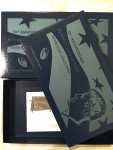
- Packaging of the 50th Anniversary Kennedy Half-Dollar Silver Set
-
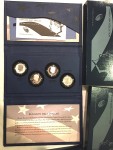
- The folder with all four coins in the 50th Anniversary Kennedy Half-Dollar Silver Set
-
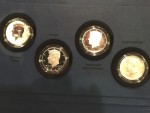
- A close-up of the silver half-dollars in the 50th Anniversary Kennedy Half-Dollar Silver Set
It was worth the trouble removing the capsules from their holders. All the coins were beautifully struck and looked great including the reverse proof struck in West Point. I love the look of the reverse proof coin. Aside from having Kennedy really standing out on the obverse, there is something regal looking about the heraldic eagle on the reverse.
At first glance there almost appears to be no difference between the proof coin, struck in Philadelphia, and the enhanced uncirculated coin struck in San Francisco. After placing the coins side-by-side it was evident that he proof coin was struck differently than the enhanced uncirculated coin. Proof coins are usually struck with more force and more than once. Looking at both coins together before using a loupe shows that the relief for the proof half-dollar was higher. You can really see the difference by looking at Kennedy’s hair which showed more definition in the proof coin.
Where the enhanced uncirculated coin has an impact is on the reverse. Whereas the elements on a proof coin are frosted the laser process used on the enhanced uncirculated coins allows the U.S. Mint to create the frosting effect on some of the elements. For the reverse of the enhanced uncirculated half-dollar, the U.S. Mint selectively frosted elements of the heraldic eagle giving a “pop” that would not be possible using any other method. By frosting some of the higher relief areas, especially around the eagle’s shield, it provides a visual cue of more depth which makes for a nice refresh of a 50 year-old design.
-
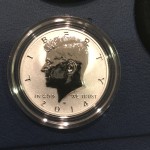
- The obverse of the 2014-W reverse proof in the 50th Anniversary Kennedy Half-Dollar Silver Set
-
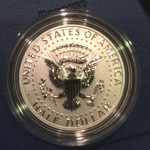
- The reverse of the 2014-W reverse proof in the 50th Anniversary Kennedy Half-Dollar Silver Set
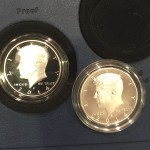
-
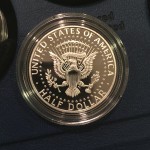
- The reverse of the 2014-S enhance uncirculated Kennedy silver Half-Dollar
As I write this, the London Fix price of gold is $1,170 per troy ounce. If the PM Fix of gold stays below $1,200, the price of the 50th Anniversary Kennedy 2014 Half-Dollar Gold Proof Coin will drop to $1,165, down from its current $1,202 and will be $75 less than its first issued price of $1,240. Although it is not a good idea to try to time the market, I wonder if all those dealers who caused problems during the coin’s initial release are worried about their profit margins now that the price of gold is going down!
Why 7.2 billion notes
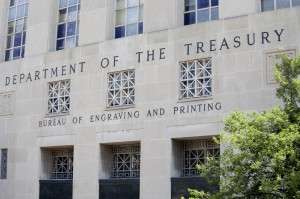 Last week, the Bureau of Engraving and Printing announced that the Federal Reserve had ordered the printing of 7.2 million Federal Reserve Notes for Fiscal Year 2015. This represents over $188 billion in currency.
According to the Federal Reserve, the number of notes they order depends on the predicted growth in demand and the predicted number of notes that have to be destroyed because they are not usable any more. Both growth and demand are predicted to include world-wide usage of the United States Federal Reserve Note as it is the standard currency for many transaction. In addition to the demand and destruction is the predicted replacement of the old $100 Federal Reserve Note with the new note that has more advanced currency features. While the Federal Reserve will not recall the old $100 notes, they are removing them from circulation as they arrive back into the Federal Reserve system.
The following table is how the Federal Reserve says they broke down their order for 2015:
| Denomination | Number of Notes | Dollar Value |
|---|---|---|
| $1 | 2,451,200,000 | $2,451,200,000 |
| $2 | 32,000,000 | $64,000,000 |
| $5 | 755,200,000 | $3,776,000,000 |
| $10 | 627,200,000 | $6,272,000,000 |
| $20 | 1,868,800,000 | $37,376,000,000 |
| $50 | 220,800,000 | $11,040,000,000 |
| $100 | 1,276,800,000 | $127,680,000,000 |
| Total | 7,232,000,000 | $188,659,200,000 |
Included with the order are the notes that the Bureau of Engraving and Printing will sell to collectors. These are the same notes that collectors can purchase online at moneyfactorystore.gov and when the Bureau of Engraving and Printing attends shows.
As part of the announcement, the Federal Reserve released a video explaining how they decide the amount of currency to order.
New law to protect the hobby
With the midterm elections behind and the anticipation of the changes, congress still had work to do in the lame duck session. Over the last few sessions, congress has been their most productive during lame duck session as polling and focus groups has lead to those running for re-election to fearing the fast moving news cycles. Even the least controversial measures can be side tracked when members think that someone is watching that could misconstrue even the best of intentions.
But good things come to those who wait. Monday afternoon, December 15, 2014, H.R. 2754, the Collectible Coin Protection Act was passed in the Senate. The bill is on the way to the White House for President Obama’s signature, which should be a formality. The Collectible Coin Protection Act was first introduced to in the U.S. House of Representatives on May 7, 2013 to amend and updates the Hobby Protection Act that was passed over 30 years ago. The new law will allow law enforcement to take criminal action and individuals to take civil action against manufacturers, importers, and sellers of counterfeit coins and bullion products. It also allows the enforcement against the unauthorized use of registered trademarks belonging to collectible certification services.
Given the changes in the way we do business today, one of the more significant issues with the Hobby Protection Act is that only the manufacturers of the counterfeits could be prosecuted. In most cases, the manufactures of these counterfeits are hiding behind the Great Wall out of the legal reach of United States law enforcement. The Collectible Coin Protection Act will update the law to add the sellers and distribution of those coins to the targets of enforcement. If we cannot get to the makers of these fakes, then those who distribute that contraband can be prosecuted.
Further expanding the legal net to catch the scofflaws is the new provision to include “any person who provides substantial assistance or support to any manufacturer, importer, or seller” who knowingly engages in any act that violates this law. In other words, this adds the accomplices and those who support any part of the act of production and selling counterfeit United State coins.
If you buy a counterfeit coins, you can now take action against the the counterfeiter, their agents, the seller, and anyone else in the supply chain who was involved in the manufacture and sale of the coin. Even if you unwhittingly buy the counterfeit coin via an online auction and attempt to flip it hoping to recover your money, the buyer can sue you as the seller of contraband. To help fight the counterfeiting of third-party certification service holders, the act extends trademark violation and the ability to sue for remedies.
These new provisions will allow collectors, dealers, and grading services to bring legal actions that are much more effective, with much stronger remedies than previously existed. It will allow those harmed to work with the Justice Department to bring criminal actions where appropriate.
Congress engrossed the bill and sent it to the White House on December 15, 2014. It is currently waiting for President Obama’s signature. It will be a good present to the holiday when he signs this bill into law.
Examples of Chinese Counterfeits
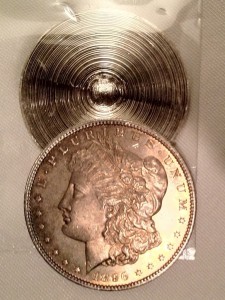
An example of a Morgan Dollar cut in half to match a date with a mintmark to have the coin appear something it is not. Coin was in a counterfeit PCGS slab and caught by one of their graders.
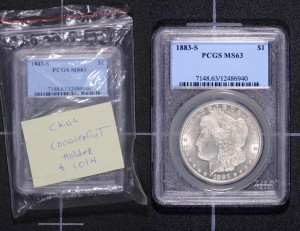
PCGS representatives showed Congressmen counterfeit U.S. coins in counterfeit PCGS holders during their recent meetings in Washington, DC. (Photo courtesy of PCGS.)
How did you Kennedy?
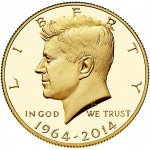 As the year winds down and the end of the 50th Anniversary of the Kennedy Half-Dollar draws to a close, I am curious as to how many of my readers bought one of the special coins offered by the U.S. Mint. This is just a quick poll to satisfy my curiosity.
Did (or will) you buy a 50th Anniversary Kennedy Half-Dollar Coin
Total Voters: 39
 Loading ...
CRomnibus and money manufacturing
In a normal world, the United States congress will pass twelve different budget bills by August or September in time for the beginning of the federal government’s fiscal year, which begins on October 1. Anyone who has followed congress over the last 20-or-more years knows that the world they live in is not normal. Rather than pass real budget bills, congress has learned the irresponsible habit of voting on continuing resolutions and omnibus funding bills.
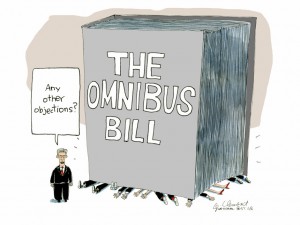
A continuing resolution (CR) is a bill that says to take the previously passed budget and extend it to a specific date. CRs can either continue the spending or make certain adjustments, such as reducing spending by a percentage. Omnibus, from the Latin “for everything,” are bills that are loaded with every bit of budget information in one very long bill.
Within the Omnibus budget bill are provisions to provide funding for the government’s money manufacturing operations. But this is different type of bill. It is an omnibus spending bill that covers most of the government through the end of this fiscal year (September) and a CR for the Department of Homeland Security so that the new congress can fight with the president over other policy matters. Reporters have been calling this a CRomnibus bill—which should never be confused with a cronut which is a very sweet treat! According to NBC News:
And the Washington word of the week is: “Cromnibus.” It’s the love child of a “continuing resolution” (CR) and “ omnibus” spending bill, two inside-the-Beltway terms for measures Congress has approved to keep the government funded.

TASTY!
Not so tasty!
For the U.S. Mint, the bill recognizes that their funding is provided by its seigniorage that is deposited in the United States Mint Public Enterprise Fund (31 U.S.C § 5136) and does not receive appropriations from the general Treasury. Congress can limit the amount that the U.S. Mint can spend from the Public Enterprise Fund. In the Omnibus Budget Bill waiting for congress to vote on, the U.S. Mint is limited to spending $20 million.
In the grand scheme of the U.S. federal government, $20 million is not a lot of money. However, it may be more than enough for the U.S. Mint to operate. According most fiscal year 2013 (FY13) annual report from the U.S. Mint, the latest report available when this is written, the U.S. Mint spent $11.89 million for FY13 and $12.03 million in FY12. If the cost cutting measures implemented by Deputy Director Richard Peterson this past year further reduces costs, the $20 million could be twice as much as the U.S. Mint needs to operate.
Appropriation for the Bureau of Engraving and Printing has a few different provisions. Although it does recognize that the BEP has what the bill calls an “industrial fund,” (31 U.S. Code § 5142), the bill does not place many limits on what the BEP can use. The bill says that the BEP cannot use the monies to redesign the $1 Federal Reserve Note making it the second oldest design used on U.S. money.
The other limit is that the BEP can use only up to $5,000 for “official reception and representation expenses.” Essentially, the BEP can only spend up to $5,000 for conferences and conference attendance. Does this mean that the BEP will not be at shows like the World’s Fair of Money because it would cost more than the $5,000 to bring their exhibit to Rosemont, Illinois next August? If the BEP does not attend the World’s Fair of Money or other shows, tell your representatives in congress that their short-sightedness is hurting the hobby!
Finally, the bill says that the money appropriated “may be used to consolidate any or all functions of the Bureau of Engraving and Printing and the United States Mint without the explicit approval of the House Committee on Financial Services; the Senate Committee on Banking, Housing, and Urban Affairs; and the Committees on Appropriations of the House of Representatives and the Senate.” In other words, if someone figures out that the BEP and U.S. Mint can become more efficient and further save money by combining certain functions they have to go to congress and ask for permission.
I wonder what congress would say if the BEP and U.S. Mint were to propose to consolidate their online and brick-and-mortar retail operations? Instead of two different operations, how much could be saved if these bureaus under the Department of the Treasury would have one fulfillment contractor or a combined storefront in their current locations?
Of course this is contingent on congress passing this budget. As I write this, the government is a few hours away from running out of money with no signs of being able to pass this bill. However, if the government shuts down the U.S. Mint and BEP will continue operating since they are self-funded organizations.
UPDATE: (12/12/14 00:45) The CRomnibus bill passed the House about 10:00 PM on Thursday but still needs to be passed by the Senate before it can be signed by the President into law. The House passed a stop-gap bill to give the Senate until this weekend to pass the CRomnibus bill. Crisis averted, but the money manufacturing process continues.
Cartoon about the Omnibus bill is actually Canadian by Gary Clement and appeared in the National Post. Who cares if it’s Canadian. It’s fitting!
Support the Coin Collectors Blog
 Buy me a coffee
Thank you for your support!
Let Me Know What You Think
Are you going to the World's Fair of Money
Total Voters: 17
Loading ...