
Weekly World Numismatic News for October 11, 2020
If you do not follow the U.S. Mint on Facebook or Twitter, they announced that there would be a price increase for silver coins as of October 13, 2020. Their statement read:
In order for the United States Mint to cover rising costs, meet its fiduciary responsibility to operate at no net cost to taxpayers, and return money to the Treasury General Fund, re-setting silver prices is necessary.
The Mint’s goal, as a fiscally responsible self-funded Federal agency, is to always provide the best quality numismatic products while maintaining fair prices. The first objective is to ensure that the numismatic portfolio (all product lines together) be self-sufficient and cover all associated costs. The new silver prices reflect a sound business decision aimed at meeting these obligations. (No tax dollars are used to fund numismatic operations.)
The United States Mint will continue to look for operations optimization and cost reduction efforts to deliver superior quality numismatic products at a fair price.
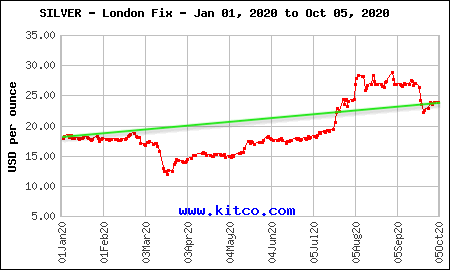
Kitco YTD Silver Price as of 10/9/2020 (does not update, trendline added)
From the $17.925 at the close of the markets on January 2 through August 6, silver rose 58-percent. If the U.S. Mint had to purchase silver in August to meet market demands, it was the most expensive silver they purchased.
| Product | Old Retail Price | New Retail price | Percent Increase |
|---|---|---|---|
| Presidential Silver Medals | $46.00 | $65.00 | 41.304% |
| America the Beautiful Quarters Silver Proof Set | $42.50 | $60.00 | 29.167% |
| American Eagle One Ounce Silver Proof Coin | $64.50 | $73.00 | 13.178% |
| American Eagle One Ounce Silver Uncirculated Coin | $54.00 | $67.00 | 24.074% |
| American Eagle One Ounce Silver Proof Coins—Bulk Pack | † | $2,920.00 | — |
| American Eagle One Ounce Silver Uncirculated Coin—Bulk Pack | † | $2,680.00 | — |
| Limited Edition Silver Proof Set | $120.00‡ | $201.00 | 67.500% |
| Silver Proof Set | $63.25 | $105.00 | 66.008% |
| America the Beautiful Five Ounce Silver Uncirculated Coin | $178.25 | $229.00 | 30.670% |
| End of World War II 75th Anniversary American Eagle Silver Proof Coin | * | $83.00 | — |
| End of World War II 75th Anniversary One Ounce Silver Medal | * | $75.00 | — |
| 2019 America the Beautiful Quarters Silver Proof Set | $36.95 | $60.00 | 62.514% |
| 2019 American Liberty High Relief Silver Medal | $99.95¶ | $175.00 | 75.088% |
| 2019 Congratulations Set | $56.95 | $75.00 | 31.694% |
| 2019 Silver Proof Set | $54.95¶ | $105.00 | 91.083% |
‡ The only items for sale at the U.S. Mint that comes close to this is the Women’s Suffrage Centennial 2020 Proof Silver Dollar and Medal Set
* Item was not for sale prior to the price hike
¶ Listed as “Currently Unavailable” on the U.S. Mint’s website.
You cannot blame the U.S. Mint’s metals buyers. First, they are mandated to buy precious metals from U.S. sources at the market value. If they need additional inventory, then they buy it on the market like everyone else. Like any investor, the U.S. Mint can try to predict the market, but the results are variable like any investor.
Since August 6, the price of silver dropped to $24.315, a 14.17-percent decrease. However, the price of silver is up 35.65-percent for the year. If the price of materials rise, how long could the U.S. Mint maintain their prices?
Aside from the rising cost of silver, the U.S. Mint did not report how much other costs have risen. Aside from the dies and facilities costs, they must account for labor, design, and production costs. The U.S. Mint has not reported what additional costs they have incurred because of the pandemic.
The U.S. Mint is unlikely to report about these issues until the release of the annual report.
And now the news…
 October 6, 2020
 → Read more at greekcitytimes.com
October 5, 2020 → Read more at newindianexpress.com
October 9, 2020 → Read more at yarmouth.wickedlocal.com
October 10, 2020 → Read more at foxnews.com
→ Read more at greekcitytimes.com
October 5, 2020 → Read more at newindianexpress.com
October 9, 2020 → Read more at yarmouth.wickedlocal.com
October 10, 2020 → Read more at foxnews.com

1000
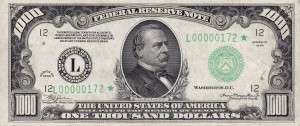
Series 1934 $1000 Federal Reserve Note
It is written as a one followed by three zeros.
In scientific notation it is written as 1 × 10³.
In the metric system, kilo- is the prefix for 1,000 of something like a kilogram is 1,000 grams or a kilometer is 1,000 meters.
A millennium is one thousand years.
One thousand days ago from today (April 14, 2013, the day this is posted) was Monday, July 19, 2010.
One thousand days from today will be Saturday, January 9, 2016. I wonder if it will snow?
“Grand” is slang for one thousand and Grover Cleveland appeared on the last one grand note produced by the Bureau of Engraving and Printing.
In Roman Numerals, one thousand is represented as “M.”
For the computer geeks, one thousand can be written as 1111101000 in binary, 01750 in octal (base 8), and 0x3E8 in hexadecimal (base 16).
If “A picture is worth a thousand words,” then what would one thousand blog posts be worth? You are reading what I never thought would occur. This is the one thousandth post to the Coin Collectors Blog!
When I started this blog on October 29, 2005, there were few websites for coin collectors. Back then, the numismatic publications were barely online and mostly as a place to subscribe to their print editions. Since starting this blog, there has been a growth in numismatic news outlets and other information. Rather than reporting the news, I moved to a little more analysis and opinion on the numismatic news of the day while keeping with other collecting information.
I like to think I started a trend but there are a lot of smart people out there with ideas of their own. I welcome them to online numismatic community.
It has been 7 years, 5 months, 16 days since my first post. I have had a lot of fun writing about my experiences, looking at the numismatic community, reporting some news, providing some analysis, and writing about whatever comes to mind. After all this time I can say that I am still having fun!
To those who have been around from the beginning, thank you for staying with me.
To those who joined since the beginning, thank you for reading.
Now onto the next 1000!
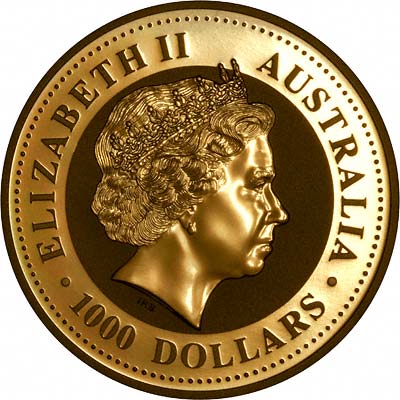
2007 Australia 1000 Dollars Lunar coins obverse
Play Ball!
 The U.S. Mint launched the Baseball Coin Design Competition today at the Russell Senate Office Building on Capital Hill. Attending the event arranged by New York Senator Kirsten Gillibrand was Rep. Richard Hanna (R-NY) whose district includes Cooperstown and introduced the National Baseball Hall of Fame Commemorative Coin Act in the 112th congress, Treasurer of the United States Rosie Rios, Member of the Baseball Hall of Fame and former third baseman for the Baltimore Orioles Brooks Robinson, President of the National Baseball Hall of Fame Jeff Idelson, and Acting Director of the U.S. Mint Richard Peterson.
As with many announcements, there was little news other that what was published in the past. The U.S. Mint did bring out a plaster model of a curved coin to show the media what it could potentially look like.
The following video shows the plaster model of the coin and the introduction by Treasurer of the United States Rosie Rios:
This is the animation that the U.S. Mint published showing the shape of the coin:
But the real news of the day is the comedy routine by Brooks Robinson. Robinson takes his sense of humor to a deprecating sense of self. It is worth watching!
Remember, this week’s poll asks if you are going to participate in this contest. Are you?
Will you try to submit a design for the National Baseball Hall of Fame commemorative?
Total Voters: 13
 Loading ...
Videos from the launch ceremony courtesy of Gannett by Brian Tumulty.
Animation video courtesy of the U.S. Mint.
Why you should care about restrictions on collecting ancient coins
 In a test lawsuit filed by the Ancient Coin Collectors Guild (ACCG), the group sued the federal government over the granting of import restrictions and confiscation of coins that foreign government have declared cultural property. The suit filed by ACCG challenges recent Memorandum of Understanding (MOU) between the State Department and the cultural regulators of Cypress and China under the Convention on Cultural Property. On March 25, 2013, the case that ACCG appealed to the Supreme Court was denied a hearing (petition for certiorari).
Over the last few years, the Coin Collectors Blog has asked readers to sign various petitions and write to the Department of State to stop restrictions on ancient coins. To understand why this is necessary, we have to understand why this is happening.
For a country to request import restrictions and confiscation of cultural property, they are required to send a letter to the State Department asking the United States to enter into an MOU to restrict the import and export of what the asking country considers cultural property as defined by the Convention on the Means of Prohibiting and Preventing the Illicit Import, Export and Transfer of Ownership of Cultural Property 1970, often called the 1970 UNESCO Convention. The purpose of the the treaty was to stop archaeological pillaging and trafficking in cultural property. In other words, it would significantly hamper the career of Indiana Jones.
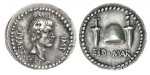
EID·MAR silver coin commemorating the death of Cæsar on March 15
Under the Convention on Cultural Property Implementation Act (CPIA; 19 U.S.C. §§ 2601 et seq.), the law passed by congress upon the Senate’s ratification of the treaty in 1983, requests are reviewed by the Cultural Property Advisory Committee (CPAC) in the State Department’s Bureau of Educational and Cultural Affairs. The CPAC authors the MOU based on the input from the requesting country and publishes the results for public comment. By law, the public has 30 days to provide comments on the proposed MOU. However, it appears that it is very rare that the CPAC makes any changes after the end of the comment period.
The MOU undergoes whatever department review is required and then is signed by the Secretary of State on behalf of the president and made part of the policy and rule provisions granted to the Executive Branch by congress (as part of the CPIA).
The original case was filed in a Fourth Circuit Federal Court in Baltimore. In its suit, ACCG claims that the rules agreed to the by CPAC are arbitrary and made by a panel that does not understand how their decisions affect coin collectors. Even though the intent has not to work against ancient coin collectors, governments have used the law to restrict the export of newly discovered ancient to the United States. The court ruled that it did not have standing to change the law since there is no constitutional question. The appellate division of the Fourth Circuit in Richmond confirmed this ruling in October 2012.
ACCG appealed the ruling to the Supreme Court. On March 25, the court denied the ACCG’s petition for hearing. The Supreme Court’s action means that the result of the test case is only binding in the Fourth Circuit (Maryland, North Carolina, South Carolina, Virginia, and West Virginia). In other words, someone has to have been harmed by the results of the law before the courts will agree to hear a case.
Last month, Patrick Heller wrote in Numismatic News that he spoke with a dealer “who had been visited by representatives of a foreign government seeking to confiscate the valuable ancient coins issued by that nation if the dealer could not provide a chain of custody proving that the coins were legally owned before that nation banned the export of ‘national treasures.’” Heller said that the representative were only interested in the more expensive coins and not the common coins from the same country but whose value was much less.
While these issues have mostly affected ancient coin dealers and collectors, some countries have attempted to petition the United States government to make the cut-off date of what is considered cultural property for coins later. In one case, China has suggested that coins from as late as the Qing Dynasty (1644-1912) should be considered cultural property but has not petitioned the CPAC for an update to their MOU with the United States. The problem is that these countries have been trying to exercise their “authority” under the 1970 convention putting U.S. dealers and collectors at disadvantage with the rest of world for political reasons.
If the State Department’s CPAC will not work on behalf of the American people, then collectors must stand up and tell the Obama administration it is time to stop. In fact, I created a petition at the White House website. This petition reads as follows:
Protect coin collectors from countries using cultural property to prevent the fair trade of ancient rare coins
Using the Convention on Cultural Property Implementation Act, foreign countries have been asking the State Department’s Cultural Property Advisory Committee to update Memoranda of Understand in such a way that could harm the ancient coin collecting in the United States by declaring coins “Cultural Property” under the 1970 UNESCO convention. The problem is that these countries are only asking the US for restrictions.
In a recent case, a dealer was confronted at a coin show by foreign officials seeking to confiscate expensive ancient coins under a loose interpretation of the law. This is going to harm the small business coin dealers involved.
We the undersigned ask the administration to end the restrictions on the buying and selling of foreign coins mistakenly included in these acts.
Please take action!
I ask all of my readers to go to http://wh.gov/MD2O and sign the petition. And share it on social media. Petitions require 100,000 signatures in order to be answered by the White House. So far there is one signature (mine). Let’s see if we can motivate the coin collecting community to add more before you will not be able to own any foreign coin older than 100 years old!
Logo courtesy of the Ancient Coin Collectors Guild.
Image of the Eid Mar silver coin courtesy of dig4coins.com.
Batter Up!
As a result of the the president signed the National Baseball Hall of Fame Commemorative Coin Act (Public Law No. 112-152 [TXT][PDF]), the U.S. Mint is required to hold a competition for the design of the obverse (heads) side of the three coins that will be issued as part of the set. The law states:
- IN GENERAL- The Secretary shall hold a competition to determine the design of the common obverse of the coins minted under this Act, with such design being emblematic of the game of baseball.
- SELECTION AND APPROVAL- Proposals for the design of coins minted under this Act may be submitted in accordance with the design selection and approval process developed by the Secretary in the sole discretion of the Secretary. The Secretary shall encourage 3-dimensional models to be submitted as part of the design proposals.
- PROPOSALS- As part of the competition described in this subsection, the Secretary may accept proposals from artists, engravers of the United States Mint, and members of the general public.
- COMPENSATION- The Secretary shall determine compensation for the winning design under this subsection, which shall be not less than $5,000. The Secretary shall take into account this compensation amount when determining the sale price described in section 6(a).
Here is your chance to design a coin that will be sold to collectors everywhere and if you create the winning design, you will win $5,000!
While you should read the Official Rules, here are some basics from the U.S. Mint:
- The obverse design must represent baseball and include the inscriptions “Liberty,” “In God We Trust,” and “2014.”
- Your design must be able to look good on a coin about the size of a nickel, which is close to the size of the $5 gold coin.
- You must be a 14 years old and older, a U.S. citizen or permanent resident to enter. Employees in any area of the Department of the Treasury, current and former members of the Artistic Infusion Program, and contractor to the Department of the Treasury are ineligible.
- Your design must not depict any real person, name, logo, stadium, field, etc. from now or in the past. It must be original artwork.
- When you are ready to submit your entries, you must submit your line art in black and while (no color) to http://www.batterup.challenge.gov/. This site is not up but will be there, ready to accept your submissions on April 11 starting at noon EDT. Deadline is May 11, 2013 at noon EDT. You can also submit a plaster or plastic model approximately 8-inches in diameter.
Do not procrastinate because the U.S. Mint has said that if 10,000 entries are received prior the May 11 deadline, they will suspend the contest early with 48 hours notice. They also said that the contest will not end before noon EDT of April 26.
If you have an idea give it a try! You do not have to be that artistic because the engravers at the U.S. Mint can translate your design into something that can be struck into coins. They are good, so give it a try!
While we are talking about the design of these coin, will you try to submit a design for this commemorative? Let me know in this week’s poll:
Are you going to the World's Fair of Money
Total Voters: 17
Loading ...Spotting a counterfeit: CoinsBlog Edition
Based on some responses in my Twitter feed and via email, a number of people forgot what day it was and did not read yesterday’s post carefully.
To understand the post’s true condition, you have to consider the following:
- The Chairman of the Federal Reserve is Ben S. Bernanke. His first name is really Ben, not Benjamin.
- The law requires the Federal Reserve to distribute the one-dollar note. Only congress can vote to stop producing the note.
- The Acting Director of the U.S. Mint is Richard A. Peterson, not Pederson.
- Seignorage is deposited in the Public Enterprise Fund. No, the leaving out of the “d” in the original post was not a typo because I was having fun!
- The Director of the Bureau of Engraving and Printing is Larry Felix. I do not know a Larry Felinks. Maybe he is a long lost cousin of the director?
- The company that supplies currency paper to the BEP is “Crane and Company.” The Sandhill Crane Company does not exist, but there is a bird called the sandhill crane. There is also a blue crane, but I am reasonably sure that there is no such person as Violet “Blue” Crane; or at least there is not one associated with Crane and Company. Maybe there is a Blue Crane working for Sandhill Crane? There is a joke in there that can use “Whooping Crane” which I will leave as an exercise to the reader!
- Finally, when was the last time you heard the Fed Chairman concerned with coin collectors? The last line was added to emphasize the date.
In other words:
Besides, who is giving a blogger an exclusive story that does not appear elsewhere? Like the Orson Well’s broadcast of The War of the Worlds, all you had to do is change the channel (or check another source).
That was fun!
Now back to our regular numismatic content.
Support the Coin Collectors Blog
 Buy me a coffee
Thank you for your support!
Let Me Know What You Think
Are you going to the World's Fair of Money
Total Voters: 17
Loading ...