
Queen of the Collection

Reverse of the £5 Queen Coin
Queen’s frontman and principal writer was Farrokh Bulsara, better known by his stage name Freddie Mercury. Mercury was talented, charismatic, and a showman whose first big hit “Killer Queen” put them on the radar of young rockers in the 1970s.
In 1975, Queen released A Night at the Opera with the iconic “Bohemian Rhapsody” that always appears on the Top 10 lists of all-time songs. A Day at the Races followed, sometimes considered Part 2 to A Night at the Opera. Next was News of the World featuring “We Will Rock You” and “We Are the Champions” that continue to be featured as anthems in sports stadiums.
There is also the phenomenal performance by Queen at the 1985 Live Aid concert at Wembley Stadium.
Earlier this year, the Royal Mint issued the first coin in their “Music Legends” collection to honor Queen. Still featuring his long curly hair, Brian May, help the Royal Mint launch the new coin series.
The coins are available as a half-ounce silver proof and a £5 uncirculated coin with limited edition slipcases. The Royal Mint partnered with the Royal Mail to produce a coin cover.
Coin covers, known as Philatelic Numismatic Covers (PNC), are covers with coins or medals encased and usually postmarked on the First Day of Issue of the stamps. PNCs are popular in Europe. The colorful cache with the stamps and coins gives the collectible more context and appeal.
-
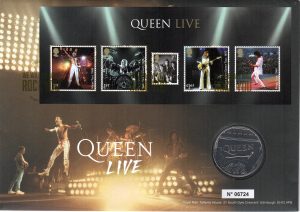
- Philatelic Numismatic Cover honoring Queen
-
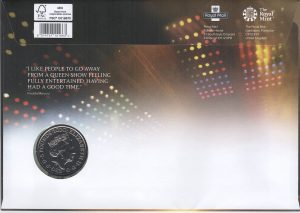
- Back of the Coin Cover honoring Queen
-
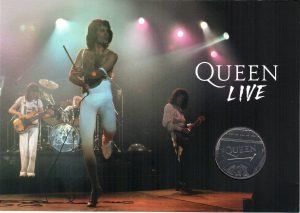
- Inside the cover is a card that holds the coin.
-
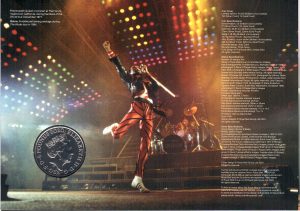
- Back of the insert Card of the PNC Honoring Queen
My collection contains every coin cover issued by the U.S. Mint, some issued by private companies, and several by the Royal Mint and Royal Mint with global interest topics. When I discovered that they issued a coin cover with the Queen coin, it was an opportunity to add a great collectible to my collection.
The covers are a great way to collect something numismatic that ties to other interests. Aside from classic rock, I noticed that the Royal Mint and Royal Mail has two limited edition covers celebrating Sherlock Holmes. I first read Arthur Conan Doyle’s The Hound of the Baskervilles for a college literature class. I thought it was fantastic. When discussing the book, the professor said that Doyle wrote many short stories featuring Holmes. As a poor college student, I was able to find an affordable two-volume set of Doyle’s 56 short stories in a used bookstore. Later, I read the four Sherlock Holmes novels.
As you can see, the coin covers add additional context to the collection. It bridges numismatics with other subjects that allow the enjoyment of both. In fact, I was listening to the Top 700 countdown of the 1970s hits on SiriusXM’s 70s on 7 channel that reminded me to write about the cover.
For the record, the listeners of the 70s on 7 voted Queen’s “Bohemian Rhapsody” as the Number 1 song of the 1970s. “We Will Rock You/We Are The Champions” was Number 10.
Summary of December 2012 Coin-Related Legislation
Public Law No. 112-201: Mark Twain Commemorative Coin Act
To require the Secretary of the Treasury to mint coins in commemoration of Mark Twain.
Sponsor: Rep. Blaine Luetkemeyer (R-MO)
• Signed by the President on December 28, 2012
See this bill at http://www.govtrack.us/congress/bills/112/hr2453
Public Law No. 112-209: March of Dimes Commemorative Coin Act of 2012
To require the Secretary of the Treasury to mint coins in recognition and celebration of the 75th anniversary of the establishment of the March of Dimes Foundation.
Sponsor: Rep. Bob Dold (R-IL)
• Passed the Senate on December 10, 2012
• Signed by the President on December 18, 2012
See this bill at http://www.govtrack.us/congress/bills/112/hr3187
The 112th Congress formally adjourned just after 12:30 P.M. on January 2, 2013 as one of the least productive in decades. It has been reported that this congress passed 219 bills as compared to 383 bills passed by the 111th congress and 460 by the 110th congress. As a comparison, the 80th congress (1947-48) that President Harry Truman labeled the “Do-nothing Congress” passed 906 bills.
2013
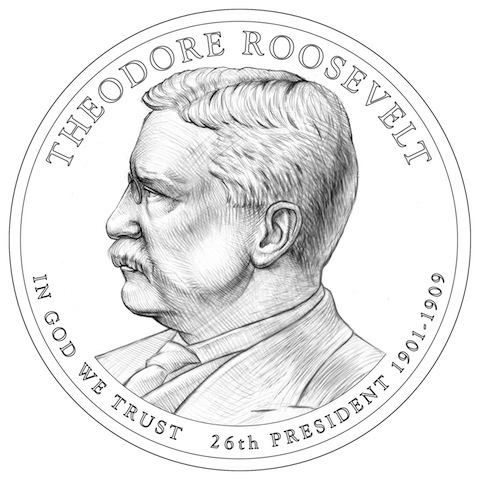
Line Art of the 2013 Theodore Roosevelt Dollar designed and engraved by U.S. Mint Sculptor and Engraver Joseph Menna
2013 Will Be Interesting
We end numismatic 2012 almost the same way as we began, discussing what to do about the one-dollar coins. The over production lead to a quite a number of bills introduced in congress to try to fix the perceived problem but none ever made it to a hearing, let alone out of a hearing. Rather, the U.S. Mint hired Current Technologies Corp. (CTC) to perform an alternative metals study required by congress.
When the U.S. Mint finally published the report and a summary they made a recommendation to study the problems further because they could not find suitable alternatives to the current alloys used. While reading the summary gives the impression that the request is reasonable, the full 400-page report describes the extensive testing and analysis that the U.S. Mint and CTC performed leaving the reader curious as to why they were unable to come to some sort of conclusion—except that there is no “perfect” solution. This is a story that will continue into 2013 and be on the agenda for the 113th congress when it is seated on January 3, 2013.
The other part of the discussion is whether or not to end the production of the one-dollar Federal Reserve Note. It was the last hearing before the House Financial Services subcommittee on Domestic Monetary Policy and Technology for Rep. Ron Paul (R-TX) and the 112th congress that will certainly carry over into 2013.
This does not mean the Bureau of Engraving and Printing is without its controversy. In order to comply with the court order as part of American Council for the Blind v. Paulson (No. 07-5063; D.C. Cir. May 20, 2008 [PDF]) and the subsequent injunction (No. 02-0864 (JR); D.C. Cir. October 3, 2008 [PDF]), the BEP has been working to provide “Meaningful Access” to United States currency.
Secretary of the Treasury Timothy F. Geithner approved the methods that will be used to assist the blind and visually impaired to U.S. currency on May 31, 2011. In addition to examining tactile features, high contrast printing, and currency readers, the BEP issued a Request for Information for additional information to implement their plan. The BEP will be participating at stakeholder organization meetings to socialize and refine their plans. There will probably be few announcements before the conventions of the National Federation of the Blind and American Council of the Blind this summer.

Another building controversy from the BEP is whether the redesigned $100 notes will find its way into circulation. Introduced in April 2010, full production has been delayed because of folding during the printing process. The situation has to be so severe that the BEP has not announced a new release date and delayed releasing the 2011 CFO Report [PDF] to the end of Fiscal Year 2012 while finding a way to bury the scope and costs of the delays. Will the redesigned $100 Federal Reserve Note be issued in 2013? Stay tuned!
Staying with currency issues, there should be a new series of notes when a new Secretary of the Treasury is appointed. It is known that the current Secretary Timothy F. Geithner wants to pursue other options. If the BEP follows its past practice, notes with the new Secretary of the Treasury’s signature would be Series 2009A notes. There have been no reports as to whether Treasurer Rosie Rios will continue in her position.
As for other products, the BEP will continue to issue specially packaged notes using serial numbers that are either lucky numbers (i.e., “777”) or ones that begin with “2013” as part of their premium products. Of course they will continue to issue their sets of uncut currency.
Another carry over from 2012 will be whether the U.S. Mint will issue palladium coins that were authorized by the American Eagle Palladium Bullion Coin Act of 2010 (Public Law No: 111-303 [Text] [PDF]). The law requires that the U.S. Mint study of the viability of issuing palladium bullion coins under the Act. That report was due to congress on December 14, 2012 but has not been made public at this time.

Bibiana Boerio was nominated to be the Director of the U.S. Mint.
Other than the higher prices for silver products, the U.S. Mint should not generate controversies for its 2013 coin offerings. There will be no changes for the cent, nickel, dime, and half dollar with the half dollar only being struck for collectors since it has not been needed for circulation since 2002. These coins will be seen in uncirculated and proof sets with silver versions for the silver sets.
For the sets with the changing designs, the reverse of the 2013 America the Beautiful Quarters Program will honor:
- White Mountain National Forest (NH)
- Perry’s Victory and International Peace Memorial (OH)
- Great Basin National Park (NV)
- Fort McHenry National Monument and Historic Shrine (MD)
- Mount Rushmore National Memorial (SD)
There has been no confirmation from the U.S. Mint whether they will strike San Francisco “S” Mint quarters for the collector community as they did in 2012.
The 2013 Presidential $1 Coins ends the 19th century and begins the 20th century with some of the more interesting Presidents of the United States in history:
If we honor the Presidents we have to honor their spouses. In 2013, the First Spouse Gold Coins will honor:
- Ida McKinley
- Edith Roosevelt
- Helen Taft
- Ellen Wilson (died 1914)
- Edith Wilson (married Woodrow Wilson 1915)
The U.S. Mint has not released designs for these coins at the time of this writing.
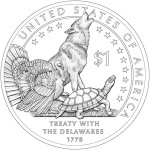
2013 Native American Dollar Reverse Design
Congress has authorized two commemorative coin programs for 2013:
- Girl Scouts of the United States of America Centennial Silver Dollar that will benefit the Girl Scouts of the USA
- 5-Star Generals Commemorative Coin Program that will include gold $5, silver dollar, and clad half-dollar coins. Proceeds will go to the United States Army Command and General Staff College
American Eagle coin programs will continue with the bullion, collector uncirculated, and proof coins for both the silver and gold. The American Eagle Platinum bullion coin will continue to use its regular reverse while the American Eagle Platinum Proof will continue with the Preamble Series. The Preamble Series is a six year program to commemorate the core concepts of the American democracy as outline in the preamble of the U.S. constitution. For 2013, the reverse will be emblematic of the principle “To Promote the General Welfare.” The U.S. Mint has not issued a design at this time.
Currently, there are no announced special products or sets using American Eagle coins and no announced plan for special strikings such as reverse proofs or “S” mint marks.
Finally, we cannot forget the American Buffalo 24-Karat Gold Coins that will be available as an uncirculated coin for the bullion/investor market and a proof coin for collectors.
And I bet you thought that 2013 would be a mundane numismatic year!
Did You Get Anything Numismatic Related?
As I am looking to pare down my collection to concentrate on a few select areas, I did not have anything on my numismatic wish list. Over the last few months, I have bought books that I will use for research. Otherwise, I have been just keeping up with the latest releases and not worrying about the holes in the parts of the collection I will be keeping.
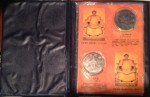
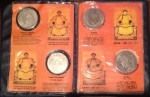
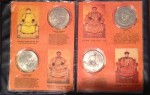
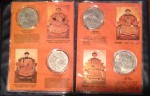
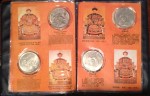
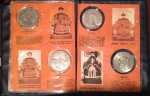
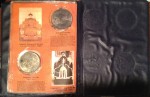
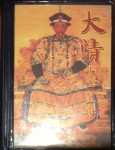 But that does not mean I did not receive a numismatic gift. Although it was not a holiday gift, a friend went to China and found a set called Qing Dynasty 12 emperors. The set contains 12 medals representing the Qing (pronounced as Ching) Dynasty that ruled China from 1616 through 1911. The set covers six pages with two medals per page. Each depicts a different emperor with their clan’s name around the top edge, their name to the right of their image, and the years of their reign below the image. All of the lettering is in Traditional Chinese. The reverse on all of the medals features the dynasty emblem that was used on the flag during the time the dynasty was in power.
Each of the medals are on a sealed plastic page with a paper insert that has an image of the emperor, his name, clan name, when he ruled, and a brief paragraph about him. On the front, the information is in Traditional Chinese, the reverse is in English. All of emperor images are drawings except for the last one, Xuantong Emperor, who abdicated in February 1912.
If you want to know more about the Qing Dynasty, you can read this page that is not pretty but uses the medal images as part of its explanation.
Based on the information I can find, the medals are 38 millimeters in diameter (1½ inches). I found a few references that they are made from silver, but I am not sure. From what I can tell by looking at the color and the weight of the medals, without cutting into the sealed pages, they may be made from a copper-nickel alloy. I do not think they are made from silver or silver-plated. But it is a very cool set and it was nice of my friend to think of me while she vacationed so far from home!
Which brings me to this week’s poll: Did you get anything numismatic-related for whatever holiday you celebrated?
Did you receive a numismatic-related gift this holiday season?
Total Voters: 26
 Loading ...
In the mean time, here are images of my Qing Dynasty 12 Emperors set.
March of Dimes Commemorative Coins Coming in 2015
 This past week, President Barack Obama signed H.R. 3187, the March of Dimes Commemorative Coin Act of 2012 (Public Law No. 112-209 [TXT] [PDF]).
According to the law, the U.S. Mint will strike no more than 500,000 silver dollar coins in 2015 that “shall be emblematic of the mission and programs of the March of Dimes, and its distinguished record of generating Americans’ support to protect our children’s health.”. The law says that the designs of the coin will “contain motifs that represent the past, present, and future of the March of Dimes and its role as champion for all babies, such designs to be consistent with the traditions and heritage of the March of Dimes.”
The law requires the U.S. Mint to consult with the March of Dimes, U.S. Commission of Fine Arts, and Citizens Coinage Advisory Committee on the design.
As with other silver dollar commemoratives, the sale of this commemorative will include a $10 surcharge that will be paid “to the March of Dimes to help finance research, education, and services aimed at improving the health of women, infants, and children.”
After congressed passed the law, the March of Dimes issued press release thanking Senators Kay Hagan (D-NC) and Susan Collins (R-ME) as well as Rep. Robert Dold (R-IL) and Nita Lowey (D-NY) for their work in getting this bill passed.
Between now and 2015 when the commemorative silver dollar is issued, I am sure the March of Dimes would appreciate as many $10 donations as you can afford. Donations to the March of Dimes are tax deductible to the extent allowed by law. It is a good way to save on taxes and do good at the same time!
Logo courtesy of the March of Dimes.
Support the Coin Collectors Blog
 Buy me a coffee
Thank you for your support!
Let Me Know What You Think
Are you going to the World's Fair of Money
Total Voters: 17
Loading ...