Weekly World Numismatic News for August 23, 2020
 On August 28-30, 2020, the Newman Numismatic Portal is hosting the virtual NNP Symposium 2020. The symposium will be presentations by numismatists from around the world delivered online and for free.
Think of it as a weekend of Money Talks seminars delivered online so that you can participate anywhere. All you need is an Internet connection and Zoom. To attend a session, download the appropriate Zoom client for your computer or mobile device, register online, receive the access information (which is why you have to register), and attend.
Registration is for the entire conference, not an individual session. You can attend any session at any time without registering again.
Each session is one hour. The presenter will deliver their talk in 30-45 minutes, leaving time for questions.
If you miss a session or cannot attend, the people at NNP will record the sessions and make them available online. The only difference is that you will not be able to ask a question in real-time.
Finally, suppose you want to know what I look at to determine whether a website is potentially going to sell you counterfeit coins. You can attend “How to Identify a Potential Scammer BEFORE Buying Coins Online.” Check your registration listing for the time and access information.
And now the news…
 August 18, 2020
 → Read more at cbc.ca
August 18, 2020 → Read more at eveningtelegraph.co.uk
August 21, 2020 → Read more at kitco.com
→ Read more at cbc.ca
August 18, 2020 → Read more at eveningtelegraph.co.uk
August 21, 2020 → Read more at kitco.com

Numismatics at an Auto Show
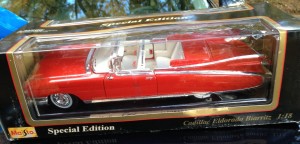
My dream car… in model form!
Saturday was the 2012 Rockville Antique and Classic Car Show, a yearly show supported by 25 local and regional car clubs. When I arrived around 1 o’clock I saw a field with more than 500 antique and classic cars. Although I was not interested in some cars, there were others that were absolutely stunning. While I did not find a 1959 Cadillac, there were a few cars that I would love to own. You can see some of the cars I found and a quick video of the inside of a Volkswagen Bus visit on my page at Photobucket.†
While the 1959 Cadillac is my dream car, my nostalgic car is a 1973 Plymouth Gold Duster. While it was not my first car, it ranks one of my favorites from my early days. This Gold Duster was “sunshine yellow” with the brown snake-skin three-quarter covered vinyl top. The 225 Hemi Slant 6 engine output 145 horsepower but was more than enough for this car especially since it did not have air conditioning! My father bought it as a new car in 1973 and I “inherited” it in 1980 while in college. Unfortunately, it met its demise on a rainy road while trying to avoid hitting a dog.
To satisfy my nostalgia, I was looking at the wares of the flea market dealers in the adjacent lot when I came across a brochure for the 1973 Gold Duster. “Get Ready to Stake Your Claim” screams the headline on the front cover. Open the brochure and it tells you that “You’ve Discovered Gold Duster.” While admiring the picture that reminded me of my youth, I noticed the coin image at the bottom right corner that said:
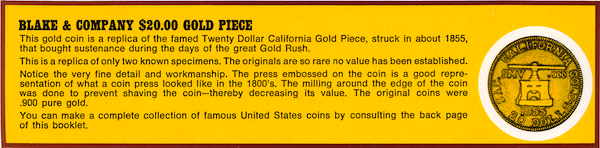
If you cannot read the image, it says:
This gold coin is a replica of the fame Twenty Dollar California Gold Piece, struck in about 1855, that bought sustenance during the days of the great Gold Rush.
This is a replica of only two known specimens. The originals are so rare no value has been established.
Notice the very fine detail and workmanship. The press embossed on the coin is a good representation of what a coin press looked like in the 1800’s. The milling around the edge of the coin was done to prevent shaving the coin—thereby decreasing its value. The original coins were .900 pure gold.
You can make a complete collection of famous United States coins by consulting the back page of this booklet.
Interested in what this collection can be, I turned over the brochure see a 1973 advertisement for 12 “authentic replicas” of the Chrysler-Plymouth “Old West” Coin Collection. The collection appears to be replicas of various assay tokens from the famous gold assayers of the time. For $7.75 per set (or $40.39 today), you could have ordered a full set along with a vinyl/velour folder.
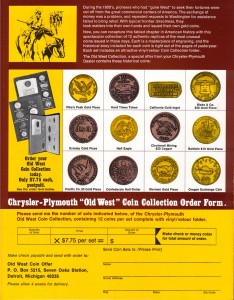
Chrysler-Plymouth “Old West” Coin Collection Order Form from 1973 Plymouth Gold Duster Brochure
At the intersection of cars and numismatics I found fascinating piece of automotive advertising history with a numismatic slant. I do not know if a version of this set has survived—an Internet search yielded more copies of the brochure—but it would be interesting to find a set.
† At the time this is posted, I have not labeled the images on Photobucket. I hope to finish that sometime this week.
Make Your Own Currency Art
Now that it has been three weeks since the autumnal equinox, the kind folks at the National Weather Service has issued a freeze warning for the Washington, D.C. area almost ending most outdoor activities. Aside from finding new coats for the dogs and their human parents and looking for a good charity which to donate the old coats, it is time to look for something to do indoors.
Being a blog about numismatics, I went on a search to find something a little different that the whole family could do when I stumbled on a YouTube video teaching the watcher “How to Make an Origami Dollar Ring.” It’s fun, functional, and costs only one dollar per ring.
Interestingly, the host of the video starts with showing how to use plain paper if you do not have a U.S. one dollar note. All it takes is using ordinary paper that is cut down to 15.5 cm in length and 6 cm in width. It is better to use metric measurements so that you can cut the sheet to the right size. Another advantage of using plain paper is that you can print anything on it prior to folding.
Here is the video to teach you what to do:
If you want to make your own ring using plain paper, I created a template based on the video’s instructions. The advantage of using the templates is that you can create your own design. After I folded my own dollar, I decided to make my own design based on the theme to this blog. Here are my results:
-
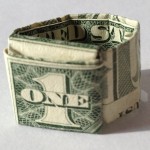
- Origami Ring made using a $1 Federal Reserve Note
-
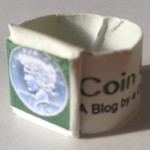
- Origami Ring made using the the template colors of the Coin Collectors Blog
If you want to make your own ring, I created templates with lines showing the basic folds. I am including a blank template for you to create your own design and the template I used to make the Blog ring. Click on the link for the format you want and it will automatically download the file for you.
| Blank Ring Templates | Coin Collectors Blog Ring Templates |
|---|---|
| Photoshop Format (Origami-Ring.psd) | Photoshop Format (CCB-Origami-Ring.psd) |
| PDF Format (Origami-Ring.pdf) | PDF Format (CCB-Origami-Ring.pdf) |
| PNG Image (Origami-Ring.png) | PNG Image (CCB-Origami-Ring.png) |
NatGeo’s America’s Money Vault
Prior to the very entertaining Vice Presidential Debate, the National Geographic Channel aired a show titled “America’s Money Vault” that was part of their “Behind the Scenes” week. The show was hosted by Jake Ward, editor-in-chief of Popular Science magazine.
The show is centered around the Federal Reserve and primarily the operations of the Federal Reserve Bank of New York. After opening the show at Times Square, we are transported downtown to the New York Fed where they are accepting a deposit of over 1 ton of gold. Following an explanation that the New York Fed is the most trusted handler of gold in the world and has 25-percent of the world’s gold on deposit, we watch the transfer process.
As part of the transfer process, the cameras are brought into the vault and the viewers are show “walls” of gold bars. Unlike the images in the 1995 movie Die Hard: With a Vengeance, it appears that the vault that is more solid than the jail-like bars shown in the movie.
Ward visited with Federal Reserve Chairman Ben Bernanke to talk about the Fed’s roll in the markets. While in Washington Ward visits the Bureau of Engraving and Printing to show some of the process in currency printing. There was also a discussion with the United States Secret Service about anti-counterfeiting.
One of the more interesting visuals was when Ward visited the East Rutherford Operations Center (EROC), one of the New York Fed’s currency operations. Viewers were shown rows of currency and coins being stored on shelves throughout the building. And in a scene to warm my technical heart, the robotic inventory system was profiled.
According to NatGeo TV, the next time America’s Money Vault will air is on Thursday, October 18, 2012 at 4:00 PM Eastern Time. If you will be away at that time, it is worth setting the DVR (or VCR for those still going old school) to record this show.
Star-Spangled Banner Commem Helps Honor Maryland Olympians
On the heels of their success in the London 2012 Olympic Games, Michael Phelps and other Olympic athletes from Maryland including Katie Ledecky of Bethesda and Suzanne Stettinius of Parkton were presented with a Star-Spangled Banner Commemorative Coin at a celebration held on Monday, September 10, 2012 at Baltimore’s Inner Harbor.
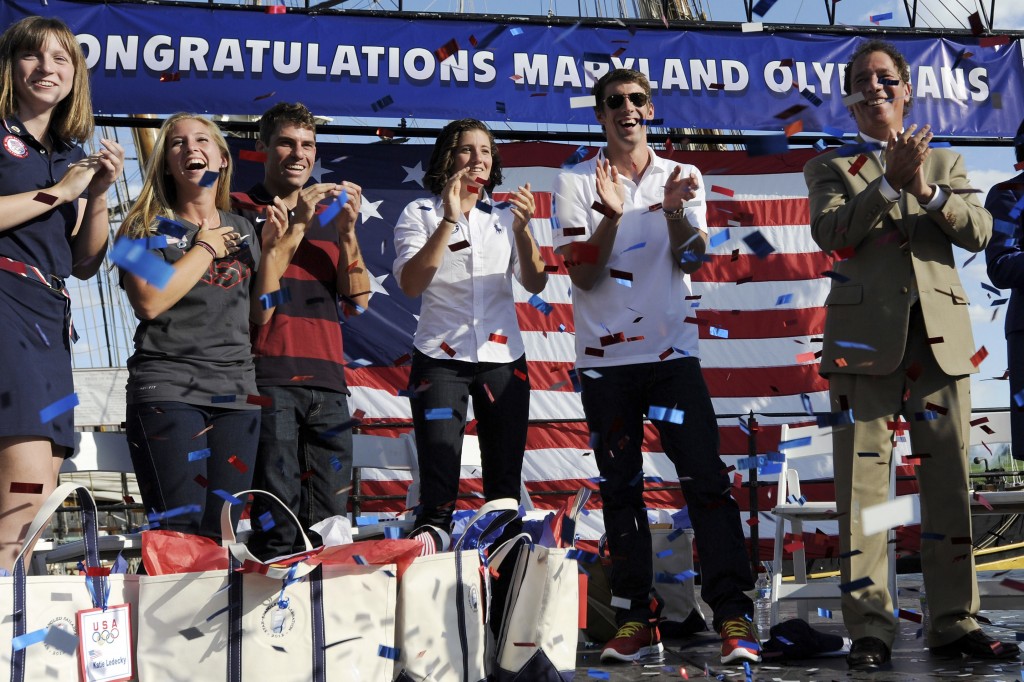
Michael Phelps, second from right, joins other Olympic athletes from Maryland, including Katie Ledecky, left, windsurfer Farrah Hall, second from left, and Suzanne Stettinius, third from right, and Baltimore County Executive Kevin Kamenetz, right, during a celebration of the achievements of Maryland Olympians. (Steve Ruark/AP Photo)

Olympian Michael Phelps shows his Star-Spangled spirit and receives a new piece of “metal” from Maryland Governor Martin O’Malley.
“Our Maryland Olympians’ resolve to work hard, train and excel embodies the spirit of our state,” said Gov. Martin O’Malley. “It’s only fitting that we honor them with these 2012 Star-Spangled Banner Commemorative Coins, which pay tribute to Maryland’s vibrant people and extraordinary history.”
Star-Spangled Banner Commemorative held by the referee that was used at the Ravens-Browns game on September 10, 2012.
“As we celebrate a variety of sports on Monday, the Star-Spangled Banner Commemorative Coin will serve as a symbol to our local athletes of Maryland’s historic tie in defending our freedom during the War of 1812,” said Ann Beegle, executive director of Star-Spangled 200 Inc., the non-profit affiliate of the Maryland War of 1812 Bicentennial Commission prior to the game. “Baltimore is home to the Star-Spangled Banner and we are pleased to recognize these athletes’ dedication with a historic symbol of our state.”
The 2012 Star-Spangled Banner Commemorative Coins, created in honor of the bicentennial of the War of 1812, exemplify the Star-Spangled Banner flag and Francis Scott Key’s poem, “The Defence of Fort McHenry” that became our national anthem. These are two of America’s most enduring icons. Coin sales will continue through December 17 and are only available through the United States Mint. The Star-Spangled Banner Commemorative coins can be purchased through the United States Mint website, at United States Mint kiosks in Washington, DC (Union Station, 50 Massachusetts Ave. NE and United States Mint Sales Counter, 801 9th Street NW) and at the Baltimore Visitor Center located at 401 Light Street, Baltimore, MD 21202.
-
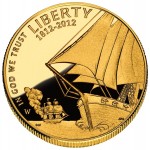
- 2012 Star-Spangled Banner Gold Commemorative Obverse depicts a naval battle scene from the War of 1812, with an American sailing ship in the foreground and a damaged and fleeing British ship in the background. Designed by Donna Weaver and engraved by Joseph Menna.
-
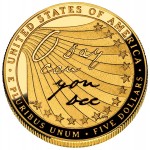
- 2012 Star-Spangled Banner Gold Commemorative Reverse Depicts the first words of the Star-Spangled Banner anthem, O say can you see, in Francis Scott Key’s handwriting against a backdrop of 15 stars and 15 stripes, representing the Star-Spangled Banner flag. Designed by Richard Masters and engraved by Joseph Menna.
-
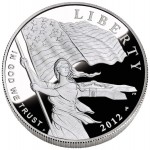
- 2012 Star-Spangled Banner Silver Commemorative Obverse depicts Lady Liberty waving the 15-star, 15-stripe Star-Spangled Banner flag with Fort McHenry in the background. Designed by Joel Iskowitz and engraved by Phebe Hemphill.
-
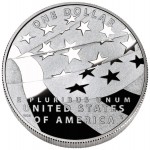
- 2012 Star-Spangled Banner Silver Commemorative Reverse depicts a waving modern American flag. Designed by William C. Burgard III and engraved by Don Everhart.
Proceeds from the sales ($35 for each gold coin and $10 for each silver coin) to support the Maryland War of 1812 Bicentennial Commission. The commission will use these funds to support its bicentennial activities, educational outreach, and preservation and improvement of the sites and structures related to the War of 1812. Help support the commission’s activities by purchasing a commemorative coin today!
Scott’s coin:

- AP photo courtesy of reachforthewall.com.
- O’Malley/Phelps and Referee Coin images are courtesy of Star-Spangled 200, Inc.
- Coin images courtesy of the U.S. Mint.
- Image of Scott’s coin is owned by the author and covered under CC BY-NC-ND 3.0 license.
U.S. Paper Money Still In Failed Dark Ages
Last year I asked why the United States would not consider using polymer notes after the Bank of Canada made their announcement that they will transition to using the polymer substrate. Not only are polymer notes very difficult to counterfeit, they last longer reducing printing costs and overhead to both the Bureau of Engraving and Printing and the Federal Reserve.
After it was announced that Spink of London will auction sheets of DuraNote trial printings from the Bank of Canada, BEP told CoinWorld that they printed as many as 40,000 sheets of Federal Reserve Notes using the DuraNote substrate.
DuraNote was a product of Mobil Chemical and AGRA Vadeko of Canada. Trials of DuraNote were not successful and the project was abandoned. Patents for DuraNote were sold following the Exxon-Mobil merger.
Around the same time, the Reserve Bank of Australia (RBA) developed a polymer substrate with a different formula that went into production in 1992. Since then, Australia has been successfully printing polymer notes.

In the mean time, there continues to be issues with folding of the paper specially designed for the new $100 Federal Reserve Note. Since the October 1, 2010 announcement by the Fed of the folding issue, the Fed and BEP has less than forthcoming on the status of the new note including the BEP withholding their annual report for fiscal year 2011 so they do not have to disclose how many of these notes they have in inventory.
The paper being used by the BEP is manufactured by Crane & Company who has had the exclusive contract with the BEP since 1879.
Where DuraNote failed RBA succeeded in creating a workable technology that is being adopted world wide. With the new $100 note having printing problems, why has the BEP not looked into the RBA polymer substrate for U.S. currency? Why does the Federal Reserve, BEP, and Secret Service cling to 19th and 20th century printing technologies in the 21st century? Or is this a matter of the influence being purchased [PDF] by Crane & Company in order to maintain its monopoly.
Maybe it is time for the Fed and the BEP to re-examine their commitment to paper and stop wasting time and money with failed technologies.
Support the Coin Collectors Blog
 Buy me a coffee
Thank you for your support!
Let Me Know What You Think
Are you going to the World's Fair of Money
Total Voters: 17
 Loading ...