
Recognizing History on United States Currency
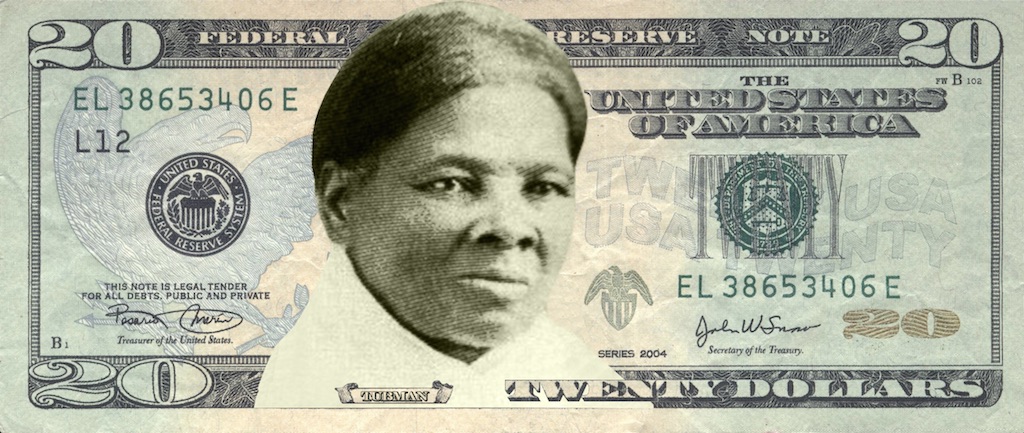
Mockup of the $20 note featuring Harriet Tubman
The Treasury Department said that the $10 note was next on its schedule to update the currency to add Advanced Counterfeit Deterrence (ACD). The ACD Steering Committee, an inter-agency group that monitors several factors that go into the maintenance of U.S. currency, suggested the change. The committee also wanted to add features that will help increase accessibility for the visually impaired as part of the court-mandated Meaningful Access Program. Treasury reports that the new note “will include a tactile feature that increases accessibility for the visually impaired.”
Others had recommended replacing the portrait of President Andrew Jackson on the $20 note with a woman. Aside from 20 being a significant number in this celebration, the groups targeted Jackson because of his history of wanton disregard for life and liberty. During the War of 1812, Jackson led U.S. Army troops against native tribes working with the British against the United States to regain the lands taken following the colonies’ independence. History records that Jackson’s troops were brutal against the native tribes on his orders, killing them rather than taking prisoners.
After beating back the British in the Battle of New Orleans, Jackson declared martial law in New Orleans and used his troops to enforce martial law. Jackson ordered his troops to arrest a local magistrate because he sided with a newspaper reporter who wrote negatively about Jackson’s rule. Jackson also had members of the local militia who sided with the British executed without trial.
As president, Jackson’s lobbied Congress passed the Indian Removal Act because he wanted the Native American tribes to relocate to the western side of the Mississippi River. Jackson disregarded the letter of the law and ratified treaties to uproot tribes and march them away. It was called “Trail of Tears.” It forced the relocation of Cherokee, Muscogee, Seminole, Chickasaw, and Choctaw nations from their ancestral homelands in the southeast to an area west of the Mississippi River. It is considered the most violent and brutal act against the native tribes in United States history.
To have Jackson’sJackson’s portrait on the United States currency is also a bit ironic. Jackson was against the concept of a central bank and refused to renew the charter of the Second Bank of the United States. He vetoed the bill to continue its charter. After winning the election in 1833, Jackson withdrew all of the country’s funds from the bank, limiting its ability to conduct business. He gave power to local banks to lend money and issued the Specie Circular, an executive order requiring government transactions in gold and silver coins (specie).
Although all of the men whose portraits appear on United States currency are very flawed people, Jackson is the worst.
Eventually, Secretary Lew sided with the activists and announced that Harriett Tubman would replace Jackson on the $20 Federal Reserve Note.
Lew resigned as the 76th Secretary of the Treasury on January 20, 2017, with the inauguration of a new administration. Steven T. Mnuchin became in as the 77th Secretary of the Treasury on February 13, 2017.
Mnuchin did not immediately interfere with the Bureau of Engraving and Printing’s efforts to redesign the $20 FRN. As the work continued, the BEP also continued to work on additional anti-counterfeiting measures for U.S. currency. Specifically, the BEP was looking into changes that would first impact the $10 note followed by the $5 bill.
The paper $5 note was a more significant focus for the BEP. In working with the U.S. Secret Service, they were finding that many counterfeiters were using bleaching products to remove the ink from the paper to use it to print higher denominations, predominantly $20 bills. One internal report suggested that the criminal would see a net gain of $14 for each $20 note they could produce.
Although it costs more to counterfeit $20 bills this way, it is a lower risk for the criminal. Few people pay attention to the problem, and those that do find that the currency passes the iodine pen test.
Interference from Mnuchin came after his first three months in office. It started with a question from a reporter who asked the president about the change. During a subsequent cabinet meeting, the president said something to Mnuchin about the change. Mnuchin agreed to do something without raising concerns.
Rather than stopping the process, Mnuchin diverted funds from the development of the proposed change in portrait. He was able to hide the change from the public because of the nature of the Treasury’s budgetary process.
In response to news reports, BEP Director Len Olijar issued the following statement via the bureau’s website saying that “BEP was never going to unveil a note design in 2020.” That was not the policy of the Treasury Department and the BEP when Secretary Lew announced the change.
Without interference from the current administration, Andrew Jackson, whose policies and actions led to the murder of many Native Americans, would have been replaced by Harriett Tubman. An honor to someone who saved lives and a tribute to 100 years of Women’s Suffrage.
Steeling Coins
Let’s start with a trivia question:
What is the only coin (not pattern) struck by the U.S. Mint that contained no copper?
(cue “Jeopardy!” music)
Give up?
If you said the 1943 Lincoln Steel Cents, you are correct. Every other coin struck by the U.S. Mint has contained some amount of copper in the alloy. Even the 1942-1945 war-time alloy used for the Jefferson Nickel was changed from a copper-nickel alloy to one made of copper-silver-manganese.
After the bombing of Pearl Harbor by the Japanese on December 7, 1941, the next day congress passed a formal Declaration of War on Japan. Three days later, a Declaration of War was passed against Germany. Mobilization took a while and the United States did not formally enter the European theater until landing on Normandy Beach on June 6, 1944, better known as D-Day. Between those declaration and full-scale fighting in both Europe and the Pacific, copper was a critical element necessary to manufacture bullets for training.
Rather than using the copper for coins, the government had bullets manufactured. In order to ensure there was a supply of circulating currency, the U.S. Mint changed the composition of the cent to zinc coated steel. Similarly, to save the nickel needed to make other armaments, the Jefferson 5-Cent coin was changed to 56-percent copper, 35-percent silver, and 9-percent manganese.
To say that 1943 Steel Cent was a disaster would be an understatement. Because of its silver color, it was not accepted by the public. Also, since the steel was not treated, it oxidized quickly and became a dark, dirty color. After a while, the coins would begin to rust. In 1944, Lincoln cents were made using the spent shell casing picked up from the training fields. This continued through 1946, the end of World War II giving the coins the nickname of “Shotgun Cents.”
One other coin that was not made using copper was a 1974 Lincoln Cent pattern that was made of aluminum. The U.S. Mint struck over 1.5 million examples in 1973 in order to convince congress to allow them to circulate them. A few was given out to members of congress as part of the U.S. Mint’s lobbying effort. After the measure was defeated, the members of congress was supposed to return the coins. However, one coin was allegedly “dropped” by a senator and retrieved by U.S. Capitol Police Officer Albert Toven. The Toven Specimen was graded MS62 by PCGS in 2005. It is estimated that 18-44 more still exist but have yet to be discovered.
Today there is another issue. Since 2006, the cost of the metals to manufacture the current Lincoln Cent (99.2-percent zinc covered with .8-percent copper) and Jefferson Nickel (75-percent copper and 25-percent nickel) has raised its base cost to at least 150-percent of face value before considering manufacturing costs. The cost has caused several “discussions” about the fate of these coins—there are some who want to eliminate the cents; others want to change its composition; and there is a small group who understands the concept of the loss-leader and is willing to let it go as long as seignorage for other coins cover the costs.
First term Rep. Steve Stivers (R-OH) wants to settle the discussion by introducing two bills that if passed will change the composition of the one-cent and five-cent coins. Stivers introduced H.R. 3693, Cents and Sensibility Act, and H.R. 3694, Saving Taxpayer Expenditures by Employing Less (STEEL) Imported Nickel Act on December 15, 2011. Both bills are being co-sponsored by Reps. Tim Ryan (D-OH) and Pat Tiberi (R-OH).
H.R. 3693 is very straight forward. It says that the “1-cent coin shall be produced primarily of steel” and “shall be treated to impart a copper color to the appearance of the coins.” If the law is enacted, the coins will use only steel produced in the United States. If it is not possible to use U.S. manufactured steel, the reason has to be published in the Federal Register. The size of the coin will not change but the weight is allowed to be altered as necessary.
H.R. 3694 is similar to H.R. 3693 in that it strives to keep the 5-cent coin to look the same using U.S. manufactured steel. Where the bill differs is how the coins are to be designed for use in circulation. The three provisions required for the conversion is that whatever composition is used, the new alloy is not supposed “require more than 1 change to coin-accepting and coin-handling equipment to accommodate coins,” use the same alloy or specifications that is used by another country, and “require changes to coin-accepting or coin-handling equipment whatsoever to accommodate both coins produced with the new specifications.”
Every time there is a proposed change in the composition of U.S. coins, the one group that has the biggest say is the vending machine industry. When silver was removed from U.S. coins in the 1960s, the decision was made to use the current copper-nickel clad coins so that it produces the same electro-mechanical signature its silver counterparts. The electro-mechanical signature is the combination of the coin’s size, weight, and how electricity is conducted by the coin. If the coin can match the specifications, it is determined to be real (as opposed to a slug) and is accepted by the machine. Considering that steel has a different density from the copper-nickel alloy, the coin will have a different weight and be a stronger conductor of electricity. Steel coins may require two changes to vending machines making it nearly impossible to comply with the law. The vending machine lobby will not like the results of this bill and will lobby for its defeat.
Before considering other options, by saying that the coins cannot use the same alloy or specifications that is used by another country, the U.S. Mint could not consider using aluminum, especially since it is being used in Canada.
The professional organizations that cover the vending machine industry has not comment on these bills.
The bill was referred to the House Committee on Financial Services. Coin bills are referred to the Domestic Monetary Policy and Technology subcommittee, chaired by Rep. Ron Paul (R-TX). Aside from Rep. Paul’s current status as a candidate for the Republican nomination for president, he is known for not being a fan of using base-metals for coins and “wasting time” on coinage changes. Remember, it took a the members of this subcommittee to bring the measure to the Financial Services Committee as a whole to have the Baseball Hall of Fame Commemorative referred to the floor for a vote.
While H.R. 3693 and H.R. 3694 may make for an interesting discussion, politics suggests that these bills may never make it out of committee.
Being Charitable By Overpaying for Collectibles
Every year, usually in December, my coin club holds its annual Donated Auction. It is an auction that lasts the entire meeting of various numismatic items where the proceeds go to the local chapter of the Boys and Girls Club. It is a tradition that has existed for the 52 years of the club’s existence and I am happy that it continues.
As opposed to our regular monthly auction, there are more lots and a lot of different type of items. And since the proceeds go to charity, we are encourage to bid early and bid often. I have to admit that on items I really want, I have been known to overbid on items.
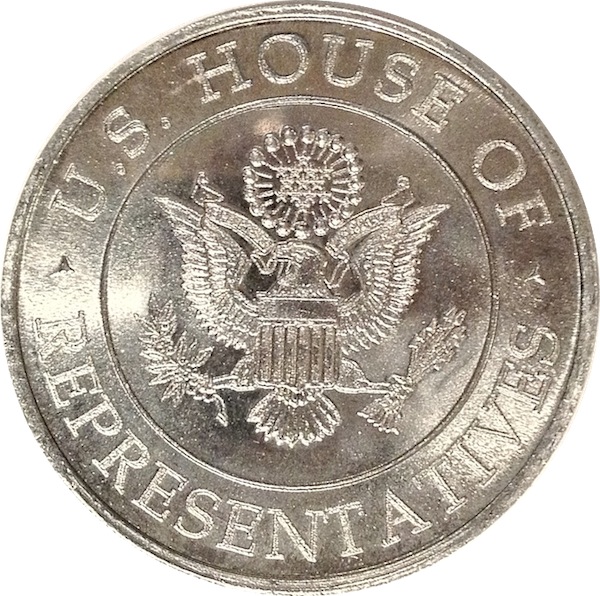
 One of my overbids was for a lot with two rolls of Lincoln Cents; one roll contained 40 steel cents and the other had 50 miscellaneous wheat back cents. However, as a bonus, this lot included a U.S. House of Representatives token. Made of aluminum, about 40mm in diameter, the front of the token is the seal of the U.S. House of Representatives. The reverse depicts the east entrance of the capitol building with the south wing closer to the foreground. The south wing is where the chamber for the House of Representatives is located. The member that donated the token was a former staffer for one of the House committees who told me that the tokens were provided to staffers to give to visitors. Although the token is made of aluminum and not that rare, I have not seen one. Since I thought it had that “oh neat” factor, I overbid in order to win the lot and this token.

 My other “oh neat” purchase was a Cheerios Penny. The Cheerios Penny is a 2000 Lincoln Cent that placed onto plastic-sealed cards and placed in boxes of Cheerios as a special Y2K promotion. Cheerios was provided the first 10 million Lincoln Cents off the presses in 2000 by the U.S. Mint. These cents are really unremarkable except for being in the Cheerios package. The remarkable cents also included one of the first 5,500 new Sacagawea Dollars to raise awareness of the new “Golden Dollars.” The Cheerios Dollar is notable as being struck from different dies than the regular business strike Sacagawea Dollars.
According to the auction lot listing, there was supposed to be one Cheerios Cent and three wooden nickels. However, when I arrived at home and opened the package, there were two Cheerios Cents. If you would like your own Cheerios Cent, you can buy it on eBay!
Buying “oh neat” with the proceeds going to charity is a lot of fun.
2012 Coin of the Year Category Winners
On Monday, Krause Publications announce the winners of the 2012 Coin of the Year Awards. From these winners, judges will select an overall Coin of the Year winner which will be announced February 4, 2012, at the World Money Fair in Berlin, Germany. Voting for the People’s Choice Award will begin in early January with the winner also announced at the World Money Fair.
Krause reports that 95 coins issued in 2010 were nominated early in 2011 for consideration. The category winners are:
- Best Silver: Austrian Mint, 10 Euro Erzberg in Styria
- Most Popular Coin Design: Austrian Mint, Silver Philharmonic bullion coin
- Best Contemporary Event Coin: The German Federal Ministry of Finance, Silver 10 Euro celebrating German Unity
- Most Historically Significant Coin: Royal Canadian Mint, $100 gold coin commemorating the 400th Anniversary of the Hudson Bay Company
- Best Gold Coin: Royal Mint, £100k London Olymics Gold Coin
- Best Crown: Andorra Mint, 5 Dinar Brown Bear Pyrenees Silver Coin
- Most Artistic Coin: Israel Coins and Medals Corporation, Jonah in the Whale 2 NIS Silver Proof Coin
- Best Trade Coin:, San Marino, 2 Euro circulating coin
- Most Innovative Coin: Coin Invest Trust of Liechtenstein, 1500 Francs CFA Silver Proof featuring The Mecca Qibla Compass with magnetic spoon that points north.
- Most Inspirational Coin, Mont of Finland, Children and Creativity 20 Euro Coin; this coin is notable because it was the first theme for a Finnish coin selected by public vote. The coin was designed by Roope Määttä, an art student at the Kajaani Upper Secondary School, who describes his design as a reminder to always remember one’s roots.
For the second year in a row, no coin from the U.S. Mint was selected for any category.
First They Came For The Ancient Coins…
I am sharing the following from Wayne G. Sayles, Executive Director of the Ancient Coin Collectors Guild (ACCG). Please read my comment following Wayne’s letter.
The following is an extremely important message from Peter K. Tompa, ACCG Board Member and Chairman of the Legislative Affairs Committee:
Fresh on the heels of its deliberation over import restrictions on coins from Bulgaria, the US State Department has now announced a hearing on extension of the MOU (Memoranda of Understanding) with Cyprus that is now up for its 5-year renewal. The Cultural Property Advisory Committee is seeking public comment on the renewal request To submit comments electronically to the State Department’s Cultural Property Advisory Committee (CPAC), see below:
Those present restrictions bar entry into the United States of the following coin types unless they are accompanied with documentation establishing that they were out of Cyprus as of the date of the restrictions, July 16, 2007:
- Issues of the ancient kingdoms of Amathus, Kition, Kourion, Idalion, Lapethos, Marion, Paphos, Soli, and Salamis dating from the end of the 6th century B.C. to 332 B.C.
- Issues of the Hellenistic period, such as those of Paphos, Salamis, and Kition from 332 B.C. to c. 30 B.C. (including coins of Alexander the Great, Ptolemy, and his Dynasty)
- Provincial and local issues of the Roman period from c. 30 B.C. to 235 A.D.
Why bother to comment when the State Department rejected CPAC’s recommendations against import restrictions on Cypriot coins back in 2007 and then misled both Congress and the public about its actions? And isn’t it also true that although the vast majority of public comments recorded have been squarely against import restrictions, the State Department and U.S. Customs have imposed import restrictions on coins anyway, most recently on ancient coins from Greece?
Simply, silence just allows the State Department bureaucrats and their allies in the archaeological establishment to claim that collectors have acquiesced to broad restrictions on their ability to import common ancient coins that are widely available worldwide. And, of course, acquiescence is all that may be needed to justify going back and imposing import restrictions on the Roman Imperial coins that are still exempt from these regulations.
Under the circumstances, please take 5 minutes and tell CPAC, the State Department bureaucrats and the archaeologists what you think.
How do I comment? To submit comments three pages in length or less electronically, go here: http://www.regulations.gov/#!submitComment;D=DOS-2011-0135-0002.
If you are having trouble, go to the Federal eRulemaking Portal (http://www.regulations.gov), enter the Docket No. DOS-2011-0135 for Cyprus, and follow the prompts to submit a comment. To send comments via US Mail or FEDEX see the directions contained in the Federal Register Notice above. For further information, also see http://exchanges.state.gov/heritage/whatsnew.html.
What should I say? The State Department bureaucracy has dictated that any public comments should relate solely to the following statutory criteria:
- Whether the cultural patrimony of Cyprus is in jeopardy from looting of its archaeological materials;
- Whether Cyprus has taken measures consistent with the 1970 UNESCO Convention to protect its cultural patrimony;
- Whether application of U.S. import restrictions, if applied in concert with similar restrictions by other art importing countries, would be of substantial benefit in deterring a serious situation of pillage and that less drastic remedies are not available; and,
- Whether the application of import restrictions is consistent with the general interest of the international community in the interchange of cultural property among nations for scientific, cultural, and educational purposes.
(See 19 U.S.C. § 2602(a).) Yet, collectors can really only speak to what they know. So, tell them what you think within this broad framework. For instance, over time, import restrictions will certainly impact the American public’s ability to study and preserve historical coins and maintain people to people contacts with collectors abroad. Yet, foreign collectors-including collectors in Cyprus-will be able to import coins as before. And, one can also remind CPAC that less drastic remedies, like regulating metal detectors or instituting reporting programs akin to the Treasure Act and Portable Antiquities Scheme, must be tried first.
Be forceful, but polite. We can and should disagree with what the State Department bureaucrats and their allies in the archaeological establishment are doing to our hobby, but we should endeavor to do so in an upstanding manner.
For more information about these issues, see: http://culturalpropertyobserver.blogspot.com/
Please submit comments just once, before the deadline on Jan. 3, 2012.
With best wishes and thanks for your support,
Wayne G. Sayles
Executive Director
From Scott: I am not a collector of ancient coins, but as a member of the numismatic community, it bothers me that the State Department has been capitulating to nearly every foreign government regarding artifacts that have been in worldwide circulation for hundreds or thousands of years with no issue. Suddenly, when countries appear to have an issue with the United States, they appear to be using peripheral means to try to take action against the U.S. and its citizens. Allowing the State Department to entertain these types of actions should be abhorrent to any collector because if it begins with the ancient coins, then where does it stop?
To borrow the concept from Pastor Martin Niemöller’s “First they came…”:
and I didn’t speak out because I wasn’t a ancient coin collector.
Then they came for all foreign coins,
and I didn’t speak out because I wasn’t a foreign coin collector.
Then they came for the obsolete currency,
and I didn’t speak out because I wasn’t a obsolete currency collector.
Then they came for the pattern coins,
and I didn’t speak out because I wasn’t a pattern coin collector.
Then they came for my silver and gold United State coins,
and there was no one left to speak out for me.
Speak now before they come for your coins!
The letter was sent via email by Wayne Sales on December 15, 2011. It was reformatted to fit in this space and some information links were added.
Last Call for 2011 Commemoratives
If you have not purchased your 2011 commemorative coins, you have until 5:00 P.M. Eastern Time to place your order before the U.S. Mint takes the coins off sale. For 2011, the two commemorative programs are for the Medal of Honor and the U.S. Army. Both programs feature a proof and uncirculated $5 gold coins, silver dollars, and clad half-dollars.
Surcharges for both programs are $35 for each gold coin, $10 for each silver coin, and $5 for each clad coin. For the Medal of Honor Commemorative, the surcharge will be paid to the Congressional Medal of Honor Foundation. Surcharges collected for sales of the U.S. Army Commemorative will support the construction of the National Museum of the United States Army at Fort Belvoir, Virginia.
The U.S. Mint reports that there are plenty of coins available. To purchase the coins, visit the U.S. Mint online catalog at catalog.usmint.gov.
Support the Coin Collectors Blog
 Buy me a coffee
Thank you for your support!
Let Me Know What You Think
Are you going to the World's Fair of Money
Total Voters: 17
 Loading ...