
Weekly World Numismatic News for May 10, 2020
 Is it Sunday already?
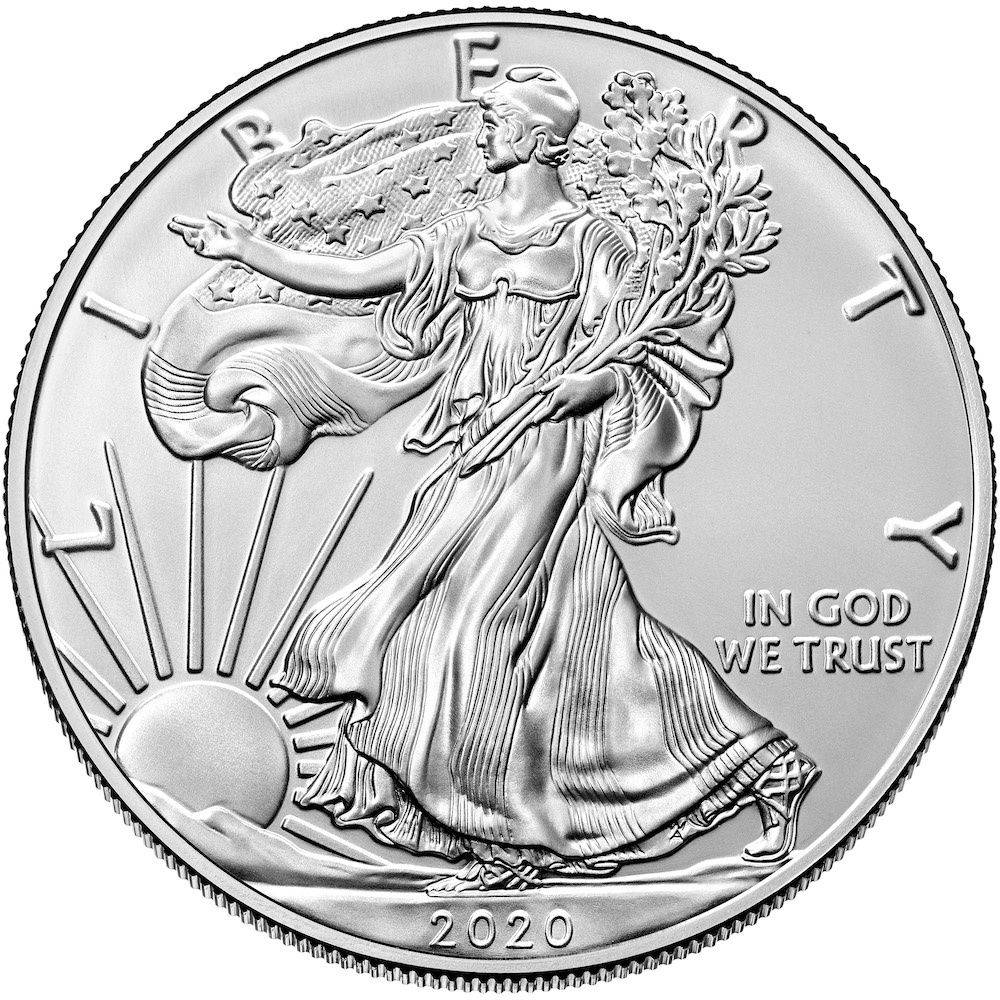
This past week, the numismatic world was greeted with the news that the Philidelphia Mint struck a limited number of American Silver Eagle bullion coins to help fill the demand.
Most of the production of the American Silver Eagle bullion coins are in the West Point Mint. Sometimes, the San Francisco and Philadelphia Mints add capacity when necessary, with San Francisco being the priority. Since the West Point and San Francisco Mints temporarily closed because of the effects of COVID-19, Philadelphia picked up the slack.
The U.S. Mint produces all bullion coins without mintmarks. In most cases, it is impossible to tell which mint struck the coins. An exception is the 2015 (P) American Silver Eagles. Collectors and the grading services have been trying to figure out where the green monster boxes came from by examining the serial number and other clues. In 2015, Philadelphia struck just under 80,000 bullion coins. Those handling monster boxes noticed a difference in the packaging and quality.
According to the U.S. Mint, “Monster boxes of 2020 American Eagle Silver Bullion Coins minted in Philadelphia were affixed with a typed label containing the box tracking number; additionally, box tracking numbers were handwritten directly on the boxes. Box tracking numbers 400,000 through and including 400,479 were used on boxes of coins minted in Philadelphia.”
The 480 monster boxes translate into about 240,000 coins.
With that knowledge, the third-party grading services will add a special label noting that the coins were struck at Philidelphia only if the monster box sent for grading has the proper label and seal.
Of course, the price gougers are out in force. Most reputable companies are selling MS-70 graded “emergency” coins at around $250. That is about $200 over a “First Strike” or “Early Release” graded coins. One online seller is offering a pre-sale of the “emergency release” coins in MS-70 PCGS slabs with John Mercanti autographs for $595.
Coins graded MS-69 are selling for $75-80, which is $40-45 over other MS-69 graded coins.
Remember, if the listing says “pre-sale” it means that the seller does not have the coins in inventory.
And now the news…
 May 6, 2020
 → Read more at theweek.co.uk
May 6, 2020 → Read more at kitco.com
May 8, 2020 → Read more at thevintagenews.com
→ Read more at theweek.co.uk
May 6, 2020 → Read more at kitco.com
May 8, 2020 → Read more at thevintagenews.com
Bitcoin And An Underground Economy
Deep in the background of an economy run amok has been the development of a new currency that has found a home supporting both legal and illegal commerce in a way that makes it difficult for regulators to regulate. To facilitate these transaction, this new underground economy has turned to Bitcoins.
Bitcoins can be best described as digital currency whose wallet system is based on a digital address. They have no intrinsic value except that of the open market that has formed around the Bitcoin System. Bitcoins do not use a bank or any central authority to govern them and Bitcoins are valued by an open market. It is a peer-to-peer system that is self-regulated by its users and limited by the number of coins in existence.
To obtain Bitcoins, someone can use their machine and the Bitcoin client (available for Windows, Mac, and Linux) to try to create Bitcoins. A Bitcoin is created when the client solves a difficult mathematical equation. You can also buy Bitcoins on an exchange, trade cash for Bitcoins, or accept Bitcoins for goods and services. Because of the volatility of this market, exchange rates can fluctuate unpredictably.
Although there are legitimate uses for Bitcoins, last week it was reported that Bitcoin is being used to support illegal activities including being used to support the hacking group LulzSec and an underground website that deals illegal drugs called “Silk Road.” Following the publication of these stories, Senators Chuck Schumer (D-NY) and Joe Manchin (D-WV), has asked U.S. Attorney General Eric Holder to shutdown the Silk Road website.
Shutting down Silk Road may be difficult since it requires a technology that anonymizes Internet connections to make it difficult to find. Rather, it might be easier for for the government to cut off its money supply—Bitcoin.
Bitcoin is an interesting concept. Bitcoins are created electronically and have no intrinsic value. Bitcoins get its value through a market that is created around these bits of information and is used to create its own economy. They do not have the protection of being legal tender or backed by a government that would make Bitcoin users whole should the market crash or is closed by legal action. There is also a question whether Bitcoin is legal. Following the conviction of Bernard von NotHaus for creation, distribution, and handling of the “Liberty Dollars,” could Bitcoin be next?
It may not be that simple. It has been reported that the part of the indictment that said “it is a violation of law for private coin systems to compete with the official coinage of the United States” was struck from the document the jury used for its deliberations. In an exchange with prosecutors before the case went to the jury, the judge said that the paragraph did not “appear to the court to be a factual predicate that is supported by the evidence in the case.”
Does this mean that prosecutor was unable to show that von NotHaus tried to create a private coin system or that the government could not prove that a private coin system was a violation of the constitution? We may never know unless von NotHaus appeals the decision and appelate courts rule on the case. In the mean time, that does not prevent the Department of Justice from pursuing Bitcoin or similar ventures.
Bitcoin may be the ultimate private market that someone like Rep. Ron Paul may endorse. But after enduring an economy where legal tender and investments tied to them have shown great volatility, Bitcoin might have to find a more solid foundation before being able to compete in the mainstream economy.
The ANA Nearly Non Election
This weekend, I received my ballot for the 2011 election of the American Numismatic Association Board of Governors. As opposed to years past, this ballot is without controversy since the only contest is for the office of the Vice President. Since all of the officers need one vote to be elected, and it is assured that each will vote for themselves, the ANA Board will be as follows:
Tom Hallenbeck, President
Hallenbeck is the current ANA Vice President and will be the 57th President of the ANA. Prior to being Vice President, Hallenbeck served as Governor. His father, Ken Hallenbeck, served as ANA President from 1989 to 1991. In his candidate statement Hallenbeck said, “One of the areas that the ANA must improve on is the utilization of technology. We must be more creative in drawing new collectors to our website and then encouraging them to join our collector community.” If he is serious about this, he will not only have my support but he can have my time to assist in his goals. Hallenbeck is free to lookup my contact information in the ANA database use it to call on my help.
The Vice President race will be discussed below.
Gary Adkins, Governor
Adkins is an ANA Life Member and long time dealer from Minneapolis. What concerns me is that in his candidate statement, the last sentence reads, “Gary will work hard to increase the ANA’s web presence, including implementing educational ‘webinars.’” It reads almost as if the statement was a last minute add-on in order to appease a certain part of the electorate. I hope he is serious and is willing to accept help from the membership who cares about this issue.
Mike Ellis, Governor
Error collectors will recognize Ellis as one of the foremost expert on error coins. Ellis, from Camilla, Georgia, has been an officer of the Combined Organizations of Numismatic Error Collectors of America (CONECA). Ellis is well known as a teacher, author, and very collector centric. Ellis does not mention the use of technology, but that is not his forte which tells me he will not presume this type of agenda. However, Ellis has proven that he will support any effort if it is good for the collector.
Jeff Garrett, Governor
Garrett is an incumbent Governor that has been involved in helping turn around the ANA from its previous issues. The Lexington, Kentucky resident is a champion for numismatic education based on his experiences with programs like the ANA Summer Seminar. I wonder if Garrett would be in favor of extending education to the electronic world?
Greg Lyon, Governor
Lyon may be the youngest member of the Board of Governors and could fall into the age group I called the “Lost Demographic” Even if he is older than the lost demographic age, the St. Louis future governor’s candidate statement echoes many of my concerns on the ANA’s non-use of technology for communicating.
Cliff Mishler, Governor
Mishler is well known in the numismatics industry as the former publisher at Krause Publications. Mishler, from Iola, Wisconsin, is the current ANA President who first ran for governor in 2007 wants to return to being Governor. Based on the few email notes I have received from Misher, I am not sure he understands the impact that technology could have on the ANA. However, I know that technocrats can meander beyond the business realities that an organization could handle. Having someone experienced with the inner workings of the ANA could help keep those of us pushing technology grounded.
Scott Rottinghaus, Governor
Rottinghaus is an incumbent Governor who sill be serving his second term. Rottinghaus is a physician in New London, Connecticut where is works as a director of clinical trials, he is on the faculty at Yale Medical School, and cares for patients at the local VA Hospital. Rottinghaus, a younger member of the board, comes to his position as a collector and from a field far different from numismatics—which provides a good mix for the Board of Governors.
Wendell Wolka, Governor
Of all the board members listed, I have heard Wolka speak the most. You will not find a more enthusiastic person than Wolka. I would also recommend his columns in The Numismatist, especially if you want to learn about currency! Wolka, from Greenwood, Indiana, is an incumbent who will be serving his third term on the Board. Having Wolka on the Board of Governors is good for the ANA.
Vice President: Arthur Fitts versus Walt Ostromecki
In the only election battle, it features Arthur Fitts of Wolfeboro, New Hampshire versus Walter Ostromecki of Encino, California. In their candidate statement, both have emphasized their education credentials working with the ANA as well as their past service to the association—Ostromecki is currently a member of the Board of Governors. Outside of the ANA Fitts is involved in the numismatic industry and Ostromecki is a teacher. Fitts is more experienced with the numismatic industry than Ostromecki but Ostromecki has been involved with youth activities within and outside of the ANA that gives him a better perspective on raising he future leaders of the ANA.
This one is difficult because both bring excellent experiences from different perspective to the ANA. Although I do have a radical streak that does not want to see industry insiders taking over the Board, I am mature enough to know that the Board needs a balance between insiders and outsiders. Fitts being a proven educator and author with the knowledge of the industry makes him a good candidate for the position.
On the other hand Ostromecki is “a 38-year veteran public high school teacher” is working with young adults who are on their way to their adult pursuits. These are the people who are about to enter the “lost demographic” age and it would be helpful to have his experience help try to keep the Young Numismatists engaged. His work over the last few years as Governor also makes him a good candidate.
Although not always the case, the Vice President is usually the President-in-waiting. This year, Tom Hallenbeck will move up from the Vice President’s position to be the ANA President and should something unforeseen happen to Hallenbeck (which we hope doesn’t), the Vice President takes over as President. In this case, Ostromecki would be a better candidate since he has been directly involved in the reforms of the last few years. However, Fitts is the more experienced with ANA and has the overall experience to step in if needed. So the question is who is better for the future of the ANA?
The future of the ANA has to be younger, more adaptable, and able to really communicate to the younger members and possible work to getting the “Lost Demographic” involved. In that regard, it might be good for the association to have a professional educator near the top of the organization and one-step away from being the President. Therefore, I am endorsing Walt Ostromecki as Vice President for the ANA.
My ballot is marked and will be mailed this week.
Last Word
I am very disappointed that there are no other races for the ANA Board of Governors. I do not know why the ANA cannot recruit people to work on behalf of the association, but if it is to build on the work of the last four years to repair the damage done by those in the past, they really need to figure out how to get more people interested in being part of the board.
Another disturbing trend is the lack of women and minorities. Two years ago, Patti Finner ran for president but was defeated by Cliff Mishler. Maybe the organization Women in Numismatics can help promote the hobby to women of all ages to become involved. This might be an issue for the new Board of Governors to consider for the future of the association.
As for minority participation, I would not know where to begin. Maybe there should be an outreach program through the scouts to build an interest amongst their minority members. If I have minority readers (and I hope I do), I hope they will reply to this post and provide suggestions.
In fact, if you have comments or are a member of the ANA Board of Governors and want to comment about what I said above, please feel free to post them!
Maryland’s Second Revolutionary War Issue
At the start of the Revolution, the Continental Congress allowed the colonies to print their own currency to help pay for the war. The Maryland Assembly approved an issue of $266,666 to be redeemed in gold or silver at 4/6 sterling per dollar by January 1, 1786. Backed by £100,000 still on account at the Bank of England, the emission was used to promote the manufacture of gunpowder.
To continue to pay for the war, the Maryland Assembly approved an emission of $535,111. The notes were to be payable by January 1, 1786 in gold or silver at the rate of 4/6 sterling per Continental dollar. Frederick Green printed these notes using new copper plates engraved in Philadelphia. The back depicted an arm holding a shield with the hand clenching the strap of the shield and holding a victory laurel with the motto SUB CLYPEO (Behind the shield).
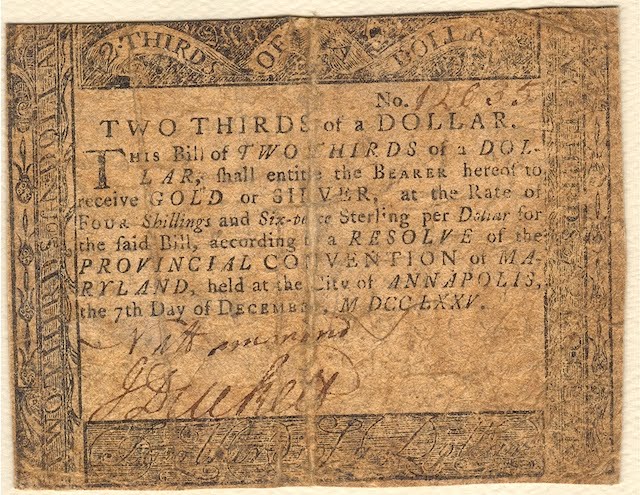
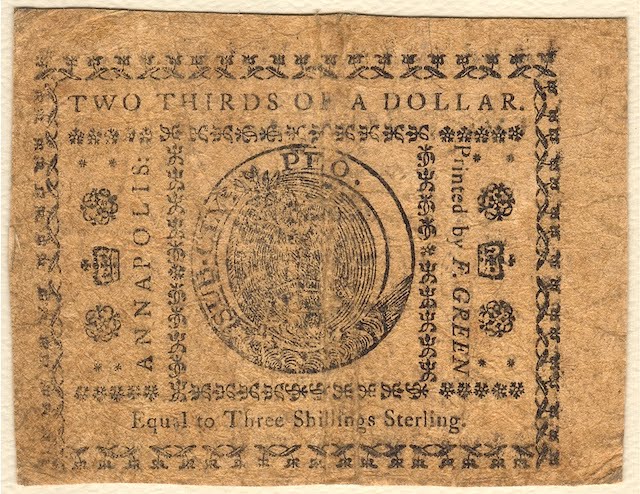
My new purchase in my Maryland Colonial series is a Two-Thirds Dollar note that was valued in 1775 as worth 3 Shillings Sterling. Because of the emergency nature of this emission, there were many signers of these notes. This PCGS Fine 12 example was signed by Nicholas Harwood and John Duckett. John Duckett, Jr. was the clerk in the lower house of the Colonial Assembly, Prince George’s County clerk, and distributor of currency on the western shore. Nicholas Harwood was Associate Clerk of the Court in Anne Arundel County from 1772–77 and later became Clerk of the same from 1777–1810. Harwood was a delegate to Maryland’s Constitutional Convention of 1776.
Memorial Day
The first recorded organized public recognition of the war dead occurred on May 1, 1865 in Charleston, South Carolina. On that day, Freedmen (freed southern slaves) celebrated the service of the 257 Union soldiers buried at the Washington Race Course (now Hampton Park). They labeled the gravesite “Martyrs of the Race Course.” African Americans continued that tradition and named the celebration Decoration Day.
 The next year, southern states began their own Memorial Days to honor their soldiers who died during the war. No specific date was used but occurred in late April through June. By 1880, there was a more organized Confederate Memorial Day. These celebrations honored specific soldiers to commemorate the Confederate “Lost Cause.” By 1913, a sense of nationalism saw a commemoration of all soldiers that have died in battle.
In the north, the fraternal organization of Civil War veterans The Grand Army of the Republic began organizing “Decoration Day” in 1868. Decoration Day was to honor the fallen by decorating the graves of Union soldiers with flowers and flags. Ceremonies included speeches that were a mix of religion, nationalism, and a rehash of history in vitriolic terms against the Southern soldiers. The acrimony against the South began to subside by the end of the 1870s
Although Ironton, Ohio and Columbus, Mississippi claims to have the oldest and longest running celebrations, the most famous was started at Gettysburg National Park in 1868.
 Gettysburg is the location of the three day battle where Union Major General George Gordon Meade’s Army of the Potomac defeated attacks by Confederate Gen. Robert E. Lee’s Army of Northern Virginia. It was the bloodiest battle of the Civil War and had the largest number of casualties. During a 50th Anniversary memoriam of the deceased, veteran of the Union and Confederate armies gathered for a four-day “Blue-Gray Reunion.” The event included speeches by President Woodrow Wilson, the first southern elected president since the Civil War, and Congressman James T. Heflin of Alabama. Heflin’s speech was memorable in his endorsement of building the Lincoln Memorial and a call for a Mother’s Day holiday.
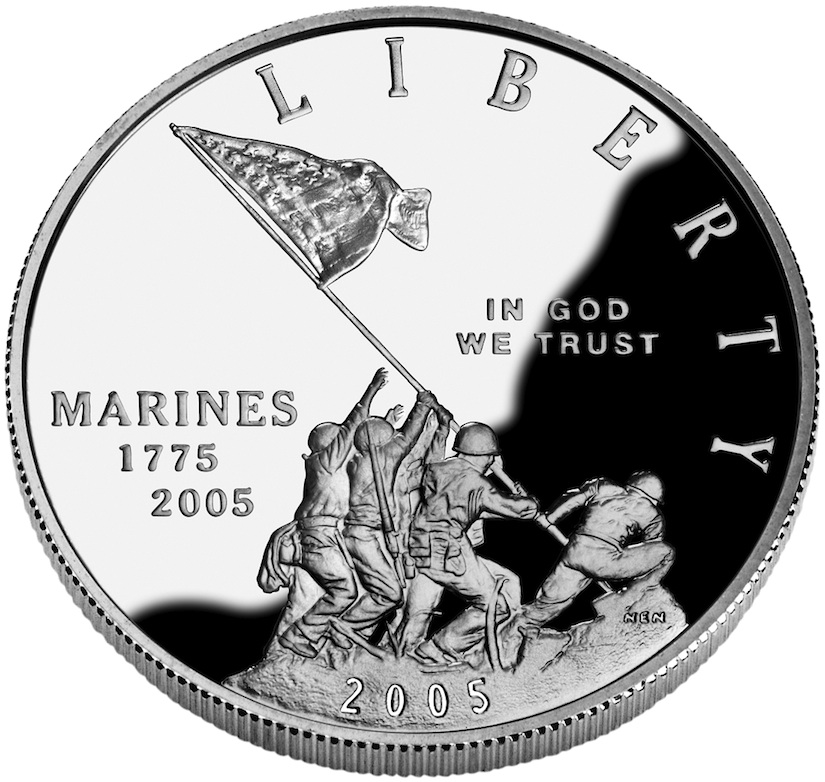 Memorial Day did not take on national significances until after World War I. Rather than being a holiday to remember those of died in service during the Civil War, the nation began to recognize all those who gave the ultimate sacrifice during all conflicts. By the end of World War II, most of the celebrations were renamed from Decoration Day to Memorial Day. Memorial Day did not become an official holiday until 1967 and its date changed from the traditional May 30 to the last Monday of the month by the Uniform Holidays Act (Public Law 90-363, 5 U.S.C. § 6103(a)) in 1968.
The modern Memorial Day is a holiday celebrating the lives of those sacrificed in defense of the United States and its ideals at home and abroad. Today, we honor the memories of those who paid the ultimate sacrifice so that I can write this blog and you can read it.
Coin images courtesy of the U.S. Mint.
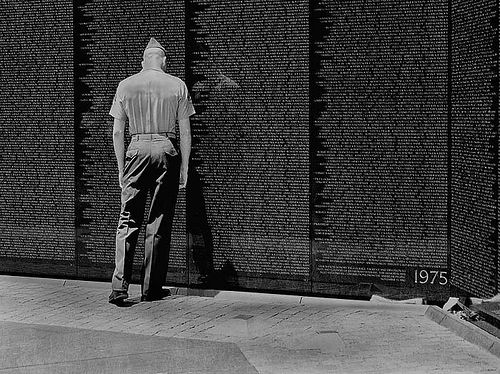
Vietnam Memorial image from Wikimedia.
National Spend a 1918 Lincoln Cent Day
NumisSociety, an online grass-roots community of numismatists, announced that the community is advocating a “National Spend a 1918 Lincoln Cent Day” on Memorial Day, May 30, 2011.
NumisSociety members were inspired by a story written by Dave Harper in Numismatic News. Harper writes about a letter he received from Army SGT Jarrett Briscoe who is stationed in Kuwait. In the letter, SGT Briscoe sent Harper a 1918 Lincoln Cent he received in change after a transaction with a local. Astonished to find a coin that old and so far away from home, SGT Briscoe asked Harper to “return it home” by putting it back into circulation in the United States.
It was a touching story that inspired the members of the NumisSociety. NumisSociety community members decided to join together to make this a truly memorable Memorial Day. In honor of SGT Briscoe and all members of our Armed Forces present and past, they want as many people to spend a 1918 Lincoln Cent in all 50 United States.
If you are interested, sign up at the NumisSocieity website and let them know (here) what state you will spend a 1918 Lincoln Cent on Memorial Day.
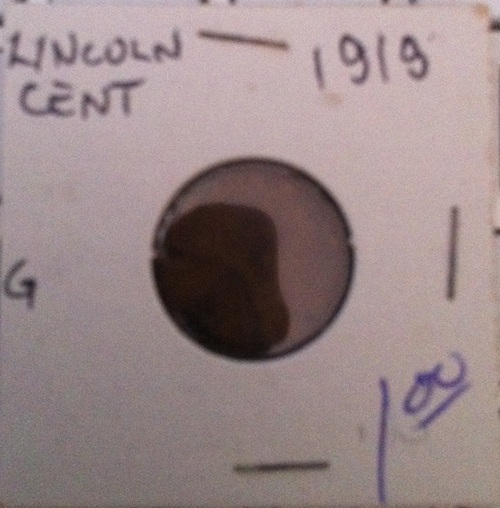
This is such a great idea, that I dug through my excess inventory and found a coin that I will spend on that day (after I remove it from its 2×2). It is the least I can do to be part of this effort to honor those who served and continue to serve on behalf of this country.
Support the Coin Collectors Blog
 Buy me a coffee
Thank you for your support!
Let Me Know What You Think
Are you going to the World's Fair of Money
Total Voters: 17
 Loading ...