
Weekly World Numismatic News for February 9, 2020
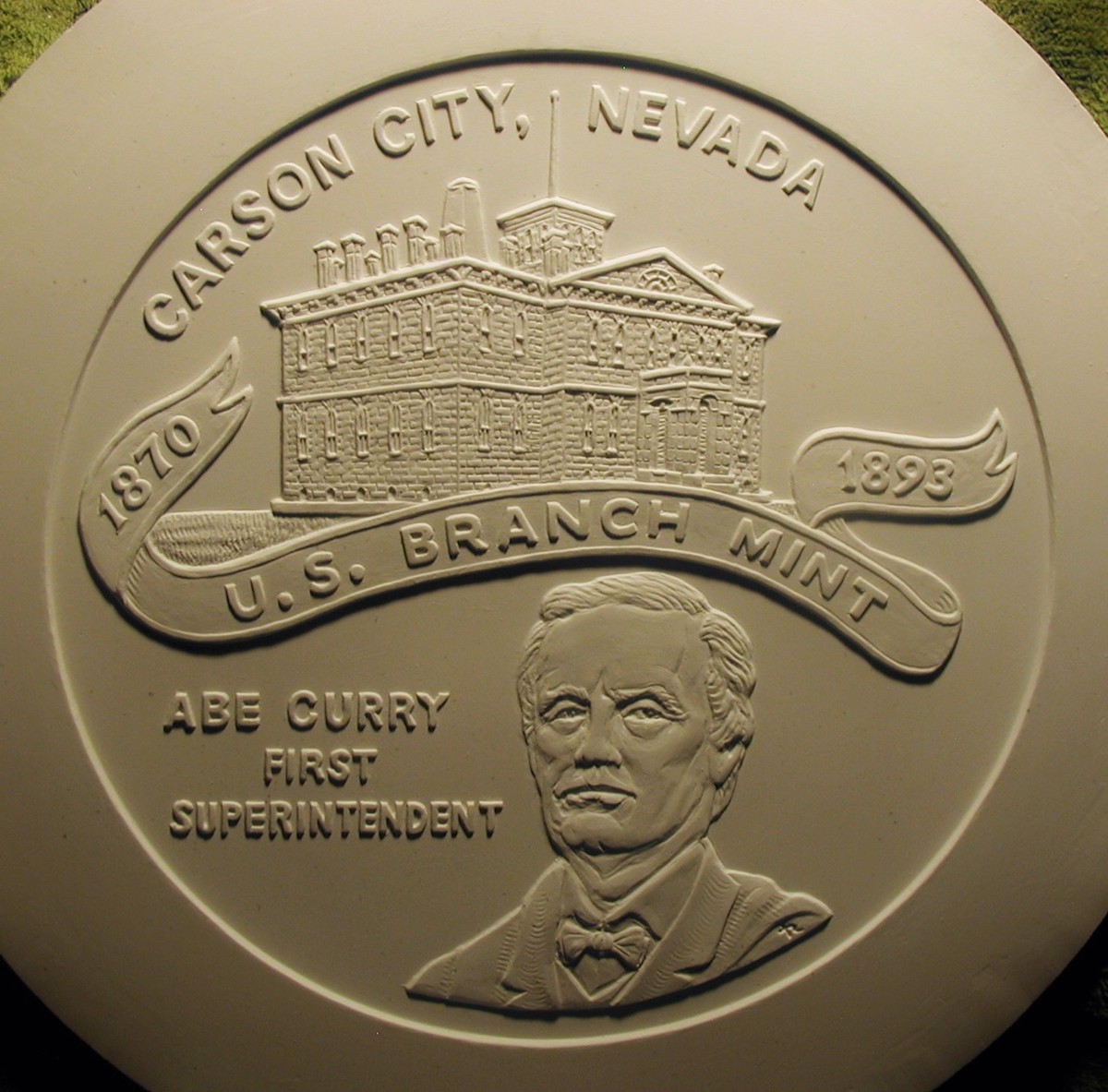
Mold used to make the dies for the Carson City Mint Sesquicentennial medal. Image courtesy of the Nevada State Museum.
Although named for Henry Comstock, he did no discover the silver mines in the area. Comstock has the distinction of claiming a stake in the lode before selling his stake for thousands of dollars, an unreasonable sum at the time, and settling in Carson City. Comstock started a few businesses. His brashness and presence lent his name to the discovery.
Comstock is not a hero. He was known for being impatient, careless, lazy, and some accused him of being insane. Comstock committed suicide in 1870, leaving several failed businesses, a failed marriage, and sever debt in his wake.
After the discovery, it was expensive to transport the silver to San Francisco for processing. Nevada politicians lobbied congress for the formation of a branch mint to assay and strike coins. Congress authorized a mint in 1868 for nearby Carson City. The building opened for production in 1870. The Carson City branch mint struck silver and gold coins but in lesser amounts than the other mints making their coins highly collectible and more expensive because of their rarity.
Many consider the coins struck at Carson City to be amongst the most beautiful of all the coins. With the lower production totals, mint employees did not have to rush production, allowing them to create proper strikes. Of course, mistakes happen, and varieties of coins struck at the Carson City Mint are some of the most desirable.
A significant distinction of the coins struck in Carson City is that they bear the “CC” mintmark. It is the only two-character mintmark used on U.S. coins.
Production ended in 1893 with the reduced output from nearby silver mines. The building served as an Assay Office beginning in 1895. It closed following the gold recall of 1933. The State of Nevada purchased the building in 1939.
Today, the building houses the Nevada State Museum, where Coin Press No. 1 continues to strike commemorative half-ounce silver medals every month. There are only four known versions of this coin press in existence and the museum has the only working model.
For the sesquicentennial celebration, the museum struck a commemorative medal for the visitors. Visitors were able to purchase half-ounce silver planchets from the museum’s gift shop and bring them to the Coin Press No. 1 for striking. Because this was an on-demand process, you had to be at the museum to purchase one.
The Mint at Carson City is a symbol of U.S. history. It is where the old west meets modern commerce. From the reports, it sounds like the celebration went well. I hope to be able to visit the museum at some point in time.
And now the news…
 February 3, 2020
 → Read more at metro.co.uk
February 4, 2020 → Read more at foxnews.com
February 6, 2020 → Read more at ktvn.com
February 6, 2020 → Read more at kamloopsmatters.com
February 8, 2020 → Read more at kitco.com
February 8, 2020 → Read more at ancient-origins.net
February 8, 2020 → Read more at dorsetecho.co.uk
February 9, 2020 → Read more at baltictimes.com
→ Read more at metro.co.uk
February 4, 2020 → Read more at foxnews.com
February 6, 2020 → Read more at ktvn.com
February 6, 2020 → Read more at kamloopsmatters.com
February 8, 2020 → Read more at kitco.com
February 8, 2020 → Read more at ancient-origins.net
February 8, 2020 → Read more at dorsetecho.co.uk
February 9, 2020 → Read more at baltictimes.com
CCAC Has A Position Open
The US Mint announced on Friday that they are accepting applications for the Citizens Coinage Advisory Committee to represent the interests of the general public. Application deadline is March 31, 2010.
Looking over the list of CCAC members it appears that the term of Dr. Mitchell Sanders is expiring in 2010. Dr. Sanders has been the Chairman of the CCAC from 2005 through 2009.
According to the US Mint:
The CCAC was created to advise the Secretary of the Treasury on the selection of themes and design proposals for circulating coinage, commemorative coins, bullion coinage, Congressional Gold Medals and other medals. The CCAC also advises the Secretary with regard to the events, persons, or places to be commemorated by the issuance of commemorative coins, as well as the mintage levels and proposed designs of commemorative coins.
Sometimes, it does not seem that the CCAC is maintaining this advisory role or they are not communicating it properly. Recently, I have been critical of the CCAC and even had a public “discussion” with a member of the CCAC that highlighted the problems with communications.
What would happen if the CCAC had a different point of view? What would happen if the CCAC had a citizen member who was interested in bringing the voice of the general public into the committee who would also be interested in ensuring that the working of the CCAC would be published in full to the general public? Could it be possible that the CCAC be seen as more of a representative of the general public?
I would like to see the CCAC take the next step and make the CCAC’s proceedings more open to the citizens. I would also like to see that whatever comes in front of the CCAC is available to the general public to read, analyze, and comment on either through the media or on their own. I would like to see the CCAC general public representative be more of a representative to the input of the general public being represented.
That being said, what if your intrepid were to apply for this opening?
The problem is that in this town, politics is the rule and not the exception. I am sure that my criticism on this blog and other venues will work against me even though I had called for the expansion of the CCAC’s role in how it relates to the US Mint. Another issue is that I work for the same company as a current member of the CCAC. Although my company does not do business with the US Mint, there is no telling how this situation would be viewed by those making the decision.
However, I have demonstrated significant and thoughtful of opinions on the US Mint and CCAC that includes suggestion for improvement. It would be great if I could work with the CCAC to try to improve what they do for the US Mint and make suggestions that would benefit the Mint’s coinage programs. I know I would be in the forefront to expand their communications capabilities to get the public more involved and better support the collecting community.
So what do you think? Should I apply? Leave a comment here and I will consider your suggestions.
Adventure Nets A Loonie and Toonie
After a busy few weeks, it was that time. It was time to put the plan into motion.
I check the flight schedules to find the plane was on time. This was good with all of the bad weather in the northeast.
I checked the flight path. The plane was to fly around the bad weather. Again, this is good because it was going to be on time.
I checked the traffic. I wanted to get to the airport on time without having to fight Washington’s infamous traffic.
Everything in place, it was time to go. I handed a treat to the dogs and off I went.
Driving to the airport went smooth except for one construction zone that was not on the list I checked on line. A quick detour allowed me to bypass the backup and coast into National Airport.
Parking was easy and close to the walkway over the road and passed the entrance for the Metro Blue and Yellow lines. Down the elevator and I found a seat near baggage claim.
After a few moments the reason I went to the airport arrived. Standing by the entrance to the baggage claim area was my mother-in-law, who flew from the frozen northeast to surprise her daughter (my wife) for her up coming birthday. We drove back and after a minor glitch in the plan—my wife was home walking the dogs and not in her office—we managed to complete the surprise!
Although my mother-in-law lives in Maine, the rest of their family is from Canada. I have not met them and have only had short conversations on the phone since I do not speak French and their English is limited, they do know I collect coins. One relative sent two different coins that my mother-in-law gave me tonight.
 The first is a 2009 Canadian one-dollar coin. Instead of a Loony—the reverse with an image of a common loon—the reverse features a commemorative to the one hundred anniversary of the Montreal Canadiens hockey team. The standard Loonie is an eleven-sided smooth edged coin that is 26.5mm in diameter and made from bronze plated nickel. The 2009 Loonies with the Canadiens Centennial reverse was only circulated in Quebec making it a unique collectible.
 The other coin is a 2008 Canadian two-dollar coin commonly called the Toonie. The Toonie is a 28mm bimetallic coin with an outer ring made from nickel and a brass inner core. Normally, the reverse of the Toonie is a polar bear during the early summer ice flow. This Toonie commemorates the 400th Anniversary of the founding of Quebec City and the first French settlement in North America.
All Canadian coins feature the portrait of Queen Elizabeth II, Queen of Canada.
Surprising my wife and getting two coins for my collections made this a good day.
Launch of the 2010 Lincoln Cent
While the Washington, DC area continued to dig out of Snowmageddon II, US Mint held a ceremony on Friday, February 11, 2010 at the Abraham Lincoln Presidential Library and Museum to introduce the 2010 Lincoln Cent. The new coin features the new shield reverse as being emblematic of the “Preservation of the Union.” The shield is featured in many of the frescos painted by Constantino Brumidi throughout the US capitol. Brumidi was the Artist of the capitol during Abraham Lincoln’s presidency.
The obverse is a slightly modified bust of Lincoln designed by Victor David Brenner that has been used since the first Lincoln cent was released in 1909.
Although the launch of the 2010 Lincoln Cent went on as schedule, the sales and distribution in the Washington, DC area was postponed because of the weather conditions. No announcement was made as to if or when the sale will be rescheduled.
The following video has scenes from the launch in Springfield, Illinois and some B-Roll footage:
Here is the video from the State Journal-Register from Springfield, Illinois:
Colonial Currency and Colonial Maryland
I am writing an article for the Maryland State Numismatic Association about Maryland colonial currency. After writing the introduction, I thought it would be of interest to my readers. I made a slight modification to neatly end this as a single article. The rest will appear in a future MSNA Journal.
Prior to the Great Depression, paper currency was backed with specie, gold or silver mined in the United States. During the founding of the country currency had been limited to coins with an intrinsic value based on their gold, silver or copper content. As the King of England tried to tax the colonies to pay for the wars in Europe, the colonies looked for ways of financing their own governments to provide services.
Since the colonies did not have the ability to coin money, they issued paper notes. These notes functioned as currency but actually were bills of credit, short-term public loans to the government. For the first time, the money had no intrinsic value but was valued at the rate issued by the government of the colony in payment of debt. Every time the colonial government would need money, they would authorize the printing of a specified quantity and denomination of notes that it would use to pay creditors. The emission laws also included a tax that would used to repay the bill of credit and the promised interest.
As taxes were paid using the paper currency, the paper was retired. As the notes were removed from circulation, that was less payments the government had to make. On the maturity date, people brought their notes to authorized agents who paid off the loan. Agents then turned the notes over to the colonial government to be reimbursed and collect a commission for acting as an agent.
Sometimes, colonies could not pay back the loan. In those cases, the colonies passed another emission law to cover the debt owed from the previous emission plus further operating expenses. In this case, mature notes were traded for new notes. The colonists accepted this system since there were shortages of coins as well as there being an inability to convert the value of foreign coins into colonial shillings by farmers and other unskilled in such matters.
Maryland was one of the more successful colonies. Maryland benefited from its ownership of the Chesapeake Bay and ran a robust economy as a trading post for Maryland and Virginia goods. Maryland merchants were able to make a sizable living trading tobacco and other crops to Europe for Virginia farmers.
Starting in 1733, there were eight emissions from the Maryland colony with four during the Revolutionary War. The last emission was in 1780 with a successful payment of obligations in 1782, prior to its 1784 maturity date. In 1784, Maryland was able to pay its debts in specie, mostly Spanish Milled Dollars, and outlawed any future release of currency.
US Mint Math: Costs More to Produce Less
 After reading a few stories on how the president’s 2011 federal budget was proposing changes to coin composition. Many of these articles point out how the budget projects that changes could save the US Mint about $150 million per year after making over $777 million in circulating coins (business strikes) in fiscal year 2009. The US Mint’s Fiscal Year 2009 Annual Report says that the US Mint earned over $904 million in seigniorage from all sources.
While everyone is concentrating on the costs of changing coinage metals, there is a missing point: even if the US Mint was able obtain the copper covered zinc planchets for the cent at no cost, the US Mint will lose 0.62-cents per cent struck just for the labor and administrative costs.
In 2009, the US Mint shipped $777 million in circulating coins after shipping over $1.2 billion in 2008. The 40-percent reduction in production also was matched by a 40-percent reduction in the amount the US Mint spent on the metals. In other words, the increase in the costs of metals between 2008 and 2009 was minimal. However, the cost to produce the 40-percent fewer coins cost the US Mint 1.1-percent more in 2009! With presses sitting idle for long periods of time for the first time in many years, the US Mint paid $98.1 million in 2009 for striking few coins and costing $97 million in 2008.
The US Mint documents the costs in the Annual Report as Sales, General & Administrative (SGA). In the Annual Report the reported SGA from 2006 through 2009 has remained stable. Increases have roughly followed the rate of inflation. When looking at the SGA for individual coins, the US Mint spent $65.3 million to sell $459 million one-dollar coins to the Federal Reserve in 2009. In 2008, it cost $52.2 million to sell $475 million one-dollar coins.
The US Mint’s core responsibility is to manufacture the coins required by the Federal Reserve for commerce. In 2009, the seigniorage for business strikes was $427.8 million while making $32.7 million for bullion sales.
The problem is not the cost of the metals. The problem is the inefficiency of operations at the US Mint. “In FY 2009,” the US Mint’s FY2009 Annual Report reads, “the worsening economic environment challenged our ability to maintain efficient manufacturing operations but also presented opportunities for long-term efficiency gains.” Then where are the efficiencies? If the US Mint has an efficient manufacturing process, then why did it cost the US Mint 1.1-percent more in 2009 to producing 40-percent fewer coins than they did in 2008?
If the Obama Administration wants the US Mint to produce more in seigniorage, then the place to start is to immediately replace the political hack that is the current director. A replacement should be someone that has had a manufacturing background working in a regulated environment to lead the US Mint forward.
Support the Coin Collectors Blog
 Buy me a coffee
Thank you for your support!
Let Me Know What You Think
Are you going to the World's Fair of Money
Total Voters: 17
 Loading ...