
DON’T BUY COINS ON TELEVISION!

Over the years, I have heard from many people regarding the problems with mailorder numismatics. Every few months, someone writes and asks about the value of something they bought from a non-numismatic magazine or from something they saw on television.
My answers tend to be upsetting because the market does not value these items as the television hucksters do.
Recently, I wrote about the experience with someone who brought in a box of coins he bought from television and magazines. I described his reaction as “The look on his face when I told him was as if I kicked his dog.” Then I was provided an example of why my words land very hard.
Sunday’s are my day off. Even though I have personal work to catch up on, I will play couch potato and watch television. This past Sunday, I entered the wrong number in the remote and landed on the Fox Business channel.
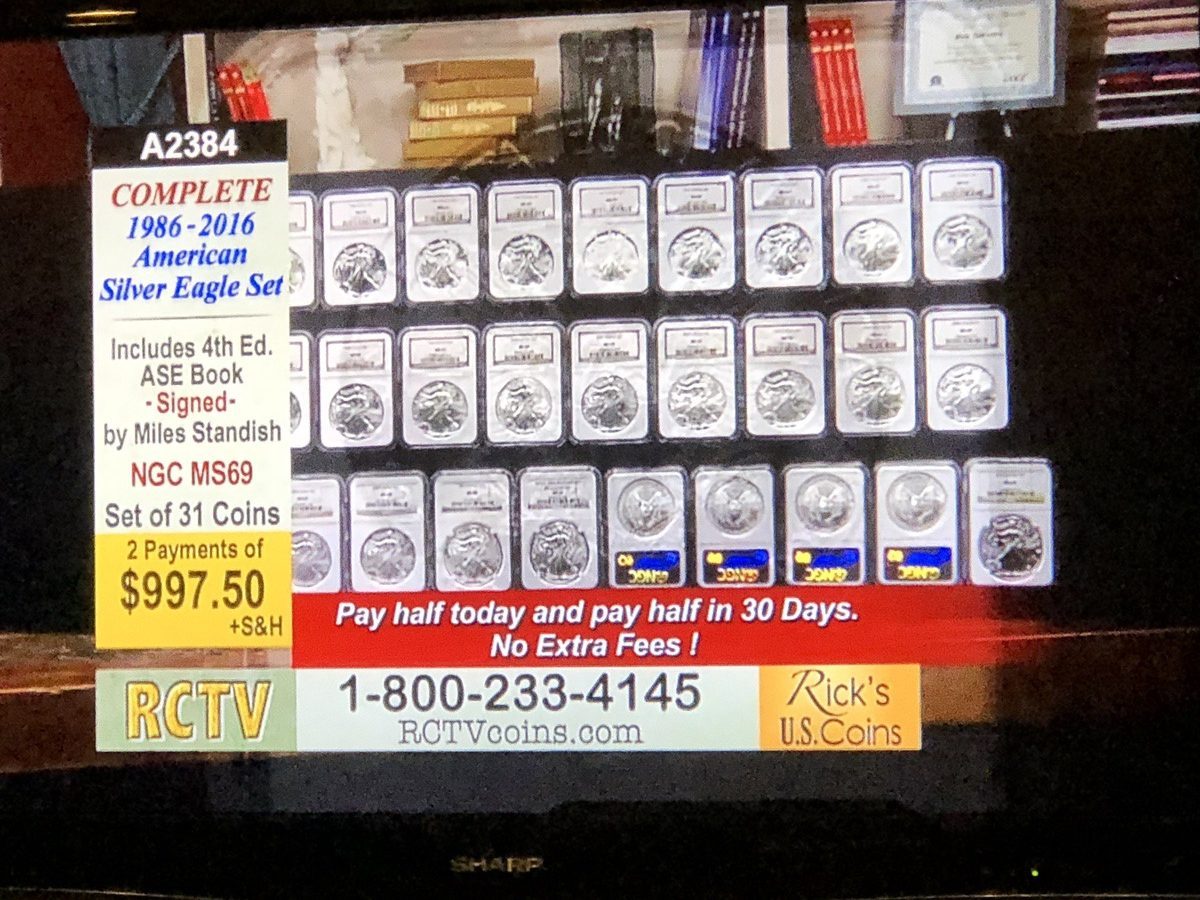 On the weekend, when the markets are not open, the business channels broadcast other programming. At this time, Fox Business was airing an infomercial for Coins TV.
When I tuned in, the camera was panning a display with graded American Silver Eagle coins. Of course, I stopped to stare at the shiny silver coins. Then I heard the pitch.
The pitchman is Rick Tomaska, owner of Rare Collectibles TV. Tomaska seemed pleasant and appeared knowledgable. His pitch was selling a date run of American Silver Eagle graded MS-69 by NGC for $1,995.00. It almost seemed reasonable until it was made clear that the pitch was for a date run of 31 coins from 1986-2016.
Is $1,995.00 a good deal for the 31 coins? My first instinct was to check the price guides. Since the online Greysheet does not include the retail price for graded bullion coins (why?), I used two other guides: Numismedia Fair Market Value Price Guide and the price guide from NGC. Based on a grade of MS-69, the guides provided the following information based on prices for the 1986-2016 34-coin set:
| Numismedia FMV 34 coins @ MS-69 |
NGC Price Guide 34 coins @ MS-69 |
RCTV Infomercial 31 coins @ MS-69 |
|
|---|---|---|---|
| Total | $1,240.00 | $1,679.00 | $1,995.00 | Average | $40.00 | $54.16 | $64.35 |
But Numismedia and NGC are price guides. Guides are not the retail prices a collector would pay. So we turn to the interwebs to search for “date run American Silver Eagle coins.” The search returned several entries on the first page that was not RCTV.
Taking the top three entries from the search, only one dealer was sold out. The others offered a complete set of 34 coins, 1986-2019, graded MS-69 by NGC for considerably less than Tomaska’s price. To be fair, where there was a difference between the cash and credit prices, I used the credit card price, which is usually higher. Then I searched eBay and sorted for the lowest price. The following is what I found:
| Company | Date Run | Coins in Set | Advertised Price | Shipping | Average per coin |
|---|---|---|---|---|---|
| RCTVcoins.com | 1986‑2016 | 31 | $1995.00 | $64.35 | |
| JM Bullion | 1986‑2019 | 34 | $1541.70 | $45.34 | |
| Mint Products.com | 1986‑2019 | 34 | $1399.99 | $41.18 | |
| eBay Seller constitutionclct | 1986‑2019 | 34 | $1299.00 | $14.95 | $38.65 |
For the eBay dealer who was charging for shipping, the cost per coin was the lowest even after adding the shipping costs to the total price.
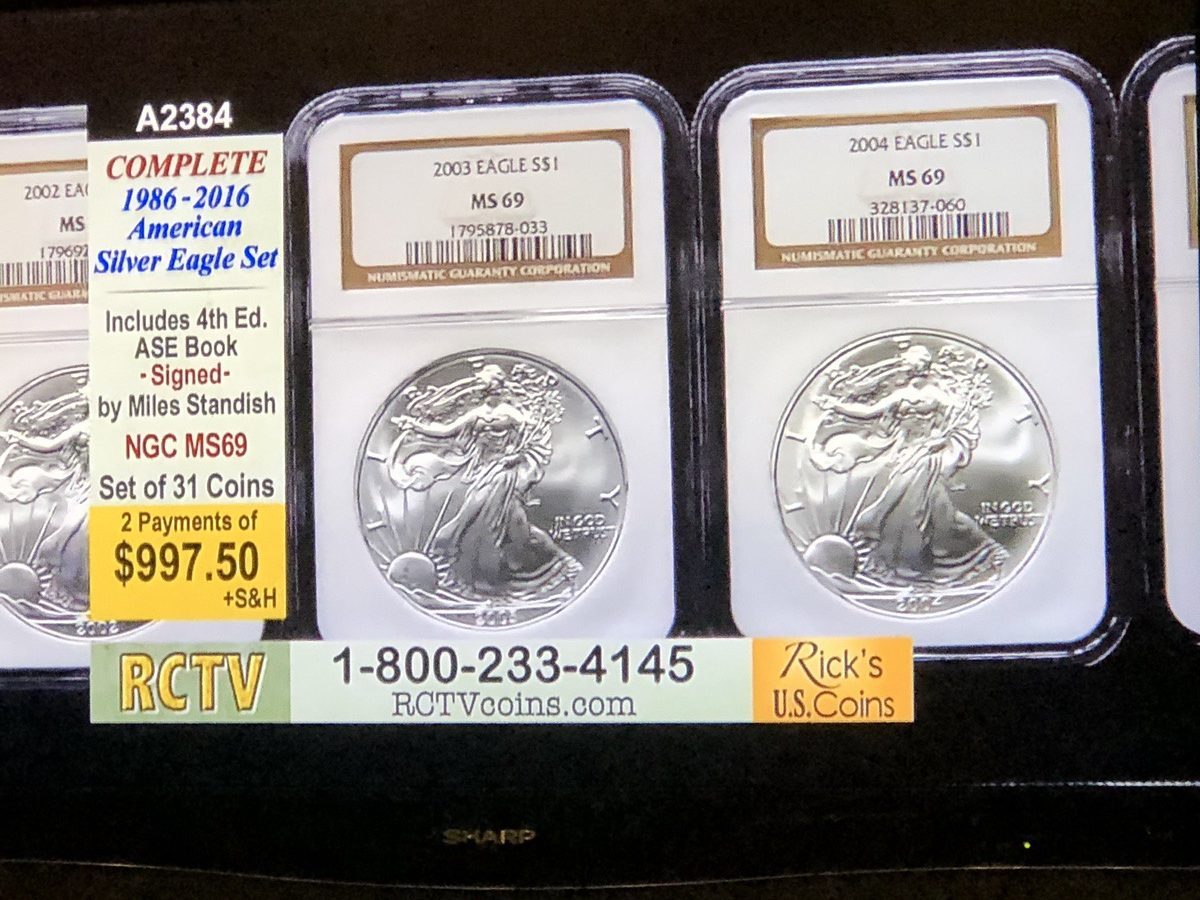 JM Bullion and Mint Products.com are reputable companies. Both firms are worth considering if you do not feel comfortable making this purchase from an eBay seller. Note that these companies will base the price of their bullion coins on the current spot price of silver. Their retail prices may fluctuate.
When you buy from these television advertisements, you will overpay.
To help enforce the issue, the JM Bullion website said that they would buy a complete date set of American Silver Eagle bullion coins for $1,094.12 when I looked up the price. If you purchased the set advertised on television, you would be LOSING $900!
As part of the pitch, if you ordered the set, Tomaska would send a copy of the 4th Edition of American Silver Eagle: A Guide to the U.S. Bullion Coin Program autographed by Miles Standish, the book’s co-author, who was present with Tomaska.
What is sad is that Miles Standish joined Tomaska as part of this infomercial. Although Standish did not assist Tomaska in his pitch for the set, his presence is an appearance of legitimacy. It is similar to the appearance of past ANA President David Ganz on an infomercial. Neither endorsed the product that was being sold, but their presence was used to suggest otherwise.
I would not recommend buying coins or any collectible from a television show. Every collectible I have seen being hawked on television was 45-60 percent over what might be considered wholesale value for its market.
As a small business owner, I would be foolish to criticize someone for making a profit. It’s the Ameican way. However, there is a difference between making a profit and price gouging. It is why I am warning you against purchasing collectibles from a pitch on television.
I Was Not Splitting Rails at Union Station
During the last and very busy week, I planned and plotted to take a long lunch so that I can visit the US Mint kiosk at Union Station to purchase rolls of the new Formative Years, or Rail Splitter 2009 Lincoln Cents. I arranged to meet a friend who was not a collector who would buy six rolls, give them to me, and I would buy lunch.
When I arrived, there was a long line. My friend and I waited over a half-hour to purchase the rolls. The scene caught the attention of The Washington Post who filed a story about the sale.
After my friend and I purchased 12 rolls of the new Lincoln Cents, we had nice lunch at a restaurant in Union Station.
What I should have done is what the collector did in the Post’s story: taken the rolls to the post office to have them stamped and post marked. Apparently, there are collectors willing to pay a premium for rolls with proof of first day of issue.
All of the rolls sold at Union Station and on Friday at the Rayburn House Office Building were from the Philadelphia Mint. Maybe I can trade a roll with someone who has rolls from the Denver Mint. I promised one roll to someone who could not be at the pickup and one roll will be used at my coin club for sale of individual coins to members. The other nine rolls will probably go on sale so I can make back the money I paid for lunch!
Here’s Andy and Ron, Not George
In the more than three years I have been writing this blog, I keep finding interesting things to write about. The problem is finding the time to write about what I find or my thoughts. But sometimes, I find something that I thought was going to give me one story but turns into something else. Let me explain…
The other day, I went to my bank’s ATM to withdraw money. As I was counting the notes the machine delivered to me, I noticed one was stamped with something. Since I was in the car, I put the note in my pocket to look at it at home. I was thinking that the last time I saw a stamp on a note, it was for the “Where’s George” website.
Where’s George is a web-based project to track the circulation of US paper money. The project was started by tracking the movement of one dollar notes and expanded to other bills. People are prompted to visit the website when they receive bill stamped with the information. Website visitors are asked to enter some basic information (denomination, serial number, series, and location) to the where your note has been and to register its current location. When I find a well circulated note with the Where’s George, it is interesting to follow the note’s trail. Registered users can track the progress of the notes they enter.
For our friends north of the border, you can visit Where’s Willy. “Willy” is Sir Wilfrid Laurier, the first French Canadian Prime Minister (1896-1911). Sir Laurier’s portrait is on the Canadian $5 bill.
 After the ten minute drive home, I looked at the note and found something unexpected. It was a stamp campaigning for Ron Paul for president along with his campaign’s web address. Dr. Paul, a Republican from the 14th District of Texas, unsuccessfully ran for the GOP nomination in 2008.
Dr. Paul is a fascinating person who has a unique approach to governance. While I may not agree with his political philosophy, I respect that he does not make emotional decisions and goes out of his way to educate himself on the issues. Dr. Paul is one of the few members of congress I respect for really trying to govern with integrity.
So if you find this $20 bill in change, follow its path after I spend it sometime this weekend. It has been entered into the database at www.wheresgeorge.com. Who knows, maybe it can find its way to Texas!
BEP’s Spider Press Demonstration
If you have never been to a show where the US Bureau of Engraving and Printing shows off their “1 Billion Dollar Exhibit,” you may not have seen the demonstration of intaglio printing with on a spider press that dates from the Lincoln Administration.
The following video appears to be from the 2005 World’s Fair of Money held in San Francisco. It shows BEP specialist Mike Beck demonstrating the intaglio printing process while printing show souvenirs.
I first saw Mike Beck’s demonstration in 2007. He is very engaging and has a wonderful sense of humor. He is also very knowledgeable of the entire currency production process and the differences between the old and current processes. If you have a chance see Mr. Beck and the BEP exhibit, I encourage you to visit. It is worth your time.
NFB Promotes the 2009 Braille Commemorative
One thing I like about numismatics is that coins, currency, tokens, and other ephemera can be used to teach history. Along with teaching history, they can be used to raise money for worthy causes. One such coin is the 2009 Louis Braille Bicentennial Silver Dollar, the first coin with readable braille. The $10 surcharge, up to a maximum of $4 million will be paid to the National Foundation for the Blind to promote braille literacy.
In order to understand where your money will go, NFB produced a video titled Change with a Dollar to explain their Braille literacy initiative and how the money raised from the sales of the Braille Commemorative will help their cause. I thought my readers would be interested in this video:
NFB also produced a one minute commercial titled I Can Do More: Louis Braille Bicentennial Silver Dollar which can be seen…
Both proof and uncirculated coins are available from the US Mint if you want to help NFB’s effort to promote Braille literacy.
Update on 2010 Lincoln Reverse Design
 I learned that the 2010 Lincoln Cent reverse design chosen by the Commission of Fine Arts has been withdrawn from consideration. Apparently, the design closely resembles the one used on the Weimar Republic of Germany 50 pfennig coin. This coin features the motto of the Weimer Republic “Sich regen bringt Segen”, meaning “hard work brings it’s own reward.”
Similar designs were used throughout the Soviet bloc countries during the Cold War era.
Aside from being US Mint policy not to use desings that have appeared on foreign coins, the imagry of using socialist and communist symbols of the past makes the design a bad idea.
I have learned that the Citizens Coinage Advisory Committee selected the shield design LP-13 (see the image). The design entitled “Shield of Union” resembles the pattern cent designed by William Barber. However, the CCAC did express their concern that the designs submitted were not as good as they could be.
Next month, the CCAC will look at new designs for the obverse of the 2010 Lincoln Cent. While I am not in favor of changing the Victor David Brenner design, I learned that the CCAC will be looking at keeping the portrait but making it larger on the planchet. Hopefully that is the only design change they make.
Image courtesy of CoinNetwork.com.
Support the Coin Collectors Blog
 Buy me a coffee
Thank you for your support!
Let Me Know What You Think
Are you going to the World's Fair of Money
Total Voters: 17
 Loading ...