
What is Numismatically Trending
Over the last few weeks, I have been posting and watching the chatter on social media about the current offerings by the world’s mints. Given the opportunity, I engaged several people to conduct an informal poll. I did not define specific questions. I allowed people to discuss and argue about what they really think. Based on these conversations, here is what I learned.
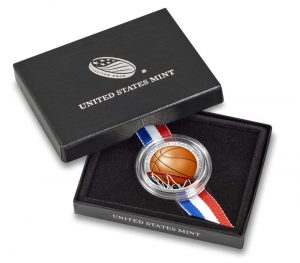
Basketball Hall of Fame 2020 Colorized Half Dollar (U.S. Mint Image)
Although those favored using color as an enhancement, an overwhelming majority did not like all printed coins. Many of the complaints came from the lenticular coins from Canada. And while most would not purchase many of the coins with comic book themes, the only objections were the printed designs.
Few people objected to the commercial themes used on coins. Whether the coins celebrate Star Trek or Star Wars, the only difference was if the collector wanted to be beamed up or was with the Force. Those who did not like colored coins would be interested in coins struck using these themes.
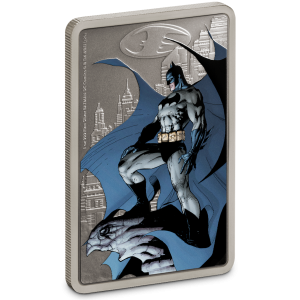
Niue $2 THE CAPED CRUSADER™ – GOTHAM CITY™ 1oz Silver Coin (Image courtesy of the New Zealand Mint)
Last week, I talked with someone about classic rock, which was wearing a Kiss tour jacket. He expressed excitement at finding the Kiss Challenge Coins online. He also mentioned challenge coins and medals from other bands. After our conversation, I searched online for the information. I found that Kiss authorized four challenge coins with each member’s image plus one for Eric Carr, the late drummer who died in 1991. Exonumia is a part of numismatics.
Themed coin series is a trendy way of collecting outside of the United States. Several British collectors thought that the Royal Mint’s 50p coins’ themes were a lot of fun. The Royal Mint produces 50p coins that celebrate children’s book characters, famous authors, and historical figures. A mother of three youngsters was excited about the recently released Winnie the Pooh 50p coin. Aside from being a children’s favorite, Winnie’s creator, A.A. Milne, also wrote speeches for Winston Churchill.
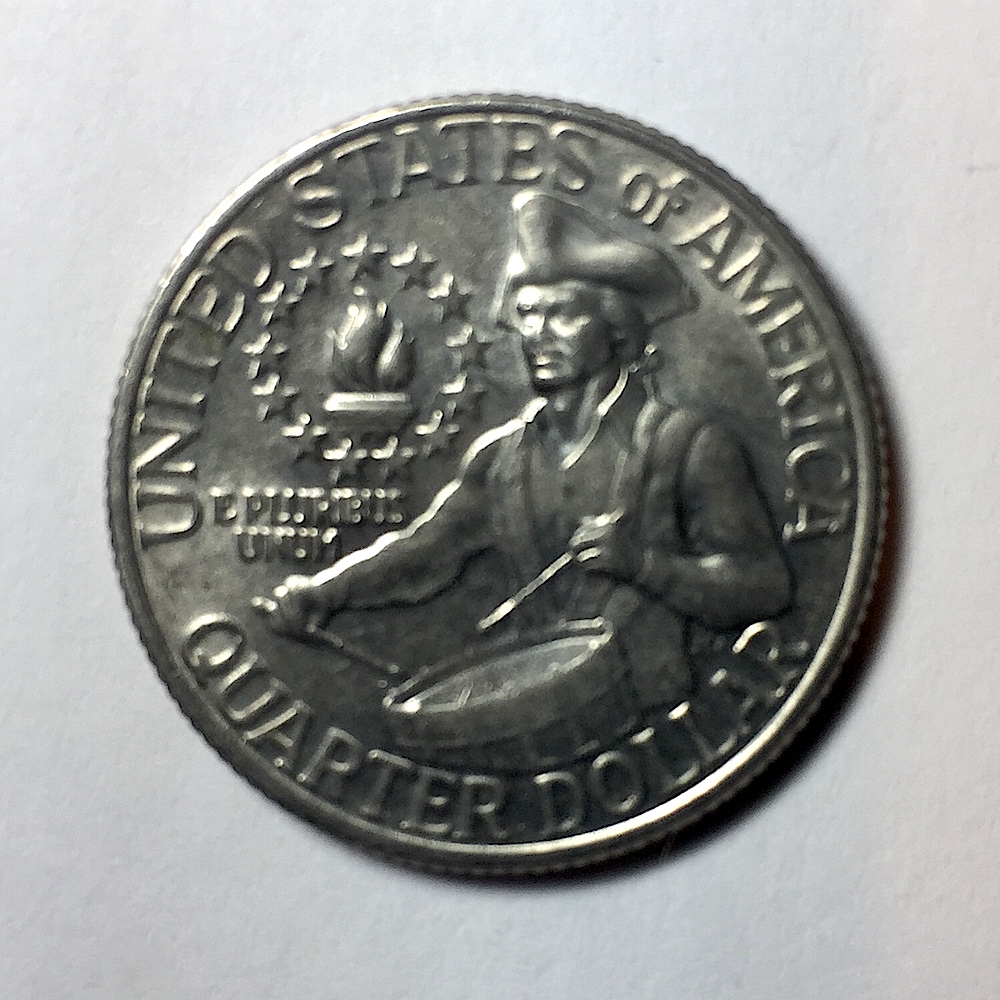
It’s not a “ classic” coin but the Drummer Boy reverse is still one of my favorite modern designs.
Numismatics is a hobby. Hobbies are supposed to be fun. You are supposed to like what you collect. If you like Kiss Challenge Coins, then go out and find them all. If using different metals to create interesting effects like the Royal Canadian and New Zealand Mints create, have fun. Even if you find enjoyment with searching pocket change for coins, you are a numismatist and are welcome to the hobby.
Everyone who collects numismatics should be welcome without being told they are collecting the wrong way. As time moves on, I will be proposing new ideas on making the hobby more inclusive. I welcome everyone’s feedback!
POLL: Will you buy this year’s commemoratives?
2013 Girl Scouts Commemorative Dollar
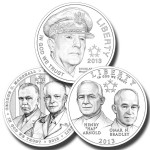
2013 5-Star Generals Commemorative Coins
The 5-Star Generals Commemorative Program includes a $5 gold coin, silver dollar, and clad half-dollar that will be offered in proof and uncirculated options. The U.S. Mint will also offer a three-coin proof set. Surcharges of $35 for each gold coin, $10 for each silver coin and $5 for each clad coin sold will to go the CGSC Foundation to support the college. With mintage limits of the 100,000 for the gold coin, 500,000 silver dollars, and 750,000 clad half-dollars, the program can raise a maximum of $16 million for the CGSC Foundation.
Do you plan to buy any of these commemorative coins? This week’s poll asks which, if any, of these commemoratives you will buy.
Do you plan to buy any of the 2013 commemorative coins?
Total Voters: 22
 Loading ...
Coin images courtesy of the U.S. Mint.
One Page Collection: 2, 3, and 5 cent coins
A few weeks ago, I wrote about a one page collection starting with the one cent coin. The set also included an example of a half-cent to cover the lowest denomination of coins produced by the U.S. Mint.
The concept of the one-page collection is to create a meaningful collection using a single 20 pocket page that holds 2×2 holders. Using this format, I can create any type of collection without being bound to the albums and folders that are published by the numismatic press. I can also personalize the collection with information I find and other stories, some that I write.
When creating a one page collection, I am looking at ungraded coins that could be graded Fine or better and costs under $100 each. While I try to keep purchases under $50, having the ability to go over for certain coins gives me a little flexibility while staying closer to affordable.
I was asked what I used as a price guide to determine affordability. For full disclosure, I had been consulting the NumisMedia Online Fair Market Value Price Guide of collector coin. The site is free, updated monthly, and is the same information printed in their monthly publication. The NumisMedia Online Dealer Price Guide as well as their printed version requires a subscription.
Since my first one-pager was of the lowest denominations, I will move up a bit and put together a collection of 2, 3, and 5-cent coins.
The first coin struck by the newly created Mint was the half disme in 1794. As one of the original coins designated by the Coinage Act of 1792, legend has it that the coins were struck using silver donated by Martha Washington. Although there is no proof that our first First Lady donated her silver, it makes for a good story.
The first half-dismes were really not struck for circulation but over 86,000 coins of the 20.8 grains (1.35 grams) of .8924 fine silver were delivered to Secretary of State Thomas Jefferson (under the First Coinage Act, the Mint was placed under the Department of State). Originally designed by Robert Scot, the early Flowing Hair and Draped Bust half-dimes (the “s” was dropped in 1796 since it was silent anyway). Production ceased in 1805 with the shortage of silver.
Production picked up again in 1829 with the Capped Bust design by William Kneass and continued until 1837. After the passage of the Act of January 18, 1837, the weight of the coin was reduced to 20 5/8 grains (1.34 grams) and the fineness raised to .900 silver. For this change, Christian Gobrecht’s Seated Liberty design was used for the new coin.
This is where the series gets interesting. First, there was a change in design in 1838 to add stars to the obverse. In 1853, to show that the size and weight was change, arrows were added to the date from 1853 through 1855 before being removed in 1856 when the weight was returned to the old standard. In 1860, the legend was move to the obverse replacing the stars and the reverse laurel leaves were made larger.
The silver half-dime was made through 1874 after the successful release of the copper-nickel coin we call the Shield nickel. Nobody is sure when the coin started to be called a nickel, especially since it is made of only 25-percent nickel. It has been speculated that it was called a “nickel” because of the composition while it circulated along side the silver half-dime.
The U.S. nickel is unique in that it is the only coin that has been made of the same .750 copper and .250 nickel composition since its introduction in 1866 except for the silver alloy used during World War II from 1942-1945.
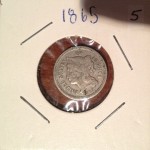
Starting this collection with an easy to find 1865 3¢ Nickel
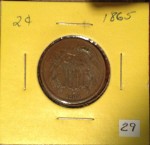
Bought this 1865 2¢ coin from my coin club’s auction
Beginning with the Liberty Head “V” nickel, most of the coins should be easy to find and not cost a lot of money. In fact, it may be easier to find an 1883 Liberty Head nickel without the “CENTS” on the reverse, also called the Racketeer Nickel, than an 1883 nickel with the “CENTS” in Fine to Very Fine grades. It may be easier to find a 20th century version that would fit this collection nicely.
For the rest of the series, you can find nice coins at all grades without problems. Just be aware of the major varieties, such as the two types of Buffalo nickels, and the modern changes in the Jefferson nickel. It should be fun to complete this set:
An interesting aspect of this collection is that the coins are of all the basic metals used in non-gold coins. The 2-cent pieces were made from copper while the 3-cent coins had one type made in silver and anther in nickel. While most of the 5-cent coins were made of copper-nickel, the wartime composition removed the nickel and lowered the copper content by adding silver and manganese. It is a good representation of coinage metals circulating in the United States.
This is one set where it was difficult to think about how to keep it to 20 coins. Depending on where you shop, your patience, and your budget, this is a collection that can easily be expanded.
If you decide to use this guideline for your set, do not limit yourself to my suggestions. Consider other options. Consider adding another page. Make it personal. Make it yours.
Most importantly: HAVE FUN!
U.S. Mint will continue to be director-less

Bibiana Boerio nomination to be the Director of the U.S. Mint was returned by the Senate.
President Obama has the option of resubmitting any nominations. Thus far, the president has not re-sent Boerio or any other nomination for Director of the U.S. Mint to the Senate for confirmation during the 113th congress.
The U.S. Mint has been without a permanent director since the resignation of Edmund Moy in January 2011. Since his resignation, the U.S. Mint has been lead by the Treasurer of the United States Rosie Rios with day-to-day operations being lead by Deputy Director Richard A. Peterson as Acting Director.
Image courtesy of the Pittsburgh Post-Gazette.
U.S. Mint raised gold and platinum prices
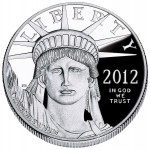 It was reported in the numismatic press but not formally announced by the U.S. Mint that they filed a notice that appeared in the Federal Register (78 FR 11954) raising precious metal prices. The new prices, which are as much as 30-percent higher than the previous became effective as of noon (ET) on Wednesday, February 27, 2013.
It was noted in the U.S. Mint’s annual report that seigniorage on precious metal products were lower in 2012 than in years past. This move appears that the U.S. Mint is trying to make up for that lost revenue.
The announcement can be found at the Government Printing Office website ![[PDF]](http://coinsblog.ws/library/images/pdf.png) or you can find a printable version at on the U.S. Mint’s website.
or you can find a printable version at on the U.S. Mint’s website.
Coin image courtesy of the U.S. Mint.
Summary of February 2013 Coin-Related Legislation
This month’s list includes one late entry that was missed from January.
S. 203: Pro Football Hall of Fame Commemorative Coin Act
A bill to require the Secretary of the Treasury to mint coins in recognition and celebration of the Pro Football Hall of Fame.
Sponsor: Sen. Robert “Rob” Portman (R-OH)
• Introduced on January 31, 2013
• Senate Banking, Housing, and Urban Affairs Committee on January 31, 2013
Track this bill at http://www.govtrack.us/congress/bills/113/s203
H.R. 627: National Park Service 100th Anniversary Commemorative Coin Act
Sponsor: Rep. Erik Paulsen (R-MN)
To provide for the issuance of coins to commemorate the 100th anniversary of the establishment of the National Park Service, and for other purposes.
• Introduced: February 13, 2013
• Referred to the House Financial Services Committee on February 13, 2013
Track this bill at
Support the Coin Collectors Blog
 Buy me a coffee
Thank you for your support!
Let Me Know What You Think
Are you going to the World's Fair of Money
Total Voters: 17
Loading ...