
Weekly World Numismatic News for July 26, 2020
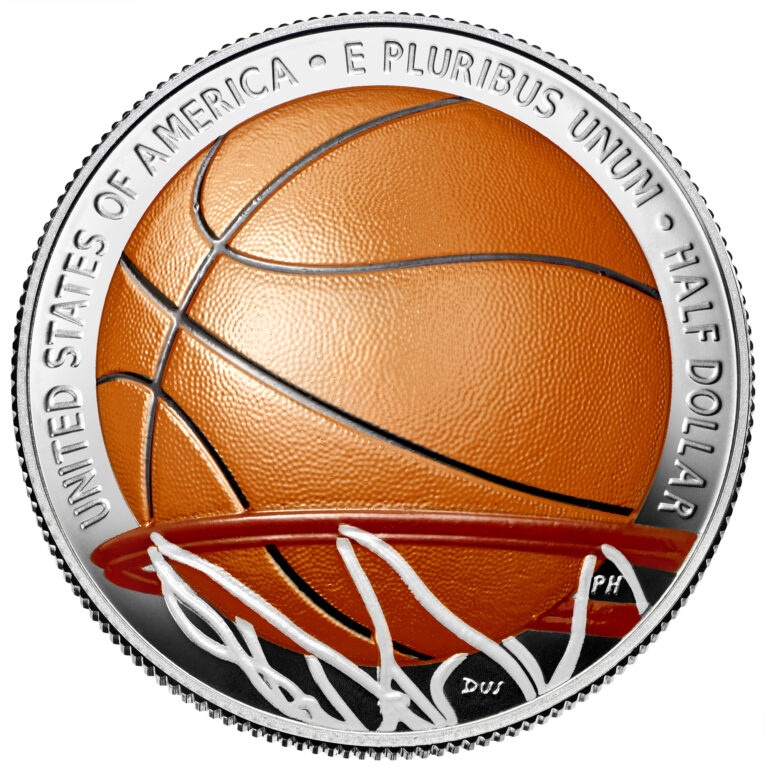
Colorized Basketball Hall of Fame Half Dollar Clad Coin (Image courtesy of the U.S. Mint)
No, the tragedy is not the alleged coin shortage.
Social media went berzerk because the U.S. Mint is going to sell colorized versions of the Basketball Hall of Fame Commemorative Coins.
How dare the U.S. Mint do something like this? It’s… it’s… un-American!
Calm down, folks. It is only a little color enhancing a commemorative coin.
But it’s not what the U.S. Mint is supposed to be about. They are supposed to produce real coins.
Real coins? Like the mess of coins in what we refer to as the Classic Commemorative Era? Can we also consider the circulating coinage disasters like the steel cent and Susan B. Anthony dollar?
It will turn us into Canada!
I can think of worse places. I like Canada. I have family in Canada. I collect Canadian coins. However, it is not going to turn the U.S. Mint into the Royal Canadian Mint. First, the Royal Canadian Mint produces more non-circulating legal tender (NCLT) coins that the U.S. Mint. Second, the Royal Canadian Mint uses technologies like lenticular printing to create the design. For the Basketball Hall of Fame coin, the colorization is an enhancement of a struck design.
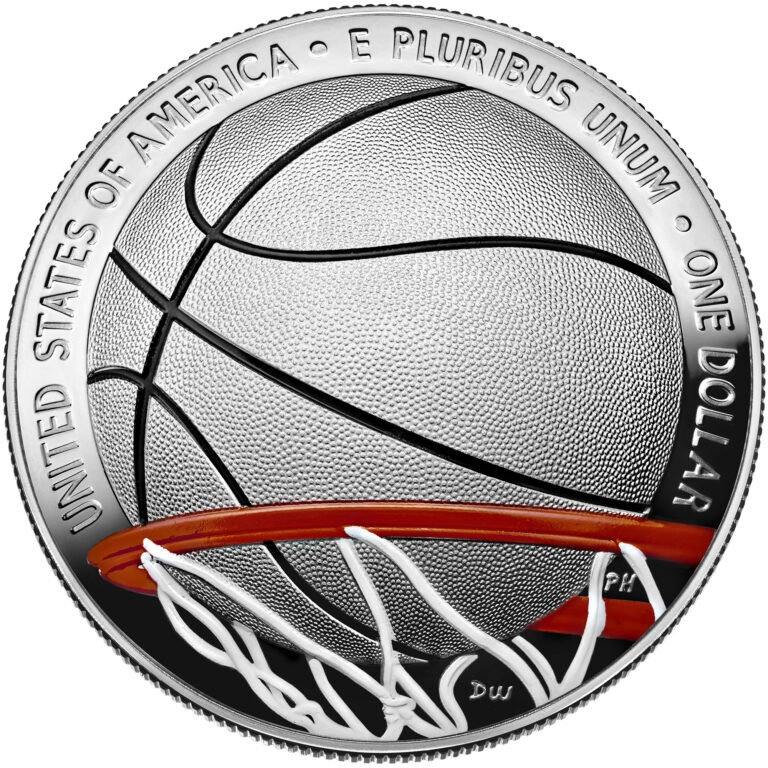
Colorized Basketball Hall of Fame Silver Dollar Coin (Image courtesy of the U.S. Mint)
That is your opinion. I like what the U.S. Mint will do to the half-dollar coin by emphasizing the ball and rim. Based on the pictures I have seen, the colorized rim on the silver dollar is not enough.
It’s not what the U.S. Mint is supposed to do. I’m not buying it!
Good! It means that I will be able to buy one for myself without trying to fight the speculators.
It’s too expensive.
Finally, an argument I can agree with. Yes, the U.S. Mint is charging too much for the colorized coins. This is because instead of bringing the technology in-house, they have to pay a contractor to do the colorization.
It’s bad for the hobby!
How many times have we heard something is wrong for the hobby. Slabs signed by television reality stars were supposed to be the beginning of the end of the hobby. Endless series of circulating commemoratives are supposed to be bad for the hobby. Commemorative coins with unpopular themes were also going to kill the hobby.
To borrow a phrase: We’re still standing. Yeah! Yeah! Yeah!
Sorry, boys and girls (and we know the complaints are mostly coming from old men). Colorized commemorative coins are not bad for the hobby. It could be good for the hobby. These coins could attract people to the hobby that may not have been interested in the past.
If you want to know what is not good for the hobby, it is the U.S. Mint selling coins that did not sell at cut-rate prices to a television huckster like RCTV that pays NGC to slab the coins with special labels and then sells them at hugely inflated prices to unknowledgeable people on television.
You may also watch for the U.S. Mint’s “de-trashing” policy that is dumping other surplus coins on the market. These are coins that did not sell during the regular sales period that will have “special designation” labels from NGC. Not that the labels would make a difference, but we know that the dealers will over-hype these coins at prices far beyond their worth.
Remember what happened with the television hucksters selling state quarters at over-inflated prices? Or even RCTV selling a set of 31 American Silver Eagle bullion coins for more than you can buy a date run of 34 coins? Eventually, these coins will end up being brought to dealers who will tell them that they overpaid.
I will take colorized coins over the feeding crap to the television hucksters any day.
And now the news…
 July 20, 2020
 → Read more at kitco.com
July 20, 2020 → Read more at fastcompany.com
July 21, 2020 → Read more at spenboroughguardian.co.uk
July 23, 2020 → Read more at barrons.com
July 23, 2020 → Read more at savingadvice.com
July 25, 2020 → Read more at cnn.com
→ Read more at kitco.com
July 20, 2020 → Read more at fastcompany.com
July 21, 2020 → Read more at spenboroughguardian.co.uk
July 23, 2020 → Read more at barrons.com
July 23, 2020 → Read more at savingadvice.com
July 25, 2020 → Read more at cnn.com

Art For Your Money
If you are not following me on Twitter or Pinterest you are missing some interesting extras that may not make it to the blog. While I can include Twitter updates on this page (see the right column), pins to Pinterest are a little more elusive unless I remember to click the box to post the pin to Twitter.
My newest pins on Pinterest came from the U.K.’s Daily Mail Online from a story about Evan Wondolowski, an artist who uses currency and coins to make portraits of politicians and celebrities. These portraits are made using shredded Federal Reserve Notes on newspaper. He make a portrait of President Obama using Lincoln Cents including 1943 Steel Cents.
Wondolowski is the Creative Director and co-owner of Mozaiks, and artist-based clothing company. His art can be see at his website The Art of E and usually depicts images of greed and politics.
Below are the images from the Daily Mail Online article. If you want to see the full images, visit Wondolowski’s online gallery.
If you are not on Pinterest and would like an invite so you join, drop me a note and if I have any invites I will send you one.
Making of the 2012 London Olympics Medals
With the 2012 Summer Olympics starting next week in London, the folks at CNN Money did a report about the making of the medals by the Royal Mint.
Medals made for the XXX Olympiad in London are the largest medals ever made for a summer Olympics. Their specifications are as:
- Diameter: 85mm (approx. 3.346 inches)
- Thickness: 7mm
- Weight: 412g (approx. 14.5 ounces)
- Designer: David Watkins
- Obverse Design: Nike with Panathinaiko Stadium in the background
- Reverse Design: The River Thames and the London Games logo with angled lines in the background
- Composition of Gold Medal: 92.5% silver, 6.16% copper, 1.34% gold
- Composition of Silver Medal: 92.5% silver, 7.5% copper
- Composition of Bronze Medal: 97% copper, 0.5% tin, 2.5% zinc
The metals used to make the medals were supplied by Rio Tinto and was mined at their Kennecott Utah Copper Mine and Oyu Tolgol project in Mongolia.
Here is the CNN Money report about the making of the medals by the Royal Mint:
Image of the London 2012 Olympic Medals courtesy of London Organising Committee of the Olympic and Paralympic Games
Video courtesy of CNN Money
Coinflation Now An iOS App
One of my favorite online resources is Coinflation.com, a site that will show you the metal value of United States and Canadian coins. The site has calculators to find the value of silver and base metal coins.
I really like the Coinflation calculators because it takes into consideration the value of all of the metals in the coin. So if you have a U.S. coin that is 90-percent silver and 10-percent copper, the calculated value includes that 10-percent copper. Comparatively, adding the value of the copper will not significantly increase the value of the coin, but if you have an obsessive curiosity streak, this will satisfy your inescapable need to know.
On July 19, I received a press release from Collector’s Universe and PCGS, owners of Coinflation, announcing the availability for the Coinflation App for Apple iOS devices. I immediately went to the iTunes App Store and downloaded the app to my iPhone and iPad to give it a test drive.
First and foremost, you cannot argue with the price: FREE. As a free download, you have to put up with some amount of advertising. In this case, the app will display eBay listings relevant to the type of calculation performed. These ads are part of the eBay affiliates program where money is paid for impressions and click-throughs. You can decide for yourself how much to support the development of this app.
When you start the app, there is no splash screen, or what I refer to as someone’s ego trip. The app starts right up with the up to date silver and gold prices and four calculator options for U.S. Silver Coins, U.S. Base Metal Coins, Silver Scrap, and Gold Scrap. There is a circular arrow on the top-right of the screen to refresh the price data.
The first thing that I noticed is the silver and gold scrap calculators which are not available on the website. When you enter the scrap calculator, you can enter the amount of metal you have, the current price will be filled in, and then you can select the purity. For gold, the purity is provided in karats, silver is one of three choices of .999+ pure, sterling silver (.925) and coin silver (.900). Lower silver values are not available.
A nice feature is that you can tap the “selected unit” button and get a popup of weights you can use for the calculations, so you are not limited to one. For silver, you have to know that Avoirdupois Ounce is the English system that we use on a daily basis. This will allow you to put your silver on a home scale to learn what your metals are worth. For some reason, this option is not available for gold.
Enter your metal weight and press the “Calculate” button at the bottom of the screen and you know what the metal value of your gold or silver is worth. A nice touch is that the line with the value is highlighted in yellow, so your eye can be directed to the information easily.
Two taps on the back arrow at the top of the screen will bring you back to the home screen. Maybe in a future version, there will be a “Home” button to bring you directly back to the home page.
The silver and base metal coin calculators are much the same as on the website but in a format for the iPhone. To select the coin, spin the virtual wheel on the bottom half of the screen. On top is the type of coin you selected and a nice, clear image of the coin reportedly from PCGSCoinFacts.com. Enter the number of coins and press the “Calculate” button and get the melt value highlighted in yellow.
For base metal coins, you will enter the face value of the coins. The resulting screen will tell you the melt value highlighted in yellow and the basis for the calculations. I was surprised that 8 Sacagawea Dollars have only 48-cents of metal in them. I thought it would be a little more!
For a version 1.0 app, it is very well done app and one that I will continue to use. Future improvements I would like to see is a home button to jump directly back to the home page, a calculator or reference to gold coin values as available on the website, and an expansion into foreign coins—at least the ones on the website.
Another change I would like to see is for it to be a native iPad app. If you load it on the iPad, it will run in compatibility mode meaning it will get lost in the middle of a big screen or pixelate (not look as smooth) when running it at double size. As an iPad app, it could provide more information, such as the total breakdown of metal values for War Nickels, and better interact with an external keyboard.
Even with these flaws, I grade this app as MS66 with room for improvement. Adding some of the reference information and becoming a native iPad app are the improvements I think are most important. This does not mean I am deleting this app. I will be using it while waiting for the improvements.
-
- Coinflation app Opening Screen on the iPhone
-
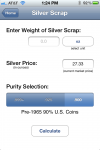
- Calculating silver scrap prices using the Coinflation app on the iPhone
-
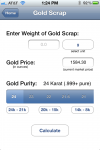
- Calculating gold scrap prices using the Coinflation app on the iPhone
-
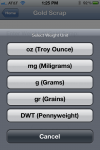
- Selecting the unit of weight for gold with the Coinflation app on the iPhone
-
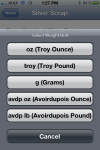
- Selecting the unit of weight with the Coinflation app on the iPhone
-
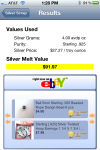
- Silver scrap calculated results using Coinflation app on the iPhone
-
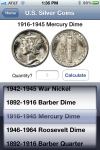
- Selecting the U.S. Silver Coin type to calculate melt value
-
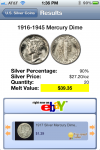
- Calculation for “what if…” I had 20 Mercury Dimes
-
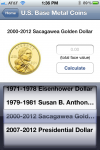
- Selecting U.S. Base Metal Coins
-
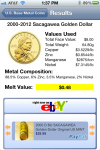
- What would the melt value be for $8 in Sacagawea Dollars
-

- Opening screen for the Coinflation app on the iPad
-
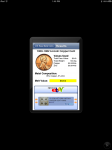
- Results page for the Coinflation app on the iPad
-
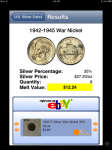
- Double sizing the Coinflation app on the iPad
Internet Sales Taxes Will Hurt Online Numismatic Sales

Concern is circulating through the numismatics industry after the Wall Street Journal published a story that the Republican Governors Association supports the collection of sales tax for Internet sales within their state.
The process started earlier this year as governors, looking for a way to close budget gaps, started to consider forcing companies like Amazon.com to collect sales taxes for goods shipped to their states. In February, New Jersey Governor Chris Christie (R) negotiated a deal with Amazon to collect sales taxes for purchases shipped to New Jersey. As part of that deal, Amazon will be opening a warehouse and shipping center in New Jersey.
What was not reported was that the reason Amazon opened a facility in New Jersey was that federal law currently prevents the collection of taxes for sales shipped across state lines for companies that do not have a presence in the state. Since Amazon now has a presence in New Jersey, they can collect sales taxes on purchases. Otherwise, federal law exempts Amazon and any other company selling on the Internet from paying sales taxes to states they have no presence in the state where the item was shipped.
Sales tax on Internet-based purchases will affect everyone that sells online including the eBay seller, coin dealers, auction houses, and bullion sellers. If you sell online, you will have to figure out how to collect sales taxes. While larger companies may have the facilities and resources to collect sales taxes and pay them to the state. The rest will have to work with a service provider to be compliant with the law. Any time a small business has to add new capabilities using an outside service, it will be an additional expense to the small business.
In the numismatics industry, most of the dealers are small businesses. Many work from their homes shipping orders throughout the country while others may work from shops with a local clientele that also provides some Internet sales.
Aside from the administrative overhead to collect taxes, states have different rules for what is taxable and what is not. Some states do not tax bullion sales while other states tax bullion sales, but do not tax them over a certain limit which could be different from state to state. Some states do not tax coin sales while other states do, but when the sales are lower than a threshold, which can change between states.
This will not only hurt numismatic sales, but all small business sales across the Internet.
While Governor Christie and his fellow governors look at Amazon as their fiscal savior, Joe’s Local Coin Shop that may do a few thousand dollars in sales from the Internet now has to figure out how to collect sales taxes for the states or stop taking Internet-based orders, reducing income. Talk about a “job killing tax plan!”
Three bills have been introduced into congress that will end the restrictions to collecting sales taxes on Internet-based sales:
- S. 1452—Main Street Fairness Act and its companion H.R. 2701. Not only will this bill open up the collection sales taxes across state boundaries, but it “asks” the states to create Unified Rules for collecting sales tax.
- H.R. 3179—Marketplace Equity Act: This bill will open cross state sales tax collection but has an exemption for small businesses. To qualify for the small business exemption, the company would have to sell less than $1 million nationwide and less than $100,000 in the state. However, the bill would allow the states to adjust these limits and affecting administrative costs to small businesses.
- S. 1832—Marketplace Fairness Act: Simiar to the Main Street Fairness Act, it has no exemptions for small businesses, but limits the sales tax to goods and services sold while exempting shipping and handling.
Adding these additional administrative burdens to small businesses in the dealer community will close or restrict interstate markets especially for the buyer in rural America who depends on Internet sales to build a collection. There will also be an impact with online auction sites that makes coins available from all over the country. It will drive up costs to run these auctions and drive sellers away.
Time is going to come when states will have to start to collect sales taxes from interstate sales. However, congress has to do its job as a regulator of interstate commerce to protect the small businesses, like coin dealers, from having to manage 50 different sales tax rules.
Contact your member of congress and let them know that if they are going to allow sales tax to be collected from Internet sales, they need to do their job under the commerce clause to prevent this from putting dealers out of business.
To find your member of the House of Representatives, go to house.gov and enter your zip code in the box on the upper right of the page. Follow the instructions to contact your representative.
For the Senate, go to senate.gov and use the pull-down menu at the top right of the page, select your state, press the “Go” button and click on your senator’s web form address and let them know what you think.
The only way to help preserve our ability to continue to buy numismatics via the Internet from any dealer, anywhere!
New Feature: Club Listing
For a while, I have been doing a lot of research into various numismatic topics. One of the lists I have been keeping are of the various national and regional clubs and organizations related to numismatics. Rather than keep that to myself, I am making it a permanent part of this site for everyone to use.
When you click on the top tab that says “Join A Club,” there are lists of clubs and organizations categorized as National and International Organizations, Collecting Type Specific Clubs and Organizations, and U.S. Regional Clubs and Organizations. The list omits local clubs because there are too many to list. If you are interested in finding a local club, check the site of the regional organization associated with where you live to see their updated list.
If you find any errors or omission, please feel free to contact me with the updated information.
Happy Collecting!
Support the Coin Collectors Blog
 Buy me a coffee
Thank you for your support!
Let Me Know What You Think
Are you going to the World's Fair of Money
Total Voters: 17
 Loading ...