Last year, I wrote an article suggesting that congress could authorize the U.S. Mint to issue commemorative coins to raise money to fix our national monuments that were damaged by an earthquake. After all, commemorative coins have been used to raise money for various other efforts, why not help the National Park Service and their fundraising efforts.
What about expanding that program to fund other areas of the government? Congress can authorize the commemorative program, the project that will be funded, and whatever money is raised from the sale of the coins will be used for that program. No taxpayer money, just funds from the sales and donations. It has the advantage of not costing the government money and involves citizens in the direct funding of their favorite projects.
What do you think? Let me know in this week’s poll!
Should congress use commemorative coins to pay for federal projects?
Yes, that sounds like a good idea (54%, 14 Votes)
Not sure it will help (35%, 9 Votes)
No, it is a bad idea or a waste of resources (12%, 3 Votes)
Although I am a proponent of the virtual world and want to see numismatics expand virtually, there is something to be said about going to a local coin show. You know the type, one that is held in a large meeting room at a local hotel where 40-50 tables are setup attended by local dealers and people in the area. Sometimes, it could be more interesting than a larger show.
Earlier today, I had the pleasure of going to the Baltimore Area Numismatic Coalition (BANC) Show at a hotel in Timonium, Maryland. BANC is coalition of the Baltimore Coin Club, Catonsville Coin Club, and the Maryland Token & Medal Society who works together to put on a local quarterly show to bring together people in the Baltimore area and numismatists that may be visiting.
My visit to the BANC Show came about because the Maryland State Numismatic Association (MSNA) held a Board of Directors meeting after the show closed. Since I am Vice President of MSNA, I drove from the metro Washington region to northwest Baltimore a little early to do a little early shopping before the meeting.
Smaller shows do not attract the type of crowd that you will see in a larger venue, like a convention center. Fewer people go to these local shows making it a more relaxed atmosphere. You also see many of the local dealers, the men and (some) women who you want to get to know better because these are the people who can really help you put together your collection. And since the crowds are more relaxed, there is time to talk with those dealers and even catch up with pther collectors you may know.
Another advantage of being at a local show is to be able to talk with people who just come to the show because they have an interest. At this show, I was introduced to a woman who initially had a question about purchasing coins directly from the U.S. Mint at their facilities in the District of Columbia. What then happened is that you get an enthusiastic collector (me) and someone who wants to talk about collecting together and it turned into a wonderful conversation.
While I forgot to ask her name, I did give her the address to this blog. If you are the woman I spoke with, I hope you enjoyed our conversation as much as I did and hope it inspired you to expand your collecting pursuits. Also, we spoke about my write up about negotiating for coins. It was part of my two-part series “How Are Coins Priced.” You can read Part I first then Part II where the section on negotiating is included.
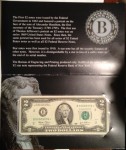
How can I go to a coin show without buying something?! Today, I kept with my New York collectibles and found a Bureau of Engraving and Printing folder with a Series 2003 $2 Single Star Note from the Federal Reserve Bank of New York. For those not familiar with the concept of Star Notes, the best short description is from the Bureau of Engraving and Printing:
When an imperfect note is detected during the manufacturing process after the serial number has been overprinted, it must be replaced with a new note. A “star” note is used to replace the imperfect note. Reusing that exact serial number to replace the imperfect note is costly and time consuming. The “star” note has its own special serial number followed by a star in place of a suffix letter. The serial number of the imperfect note that was removed is not used again in the same numbering sequence.
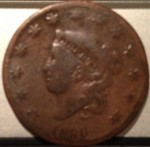
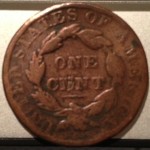
The other purchase was an 1830 Matron Head large cent that looks like it was dipped a long time ago and has re-toned. Although I prefer original surfaces, it is a good looking coin for its age and condition. Since I am passively working on a large cent year set (no varieties), it will fill a hole in that book. Too bad the dealer did not have other large cents to fill the holes since the price was right. But other coins were either too vigorously cleaned or had some corrosion.
Folder for the Series 2003 $2 Single Star Note from the Federal Reserve Bank of New York
Series 2003 $2 Star Note from the Federal Reserve Bank of New York. Rosario Marin/John Snow signatures.
Anyone that holds congress in contempt for the dysfunction that plagues the government should love the first two coin-related bills that have been introduced to congress.
The first pitch of political piffle is H.R. 77, the Free Competition in Currency Act of 2013. This folly was introduced by Rep. Paul Broun (R-GA) that takes up where the now retired Ron Paul has left off by introducing a bill “To repeal the legal tender laws, to prohibit taxation on certain coins and bullion, and to repeal superfluous sections related to coinage.” It marks the fourth congressional session that this bill has been introduced and it is likely to meet the same fate as its predecessors.
Although I took this seriously in the past, it appears that Broun did not get the memo that the government needs people to govern and not pontificate. Then again, it is difficult to find anyone of the 535 members of congress who really wants to govern on either side of the aisle, so I expect more of this hooey from this congress. It is unfortunate that he and I share the same undergraduate alma mater.
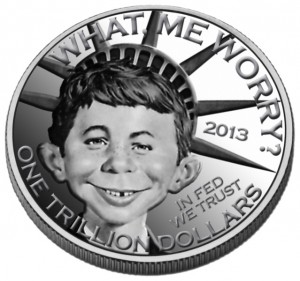
Dallas-based Heritage Auctions, the world’s largest collectibles auctioneer, is asking the public to suggest names, and has even created a proposed design for the coin. Information about naming the coin now is on Heritage’s Facebook pages.
Then again, asking for sanity from this congress may be too much to expect. Rather than responding to fact, Rep. Greg Walden (R-OR), and 19 other “quick” thinkers, introduced H.R. 220, Stop the Coin Act, that will “amend section 5112 of title 31, United States Code, to limit the face value of coins that the Secretary of the Treasury may issue, and for other purposes.”
I love that phrase, “and for other purposes.” Adding it allows congress to add their favorite brand of pork onto any bill.
The problem is that H.R. 77 might make sense if it was not introduced in reaction to the rumored $1 Trillion platinum coin. Aside from the platinum coin idea being a nonsense proposal, the idea did not even come from the administration. The best I can find, it was some blogger’s delusion that problems can be solved without the understanding of basic accounting—essentially, balancing the books when you create money. It is amongst the reasons why the nation is in such debt.
At another time and in a different context, it might be worth discussing the merits of H.R. 77, which would limit the face value of any coin produced by the U.S. Mint to $200. But for now, both the Department of the Treasury and the Federal Reserve said that it is not going to happen and that neither “… believes that the law can or should be used to facilitate the production of platinum coins for the purpose of avoiding an increase in the debt limit.”
Unfortunately, I have a feeling that the Treasury’s statement will not end the discussion.
The Alfred E. Neuman-head Trillion Dollar coin mockup courtesy of Heritage Auctions. And if you think that’s funny, it seems that the mad folks at Mad magazine thought if it first!
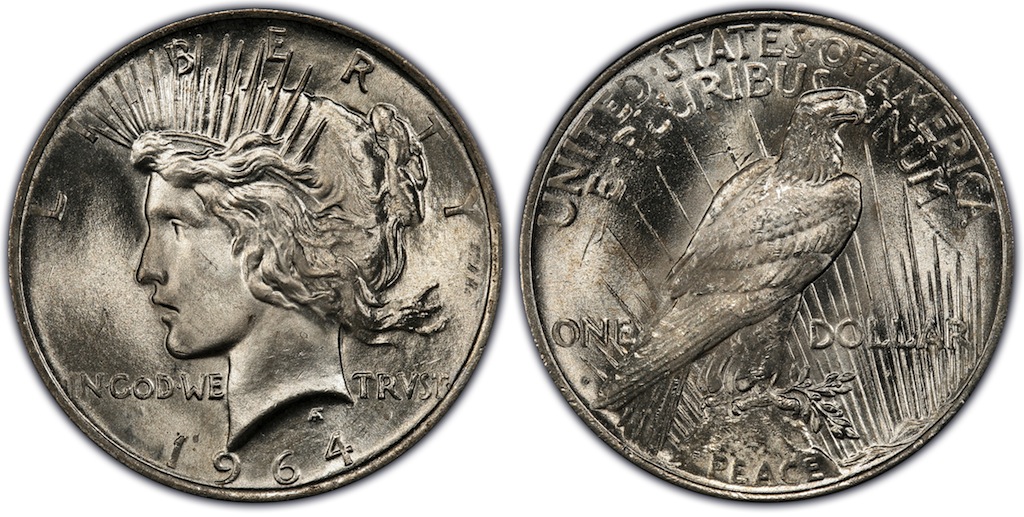
Artist’s conception of the 1964-D Peace dollar, the #1 coin on the new PCGS Top 100 Modern U.S. Coins list.
At the top of the list is the 1964-D Peace dollar, the coin I chose for the logo of this blog. Although U.S. Mint records from the time show that 316,076 were struck, they were never placed into circulation and all were allegedly destroyed. Apparently, PCGS believes, as I do, that someone might have purloined at least one coin. They are offering a $10,000 reward just to seeand authenticate an example.
Let’s assume for the moment that a 1964-D Peace dollar still exists and you had the money to spend, which of the Top 5 in the PCGS Top 100 Modern U.S. Coins would you like for your collection?
Now that it is award season, Professional Coin Grading Service is getting into the act by release its first annual listing of the “PCGS Top 100 Modern United States Coins.” PCGS is using the rising popularity of modern coins, those minted since the change to base metals in 1965, to bring this list to the public. PCGS announced the list on January 11, 2013, during a luncheon at the Florida United Numismatics Convention in Orlando, Florida.
PCGS is offering a $10,000 reward to verify a genuine 1964-D Peace dollar, the number one coin on the new PCGS Top 100 Modern U.S. Coins list. This image is a PCGS artist’s conception of a 1964-D Peace dollar.
Topping the list is the 1964-D Peace dollar, a coin that was struck but never put into circulation and allegedly destroyed.
“Mint records indicate that 316,076 1964-dated silver Peace dollars were struck at the Denver Mint in May 1965,” said Don Willis , President of PCGS, “but they were all were supposed to be destroyed.”
PCGS believes that not every 1964-D Peace dollar was destroyed and has offered a $10,000 reward “just to view in person and verify a genuine 1964-D Peace dollar.”
In 1964 the price of silver rose to new heights that it made the value of ordinary circulating coins worth more for their metals than their face value. Because of this, silver coins were being hoarded by the public and becoming scarce in circulation. Western states that relied on hard currency including the gaming areas of Nevada needed the U.S. Mint to strike additional coins for circulation.
The striking of a dollar coin had a powerful ally: Senator Majority Leader Mike Mansfield, Democrat from Montana, whose state would be directly affected by the new coins. Although the numismatic press was not in favor of the measure because of its limited ability to solve the coin shortage, Mansfield pushed a bill through congress to authorize the Mint to strike 45 million silver dollars.
After much discussion, the Mint looked for working dies but found that few survived a 1937 destruction order. Those that did survive were in poor condition. Mint Assistant Engraver Frank Gasparro, who would later become the Mint’s 10th Chief Engraver, was authorized to create new dies of the Peace dollar with the “D” mintmark. Since the coins would mostly circulate in the west it was logical to strike them closest to the area of interest.
Treasury Secretary C. Douglas Dillon was opposed to the the coin and wrote a letter to President Lyndon B. Johnson saying that the coins would not be likely to circulate and be hoarded. After Dillon resigned, Mansfield questioned the new Secretary, Henry H. Fowler, who assured Mansfield that the coins would be struck.
Although Mint Director Eva Adams, who was from Nevada, also objected to striking the coin, the Denver Mint began trial strikes of the Peace dollar on May 12, 1965.
When the coins were announced three days later, coin dealers immediately offered $7.50 per coin which would ensure that they would not circulate as intended. Everyone saw this as a poor use of Mint resources during a time of sever coin shortages. Adams announced that the pieces were trial strikes never intended for circulation and were later melted under reportedly heavy security.
To prevent this from happening again, Congress added a provision in the Coinage Act of 1965 (Public Law No. 89-81; 79 Stat. 254) that put a moratorium on striking silver dollars for five years.
There have been reports that some Peace dollars were struck using base metals (copper-nickel clad) as experimental pieces in 1970 in anticipation of the approval of the Eisenhower dollar. The same reports also presume these coins have been destroyed.
“It sometimes takes years for famous coins to surface,” said Hall. “Until 1920, no one knew there actually were 1913 Liberty Head nickels in existence. Until 1962, no one knew the 1804 Draped Bust silver dollar and the other coins in the special presentation set given by the United States to the King of Siam in 1836 were still in existence.”
“When we offered a $10,000 reward in 2003 to be the first to see and authenticate the long-missing Walton specimen 1913 Liberty Head nickel it resulted in the re-discovery of that coin after a 41-year absence from the hobby,” Hall continued. “Perhaps this new reward offer will help solve the mystery of whether any 1964-D Peace dollars survived the melting pots. It’s the number one modern U.S. coin.”
For collectors of silver crown-sized coins and large U.S. dollars, the 1964-D Peace dollar is the ultimate fantasy coin. As someone who collects silver coins including modern bullion issues, it should come as no surprise that I chose the 1964-D Peace dollar for this blog’s logo. My version was made using Photoshop and colored to not look “real” to avoid potential issues from our law enforcement friends at the Department of the Treasury.
It would be difficult to put a price if a version of the coin is found. It would certainly be a unique coin whose auction would start well out of my price range—maybe set a record for being the highest price paid for a single coin, topping the 1933 Farouk-Fenton Saint-Gaudens Double Eagle that sold for $7,590,020 in 2002.
This week’s poll asks if you belong to a local coin club.
I believe that local coin clubs are more the future of the hobby than national clubs. Members of local coin clubs can get involved in ways they cannot with a national club and have a greater impact in their community than on a national basis.
I am a member of two local clubs, the Montgomery County Coin Club (MCCC) and the Washington Numismatic Society (WNS). I joined MCCC in 2002 when I became interested in collecting again and have been significantly involved since. I think we are a strong club in an area of the country where there are varied interests a lot of alternative activities for people to be involved. Attendance at our monthly meets range from 20 during the slow summer months to over 40 when we have a popular program. For 2013, I will once again serve as the club’s president.
Last year I joined WNS with the intent of going to their meetings and getting involved with a different group of members. While some WNS members are also MCCC members, there people who are not members of both and a different way of doing things. My “real life” work requirements has prevented me from being more involved, but I hope that will change in 2013.
I am also a member of the Maryland State Numismatic Association (MSNA), the umbrella organization over clubs in Maryland where I have been Vice President since 2012. MSNA is in transition because of local changes in the numismatic climate, mainly the three-times per year Whitman Coin and Currency Expo held in Baltimore. The transition gives us an opportunity to try new ideas and help grow interest in numismatics in Maryland.
Being a member of these organizations allows me to meet and talk with others about numismatics. There are some members who are well known on the national scene, those whose regional knowledge has been valuable, and those with interesting collections and ideas that I would have never thought about.
Taking the time to meet other collectors is as rewarding as the hobby—especially with MCCC and WNS who dedicates a part of their meeting to exhibits, a numismatic “show-and-tell” of new finds or something different from their collections.
Are you a member of a local coin club? If not, why not? Vote in the poll and comments are always welcome below!
EDITED TO ADD: To find a club in your area, you can search for one through the ANA Club Directory. You can search by state, zip code, or even by specialty.
Do you belong to a local coin club?
No, but I am interested in joining (58%, 11 Votes)
Yes and I attend meetings regularly (26%, 5 Votes)
There is no coin club in my area (11%, 2 Votes)
Yes, but I do not attend meetings regularly (5%, 1 Votes)
Over the last few weeks there have been a public drumbeat for the U.S. Mint to strike a $1 Trillion platinum bullion coin to resolve part of the country’s debt issues. Regardless of the story saying that this should be done, the concept is that the coin would be deposited in the Federal Reserve and it would instantly generate $1 Trillion in profit (seigniorage) that would then be deposited in the Treasury general fund.
Regardless of the side of the political spectrum you are in this topic, it will not work.
The United States Code (U.S.C.) is the codification of the laws of the United States. It is divided into 51 titles each covering one general topic. References to the law are made by providing the title number, followed by “U.S.C.,” then the section of the law. Subsections are added using parentheses after the section. All of the laws governing the U.S. Mint are under Title 31. When talking about what coins the U.S. Mint may be allowed to strike, you would find those laws in Title 31 Section 5112 (31 U.S.C. §5112).
First question is whether it is legal for the U.S. Mint to strike the $1 Trillion coin. Although there are as many answers as there are pundits, everyone points Title 31, Section 5112, paragraph “k” (31 U.S.C. § 5112(k)) that reads as follows:
The Secretary may mint and issue platinum bullion coins and proof platinum coins in accordance with such specifications, designs, varieties, quantities, denominations, and inscriptions as the Secretary, in the Secretary’s discretion, may prescribe from time to time.
This law was passed by congress under their authority in Article 1, Section 8 of the U.S. Constitution that says “The Congress shall have Power… To coin Money, regulate the Value thereof, ….” The law’s intent was to give the U.S. Mint the authority to issue the American Eagle Platinum Bullion and Platinum Proof coins. American Eagle Platinum coins have a $100 face value and sell for a premium over the market price of platinum and taking into consideration coin’s production cost. However, the law does not restrict the issuance of the platinum coin to the American Eagle program.
But is it constitutional? The argument from John Carney of CNBC says it is not by twisting a ruling by the Supreme Court. Carney cites the case Whitman v. American Trucking Assns., Inc. (531 U.S. 457 (2001)) in saying that “the Environmental Protection Agency rule making authority was too broad because Congress had failed to provide ‘intelligible principle’ to guide the agency.” Unfortunately, like a lot of people, Carney reads the headlines and not the majority opinion. In the majority opinion, Justice Antonin Scalia wrote the law “does not permit the Administrator [of the EPA] to consider implementation costs” which is against previous precedent because the Clean Air Act, which was under question, “often expressly grants the EPA the authority to consider implementation costs, a provision for costs will not be inferred from its ambiguous provision.”
In other words, the Supreme Court said that because there are conflicts in the law. The “intelligible principle” is that Congress cannot delegate partial authority over one part of a law where other parts have a requirement to consider other circumstances. In other words, the Supreme Court is saying that Congress has to be consistent in delegating its authority.
Could 31 U.S.C. § 5112(k) be interpreted in the same manner? It is possible for the Supreme Court to declare the law unconstitutional, but if they do so they would also have to rule that the law that allowed the U.S. Mint to create the 2009 Ultra High Relief Gold Coin unconstitutional. According to 31 U.S.C. § 5112(i)(4)(C):
… at the same time the Secretary in minting and issuing other bullion and proof gold coins under this subsection in accordance with such program procedures and coin specifications, designs, varieties, quantities, denominations, and inscriptions as the Secretary, in the Secretary’s discretion, may prescribe from time to time.
Under both 31 U.S.C. § 5112(k) and 31 U.S.C. § 5112(i)(4)(C), the Secretary can authorize the U.S. Mint to strike any denomination platinum or gold coin with the value of $1 Trillion. Since there is no ambiguity or contradictions that would be able to use Whitman v. American Trucking Assns. as a precedence, the constitutionality should not be in question.
If the Secretary could mint and issue a $1 Trillion coin, then the Secretary could mint 17 such coins that could theoretically be used to pay off the country’s debt and give the country a positive balance for the first (and only) time since 1835 under President Andrew Jackson.
For discussion sake, let us say that the Secretary authorized the U.S. Mint to produce a $1 Trillion coin. Who is going to buy the coin?
If the concept is to use the profit (seigniorage) from the sale of the coin, whether it is made of gold or platinum, the coin has to be sold in order for there to be a profit. If the government would just deposit a $1 Trillion coin in the Federal Reserve, then where is the profit for the government? In order for a coin to become legal tender, it has to be bought from the government for at least its face value unless the law allows otherwise (see the American Eagle Bullion program and any of the commemorative programs). The U.S. Mint does not consider a coin to be legal tender until it receives an appropriate deposit of bullion or other forms of legal tender.
It this concept of legal tender that has been behind the government’s position that because the 1933 Saint-Gaudens Double Eagle coin was not paid for by a depositor (part of which is required in 31 U.S.C. § 5122), they are government owned coins (31 U.S.C. § 5121) and not legal tender. This concept has been upheld in the history of the 1933 Saint-Gaudens Double Eagles including the settlement over the Fenton-Farouk coin that sold for $7,590,020 with $20 going to “monetize” the coin.
Most recently, Judge Legrome D. Davis (U.S. District Court for Eastern Pennsylvania) confirmed the legal tender status of the 10 Double Eagles that Joan Langbord allegedly found in a box once owned by her father, infamous Philadelphia jeweler Israel Switt who is considered one of the central figures in the coins removal from the U.S. Mint. In Lanbord et al v. U.S. Treasury (Civil Action No. 06-5315), Judge Davis’s opinion cites past cases including the government’s own case against Israel Switt in 1934 for not forfeiting recalled gold and the previous return of 75 coins attributed to him. His opinion effectively confirms the U.S. Mint’s argument that once it creates a coin it is not legal tender and a liability on their balance sheet until the coins is bought.
If the coin is has to be paid for by a depositor before it can become legal tender, who will buy a $1 Trillion coin?
If the coin is just deposited with the Federal Reserve, there will be a $1 Trillion liability on the government’s balance sheet. In order to make the books balance, the Department of Treasury would have to sell debt bonds to make up the difference and that would add $1 Trillion to the national debt.
If the coin is bought by the Federal Reserve, then the Fed will have to pay $1 Trillion to the U.S. Mint for the coin reducing its overall working capital by $1 Trillion. Paying for a $1 Trillion that could not be used will just transfer the debt from the general treasury to the Federal Reserve. Since the Federal Reserve is in charge of managing the country’s money supply, the net effect will be to reduce the money supply by $1 Trillion that will cause the economy to shrink—any time you artificially remove money from the economy it will shrink which will also weaken the buying power of the U.S. dollar.
Transferring the debt away from the general fund might look good on paper but the effect will shrink the economy and cause more problems than even considering the constitutionality of doing this.
Public Law No. 112-201: Mark Twain Commemorative Coin Act
To require the Secretary of the Treasury to mint coins in commemoration of Mark Twain.
Sponsor: Rep. Blaine Luetkemeyer (R-MO)
• Signed by the President on December 28, 2012
See this bill at http://www.govtrack.us/congress/bills/112/hr2453
Public Law No. 112-209: March of Dimes Commemorative Coin Act of 2012
To require the Secretary of the Treasury to mint coins in recognition and celebration of the 75th anniversary of the establishment of the March of Dimes Foundation.
Sponsor: Rep. Bob Dold (R-IL)
• Passed the Senate on December 10, 2012
• Signed by the President on December 18, 2012
See this bill at http://www.govtrack.us/congress/bills/112/hr3187
The 112th Congress formally adjourned just after 12:30 P.M. on January 2, 2013 as one of the least productive in decades. It has been reported that this congress passed 219 bills as compared to 383 bills passed by the 111th congress and 460 by the 110th congress. As a comparison, the 80th congress (1947-48) that President Harry Truman labeled the “Do-nothing Congress” passed 906 bills.
We end numismatic 2012 almost the same way as we began, discussing what to do about the one-dollar coins. The over production lead to a quite a number of bills introduced in congress to try to fix the perceived problem but none ever made it to a hearing, let alone out of a hearing. Rather, the U.S. Mint hired Current Technologies Corp. (CTC) to perform an alternative metals study required by congress.
When the U.S. Mint finally published the report and a summary they made a recommendation to study the problems further because they could not find suitable alternatives to the current alloys used. While reading the summary gives the impression that the request is reasonable, the full 400-page report describes the extensive testing and analysis that the U.S. Mint and CTC performed leaving the reader curious as to why they were unable to come to some sort of conclusion—except that there is no “perfect” solution. This is a story that will continue into 2013 and be on the agenda for the 113th congress when it is seated on January 3, 2013.
The other part of the discussion is whether or not to end the production of the one-dollar Federal Reserve Note. It was the last hearing before the House Financial Services subcommittee on Domestic Monetary Policy and Technology for Rep. Ron Paul (R-TX) and the 112th congress that will certainly carry over into 2013.
This does not mean the Bureau of Engraving and Printing is without its controversy. In order to comply with the court order as part of American Council for the Blind v. Paulson (No. 07-5063; D.C. Cir. May 20, 2008 [PDF]) and the subsequent injunction (No. 02-0864 (JR); D.C. Cir. October 3, 2008 [PDF]), the BEP has been working to provide “Meaningful Access” to United States currency.
Secretary of the Treasury Timothy F. Geithner approved the methods that will be used to assist the blind and visually impaired to U.S. currency on May 31, 2011. In addition to examining tactile features, high contrast printing, and currency readers, the BEP issued a Request for Information for additional information to implement their plan. The BEP will be participating at stakeholder organization meetings to socialize and refine their plans. There will probably be few announcements before the conventions of the National Federation of the Blind and American Council of the Blind this summer.
Another building controversy from the BEP is whether the redesigned $100 notes will find its way into circulation. Introduced in April 2010, full production has been delayed because of folding during the printing process. The situation has to be so severe that the BEP has not announced a new release date and delayed releasing the 2011 CFO Report [PDF] to the end of Fiscal Year 2012 while finding a way to bury the scope and costs of the delays. Will the redesigned $100 Federal Reserve Note be issued in 2013? Stay tuned!
Staying with currency issues, there should be a new series of notes when a new Secretary of the Treasury is appointed. It is known that the current Secretary Timothy F. Geithner wants to pursue other options. If the BEP follows its past practice, notes with the new Secretary of the Treasury’s signature would be Series 2009A notes. There have been no reports as to whether Treasurer Rosie Rios will continue in her position.
As for other products, the BEP will continue to issue specially packaged notes using serial numbers that are either lucky numbers (i.e., “777”) or ones that begin with “2013” as part of their premium products. Of course they will continue to issue their sets of uncut currency.
Another carry over from 2012 will be whether the U.S. Mint will issue palladium coins that were authorized by the American Eagle Palladium Bullion Coin Act of 2010 (Public Law No: 111-303 [Text] [PDF]). The law requires that the U.S. Mint study of the viability of issuing palladium bullion coins under the Act. That report was due to congress on December 14, 2012 but has not been made public at this time.
Bibiana Boerio was nominated to be the Director of the U.S. Mint.
One final bit of unfinished business from 2012 is the nomination of Bibi Boerio to be the 39th Director of the U.S. Mint. The former Chief Financial Officer of Ford Motor Credit and Managing Director of Jaguar Cars Ltd. has recently been a Special Advisor to the President of the Detroit Regional Chamber of Commerce while waiting for the Senate to confirm her nomination. The Senate will have quite a few presidential nominations on its agenda that will he taken up in the new congress.
Other than the higher prices for silver products, the U.S. Mint should not generate controversies for its 2013 coin offerings. There will be no changes for the cent, nickel, dime, and half dollar with the half dollar only being struck for collectors since it has not been needed for circulation since 2002. These coins will be seen in uncirculated and proof sets with silver versions for the silver sets.
There has been no confirmation from the U.S. Mint whether they will strike San Francisco “S” Mint quarters for the collector community as they did in 2012.
American Eagle coin programs will continue with the bullion, collector uncirculated, and proof coins for both the silver and gold. The American Eagle Platinum bullion coin will continue to use its regular reverse while the American Eagle Platinum Proof will continue with the Preamble Series. The Preamble Series is a six year program to commemorate the core concepts of the American democracy as outline in the preamble of the U.S. constitution. For 2013, the reverse will be emblematic of the principle “To Promote the General Welfare.” The U.S. Mint has not issued a design at this time.
Currently, there are no announced special products or sets using American Eagle coins and no announced plan for special strikings such as reverse proofs or “S” mint marks.
As I am looking to pare down my collection to concentrate on a few select areas, I did not have anything on my numismatic wish list. Over the last few months, I have bought books that I will use for research. Otherwise, I have been just keeping up with the latest releases and not worrying about the holes in the parts of the collection I will be keeping.
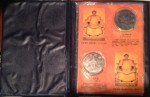
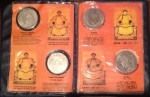
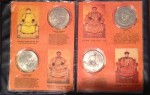
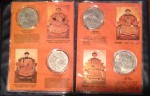
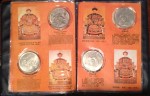
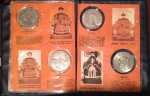
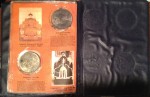
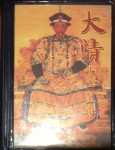
But that does not mean I did not receive a numismatic gift. Although it was not a holiday gift, a friend went to China and found a set called Qing Dynasty 12 emperors. The set contains 12 medals representing the Qing (pronounced as Ching) Dynasty that ruled China from 1616 through 1911. The set covers six pages with two medals per page. Each depicts a different emperor with their clan’s name around the top edge, their name to the right of their image, and the years of their reign below the image. All of the lettering is in Traditional Chinese. The reverse on all of the medals features the dynasty emblem that was used on the flag during the time the dynasty was in power.
Each of the medals are on a sealed plastic page with a paper insert that has an image of the emperor, his name, clan name, when he ruled, and a brief paragraph about him. On the front, the information is in Traditional Chinese, the reverse is in English. All of emperor images are drawings except for the last one, Xuantong Emperor, who abdicated in February 1912.
If you want to know more about the Qing Dynasty, you can read this page that is not pretty but uses the medal images as part of its explanation.
Based on the information I can find, the medals are 38 millimeters in diameter (1½ inches). I found a few references that they are made from silver, but I am not sure. From what I can tell by looking at the color and the weight of the medals, without cutting into the sealed pages, they may be made from a copper-nickel alloy. I do not think they are made from silver or silver-plated. But it is a very cool set and it was nice of my friend to think of me while she vacationed so far from home!
Which brings me to this week’s poll: Did you get anything numismatic-related for whatever holiday you celebrated?
Did you receive a numismatic-related gift this holiday season?
Yes I did and it was something I really wanted. (42%, 11 Votes)
I did not but I bought myself my own numismatic gift. (38%, 10 Votes)
Yes I did but it wasn't something on my want list. (8%, 2 Votes)
I did not but I did not have a numismatic gift on my list. (8%, 2 Votes)
I did not... maybe next year or for my birthday. (4%, 1 Votes)
Total Voters: 26
Loading ...
In the mean time, here are images of my Qing Dynasty 12 Emperors set.

 Loading ...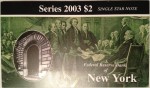


 But that does not mean I did not receive a numismatic gift. Although it was not a holiday gift, a friend went to China and found a set called