I have said that I do not like painted coins then I admit to buying painted coins.
So far, I have stayed away from strictly screen printed and lenticular printed coins but I have lauded some painted coins and added them to my collection.
If there is something that I prefer over everything else is a coin whose design is based on the engraving. For that reason, I have complemented and purchased $20 for $20 coins from the Royal Canadian Mint. Their $20 for $20 program produces .9999 pure silver coins sold with the face value of $20 (in Canadian funds). They are available directly from the RCM to Canadian and United States buyers only.
Last year, I purchased the Bugs Bunny and the Superman “Man of Steel” coins directly from the Royal Canadian Mint. My final price was $16.46 each in U.S. dollars after the exchange rate and the credit card company’s conversion fee. Sure these are gimmick coins, but I like the themes.
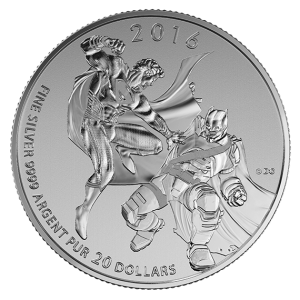
This year, the RCM has issued a Batman v Superman: Dawn of Justice $20 for $20 coin. With a mintage of 300,000 coins, numismatists who are also fans of the movie can add this silver coin to their collection. Based on the image, it appears that Superman is overpowering Batman.
Looking at the coin’s aesthetics, it is a good looking coin. The artists at the RCM are very capable and have come up with really nice designs. While the concept of the $20 for $20 (US$15.14 as I type this) may be somewhat of a gimmick for a coin with 7.96 grams of silver ($3.90 when silver is $15.32 per ounce), the design is engraved art struck into a silver planchet that is affordable for many collectors.
I have not had the opportunity to see the movie. I do enjoy comics and comic-related stories, but I am not a hardcore fan. I like both characters and have always been a fan of Wonder Woman now played by Gal Godot. But the coin intrigues me. I might buy the coin before seeing the movie!
Like any good movie, here is the “trailer” the Royal Canadian Mint produced for the coin:
Monopoly Ultimate Banking, a cashless version of the famous board game.
Could toy maker Hasbro be projecting the future of money?
At the 2016 New York Toy Fair, Hasbro announced that it will release an “update” the famedMonopoly game creating the Monopoly Ultimate Banking Game where the cash has been eliminated for electronic bank cards. The bank is now a hand-held unit that will scan the bank cards to make transactions.
As part of the game, the bank card is used to pay rent, taxes from the cards, and buy property. The new property cards will now have bar codes for the players to scan in order to make the purchase or mortgage their property.
This version of Monopoly will still have Chance cards. Previews suggest that the Community Chest cards have been eliminated. Chance cards will now allow for market crashes, fluctuations in rent, and other “real life” scenarios faced in the modern age.
Hasbro does have an Electronic Banking edition that uses a similar hand-held device. A Hasbro representative said that the Electronic Banking edition is the traditional Monopoly game using the bank card technology. It does not have the ability to scan property cards for transactions and requires more manual input than will be allowed for the Ultimate Banking Game.
Recently, the advocates for a cashless society or one that uses a limited amount of physical currency have been on their virtual soapboxes trying to find every reason to eliminate cash. One story that appeared on the CNBC website reported about a San Francisco-area restauranteur who tried to accept only credit cards had to reverse the decision because of backlash from customers.
There are segments of our culture who do not trust banks. There are industries that work better when the transactions are made in cash. There are some of us who do not like the electronic trail non-cash transactions create. These are only some of the reason cash will continue to live on.
Hasbro said that the Monopoly Ultimate Banking Game will be released later this summer. My only question is will it support house rules like double payment for landing on Go or having the taxes paid to the Free Parking pool for the next player that lands there?
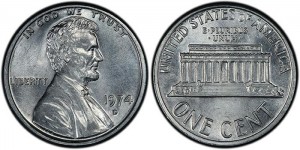
1974-D Experimental Lincoln cent pattern made using an aluminum planchet (J2151)
Once again the U.S. Mint is saving us coin collectors from ourselves and preventing a legally obtained collectible from being owned by the collecting public. In a canned statement that had to have been copied from previous canned statements, U.S. Mint Principal Deputy Director Rhett Jeppson said that the agreement to return the only known version of a 1974-D Aluminum Lincoln cent pattern “is not only good for the integrity of the coin collecting hobby but for the integrity of the government property and rule of law.”
In 1974, as part of the effort to find a composition that would replace the 95-percent copper planchet for the one-cent coin that was used at the time, the U.S. Mint struck 1.4 million as patterns with the intent on destroying all of the coins struck when completed.
Congress did not like the concept fearing that their silver color would confuse them with other coins. Additionally, the aluminum composition could not be detected in vending machines nor would show up on an x-ray if swallowed. The coins were melted down.
Patterns that were struck for this test were made entirely in Philadelphia.
Which brings us to the story of the 1974-D cent pattern in this story.
Harry Lawrence who retired as deputy superintendent of the Denver Mint in 1979 owned this coin. Lawrence died in 1980. Harry’s son, Randall, discovered the coin in 2013 after moving to La Jolla from Denver and selling a bag of his father’s old coins to Michael McConnell at the La Jolla Coin Shop.
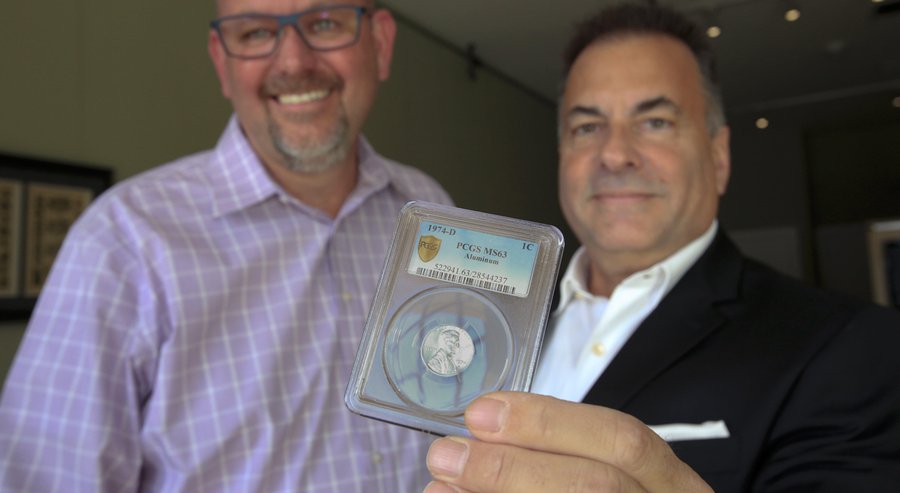
McConnell had the coin graded by Professional Coin Grading Service as MS-63 and determined it to be a genuine pattern. They were going to offer the coin for auction when the government stepped in to stop the sale and demanded its return.
Michael McConnell (left) and Randy Lawrence (right) returned the rare 1974-D penny made from aluminum back to the U.S. Treasury Department Thursday afternoon. — Nelvin C. Cepeda
There is one caveat to this story: there is no record of Denver ever striking such a coin. According to Randy Lawrence, the coin was given to his father when he retired from the Denver mint.
When Lawrence and McConnell sued the government to end the demand order, it is reported that Alan Goldman, former interim Mint director who headed the aluminum cent project, speculated in his deposition that the coin might have been made as part of a practical joke. Goldman allegedly named a suspect whose name was not released but is reported to be deceased.
The ensuing lawsuit lasted about two years and was settled today with McConnell returning the coin to the U.S. Mint on March 17, 2016.
The precedence this ruling is more dangerous for the hobby than people think. The most important issue is that it puts into jeopardy the status of the five 1913 Liberty Head nickels. Created under allegedly similar circumstances, the U.S. Mint has no record that these coins were ever produced. Although the government has tacitly agreed not to pursue that coin, there may be a time when someone with a more parochial view might use this situation to recover alleged chattel as property of the state.
Rulings like this will likely keep any surviving 1964-D Peace dollars hidden from the public. This will partially bury the history of turmoil in the coinage markets of the early 1960s. Hiding history is never good for anyone.
Credits
1974-D Aluminum cent courtesy of PCGS via Coin World.
Rhett Jeppson, nominated to be the 39th Director of the U.S. Mint
Unless something happens, the Senate Committee on Banking, Housing and Urban Affairs will meet in open session to hold hearings on a few presidential nomination. One nomination hearing will be for Rhett Jeppson to become the 39th Director of the U.S. Mint. Jeppson was nominated last July after being appointed as Principal Deputy director.
Edmund C. Moy, the 38th Director of the U.S. Mint, resigned effective January 9, 2011, about nine months short of completing his five-year term.
Following Moy’s departure, Treasurer Rosie Rios became acting director and served until Richard Peterson was hired as Deputy Director on January 25, 2011. Peterson was acting director until Jeppson was hired in January 2015. Since then, Peterson and Jeppson were government employees as part of the Senior Executive Service.
Prior to Jeppson’s hiring, Bibiana Boerio was nominated in September 2012, right before the midterm election. But as congress was trying to put the fun in dysfunctional, Boerio’s nomination was not heard by the Senate. By senate rules, the nomination was returned to the president when the 112th congress adjourned for the final time on January 3, 2013.
Although there should be no problems with the nomination, one can never know what will happen with this congress. When the cameras are turned on, members of congress are prone to grandstanding for whatever cause they feel is necessary regardless of whether it is germane to Jeppson’s nomination. I will predict that the cost to strike the one-cent coin and what to do with dollar coins will come up at this hearing even though the real decision makers are the ones asking the question.
Sometimes I wonder how these people get and stay elected!
If you are interested in attending the hearing, it will be held at 10:00 on the Ides of March, Tuesday, March 15, 2016, in Room 538 in the Dirksen Senate Office BuildingDirksen Senate Office Building located on First Street NE between C Street NE and Constitution Avenue NE.
Those who attend the meeting are welcome to share their comments below!
The latest attack on the money in your pocket is the talk about eliminating the highest denomination banknotes. This discussion was intensified in the political policy world with the article by Lawrence Summers that appeared in The Washington Post. Summers is a professor at Harvard and had once been the Secretary of the Treasury and Director of the White House’s National Economic Council.
Summers cites a paper by Peter Sands of Harvard and students that claims to make a compelling case to stop issuing high denomination notes and possibly withdraw them from circulation because of its use in crime and corruption.
Crime is mostly a cash-based enterprise. Criminals do not use gold, checks, or credit cards. As those of us who use cash over other payment types understand, cash is more anonymous. Cash transactions can be used to perform untraceable transaction that could be used to evade taxes. Criminals use cash to avoid law enforcement and terrorists use cash to fund their activities outside of the monitoring of financial transactions. In fact, Sands notes that these criminals have nicknamed the €500 note the “Bin Laden.”
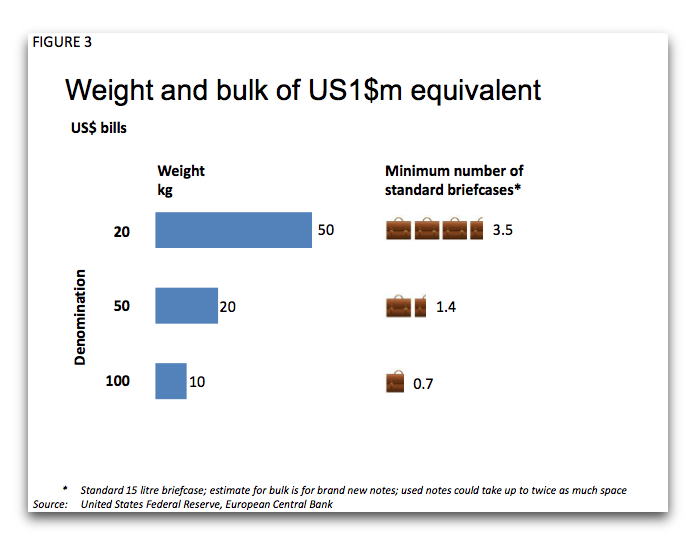
In order to carry out cash-based transactions is the ability to carry the cash. Sands’ paper and Summers’ article both say that lower denomination currency will make it difficult to carry large volumes of currency in order to make these transactions. Considering the weight of United States currency, carrying $1 million worth of $100 Federal Reserve Notes would weigh about 10 kilograms (22.0462 pounds). Using a 15 liters (just under 4 gallons) as the “standard” briefcase capacity, you could carry $1 million in 0.7 cases.
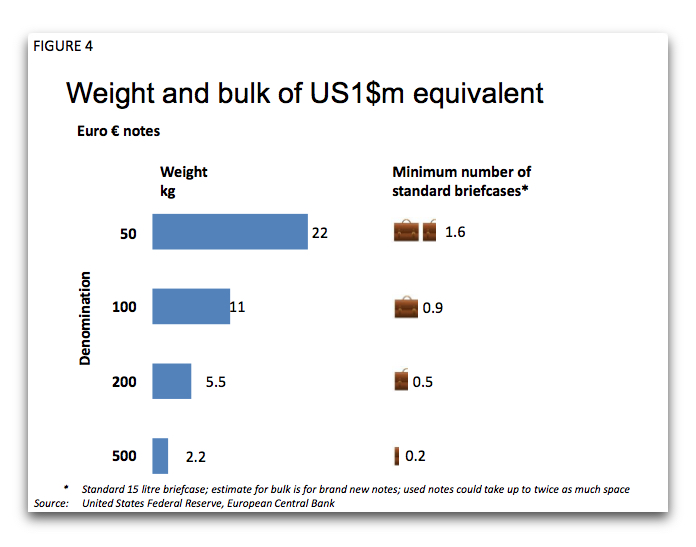
As a comparison, $1 million worth of $50 Federal Reserve Notes would require 1.4 briefcases and 3.5 briefcases when using $20 notes. If the $1 million was being paid using €500 notes, it would weigh 2.2 kilograms or about 4.85 pounds that takes up a quarter of a briefcase.
Comparison of the weight of the equivalent of $1 million using U.S. Federal Reserve Notes
Comparison of the weight of the equivalent of $1 million using euro currency
Sands says:
By eliminating high denomination, high value notes we would make life harder for those pursuing tax evasion, financial crime, terrorist finance and corruption. Without being able to use high denomination notes, those engaged in illicit activities – the “bad guys” of our title – would face higher costs and greater risks of detection. Eliminating high denomination notes would disrupt their “business models”.
Summers agrees with Sands and even suggests that the baseline currencies, specifically the dollar and the euro, should “stop issuing notes worth more than say $50 or $100.” Both consider demonetizing these high denomination notes a step in the right direction.
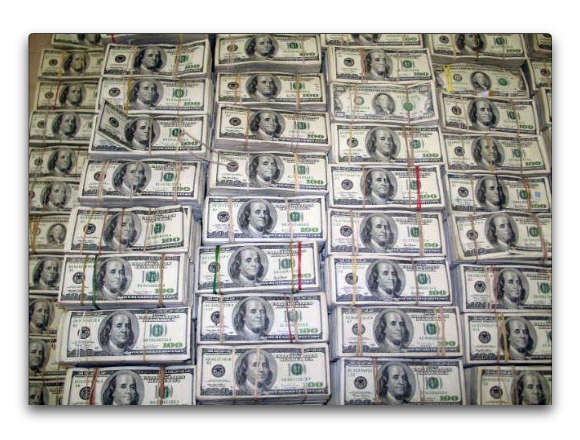
$207 Million in $100 notes seized as part of a drug raid in 2007
In the world of policy analysis there is the concept of the three-legged stool. The first leg is to identify the policy, which is what Sands’ paper does. Next would be to translate the policy idea into something that could be used as the basis for a law. The final step is something to drive the policy to be considered by the lawmakers in order to do something with the policy.
This is how the one cent coin went from being 95-percent copper to being copper-covered zinc. There was the idea to change the composition of the coin in order to save money. After the idea, there was the research and the law writing that went into changing the composition. As part of that second-leg exercise was the creation of the 1974 aluminum cent pattern. Finally, by 1982, the costs were so out of line that it became the driver that forced action.
Although the article and report has been well discussed as part of the financial press it is not likely to be acted on in the near future. It is only the first leg. It will take time before this stool gets its two other legs.
Images were copied from the report “Making it Harder for the Bad Guys: The Case for Eliminating High Denomination Notes,” by Peter Sands, et. al.
In December, I coined a term “numismentos,” a portmanteau of numismatic+memento. I was reminded of that with the recent announcements from both major third-party grading services.
Professional Coin Grading Service announced that as part of their 30th Anniversary celebration that they created a series of labels for their slabs including a retro-green label similar to the first labels issued by PCGS 30 years ago. Some, like the Mark Twain “First Strike” label will only be available at shows like the recently held the Long Beach Expo.
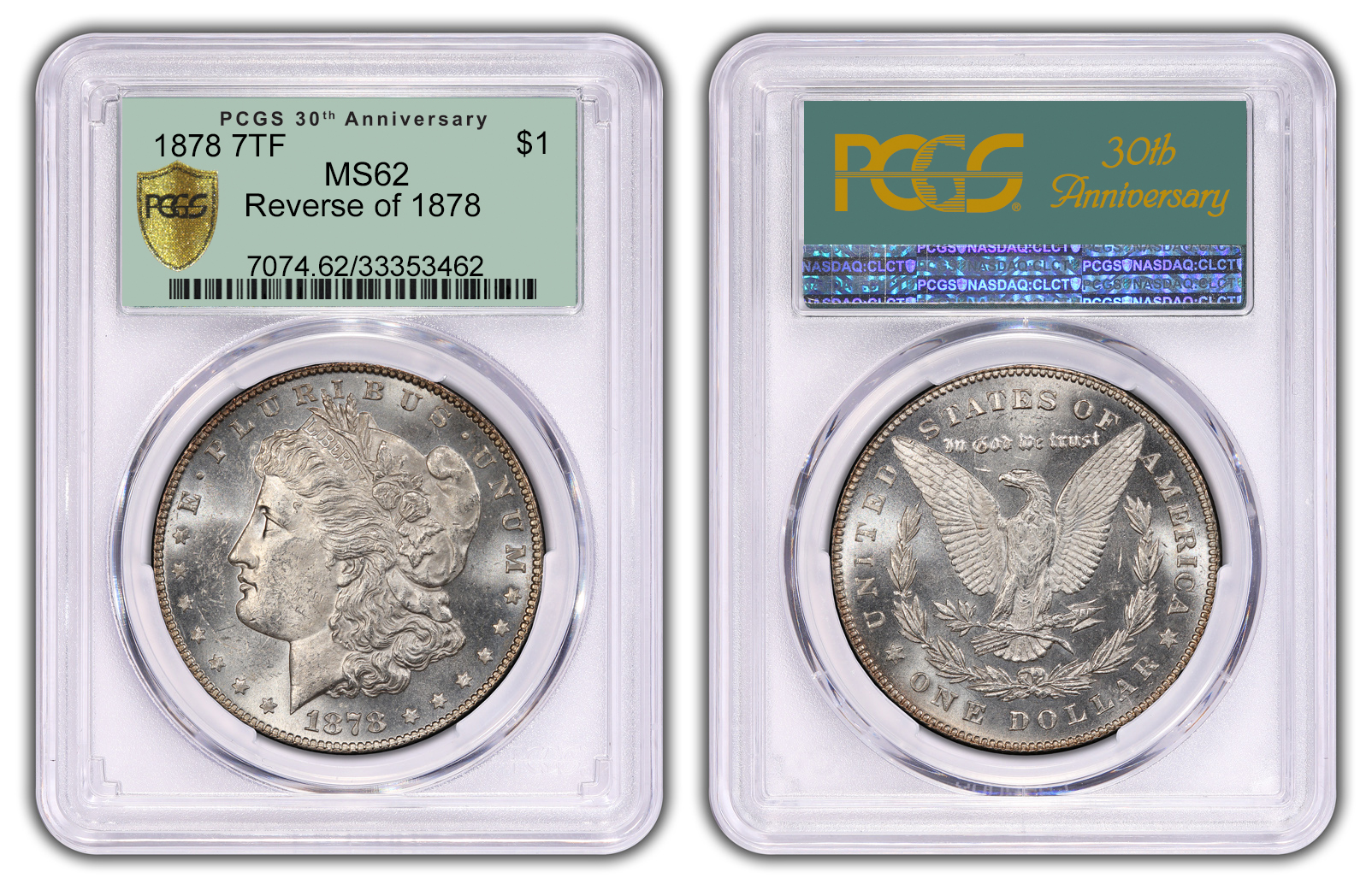
The PCGS 30th anniversary label for silver (shown here) and gold 2016 First Strike American Eagles. (PCGS)
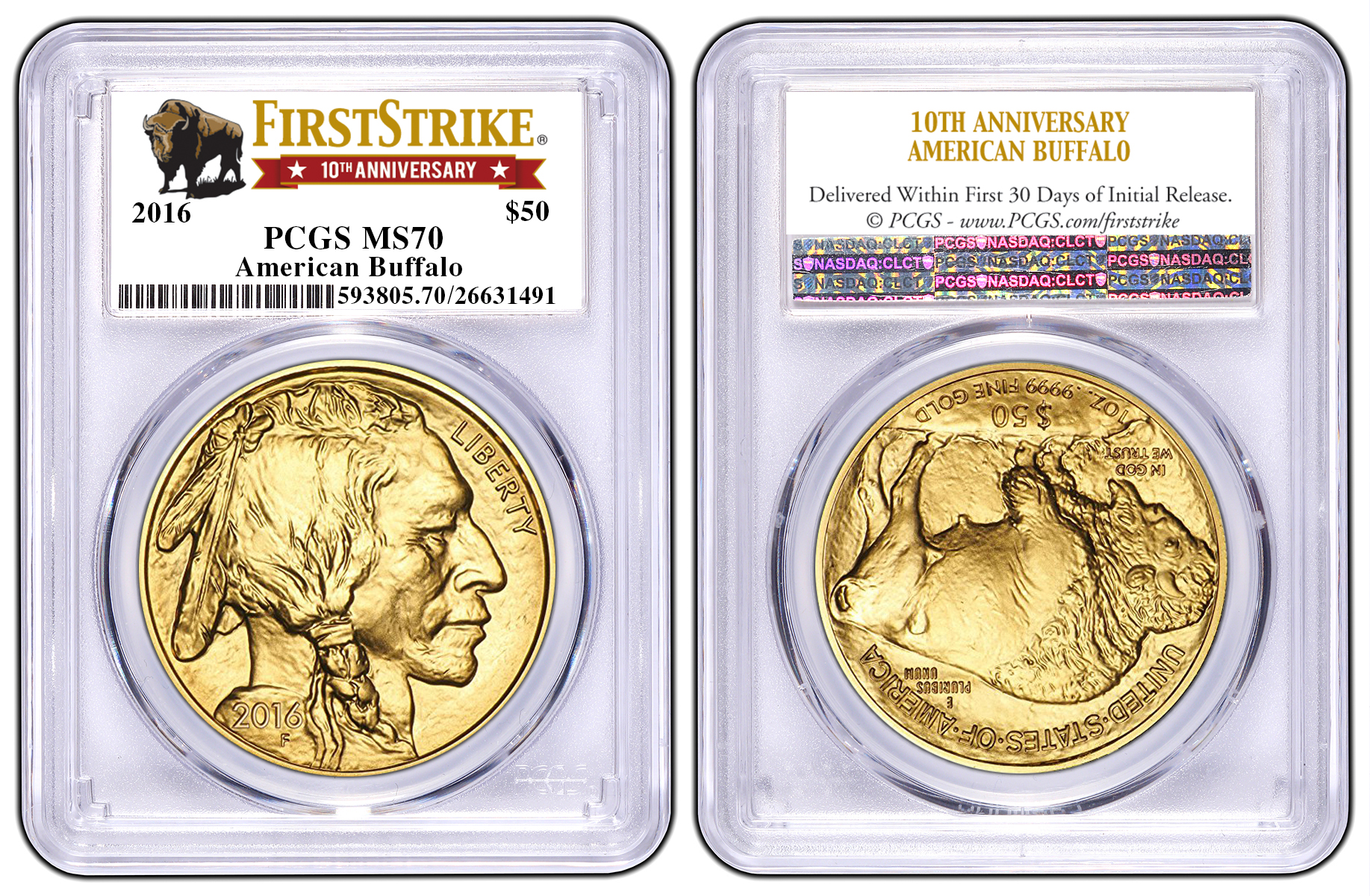
An example of a PCGS special First Strike insert label for the 2016 10th anniversary of the gold Buffalo coins.
PCGS has produced special First Strike – Long Beach Expo labels for the new silver $1 and gold $5 (shown here) 2016 Mark Twain coins.
An example of the PCGS 30th anniversary retro 1986-era green label insert.
2016 Australia $1 Wedding silver proof coin with autograph label
Former Perth Mint Director Ed Harbuz
I was curious as to what my readers thought. Do you collect the labels? Do you look for the labels? Do you care? Take the survey and then weigh in with comments!
Have you ever looked at a coin and wondered where the design ideas come from? Have you ever said to yourself that you could do a better job? Then here is your chance!
There is a caveat: you have to be an artist of some type and a U.S. citizen 18 years of age or older. Phase I of the competition is the evaluation of up to five examples of your work submitted digitally to the U.S. Mint who is hosting the competition committee. You have to be able to submit a digital portfolio. Even if your work is good and you think you can be part of the competition, you either have to be able to take a good picture of your work or find a photographer who can help.
The “expert jury” will review your portfolio and select no more than 20 artists for the second phase.
Phase II, those selected artists will be asked to submit one design along with a plaster model of both the obverse and reverse for the proposed coin. Only one artist’s design will be selected
The winning artist will receive $10,000 and have your name etched in numismatic lore for being the designer of the coin. For this, your initials will appear on the coin, the Certificate of Authenticity, and in places like the Red Book!
“Artists are expected to distill the program’s design theme to its essence, representing a complicated subject on a very small palette.” A silver dollar is 38 millimeters in diameter!
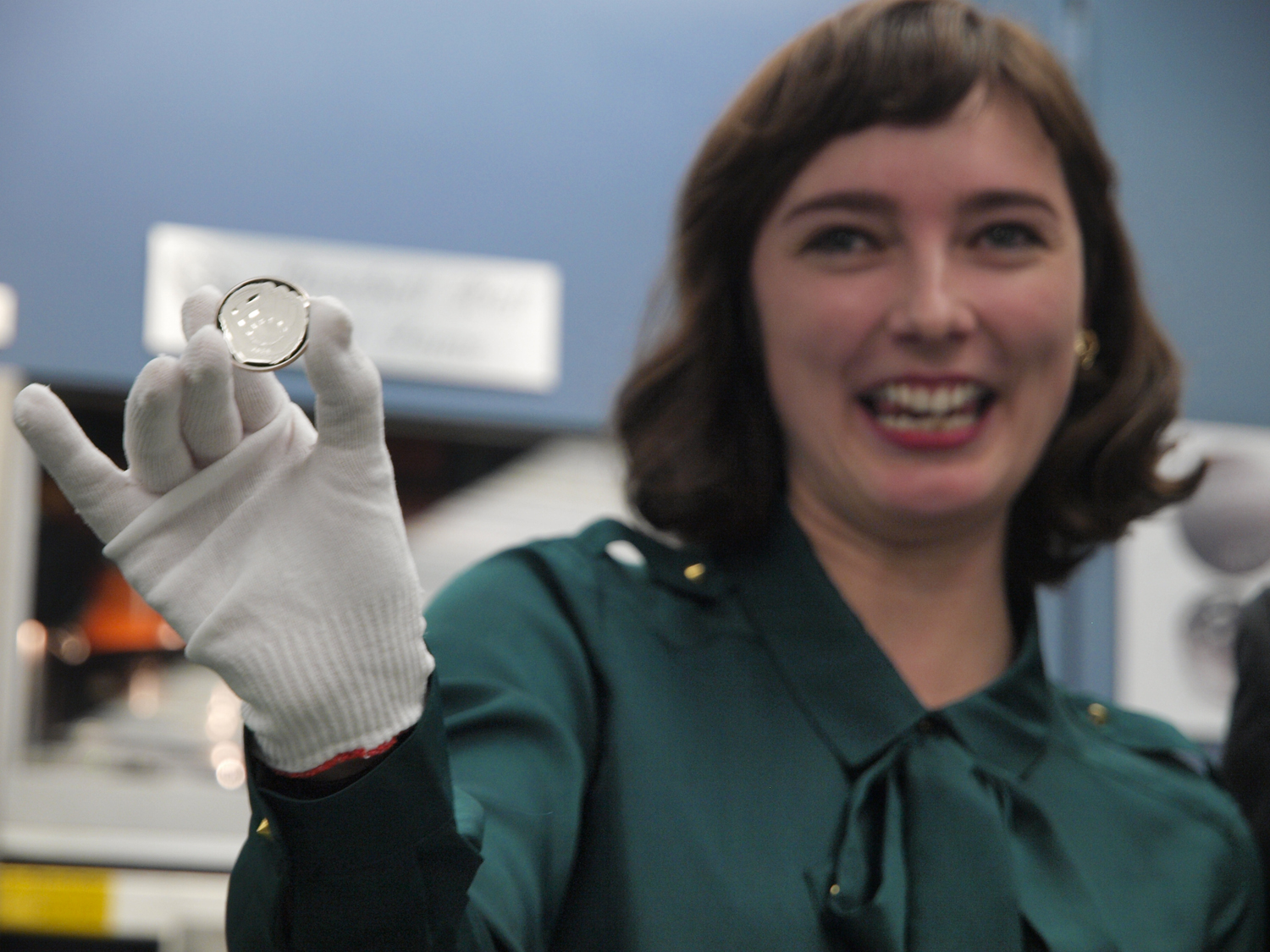
Cassie McFarland holds up Baseball Hall of Fame Commemorative Dollar with her design
Remember Cassie McFarland? She was the artist from California who entered the National Baseball Hall of Fame Commemorative Coin competition and won the design contest. This is the coin whose clad half-dollar won Coin of the Year honors for the most innovative coin on a commemorative that was just about a sellout (over 1 million coins struck).
Artists are always looking for a something to add to their portfolio. McFarland has had her picture in nearly every major newspaper throughout the United States and the image here has made the rounds on social media. I hope she has been able to boost her career with this. She definitely deserves any attention she receives.
Think about it… your design on thousands of coins in the hands of collectors, preserved forever. Cassie’s design is. How about you?
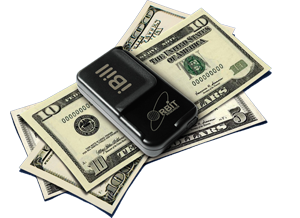
The iBill currency reader is a product of Orbit Research. Retailing at $119.00, iBill is a pocket-sized reader that can identify all Federal Reserve Notes in circulation. Orbit Research claims that “most bills are identified in less than one second” and can announce “the denomination in a clear female voice; tone and vibration modes protect privacy.” It requires one AAA battery that is included.
The Meaningful Access Program came about as the result of a settlement between the government and the American Council of the Blind who brought suit claiming that U.S. currency violated Section 504 of the Rehabilitation Act. This was first confirmed by the courts in 2006 and subsequent appeals had judges requesting a settlement. Following the 2009 settlement, the BEP began to work on meaningful access programs.
IDEAL Currency Identifier
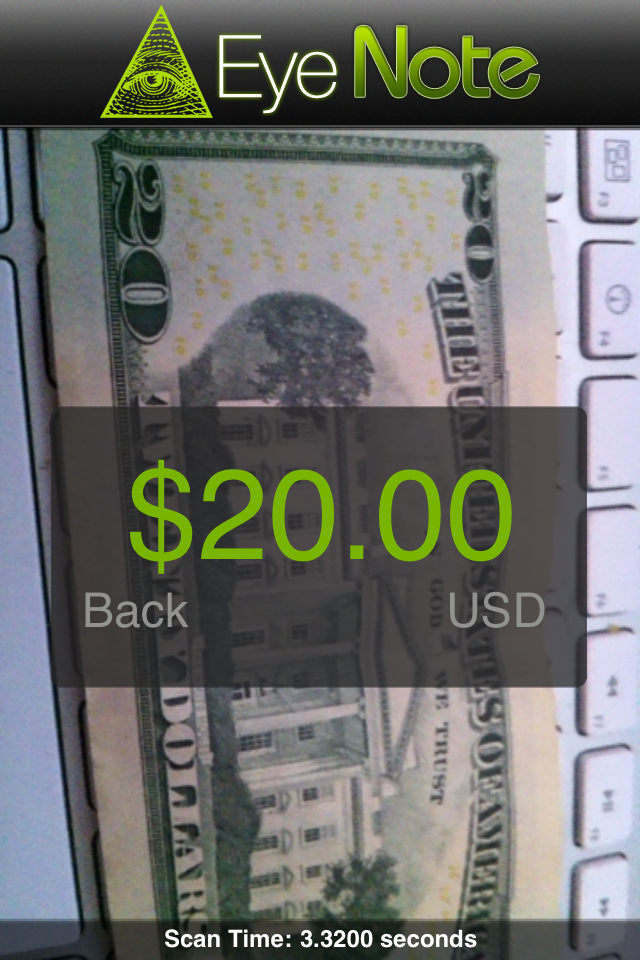
BEP developed EyeNote
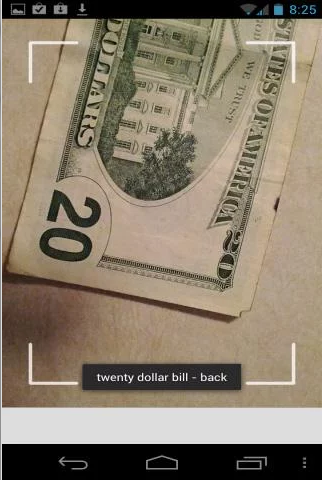
One of their first attempts was EyeNote, an iPhone app the camera to scan the note and identify it in 2-4 seconds. Although slower than the iBill, it is a very capable app that will allow the visually impaired iPhone user to carry one less device.
According to the BEP Meaningful Access mobile application page, the BEP worked in collaboration with the Department of Education to have the IDEAL Currency Identifier that works on Android devices. This app can be found on the Google Play Store.
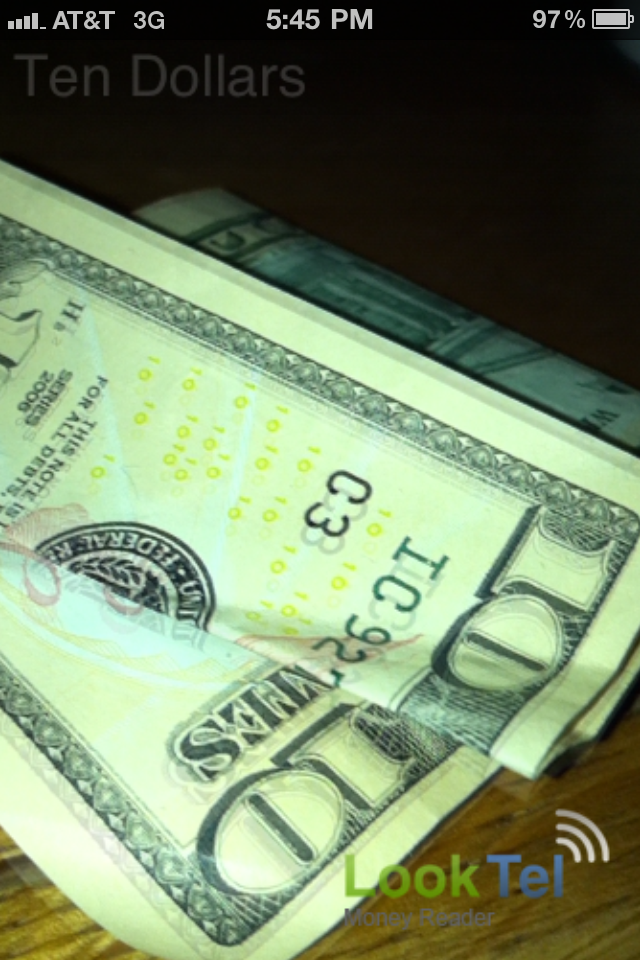
A more impressive app is the LookTel Money Reader available for iOS and the Mac. For the visually impaired traveler, not only can Money Reader recognize U.S. currency, but the currency of 20 other countries including the Australian Dollar, British Pound, Canadian Dollar, Euro, Indian Rupee, Japanese Yen, and Saudi Arabian Riyal. Money Reader is faster at identifying currency than EyeNote and can identify fragments, as I found in my last review.
LookTel Money Reader
In order to qualify for the free iBill reader, a “competent authority” must certify that your vision is 20/200 or less in your better eye with corrective lenses or that the widest diameters of visual field angular distance not greater than 20 degrees or that the “competent authority” certifies that you cannot read any printed material regardless of correction. The competent authority is usually a doctor, registered nurse, licensed therapists, institutions and welfare agencies familiar with your case.
If you think you, a relative, or someone you care for qualifies, download and fill out the simple form and send it to the BEP address on the form&rsqou;s instructions. It will take up to eight weeks for you to receive your free iBill currency reader.
As an aside, this is not a taxpayer funded venture. BEP earns its funding from their business operations. Most of their money is earned from printing money for Federal Reserve. They also earn a smaller amount of profit from sales to collectors.
Credits
iBill image courtesy of Orbit Research.
IDEAL Currency Identifier screenshot courtesy of IDEAL Group Inc. on the Google Play Store.
On January 11, 2016 the U.S. Government Accountability Office (GAO) release a report (GAO-16-177) about the “Implications of Changing Metal Compositions.” The GAO, an agency of the Legislative Branch, is supposed to be an independent, nonpartisan agency that investigates how the government spends taxpayer dollars and reports their findings to congress. It is important to remember that the GAO does not investigate for the sake of investigating agencies. They are asked by members of congress for a report about the implementation of specific policies. This report was requested by Rep. Bill Huizenga (R-MI), Chairman of the Subcommittee on Monetary Policy and Trade under the Finance Committee.
NON-NEWS FLASH: The U.S. Mint spends more money on the metals used to strike one- and five-cent coins than their face value.
“Wait,” you say. “That’s not news.” Of course you are right because you are an astute collector and a reader of the Coin Collectors Blog! Unfortunately, those who write news stories point to this GAO report to show that they are correct for proposing their narratives supporting changes to be made at the U.S. Mint. By focusing on the metals costs misses the entire story.
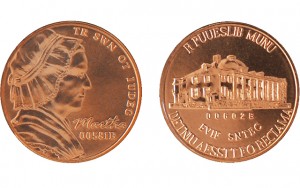
Experimental test strikes of the 5-cent denomination using Martha Washington/Mount Vernon nonsense dies were produced on planchets of the same copper-plated zinc composition used for the current Lincoln cents.
First, the report admits that the “potential government savings found these estimates to be narrow in scope.” The GAO’s narrow scope is because this report is based on a 2012 study of alternative metals performed by Navigant for the U.S. Mint. Navigant was constrained to performing their study to alloys that have been used by other mints, like the Royal Canadian Mint, and immediately available from United States manufacturing sources. Further, they did not consider the 2014 updated study that has more information than considered.
Changing coinage metals will not translate into instant savings. In fact, for the first two-to-three years it might show a loss greater than if congress would leave the metals composition the same. It is not clear whether the current die making and coining presses would work with a different planchets. And we are not talking about a few presses. Can you imagine how many presses were needed in Philadelphia and Denver to produce over 8 billion coins in each location in 2015?
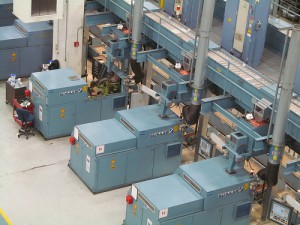
If I remember correctly from my last visit to the Philadelphia Mint, there were 20 presses in one row of presses in Philadelphia. Four rows were used to strike one-cent coins in three 8 hour shifts. There were two rows striking five-cent coins. Change the composition of these coins and that means the U.S. Mint will have to make changes to 120 presses!
That only covers the physical changes to the presses. Since most of the alternative alloys are harder than the current cupronickel alloy, dies will have to be replaced more often, the presses will require additional maintenance, and the processing will have to change. There are annealing machines, upsetting mills, and internal transportation systems that would have to be changed for the new alloys.
I spoke with a friend who works for a major manufacturer with facilities all over the world. During the discussion I was reminded of the usual changes in manufacturing that causes interruptions but are significant to think about. For example, oil refineries can close for two-weeks to a month in order to be retooled in order to change the production of fuel blended for cold weather driving to those for warmer weather driving. These costs are built into the prices you pay at the gas pump.
Similarly, an automobile manufacturer that changes model designs have to close to retool and retrain employees on the new designs. Making simple changes are easy. Change a body style and the entire line has to close at a cost to manufacturing.
Coining machines striking one-cent coins at the U.S. Branch Mint in Philadelphia.
Retooling the Philadelphia and Denver mints will be like an automobile manufacturer changing the entire design of a model. The plant will be closed, new equipment will have to be installed and tested, and the employee trained. Planning, purchasing, and installing the equipment will require money to be spent. There will be more costs for training of everyone from the engravers that have to consider coining issues with the new metals to the die makers to the line workers.
The other story missed is that the GAO claims that the coin-operated industry over estimated their estimation on the costs to the industry if change is changed. The GAO report cites a 2014 study provided to the U.S. Mint by the National Automatic Merchandising Association (NAMA), the $45 billion per year vending industry trade association in the United States, which says it will cost from $100 to $500 per machine to convert them to accept new coinage while the old coinage continues to circulate.
While trying to justify the over estimation claim, the GAO actually strengthens the NAMA argument by not controverting the per machine cost.
The GAO does not consider that the NAMA does not represent the entire coin-op industry. The American Amusement Machine Association (AAMA) represents coin-op games (video, pinball, etc.), fair operators, gum ball machine manufacturers, jukebox manufacturers, and similar businesses. When the report was first discussed, then AAMA President John Schultz was reported to have said to leave the coinage alone “because it works, rather than risk the costly consequences.” AAMA has not provided an estimate for those costly consequences.
Another consequence would be changes that the government would have to undergo to support new coinage alloys. Any location that the government relies on cash transactions would have to be updated accordingly. While the Postal Service has eliminated most of their vending machines in favor of automated kiosks, this change will hasten a complete removal of those vending machines that continue to operate in areas where electronically connected kiosks cannot be supported. This could leave people in remote communities without particular services they rely on.
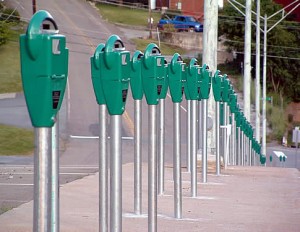
Aside from parking meters, how many vending machines, coin-op washers and dryers, change machines, even vending machines will have to be updated at your expense?
In addition to the federal government, local governments that rely on parking meters, parking systems, mass transit fare collection systems, tolls, and other systems would have to be converted. Although cost estimates have not been made those costs will be paid by the users of the service and you, the taxpayer.
Someone my say to just eliminate the one-cent coin. Why not? Canada did it, why can’t the U.S. do the same? The most significant problem is that this would change an economy that is over 9-times the size of the Canadian economy. Using the Gross Domestic Product (GDP), the total cost of goods and services, as a benchmark converted to U.S. dollar, the World Bank reports that the GDP of $1.5183 trillion in 2010, the last year statistics are available. Similarly, the U.S. GDP in 2010 was $13.9631 trillion.
Even if someone was able to figure out how this change will impact an economy that produces over $15 trillion in goods and services (2014 data), there are also the ancillary costs of changing machines, systems, services, and anything else that could be impacted.
Although it might seem easy to change the alloys used for coins or eliminate the lowest denominations, the impact reaches far beyond all analysis including that of the GAO. To tell everyone to “just deal with it” is an expensive proposition that will have to be paid for. Are you ready to pay more taxes for governments to “just deal with it?” More fees for services? Or dealing with a loss of services because in order to “just deal with it” because the service provider decided that it is better to stop providing the service than convert?
Credits
Image of Denver Mint courtesy of Wikipedia.
Image of Martha Washington trial strikes courtesy of the U.S. Mint via Coin World.
Image of the Philadelphia Mint was published in a Numismatic Bibliomania Society E-Sylum newsletter provided by Sandy Pearl.
As I write this the current estimated jackpot for Powerball on Wednesday, January 13, 2016 is $1.4 billion. It is the largest lottery jackpot in history.
If you win the jackpot and elect to be paid out over 30 years, you will receive $46,666,666.66 per year, less taxes.
The cash-out option, where you take all of the cash up front, is estimated to be “only” $868 million, less taxes.
As for the taxes, the lottery takes 25-percent off the top but you will still be required to pay the federal rate of 39.6-percent and your state tax. In places like New York City there is also a city tax. While I love New York, I would move before collecting the prize!
If you were wondering, the best place to move because of the taxes would be to California. California does not tax lottery winnings. But you will be subject to the federal income taxes at the highest rates.
For discussion, let’s imagine that you won and decided on the cash-out option. If you consider your state tax is the average of 7-percent, you will be left with $747.6 million. After you pay the bills, buy the new dream home, cars, vacations, etc., most of my readers should consider what you are going to do with your numismatic collection. You can build a great collection or purchase just about any coin with what is left.
What is your numismatic fantasy?
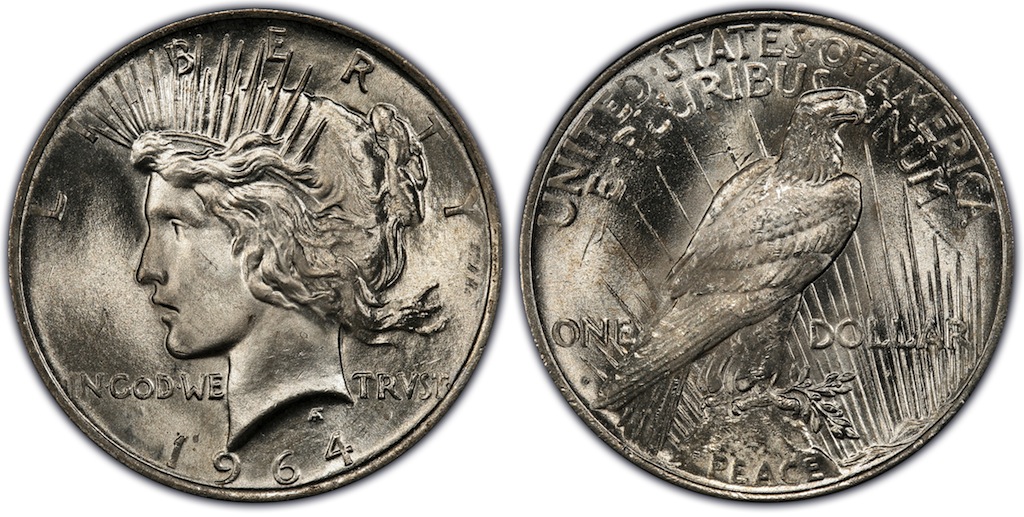
If I win Powerball, I will put up a $15 million reward for the owner of a surviving 1964-D Peace dollar to sell this special coin to me. The coin must be able to be certified as legitimate by experts in a manner that the Walton Liberty Head Nickel was certified. The reward will be paid only if the coin can be certified.
Why did I choose $15 million? Because I wanted to ensure that it was the most expensive coin on record. For a coin this special and this unique, it should be an appropriate price.
You know mine, what is yours?
PCGS is offering a $10,000 reward to verify a genuine 1964-D Peace dollar, the number one coin on the new PCGS Top 100 Modern U.S. Coins list. This image is a PCGS artist’s conception of a 1964-D Peace dollar.
UPDATE: I didn’t win the $1.5 billion jackpot. Sorry, no reward for a 1964-D Peace Dollar at this time!
Powerball logo courtesy of the Multi-State Lottery Association. Fantasy image of the 1964-D Peace dollar courtesy of PCGS.







 Loading ...