
September 2020 Numismatic Legislation Review
 At the beginning of every month, I try to summarize the numismatic-related legislation from the previous month. A few months were skipped because they were boring. September was not boring. It was overwhelming because the bills that showed progress are very significant.
H.R. 1923: Circulating Collectible Coin Redesign Act of 2020
- initiate a program to promote collection of the coins and recognition of their subjects, and
- strike and make available for sale silver bullion coins that are the exact duplicates of the coins.
Starting with H.R. 1923, Circulating Collectible Coin Redesign Act of 2020, it became a catchall bill to make many changes to the U.S. Mint’s circulating coin programs. Initially, the bill began as a proposal to create a series of circulating quarters honoring Women’s History and the Nineteenth Amendment. Since it was a convenient vehicle, other series ideas were added.
If the bill passes the Senate, the following will change your pocket change:
Quarters
- 2022-2025: Accomplishment of American Women, 5 per year
- 2026: U.S. Semiquincentennial, up to 5
- 2027-2030: Sports Played by American Youth, 5 per year
Half-Dollars
- 2027-2030: Paralympic Sports
Dollars
- 2026: U.S. Semiquincentennial
Medals
- 2027-2030: Accompanying Sports Medals
- 2028: Manufacture medals for the 2028 Olympic Games in Los Angeles
Silver Bullion Coins
- 5-ounce coins based on the quarter and half-dollar designs
- Can produce “ fractional” silver bullion coins
George Washington will continue to appear on the obverse but “be designed in a manner, such as with incused inscriptions, so as to distinguish it from the obverse design used during the previous quarters program.” Does this mean that the John Flannagan design and its many permutations can be retired for something a little more attractive? Replacing the Flannagan design for the Laura Gardin Fraser design would be appropriate.
The bill includes similar language for the image of John F. Kennedy on the 2026 Semiquincentennial half-dollar.
H.R. 4104: Negro Leagues Baseball Centennial Commemorative Coin Act
H.R. 4104, Negro Leagues Baseball Centennial Commemorative Coin Act, is a typically formatted commemorative coin program for 2022 to honor the Negro Leagues’ centennial. Surcharges will be paid to the Negro Leagues Baseball Museum.
H.R. 6192: 1921 Silver Dollar Coin Anniversary Act
H.R. 6192, 1921 Silver Dollar Coin Anniversary Act, will allow the U.S. Mint to produce a Morgan and Peace Dollar in 2021. These coins may contain more than the original 90-percent silver of the original.
The rest of the bills were introduced in September. There is not much to talk about until something happens, which is not likely until the lame-duck session.
H.R. 8242: National Women’s Hall of Fame Commemorative Coin Act of 2020
S. 4663: A bill to amend title 31, United States Code, to save Federal funds by authorizing changes to the composition of circulating coins, and for other purposes.
S. 4730: A bill to amend title 31, United States Code, to require the Secretary of the Treasury to mint and issue quarter dollars in commemoration of the Nineteenth Amendment, and for other purposes.

TR Finally Get His Due
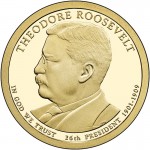 Even though the Presidential $1 Coins have been relegated to collector coins, numismatists should celebrate the release of the Theodore Roosevelt dollar coin.
Theodore “Teddy” Roosevelt, Jr. became the 26th President of the United States on September 14, 1901 following the assassination of William McKinley. Prior to becoming president, Roosevelt was a deputy sheriff in the Dakota Territory, Police Commissioner of New York City, U.S. Civil Service Commissioner, Assistant Secretary of the Navy, and Colonel of the Rough Riders for which he was awarded the Medal of Honor. Roosevelt was elected to the New York State Assembly, Governor of New York, and Vice President of the United State. In fact, his nomination as vice president to run with William McKinley by the Republican Party was to get him out of New York because he was reforming the status quo out of existence.
On September 14, 1901, at 42 years and 322 days of age, Roosevelt became the youngest President when McKinley was assassinated (Kennedy was the youngest elected president when he was inaugurated at 43 years, 236 days). As president he was a trust buster, conservationist, and his slogan of “Speak softly and carry a big stick” set the tone for military and foreign policy that even impacts today’s policies. Roosevelt was the first U.S. citizen and sitting president to win the Nobel Peace Prize for negotiating the 1905 peace treaty ending the Russo-Japanese War.
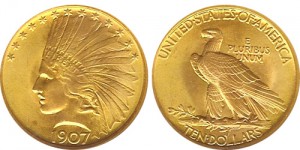
Augustus Saint-Gaudens designed the $10 Indian Head gold eagle that was first released in 1907.
After Saint-Gaudens died of cancer, Roosevelt continued to look to revitalize U.S. coinage. He seized upon Abraham Lincoln’s 100th birthday to redesign the small cent. He was steered to Victor David Brenner, whose bust of Lincoln was used as the model for the new Lincoln Cent first issued in 1909. Not only was Lincoln the first president to appear on a circulating coin, but Brenner’s obverse design is still in use today.
Roosevelt called his coinage redesign his “pet crime.”
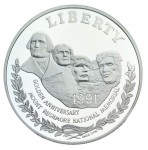
1991 Mount Rushmore Golden Anniversary Silver Dollar
Interestingly, the 2013 Mount Rushmore National Memorial quarter that will be released later this year will only show Washington and Jefferson during its sculpture. Lincoln and Roosevelt are not part of this image.
Teddy is now featured on the current one-dollar coin. The coin has a portrait Roosevelt facing to his right that even gives the impression of someone looking into the distance. It is fitting for a man who was always looking forward to preservation of America’s ideals and its place as a world leader.
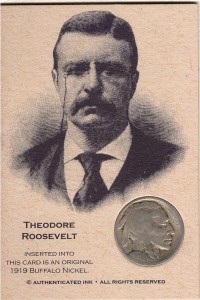
Teddy Roosevelt is my favorite president for many reasons including his view on coin designs. BULLY!
- 2013 Theodore Roosevelt Dollar and 1991 Mount Rushmore Golden Anniversary Commemorative Silver Dollar images courtesy of the U.S. Mint.
- Image of the 1907 Indian Head $10 Gold Eagle courtesy of U.S. Rate Coin Investments.
- Theodore Roosevelt card with 1919 Buffalo Nickel property of the author.
Here We Go Again… ANA Board Fires Jeff Shevlin
I just received an email from the American Numismatic Association saying that the Board of Governors announced that they will not extend the contract of Executive Director Jeff Shevlin.
“After considering the Board’s mission and objectives, the Board of Governors concluded that Mr. Shevlin was not the right fit to lead the Association going forward,” Hallenbeck said. “The board felt that it was in the Association’s best interest to sever our relationship and seek new leadership for the Association.”
Unless Jeff did something wrong that the Board is not telling us, this is the wrong decision bordering on downright foolish!
I have had a working relationship with Jeff for more than a year participating with the ANA Technology Committee. I have found Jeff to be incredibly accommodating and wanting nothing but the best for the ANA. He had taken on the role with the ANA Technology Committee as a volunteer before being interviewed and hired as the organizations after being a college professor. In our conversations, he described being the ANA’s executive director as his dream job.
Jeff relocates to Colorado Springs to take over an organization whose last two executive directors were “dismissed” for various reasons. Both of his predecessors pursued legal action against the ANA. Christopher Chipoletti’s suit was settled a few years ago, Larry Shepherd filed his case last December.
What did Jeff do wrong to not be renewed?
Jeff initiated the work to start to bring the ANA into the 21st century by looking at its technology infrastructure. He is concerned that the aging population of the ANA cannot sustain the organization that is not attracting enough younger members. Jeff knows that the way to engage the younger members is to use technology to get them involved and keep them engaged.
Jeff is an enthusiastic ambassador for the hobby. Nicknamed the “So-Called Guy” for his interest and work on So-Called Dollars. So-called Dollars are medals approximately the size of a silver dollar that were struck to commemorate a U.S. historical event. Jeff and Bill Hyder co-wrote Discover the World of CHARBNEAU SO-CALLED DOLLARS. Jeff was a collector. Jeff was one of us.
Maybe that was his problem. Jeff was a collector and not a dealer. While dealers are an important part of the ANA, the dealers do not have buyers without a strong collecting community. Dealers need the collectors as much as the collectors need the dealers. However, the dealer population is limited compared with the potential number of collectors, researchers, and other interested people that could be members of the ANA.
From my perspective, Jeff was doing everything right to help the ANA recover some of its past problems. The ANA has to be an all inclusive organization and think about the collectors and not just the business. The ANA needs to be more open and be able to reach out. The only way to do that in today’s environment is to use technology. Jeff understood that and understood that the ANA has to look at the organization as a whole and find balance.
This move represents everything that has been wrong with the Board of Governors over the last 10 years and have shown that this board has done little to work on the issues that I referenced in my platform.
Rather than set clear policies and goals (one of planks of my platform), the current Board seemingly used Jeff to figure out what to do next. This is NOT how to run a national organization. There are no clear goals, policies, or objectives. If they were the Board would not be in this situation.
Unless the ANA Board of Governors has something more tangible than saying that Jeff “was not the right fit,” it appears that the Board of Governors has once again failed the ANA membership making it time to replace the entire Board of Governors.
I’ll take “Don’t Get Too Excited” for $100
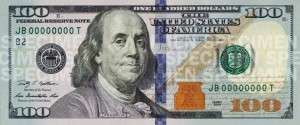 Earlier today, the Federal Reserve issued a press release announcing that the redesigned $100 Federal Reserve Note will be issued on October 8, 2013.
The redesign of the $100 note was announced with a press release that was to be held on April 21, 2010 at the Department of the Treasury Cash Room with all of the usual suspects: then Secretary of the Treasury Timothy Geithner, Chairman of the Board of Governors of the Federal Reserve System Ben Bernanke, Treasurer of the United States Rosie Rios, and the since retired Director of the United States Secret Service Mark Sullivan.
The date of the announcement, the Bureau of Engraving and Printing and Federal Reserve announced that Chairman of the Federal Reserve Board Ben S. Bernanke said, “When the new design $100 note is issued on February 10, 2011, the approximately 6.5 billion older design $100s already in circulation will remain legal tender.”
Throughout the summer of 2010, the BEP and Federal Reserve released a lot of training and education materials in anticipation of the release of the new notes.
Everything seemed to be going well until October 1, 2010 when the Federal Reserve “announced a delay in the issue date of the redesigned $100 note.” The Federal Reserve and BEP said that there was a problem with creasing of the paper during the printing process. That was the last we heard from the Federal Reserve until today’s announcement.
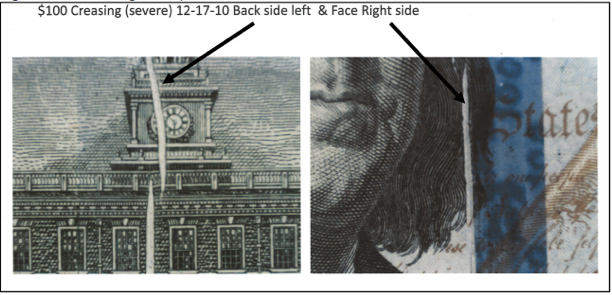
Magnified images of the creasing showing up on the new $100 notes.
In the mean time, the Treasury Office of the Inspector General issued a report (OIG-12-038 [PDF]) that said the BEP did not handle this process properly. The report said:
We consider the delayed introduction of the NexGen $100 note to be a production failure that potentially could have been avoided and has already resulted in increased costs. We found that BEP did not (1) perform necessary and required testing to resolve technical problems before starting full production of the NexGen $100 note, (2) implement comprehensive project management for the NexGen $100 note program, and (3) adequately complete a comprehensive cost-benefit analysis for the disposition of the approximately 1.4 billion finished NexGen $100 notes already printed but not accepted by FRB. [Federal Reserve Board]
After the report noted that the BEP basic responded by saying that they were sorry and are looking into it, the OIG caved and said that even though the BEP was bad, the corrective actions “are responsive to our recommendations.”
Then nothing. No follow up by the OIG or the Government Accountability Office. In fact, we have not heard from the GAO since their 2005 report suggesting whether a second supplier of currency paper is needed (see GAO-05-368).
Of course it is easy for the BEP to say that Crane & Co., the Dalton, Massachusetts company that has been the exclusive currency paper supplier since 1879, because it would be easy to justify. Some of the arguments against finding a second supplier includes the cost of entering the market and the established relationship with Crane who the BEP allows to “own” the innovations paid with taxpayer money. There was also the case of having two of the most powerful senators, Ted Kennedy and John Kerry, there to protect Crane. Neither are the senators from Massachusetts today.
While the BEP has been struggling with rag-bond paper, countries have been moving to using polymer “paper.”. The polymer “paper” was developed by the Reserve Bank of Australia to enhance the durability of the notes and to incorporate security features not possible with paper or rag-based paper. RBA has been distributing polymer notes since 1992. While the polymer substrate costs little more and the production is only marginally more expensive, the benefit will come from the reduction in counterfeiting and the durability of the note. Polymer will last three-to-six times longer than rag-based paper.
The Bank of Canada has reissued its C$100, C$50, and C$20 notes using the polymer paper and will issue the new C$5 and C$10 notes later this year.
Switching to polymer notes, especially for higher denominations, would be a better decision. It will reduce counterfeiting and reduce the costs over the lifetime of the note. And there is no law that would prevent the Federal Reserve from using the polymer paper.
Considering the Bureau of Engraving and Printing’s previous performance with the $100 notes, this should not be consider the time to celebrate. Especially since a pre-solicitation notice asking for information about purchasing a Single Note Inspection System is still open at FedBizOpps.gov and the BEP has not issued a request for proposal (RFP) to purchase such a system. Let’s wait for the BEP to deliver the notes to the Federal Reserve for distribution before considering this a success.
While waiting, enjoy this video announcement narrated by Federal Reserve Deputy Associate Director Michael Lambert about the new release date.
Images courtesy of the Bureau of Engraving and Printing.
Video courtesy of the Federal Reserve.
The Hopi Tribe shows us why we should care
While the State Department’s Cultural Advisory Committee (CPAC) continues to kowtow the the whims of foreign government looking to use the Convention on Cultural Property Implementation Act (CPIA; 19 U.S.C. §§ 2601 et seq.) as some sort of virtual tool to attack the United States, little seems to be said by the foreign archeological supporters when a Paris court ruled for a French auction house allowing them to sell Native American artifacts.
The case involves the sale of 70 artifacts from Arizona’s Hopi Tribe by the Paris auction house Néret-Minet. Hopi tribe members and historians believe that the items were illegally obtained. Representatives from Néret-Minet claim that the items were purchased legally from a collector in the United States.
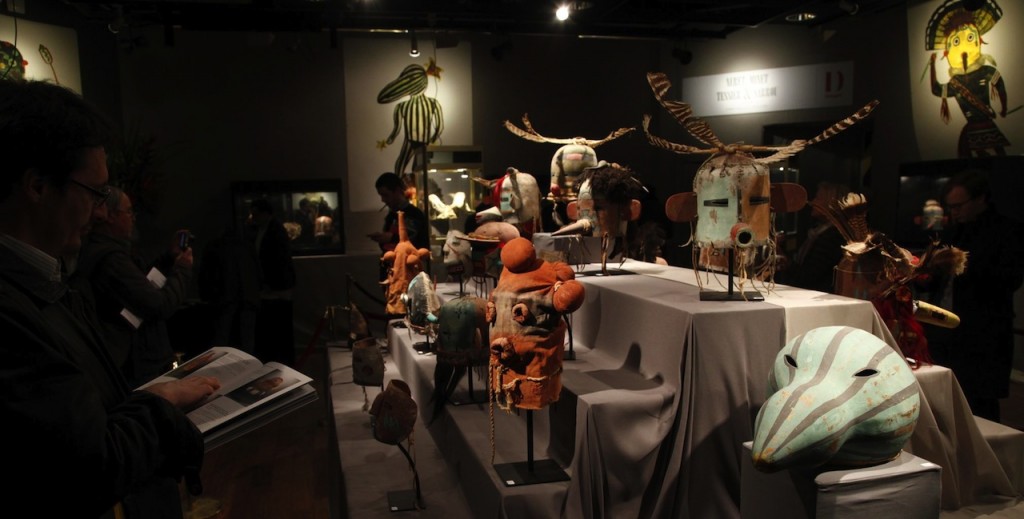
A visitor looks at antique tribal masks revered as sacred ritual artifacts by a Native American tribe in Arizona which are displayed at an auction house in Paris April 11, 2013. (REUTERS/John Schults)
Following the ruling, Néret-Minet went ahead with the auction. According to The New York Times, the auction generated $1.2 million in sales (with buyer’s premiums). Five of the 70 items did not sell and not sold for less than their estimated value.
According to The New York Times:
So let me get this straight, religious objects that are allegedly protected by the same treaties as ancient coins and United States law can be sold as “art objects” while foreign governments confront a dealer on a bourse floor while the State Department does little to protect collectors and those who have legitimate claims?
If France can do this with items of religious and cultural significance to the Hopi tribe, then will happen to the coin collecting hobby? I know some people can take their hobby seriously, but it is not religion. Most countries already have examples of the coins in question, so why are additional examples “culturally significant.” Remember, it was reported that when a dealer was approached in Baltimore by representatives of a foreign government, they were only interested in the more expensive coins and not the common coins from the same country with a lesser value.
The State Department is not doing enough to protect the American people, whether it is to protect what is really culturally significant items like the artifacts from the Hopi tribe or the abuse of international law as demonstrated by the actions of the State Department’s CPAC and the confrontation in Baltimore. This is something that must be addressed by the president!
Please take action!
I renew my request that all of my readers to go to http://wh.gov/MD2O and sign the petition. Share it on social media. I made it easy—just see the widget at the top of the right column. Petitions require 100,000 signatures in order to be answered by the White House. So far there are five signatures (THANK YOU!). Let’s see if we can motivate the coin collecting community to add more before you will not be able to own any foreign coin older than 100 years old!
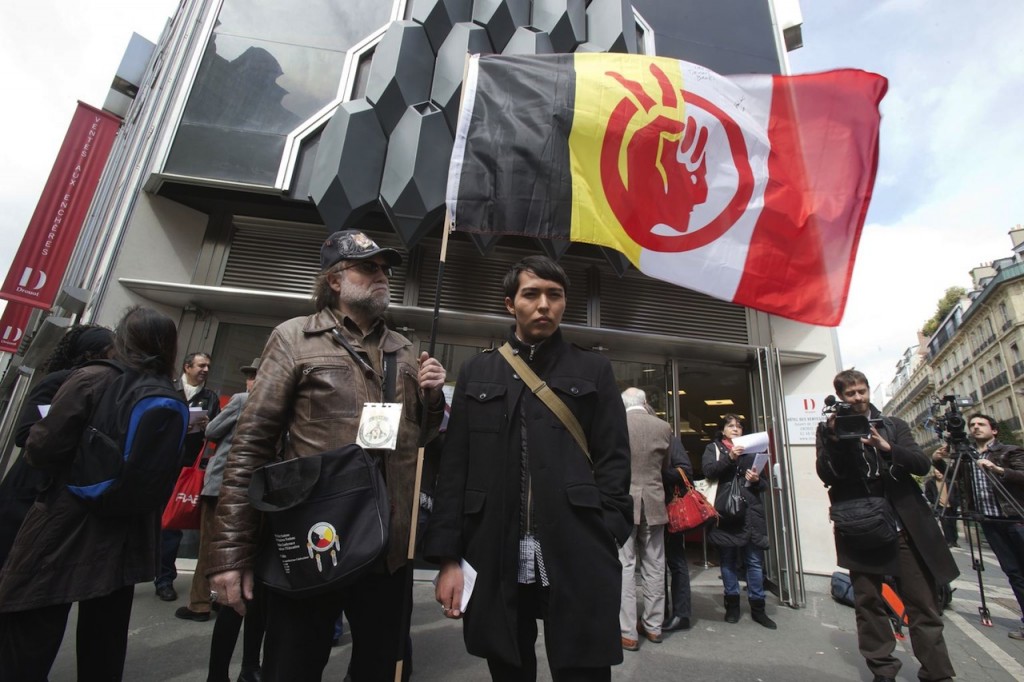
A French supporter of the Indian cause, who refused to give his name, left, holds a flag of the American Indian Movement and an American exchange student, member of the Arizona’s Hopi tribe, Bo Lomahquahu, right, stand outside of the Druout’s auction house to protest the auction of Native American Hopi tribe masks in Paris, Friday, April 12, 2013. A contested auction of dozens of Native American tribal masks went ahead Friday afternoon following a Paris court ruling, in spite of appeals for a delay by the Hopi tribe, its supporters including actor Robert Redford, and the U.S. government. (AP Photo/Michel Euler)
A Week Fit for a Buffalo
 Welcome to National Coin Week. This year, from April 21 through April 27, the National Coin Week theme is “Black Diamond Strikes Again” to celebrate the 100th Anniversary of the introduction of James Earle Fraser’s Buffalo nickel.
According to legend, Black Diamond was Fraser’s model for the reverse of the Buffalo nickel. Black Diamond was a North American bison that was living in the Central Park Zoo. He was donated to the zoo by Barnum and Bailey and lived his life there until he was auctioned in 1915 to a game and poultry dealer who was later sold as steaks for $2 a pound.

James Earle Fraser, ca. 1920
But like the story of who was the model for the Indian on the obverse, why should facts spoil a good story!
According to the fun folks at the American Numismatic Association, Black Diamond lives. Not only are they on the hunt to find him, but you can follow his exploits on Twitter using the handle @Diamondisalive.
Be sure to check out the the information at the ANA website. One thing you may want to read is the “The History and Romance of Hobo Nickels” [PDF] from the Money Museum.
Are you going to celebrate National Coin Week?
Total Voters: 16
 Loading ...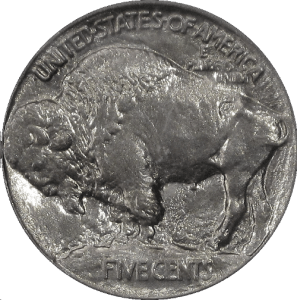
1913 Buffalo Nickel Type 1 Reverse
National Coin Week banner courtesy of the American Numismatic Association.
Other images courtesy of Wikipedia.
Support the Coin Collectors Blog
 Buy me a coffee
Thank you for your support!
Let Me Know What You Think
Are you going to the World's Fair of Money
Total Voters: 17
Loading ...