
Weekly World Numismatic News for September 6, 2020
When a $1 coin worth over $10 million is scheduled for auction, it will make worldwide news. The announcement that one of the first silver dollars ever struck by the U.S. Mint will be sold at auction in October.
In June, Legend Numismatics announced the Bruce Morelan Collection sale that includes a rare, early die-state 1794 Silver Dollar graded Specimen 66 by PCGS that Legend purchased for a record $10 million in 2917.
Moreland assembled the finest examples of early dollar coins from the founding of the Mint in 1794 through 1804 with Legend and its principal owner, Laura Sperber.
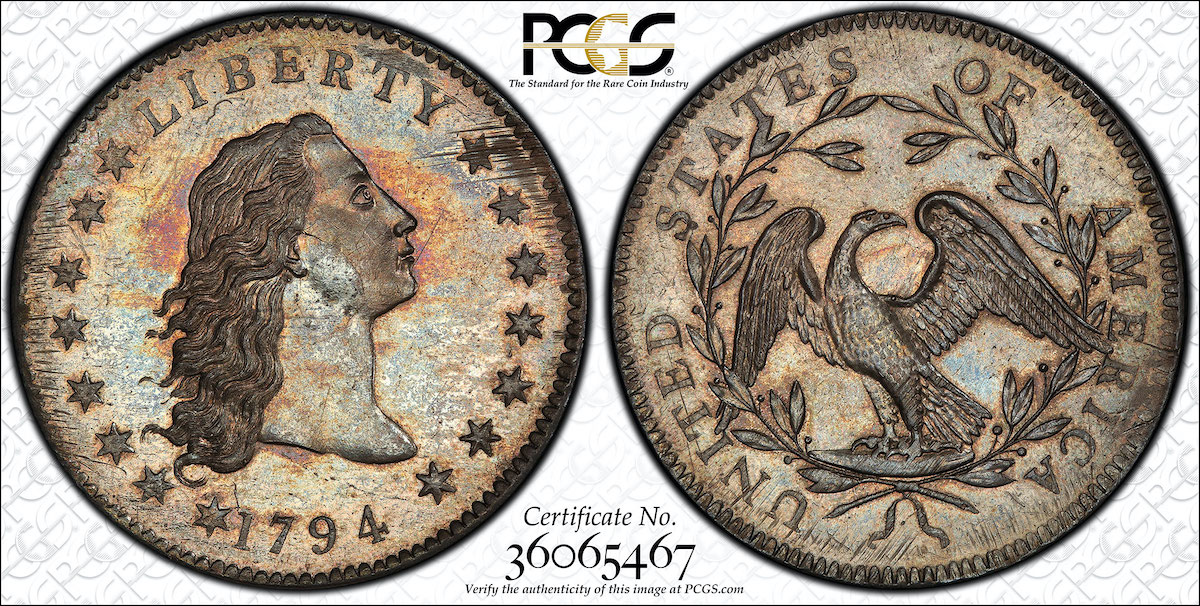
1794 Flowing Hair Dollar, PCGS SP66
(Image courtesy of PCGS)

1804 Draped Bust Dollar, Original – Class BB-304, PCGS PR65 (Image courtesy of PCGS)
While the news focused on the 1794 dollar coin, most missed the Class I 1804 dollar, the other significant rarity in the collection. Class I 1804 dollars was part of the eight coins that were struck in the early 1830s to create sets for diplomatic missions. The 1804 dollar in the Moreland collection is the Dexter Specimen named for one of its first owners James V. Dexter. It is believed that Dexter carved a small “D” into the reverse of the coin.
The coin’s pedigree includes being owned by the U.S. Mint, who bought the coin after being in a private collection, and D. Brent Pogue. It is the third finest example of the 1804 dollar.
The Moreland collection is scheduled to be part of the auction at the PCGS Members-only Show held in Las Vegas in early October.
And now the news…
 August 28, 2020
 → Read more at atlasobscura.com
August 28, 2020 → Read more at fresnobee.com
August 29, 2020 → Read more at euromaidanpress.com
September 2, 2020 → Read more at businessinsider.com.au
→ Read more at atlasobscura.com
August 28, 2020 → Read more at fresnobee.com
August 29, 2020 → Read more at euromaidanpress.com
September 2, 2020 → Read more at businessinsider.com.au
Stop me if you’ve heard this before: A fired Exec Director sues the ANA…
 We knew it was coming. The American Numismatic Association issued a press release saying that they are being sued by former Executive Director Larry Shepherd.
“There is no merit to any of the allegations contained in the lawsuit, and it will be vigorously defended,” read the press release. “he ANA will make no further comment with regard to this pending litigation.”
This saga started on August 23, 2011 when the ANA announced that Shepherd was placed on administrative leave. After a month of speculation on why the ANA took this action, it was announced on September 28, 2011 that the ANA had “ended its employment arrangement with Larry Shepherd, as executive director, effective as of September 20, 2011. the vote of the Board to sever that relationship was unanimous.”
Obviously, Shepherd did not take it well and issued a statement about his firing when the ANA responded but should not have. All has been quiet until a the Shepherd filed suit for wrongful termination.
This will make two dismissed executive directors who have sued the ANA. Even if the ANA wins their argument, the ANA loses because of the costs to defend itself. Just as the ANA was getting its financial footing back together, here is a potentially large, unexpected expense that has to be dealt with.
If the “third time’s a charm,” then the ANA has done well by hiring Jeff Shevlin. After meeting Jeff, I believe he really has the best interest of the ANA at heart and will do a great job.
POLL: Which 2013 coins are you most interested in?
Last week, the U.S. Mint published their product schedule for the rest of the month and the first quarter of 2013. So for this week’s poll, which 2013 coin are you most interested in?
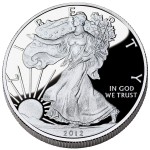
American Silver Eagle Proof
For the changing programs, the 2013 Presidential $1 Coins will honor the presidencies of William McKinley (the 25th President), Theodore Roosevelt (26th, whose “Pet Crime” gave us better coin designs), William Howard Taft (27th, the only president to become Chief Justice of the Supreme Court), and Woodrow Wilson (28th president). Although there are interesting stories about earlier presidents, “modern” United States history is usually taught beginning either McKinley or Roosevelt—which is unfortunate because many people could learn a lot from post-reconstruction politics.
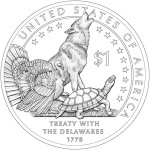
2013 Native American Dollar Reverse Design
Finally, there are the two commemorative coin programs for 2013: the 5-Star Generals Commemorative Coin Program and the Girl Scouts of the USA Centennial Silver Dollar. The 5-Star Generals commemoratives will feature a $5 Gold Coin honoring General Douglas MacArthur, a Silver Dollar honoring Generals George C. Marshall and Dwight D. Eisenhower, and a Clad Half-Dollar honoring Generals Henry “Hap” Arnold and Omar N. Bradley. Surcharges will be paid to the United States Army Command and General Staff College.
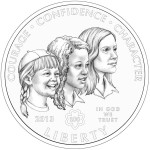
2013 Girl Scouts of the USA Centennial Silver Dollar
Which 2013 coins are you interested in purchasing?
Which 2013 coins are you most interested in?
Total Voters: 37
 Loading ...
All coin images courtesy of the U.S. Mint.
Last Chance for Star-Spangled Banner Commem
 As we come down to the home stretch of the 2012 products, let me put in a word for the 2012 Star-Spangled Banner Commemorative Coins. Proceeds from the sale of these coins ($35 for the gold coin and $10 for the silver dollar) goes to the Maryland War of 1812 Bicentennial Commission to support their bicentennial activities, educational outreach, and preservation and improvement of the sites and structures related to the War of 1812, a war that has been called our second war for independence.
The design of the 2012 Star-Spangled Banner commemorative coins enhance the depiction of liberty and the fight for freedom that should be the hallmark of U.S. coin designs. The gold coin features a naval battle scene representing the victory in Baltimore Harbor over the Royal Navy in defending Fort McHenry and the reverse has the first words of Francis Scott Key’s poem, “The Defence of Fort McHenry.”
While the gold coin is a nice design, the design of the silver coin is even better. The obverse depicts Lady Liberty waving the 15-star, 15-stripe Star-Spangled Banner flag with Fort McHenry in the background. It is a powerful image representing one of the best designs representing freedom and liberty. The reverse is a modern 50-star flag waving. Images (included below) does not do this coin justice. You have to see this coin in hand to appreciate the design.
It is always fascinating to see how the U.S. Mint works behind the scenes and hear from the designers and engravers. Philadelphia’s WPVI-TV went to the Philadelphia Mint to see how the 2012 Star-Spangled Banner commemorative coins are made. Here is their report:
In related news, it was announced that the Navy’s heralded Blue Angels will perform in Baltimore for the finale of the War of 1812 commemoration September 12-13, 2014. The Blue Angles will appear during the Star-Spangled Spectacular that will be held September 6-14, 2014 in Baltimore.
Buying the coins will not only add a beautiful coin to your collection but will help support the celebrations of the bicentennial of these important events in United States history. I bought the silver proof coin at Fort McHenry during the launch event.
The Coins:
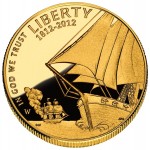
- 2012 Star-Spangled Banner Gold Commemorative Obverse depicts a naval battle scene from the War of 1812, with an American sailing ship in the foreground and a damaged and fleeing British ship in the background. Designed by Donna Weaver and engraved by Joseph Menna.
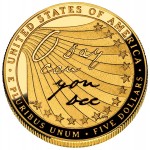
- 2012 Star-Spangled Banner Gold Commemorative Reverse Depicts the first words of the Star-Spangled Banner anthem, O say can you see, in Francis Scott Key’s handwriting against a backdrop of 15 stars and 15 stripes, representing the Star-Spangled Banner flag. Designed by Richard Masters and engraved by Joseph Menna.
-
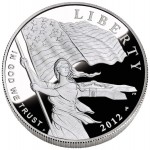
- 2012 Star-Spangled Banner Silver Commemorative Obverse depicts Lady Liberty waving the 15-star, 15-stripe Star-Spangled Banner flag with Fort McHenry in the background. Designed by Joel Iskowitz and engraved by Phebe Hemphill.
-
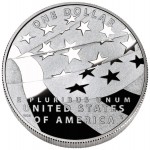
- 2012 Star-Spangled Banner Silver Commemorative Reverse depicts a waving modern American flag. Designed by William C. Burgard III and engraved by Don Everhart.
Scott’s coin:

- Logo courtesy of the Maryland War of 1812 Bicentennial Commission.
- Video courtesy of WPVI-TV, Philadelphia.
- Coin images courtesy of the U.S. Mint.
- Image of Scott’s coin is owned by the author and covered under CC BY-NC-ND 3.0 license.
Debunking the Bunkum for a Buck
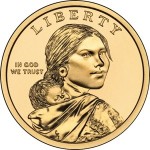
Obverse of the 2009-present Native American Dollar
Let’s look at the drivel about eliminating the dollar coins:
A summary of these arguments could be read on the Wonk Blog at The Washington Post. As I read the argument against, there is a lot of phrases with qualifiers like “if” and “may” that does not provide a solid feeling of deep analysis.
The bottom line is that for every dollar coin the U.S. Mint strikes, the government collects 72½ cents per coin. On the other hand, the Bureau of Engraving and Printing prints each note for around 8 cents per note but does not charge the Federal Reserve $1 for each note. By cost, the U.S. government makes more on seigniorage for the coin than the currency.
Converting to coins from the paper currency will cost the Fed more to purchase the dollar coin over printing currency. However, the Fed is not a government agency and does not use taxpayer money for its operations. It uses money earned off of its banking operations and turns over a percentage of its profits to the United States Treasury. While this will lower the amount of profit, it will be made up by the additional seigniorage.
When I read this in an editorial from my hometown The New York Times, I scratched my head and wondered what happened to The Old Grey Lady. What used to be a forward thinking newspaper sounds like the elderly neighbor chewing his gums yelling at you to “get off my lawn.” What The Times forgot is that following the problems the design of the Susie B’s caused, congress authorized changes to prevent those issues from reoccurring by changing the coin’s color and using a smooth edge rather than a reeded edge.
I challenge The Times editorial board to handle a quarter and a post-2000 dollar while reconsidering their misguided editorial.
A story in Bloomberg points out the savings may be limited because of the reduced number of dollar notes being produced. The writer credits the increased use of credit cards as a reason. However, reports show that consumer credit card debt has gone down every month since October 2008 until the first rise in October 2012.
The record shows that Americans have used their credit cards less and the use of cash has increased until these last few months while the Bureau of Economic Analysis reports wages have increased modestly during the slow recovery. In other words, the Bloomberg report does not hold up against facts.
Once again, some “analyst” at National Public Radio over thinks the issue with wrong data. NPR’s Jacob Goldstein writes that it is not a cost savings to the government because of shift from the production by the Bureau of Engraving and Printing to the U.S. Mint. However, his conclusion is based on the assumption that the seigniorage is the same for printing the note as it is for striking the coin. It is not, as we discussed earlier.
An interesting thing happens when the government tries to tackle an issue is that you get alleged pundits like Mike Rosen making irrelevant arguments based on an tangential premiss. The reason why Rosen’s writing is inconsequential is that the discussion is replacing one form of a dollar for another not eliminating a denomination. If the time comes to discuss the elimination of a denomination, then we can learn from the 1856 discussion that lead to the elimination of the half-cent. Otherwise, trying to justify eliminating a denomination using the discussion to replace the representation of another is an exercise in twisted logic.
From Boston, Jon Keller writes that it is not culturally possible to change from notes to coins. Keller is indicative of alleged analysts who are thinking with their head up the past and not providing anything but his emotional reasoning for not making the change.
This goes along with the arguments that Americans do not want to change that will put more change in their pocket. These people say that Americans do not want the coin and will resist this move. But if you look at reality, Americans are all about change. In the last 50 years we gave up our silver coinage, went from muscle cars to more fuel efficient cars, brought in and (thankfully) dumped disco, changed the Lincoln cent from copper to copper-plated zinc, handled the end of the Cold War while ushering in the era of terrorism, and adapted to life post 9/11/01. There have been floods, droughts, hurricanes, tornadoes, mega-storms, and earthquakes that has show the resiliency of the American people. To ask Americans to adapt to using coins instead of notes is a pittance compared to everything else.
I do not believe in conspiracy theories but there some who are not afraid to spout this insolence. It is an argument based on false equivalency based on being unaware of the legal mechanisms of how the government works.
If anyone has a real reason based on documented fact to support saving the paper dollar for the coin, I welcome their argument below.
Continuing to Amuse Twain

Mark Twain in his gown (scarlet with grey sleeves and facings) for his D.Litt. degree, awarded to him by Oxford University
This law will allow the striking of the Twain commemorative in 2016. The program will be for 100,000 $5 gold coins and 350,000 silver dollars whose designs “shall be emblematic of the life and legacy of Mark Twain.” There will be the usual $35 surcharge for the gold coin and $10 for the silver dollar that will be distributed evenly to:
- Mark Twain House & Museum in Hartford, Connecticut
- University of California, Berkeley for the benefit of the Mark Twain Project at the Bancroft Library
- Elmira College, New York, to be used for research and education purposes
- Mark Twain Boyhood Home and Museum in Hannibal, Missouri
I still think Twain would be amused.
Support the Coin Collectors Blog
 Buy me a coffee
Thank you for your support!
Let Me Know What You Think
Are you going to the World's Fair of Money
Total Voters: 17
Loading ...