Feb 1, 2013 | exonumia, medals, news, obituary, tokens
My hometown was in the news today for two very different reasons, yet both remind me of why I continue to love New York.

Mayor Ed Koch at the commissioning ceremony for the USS LAKE CHAMPLAIN (CG 57), 1988
Koch’s exuberance and love of New York propelled himself and the city from the what was seen as the bottom to a trajectory that you could not think of New York without Ed Koch or Ed Koch without New York. Koch’s perpetual question, “How am I doing?” will forever be his trademark throughout the streets, cabs, subways, highways, and byways of New York City.
A more happier note, it was on February 1, 1913 that Grand Central Station (really named “Grand Central Terminal” but that’s not what we called it growing up in New York) opened. It was not the first terminal on the site to bear the Grand Central name. The previous version opened in 1903 and comprised of three separate buildings. Over the next ten years the structure that stands there today was built in phases that including the underground rail tunnels that are still in use today.
Grand Central underwent a rehabilitation that started in 1994 through 2000 that cleaned up the famous ceiling in the grand concourse and reconfigured the above ground areas to include more shops. But it still represents the major transportation hub of New York.
Collecting transportation tokens are the ultimate numismatic collection that represents local history. Transportation has been at the heart of every city and can be used as a personal tie to your collectible. Tokens and medals representing local transportation can be more beautiful and significant than coins from the same era. Not long ago, I was able to find a pewter medal from the dedication of the East River Bridge. The bridge was rename in 1915 and is known today as the Brooklyn Bridge.
Having a collection of subway tokens reminds me of all those subway trips I had taken over the course of my life and the sesquicentennial medal of the Long Island Railroad represents my daily commutes from Long Island to my job at 30 Rock.
As I think about my hometown today, remember where you are from and consider starting a collection of tokens and medals that helps to tell your story. It can be as rewarding as your memories.
And to Hizzoner, you did just fine! Rest in peace.
Image of Ed Koch courtesy of Wikipedia.
Jan 27, 2013 | ANA, news, personal
 Montgomery County, Maryland—Newly installed Montgomery County Coin Club (MCCC) President Scott Barman announced that he would be running for a seat on the American Numismatic Association (ANA) Board of Governors.
“I would like to bring new ideas to the ANA that will increase its membership beyond the steady 25,000-28,000 of the last decade,” Scott said in his announcement. “Not only does the ANA need to embrace the future, but find ways of keeping young numismatists engaged after they reach 18 years old instead of waiting for them to find their way back after 40.”
Like many young numismatists, Scott’s collecting pursuits waned when he entered college. Although he carried his old blue folders and albums through adulthood, there was never time to engage in the hobby while growing a career and family. Like many, that changed in his 40s after becoming a widower.
Scott believes that if the technology was as available as it is today, he could have integrated collecting into his young adult activities into his life and continued with his collecting interests.
“Technology has changed a lot since I wrote my first program on punch cards,” Scott noted. “We use technology for everything from our work to talking with our neighbors. Schools teach classes online. Seminars are held online. Virtual organizations meet online. The ANA should embrace technology to keep those between 18 and 40 engaged.”
In keeping up with the technology industry, Scott knows that social media and computer-based learning are part of the fabric of life for those under 40. There is a lot that can be done with modest investments to keep young numismatists engaged as they advance to adulthood and help others interested to engage.
“A number of reports said that more than 3 million people were collecting State Quarters since the program started in 1999,” Scott said. “Why hasn’t that interest translated into more ANA members?”
Aside from making the services and resources of the ANA more available to its members, Scott is worried that the Association does not feel more accessible to the average collector. While the support from the commercial community is important, the ANA would benefit by engaging more collectors.
Building a service platform that the ANA can deliver its content to a wider audience will go a long way to engage current and new collectors. This will help make the ANA a leader in educating the public and possibly a model for similar organizations to emulate.
Another area that has to be addressed is the stability of the ANA Headquarters. For the second time, a dismissed executive director has chosen to pursue a claim against the ANA in court. This gives the appearance of a dysfunctional situation in Colorado Springs. Scott believes that the professionals working for the ANA are competent and qualified, but the Board of Governors must look into what it will take to create an atmosphere to support them and prevent the problems of the past.
“With support for the professionals in Colorado Springs and expanding the use of technology to engage more collectors, the future of the ANA will be very bright,” Scott added.
When Scott returned to collecting in 2002, he joined the Montgomery County Coin Club. Finding a club with an active membership, Scott embraced the challenge to become more active and looked to make an immediate impact. Shortly after joining, Scott became Webmaster of the MCCC website (montgomerycoinclub.org) and began to contribute to meetings with presentations. Eventually, Scott was elected to the MCCC Board of Directors before being first elected club president in 2008.
Scott served two terms as MCCC president including 2009, the club’s 50th anniversary. Club rules prohibited seeking a third consecutive term, so he became a board member and then vice president. Scott was elected president for 2013 and will continue to serve the club as its president and Webmaster.
After becoming hooked on numismatics again, Scott joined the ANA in 2003 and read everything he could find about his collecting interests. This has lead to Scott joining the American Israel Numismatic Association while collecting Israel currency and exploring his Jewish heritage, and the Royal Canadian Numismatic Association to learn more about Canadian coinage since his second wife’s family is from Canada.
Following his time as a club representative to the Maryland State Numismatic Association (MSNA), Scott became a member and the organization’s webmaster (mdstatenumisassn.org), board member, then was elected vice president for 2012. MSNA Vice President Scott Barman is serving his second term in 2013.
In 2005, Scott started the Coin Collectors Blog (coinsblog.ws) that he continues to write today. The Coin Collectors Blog is where Scott has spoken directly to other collectors writing about news, history, instructions, opinions, and whatever else has come to mind. This has lead to articles that have appeared in on-line and printed numismatic publications.
For the last year, Scott has worked with the ad-hoc ANA Technology Committee providing assistance to the ANA Board of Governors to repair and grow the ANA’s technology platforms. His work will continue with this committee and support it being made a permanent advisory committee to the ANA Board of Governors.
Recently, Scott has been working with the Gold & Silver Political Action Committee as political coordinator keeping the membership informed of the numismatic and precious metal news in his locale, Washington, DC.
When not involved in numismatics, Scott is an information security and systems architecture analyst for a not-for-profit corporation that works with the Federal Government. His job is to help the government build systems to serve the public and protect personal information. Scott holds a Bachelor of Science with a major in Computer Science from the University of Georgia and a Master of Information Systems Management with a concentration in information security and public policy management from Carnegie Mellon University.
Scott is currently finishing a book about collecting titled Enjoying Numismatics, A Conversation in Collecting. This will be published as an electronic book to reach the same audience he wants to interest in becoming ANA members.
Scott’s next project is tentatively titled The Policy and Politics of Money Manufacturing in the United States. The plan is to use his interest in public policy and numismatics and study what is behind the minting and printing of money in the United States. It will also help answer the perpetual question, “Why did the Mint do that?”
Scott’s collecting passion includes the coins of the 20th Century, numismatics representing his hometown of New York City and Inwood, Long Island; Maryland Colonial Currency; and Israel banknotes. He is also a fan of Philatelic Numismatic Covers also called coin covers with interesting themes.
Scott is passionate about collecting and the organizations that support the collector and dealer communities. He would like to use his unique background to bring a new perspective to the Board of Governors and to ensure the ANA’s future.
For more information, please contact Scott Barman at scott@vote4scott.info.
To read more about my platform, visit my campaign website at vote4scott.info.
Jan 21, 2013 | celebration, history, medals, news
Today was the ceremonial inauguration of Barack Obama for his second term as the 44th President of the United States. This is the 57th presidential inauguration in United States history. Obama is the 43rd person to hold the office of the presidency (Grover Cleveland served two non-consecutive terms).
The inauguration was held the day after the constitutionally mandated January 20th date because for the seventh time in history, the mandated date fell on a Sunday. Obama was inaugurated for his second term during a private ceremony held in the Blue Room of the White House.
Although the only part of the inauguration required by the constittution is the oath of office, all of the 57 presidential inaugurals have been as unique as the presidents and the times they served.
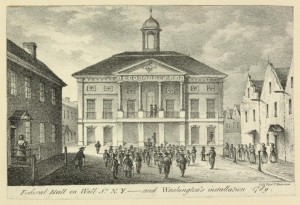
Federal Hall on Wall St. N.Y. and Washington’s installation 1789 / lith. Risso & Browne.
Thomas Jefferson was the first president to be inaugurated in Washington, DC on March 4, 1801. Six presidents were not inaugurated in Washington, DC including Washington and John Adams. The last was Lyndon B. Johnson whose first inauguration was on in Dallas on Air Force One following the assassination of John F. Kennedy. Johnson was the first and so far only president to be sworn in by a woman, U.S. District Judge Sarah T. Hughes.
Presidential fashion was changed on March 4, 1825 when John Quincy Adams was the first to wear long pants rather than knickers.
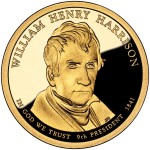
2009 William Henry Harrison Proof Obverse
Speaking of ascension to the presidency by the Vice President, this has happened nine times. Aside from Tyler being the first, the last and most significant was probably Gerald R. Ford, who was appointed Vice President under the provisions of the provisions of the 25th Amendment to the U.S. Constitution. This made Ford the only president not to be elected to national office.
Although the U.S. Constitution requires the president to be born in the United States, New York-born Millard Fillmore was the first president not to be born a British subject. Although Tyler was the governor of Tennessee, the first state that was not an original colony, Tyler was born in North Carolina which was an original colony. Kentucky-born Abraham Lincoln was the first president not born in one of the original 13 colonies. Obama was the first president to be born in Hawaii and the first not to be born in the continental United States.
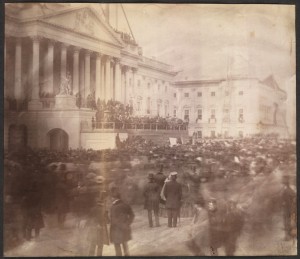
Photograph of the Inauguration of James Buchanan, March 4, 1857 by John Wood
Washington, DC is not known to have the best weather. Even the moving of the inauguration from March 4 to January 20 by the 20th Amendment (effective with Franklin D. Roosevelt’s second inaugural) has not done much to change this. Rain plagued ten inaugurations. It snowed for seven inaugurations. Even though the warmest was 55-degrees for Ronald Reagan’s first inaugural on January 20, 1981, he experienced the coldest inauguration for his second go around on January 21, 1985 when the mercury was 7-degrees.
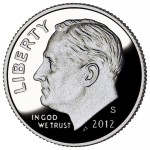 While Franklin D. Roosevelt was the only president to be inaugurated for four terms, Obama tied Roosevelt’s record for being the only presidents to receive the oath of office four times. Obama was given the oath of office a second time on January 20, 2009 after Chief Justice John G. Roberts, Jr. did not exactly get the words right the first time. This year, Roberts delivered the oath on January 20, 2013 as required by the constitution and then delivered it again on January 21 in a public ceremony.
Finally, following the tradition of all presidents, the 2013 Presidential Inaugural Committee commissioned an official inaugural medal that was struck in bronze, silver, and gold. Struck by the Medalcraft Mint of Green Bay, Wisconsin. Medals are available in bronze, silver, and gold. If you sign up for their mailing list, you will receive a code for discounts that can be applied to purchases. The last code I received was “2013” to take 15-percent off your order, but that could change as time passes.
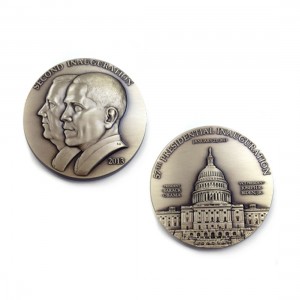
Barack Obama Second Term Bronze Inaugural Medal
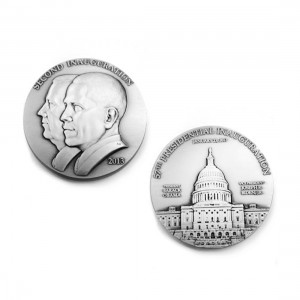
Barack Obama Second Term Silver Inaugural Medal
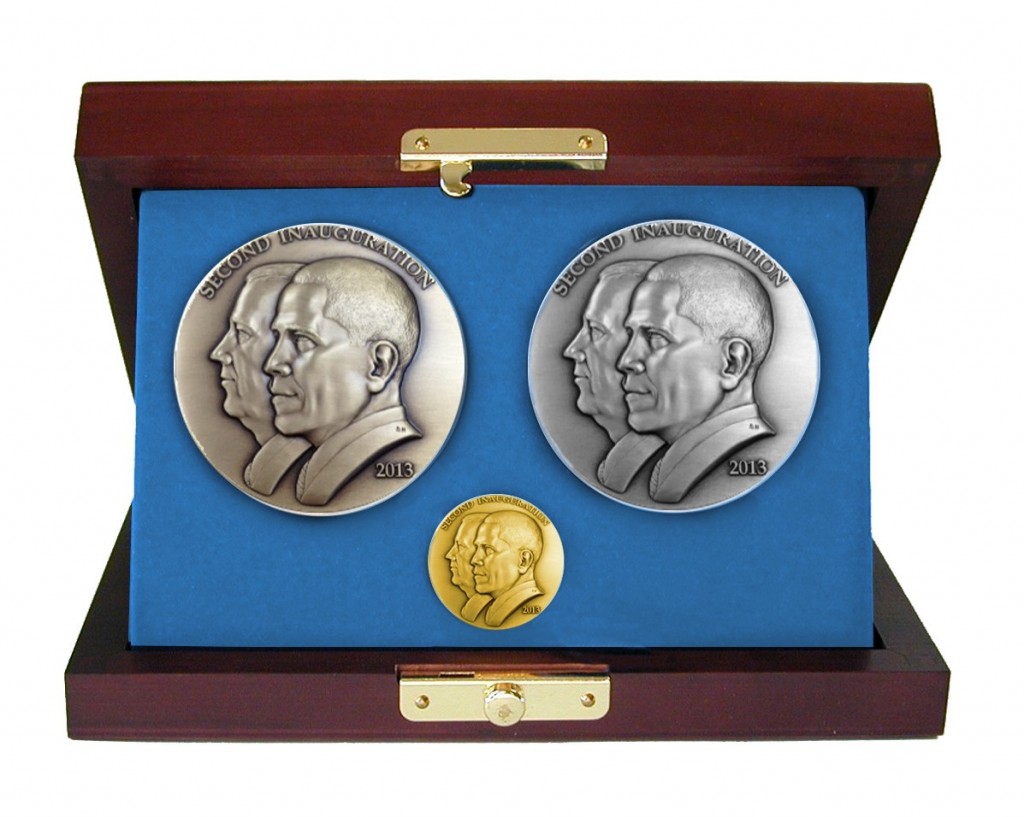
Barack Obama Second Term Inaugural Medal Set (L to R: bonze, gold, silver)
Credits
- Inaugural Medal images courtesy of Presidential Inaugural Committee 2013.
- Washington Inauguration at Federal Hall image courtesy of the New York Public Library.
- Coin images courtesy of the U.S. Mint.
- Photograph of James Buchanan Inauguration courtesy of Wikimedia Commons.
Dec 27, 2012 | base metals, BEP, bicentennial, bullion, coins, commemorative, copper, currency, dollar, Euro, Federal Reserve, First Spouse, gold, halves, legislative, nclt, news, nickels, policy, silver, US Mint
We end numismatic 2012 almost the same way as we began, discussing what to do about the one-dollar coins. The over production lead to a quite a number of bills introduced in congress to try to fix the perceived problem but none ever made it to a hearing, let alone out of a hearing. Rather, the U.S. Mint hired Current Technologies Corp. (CTC) to perform an alternative metals study required by congress.
When the U.S. Mint finally published the report and a summary they made a recommendation to study the problems further because they could not find suitable alternatives to the current alloys used. While reading the summary gives the impression that the request is reasonable, the full 400-page report describes the extensive testing and analysis that the U.S. Mint and CTC performed leaving the reader curious as to why they were unable to come to some sort of conclusion—except that there is no “perfect” solution. This is a story that will continue into 2013 and be on the agenda for the 113th congress when it is seated on January 3, 2013.
The other part of the discussion is whether or not to end the production of the one-dollar Federal Reserve Note. It was the last hearing before the House Financial Services subcommittee on Domestic Monetary Policy and Technology for Rep. Ron Paul (R-TX) and the 112th congress that will certainly carry over into 2013.
This does not mean the Bureau of Engraving and Printing is without its controversy. In order to comply with the court order as part of American Council for the Blind v. Paulson (No. 07-5063; D.C. Cir. May 20, 2008 [PDF]) and the subsequent injunction (No. 02-0864 (JR); D.C. Cir. October 3, 2008 [PDF]), the BEP has been working to provide “Meaningful Access” to United States currency.
Secretary of the Treasury Timothy F. Geithner approved the methods that will be used to assist the blind and visually impaired to U.S. currency on May 31, 2011. In addition to examining tactile features, high contrast printing, and currency readers, the BEP issued a Request for Information for additional information to implement their plan. The BEP will be participating at stakeholder organization meetings to socialize and refine their plans. There will probably be few announcements before the conventions of the National Federation of the Blind and American Council of the Blind this summer.

Another building controversy from the BEP is whether the redesigned $100 notes will find its way into circulation. Introduced in April 2010, full production has been delayed because of folding during the printing process. The situation has to be so severe that the BEP has not announced a new release date and delayed releasing the 2011 CFO Report [PDF] to the end of Fiscal Year 2012 while finding a way to bury the scope and costs of the delays. Will the redesigned $100 Federal Reserve Note be issued in 2013? Stay tuned!
Staying with currency issues, there should be a new series of notes when a new Secretary of the Treasury is appointed. It is known that the current Secretary Timothy F. Geithner wants to pursue other options. If the BEP follows its past practice, notes with the new Secretary of the Treasury’s signature would be Series 2009A notes. There have been no reports as to whether Treasurer Rosie Rios will continue in her position.
As for other products, the BEP will continue to issue specially packaged notes using serial numbers that are either lucky numbers (i.e., “777”) or ones that begin with “2013” as part of their premium products. Of course they will continue to issue their sets of uncut currency.
Another carry over from 2012 will be whether the U.S. Mint will issue palladium coins that were authorized by the American Eagle Palladium Bullion Coin Act of 2010 (Public Law No: 111-303 [Text] [PDF]). The law requires that the U.S. Mint study of the viability of issuing palladium bullion coins under the Act. That report was due to congress on December 14, 2012 but has not been made public at this time.

Bibiana Boerio was nominated to be the Director of the U.S. Mint.
Other than the higher prices for silver products, the U.S. Mint should not generate controversies for its 2013 coin offerings. There will be no changes for the cent, nickel, dime, and half dollar with the half dollar only being struck for collectors since it has not been needed for circulation since 2002. These coins will be seen in uncirculated and proof sets with silver versions for the silver sets.
For the sets with the changing designs, the reverse of the 2013 America the Beautiful Quarters Program will honor:
There has been no confirmation from the U.S. Mint whether they will strike San Francisco “S” Mint quarters for the collector community as they did in 2012.
The 2013 Presidential $1 Coins ends the 19th century and begins the 20th century with some of the more interesting Presidents of the United States in history:
If we honor the Presidents we have to honor their spouses. In 2013, the First Spouse Gold Coins will honor:
- Ida McKinley
- Edith Roosevelt
- Helen Taft
- Ellen Wilson (died 1914)
- Edith Wilson (married Woodrow Wilson 1915)
The U.S. Mint has not released designs for these coins at the time of this writing.
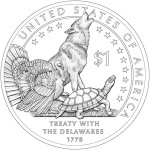
2013 Native American Dollar Reverse Design
Congress has authorized two commemorative coin programs for 2013:
American Eagle coin programs will continue with the bullion, collector uncirculated, and proof coins for both the silver and gold. The American Eagle Platinum bullion coin will continue to use its regular reverse while the American Eagle Platinum Proof will continue with the Preamble Series. The Preamble Series is a six year program to commemorate the core concepts of the American democracy as outline in the preamble of the U.S. constitution. For 2013, the reverse will be emblematic of the principle “To Promote the General Welfare.” The U.S. Mint has not issued a design at this time.
Currently, there are no announced special products or sets using American Eagle coins and no announced plan for special strikings such as reverse proofs or “S” mint marks.
Finally, we cannot forget the American Buffalo 24-Karat Gold Coins that will be available as an uncirculated coin for the bullion/investor market and a proof coin for collectors.
And I bet you thought that 2013 would be a mundane numismatic year!
Dec 20, 2012 | ANA, commentary, legal, news
 We knew it was coming. The American Numismatic Association issued a press release saying that they are being sued by former Executive Director Larry Shepherd.
“There is no merit to any of the allegations contained in the lawsuit, and it will be vigorously defended,” read the press release. “he ANA will make no further comment with regard to this pending litigation.”
This saga started on August 23, 2011 when the ANA announced that Shepherd was placed on administrative leave. After a month of speculation on why the ANA took this action, it was announced on September 28, 2011 that the ANA had “ended its employment arrangement with Larry Shepherd, as executive director, effective as of September 20, 2011. the vote of the Board to sever that relationship was unanimous.”
Obviously, Shepherd did not take it well and issued a statement about his firing when the ANA responded but should not have. All has been quiet until a the Shepherd filed suit for wrongful termination.
This will make two dismissed executive directors who have sued the ANA. Even if the ANA wins their argument, the ANA loses because of the costs to defend itself. Just as the ANA was getting its financial footing back together, here is a potentially large, unexpected expense that has to be dealt with.
If the “third time’s a charm,” then the ANA has done well by hiring Jeff Shevlin. After meeting Jeff, I believe he really has the best interest of the ANA at heart and will do a great job.
Dec 9, 2012 | BEP, coins, dollar, Federal Reserve, legislative, news, US Mint
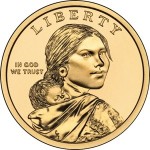
Obverse of the 2009-present Native American Dollar
Let’s look at the drivel about eliminating the dollar coins:
Replacing the dollar bill with a coin will not save money.
A summary of these arguments could be read on the Wonk Blog at The Washington Post. As I read the argument against, there is a lot of phrases with qualifiers like “if” and “may” that does not provide a solid feeling of deep analysis.
The bottom line is that for every dollar coin the U.S. Mint strikes, the government collects 72½ cents per coin. On the other hand, the Bureau of Engraving and Printing prints each note for around 8 cents per note but does not charge the Federal Reserve $1 for each note. By cost, the U.S. government makes more on seigniorage for the coin than the currency.
Converting to coins from the paper currency will cost the Fed more to purchase the dollar coin over printing currency. However, the Fed is not a government agency and does not use taxpayer money for its operations. It uses money earned off of its banking operations and turns over a percentage of its profits to the United States Treasury. While this will lower the amount of profit, it will be made up by the additional seigniorage.
People have not forgotten the Susan B. Anthony dollar coin… failed to wean Americans from the dollar bill because it looked too much like a quarter.
When I read this in an editorial from my hometown The New York Times, I scratched my head and wondered what happened to The Old Grey Lady. What used to be a forward thinking newspaper sounds like the elderly neighbor chewing his gums yelling at you to “get off my lawn.” What The Times forgot is that following the problems the design of the Susie B’s caused, congress authorized changes to prevent those issues from reoccurring by changing the coin’s color and using a smooth edge rather than a reeded edge.
I challenge The Times editorial board to handle a quarter and a post-2000 dollar while reconsidering their misguided editorial.
Why worry about the dollar because more people are using credit cards
A story in Bloomberg points out the savings may be limited because of the reduced number of dollar notes being produced. The writer credits the increased use of credit cards as a reason. However, reports show that consumer credit card debt has gone down every month since October 2008 until the first rise in October 2012.
The record shows that Americans have used their credit cards less and the use of cash has increased until these last few months while the Bureau of Economic Analysis reports wages have increased modestly during the slow recovery. In other words, the Bloomberg report does not hold up against facts.
It will not save the government money because it is a transfer costs.
Once again, some “analyst” at National Public Radio over thinks the issue with wrong data. NPR’s Jacob Goldstein writes that it is not a cost savings to the government because of shift from the production by the Bureau of Engraving and Printing to the U.S. Mint. However, his conclusion is based on the assumption that the seigniorage is the same for printing the note as it is for striking the coin. It is not, as we discussed earlier.
A better way to save money is by eliminating 1-cent coins entirely.
An interesting thing happens when the government tries to tackle an issue is that you get alleged pundits like Mike Rosen making irrelevant arguments based on an tangential premiss. The reason why Rosen’s writing is inconsequential is that the discussion is replacing one form of a dollar for another not eliminating a denomination. If the time comes to discuss the elimination of a denomination, then we can learn from the 1856 discussion that lead to the elimination of the half-cent. Otherwise, trying to justify eliminating a denomination using the discussion to replace the representation of another is an exercise in twisted logic.
That fancy money clip you inherited from your grandfather would be useless.
From Boston, Jon Keller writes that it is not culturally possible to change from notes to coins. Keller is indicative of alleged analysts who are thinking with their head up the past and not providing anything but his emotional reasoning for not making the change.
This goes along with the arguments that Americans do not want to change that will put more change in their pocket. These people say that Americans do not want the coin and will resist this move. But if you look at reality, Americans are all about change. In the last 50 years we gave up our silver coinage, went from muscle cars to more fuel efficient cars, brought in and (thankfully) dumped disco, changed the Lincoln cent from copper to copper-plated zinc, handled the end of the Cold War while ushering in the era of terrorism, and adapted to life post 9/11/01. There have been floods, droughts, hurricanes, tornadoes, mega-storms, and earthquakes that has show the resiliency of the American people. To ask Americans to adapt to using coins instead of notes is a pittance compared to everything else.
Take away our dollar bills, and our assault rifles will be next.
I do not believe in conspiracy theories but there some who are not afraid to spout this insolence. It is an argument based on false equivalency based on being unaware of the legal mechanisms of how the government works.
If anyone has a real reason based on documented fact to support saving the paper dollar for the coin, I welcome their argument below.
Nov 29, 2012 | coins, commentary, dollar, legislative, news, RCM, US Mint
Starting with a blog post on the Wall Street Journal website, the interwebs were all a twitter about the a testimony statement published in advance of the “The Future of Money: Dollars and Sense” hearing before the House of Representatives Subcommittee on Domestic Monetary Policy and Technology November 29, 2012.
The testimony is by Lorelei St. James, Director, Physical Infrastructure Issues of the non-partisan Government Accountability Office. The testimony report, “Benefits and Considerations for Replacing the $1 Note with a $1 Coin,” reiterates the six previous GAO reports claiming large savings by replacing the paper dollar with a coin. This is not a new stance by the GAO. They have issued six reports since 1990 making the same recommendation with the last report (GAO-12-307) released on February 15, 2012—something I wrote about here.
Rather than concentrating on the redux of the GAO’s statements, the media missed the advance statement from Beverley Lepin, Chief Operating officer of the Royal Canadian Mint. In her testimony, Lepin will point out how the RCM changed alloys twice, has a coin recycling program, added color, and has anti-counterfeiting technology for their one-dollar (Loonie) and two-dollar (Toonie) coins.
Basically, Lepin is saying something only whispered by some: the Royal Canadian Mint is more advanced than the U.S. Mint.
But the problem is not the U.S. Mint’s fault. When it come to running their operation like a business, the RCM has a real business structure that works with the the Bank of Canada and the Parliament of Canada to ensure that their money supply is modern and more efficient. Neither Canada’s parliament nor the Bank of Canada micro-manages the RCM’s operations the way congress micro-manages the U.S. Mint.
I know that Article I, Section 8 of the United States Constitution says that “The Congress shall have Power… To coin Money, regulate the Value thereof, …” but it does not say that congress shall have the power to micro-manage the U.S. Mint to the point where it is running using rules that have been made as long as 220 year ago. Maybe it is time to learn the real lessons from the RCM and modernize the structure of the U.S. Mint.
Before some strict constitutionalist or ardent supporter of congress accuse me of trying to usurp congress’s powers, let me remind you that Article I, Section 8 also grants congress the power “To establish Post Offices and post Roads.” The last time I looked, the United States Postal Service is an independent organization that establishes and closes post offices and it has been over 50 years since the last time a “post Road” has been built.
I do not expect anything to happen as a result of this hearing except for verbal fireworks from the politicians, overly excited sound-bites from the cable news talking heads, and incorrect information from the print media—which we will correct here, of course. I will just sit back and enjoy the show of the last hearing of this type held by a Ron Paul-lead subcommittee.
GAO Reports
The following is a list of the reports and testimonies from the Government Accountability Office about replacing the one-dollar note with a one-dollar coin:
- National Coinage Proposals: Limited Public Demand for New Dollar Coin or Elimination of Pennies, GAO/GGD-90-88, May 23, 1990
- 1-Dollar Coin: Reintroduction Could Save Millions If Properly Managed, GAO/GGD-93-56, March 11, 1993
- Dollar Coin Could Save Millions, GAO/T-GGD-95-203, July 13, 1995
- Financial Impact of Issuing the New $1 Coin, GAO/GGD-00-111R, April 7, 2000
- U.S. Coins: Replacing the $1 Note with a $1 Coin Would Provide a Financial Benefit to the Government, GAO-11-281, March 4, 2011
- U.S. Coins: Alternate Scenarios Suggest Different Benefits and Losses from Replacing the $1 Note with a $1 Coin), GAO-12-307, February 15, 2012
- U.S. Coins: Benefits and Considerations for Replacing the $1 Note with a $1 Coin, GAO-13-164T, November 29, 2012
Oct 11, 2012 | Baltimore, coins, commemorative, news, US Mint
On the heels of their success in the London 2012 Olympic Games, Michael Phelps and other Olympic athletes from Maryland including Katie Ledecky of Bethesda and Suzanne Stettinius of Parkton were presented with a Star-Spangled Banner Commemorative Coin at a celebration held on Monday, September 10, 2012 at Baltimore’s Inner Harbor.
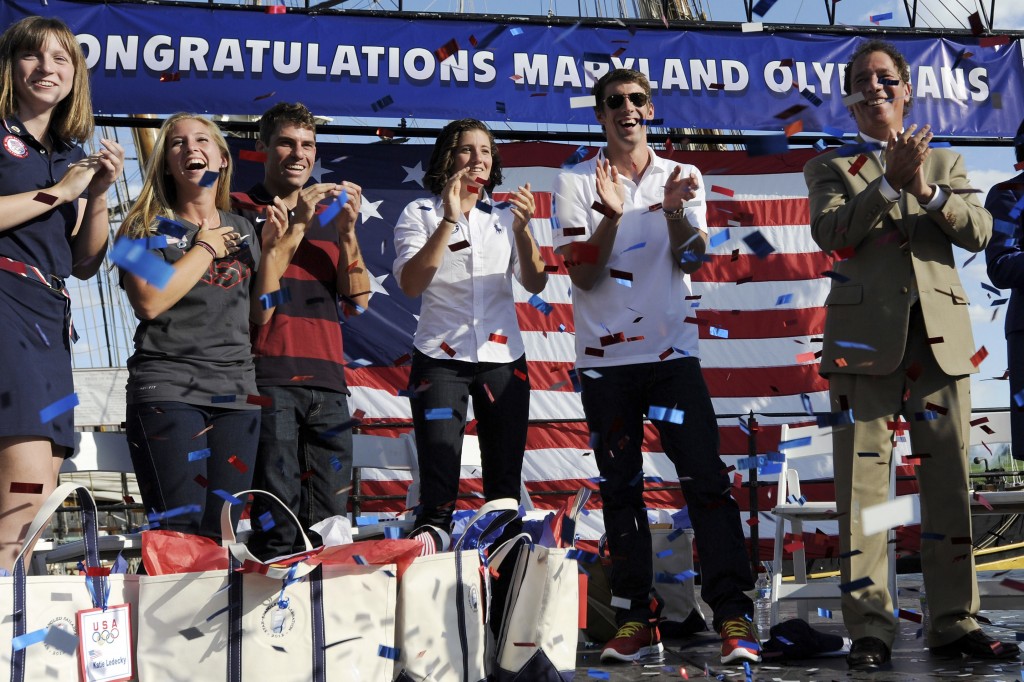
Michael Phelps, second from right, joins other Olympic athletes from Maryland, including Katie Ledecky, left, windsurfer Farrah Hall, second from left, and Suzanne Stettinius, third from right, and Baltimore County Executive Kevin Kamenetz, right, during a celebration of the achievements of Maryland Olympians. (Steve Ruark/AP Photo)

Olympian Michael Phelps shows his Star-Spangled spirit and receives a new piece of “metal” from Maryland Governor Martin O’Malley.
“Our Maryland Olympians’ resolve to work hard, train and excel embodies the spirit of our state,” said Gov. Martin O’Malley. “It’s only fitting that we honor them with these 2012 Star-Spangled Banner Commemorative Coins, which pay tribute to Maryland’s vibrant people and extraordinary history.”
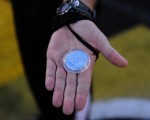
Star-Spangled Banner Commemorative held by the referee that was used at the Ravens-Browns game on September 10, 2012.
“As we celebrate a variety of sports on Monday, the Star-Spangled Banner Commemorative Coin will serve as a symbol to our local athletes of Maryland’s historic tie in defending our freedom during the War of 1812,” said Ann Beegle, executive director of Star-Spangled 200 Inc., the non-profit affiliate of the Maryland War of 1812 Bicentennial Commission prior to the game. “Baltimore is home to the Star-Spangled Banner and we are pleased to recognize these athletes’ dedication with a historic symbol of our state.”
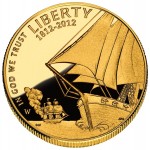
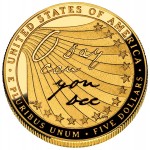
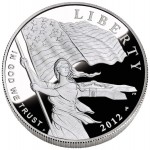
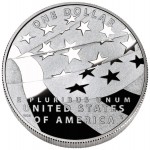
The 2012 Star-Spangled Banner Commemorative Coins, created in honor of the bicentennial of the War of 1812, exemplify the Star-Spangled Banner flag and Francis Scott Key’s poem, “The Defence of Fort McHenry” that became our national anthem. These are two of America’s most enduring icons. Coin sales will continue through December 17 and are only available through the United States Mint. The Star-Spangled Banner Commemorative coins can be purchased through the United States Mint website, at United States Mint kiosks in Washington, DC (Union Station, 50 Massachusetts Ave. NE and United States Mint Sales Counter, 801 9th Street NW) and at the Baltimore Visitor Center located at 401 Light Street, Baltimore, MD 21202.
Proceeds from the sales ($35 for each gold coin and $10 for each silver coin) to support the Maryland War of 1812 Bicentennial Commission. The commission will use these funds to support its bicentennial activities, educational outreach, and preservation and improvement of the sites and structures related to the War of 1812. Help support the commission’s activities by purchasing a commemorative coin today!
Scott’s coin:
Credits
- AP photo courtesy of reachforthewall.com.
- O’Malley/Phelps and Referee Coin images are courtesy of Star-Spangled 200, Inc.
- Coin images courtesy of the U.S. Mint.
- Image of Scott’s coin is owned by the author and covered under CC BY-NC-ND 3.0 license.
Sep 21, 2012 | news, US Mint

Bibiana Boerio as Managing Director of Jaguar, was appointed by President Obama to be the Director of the U.S. Mint.
Boerio is currently Special Advisor to the President of the Detroit Regional Chamber of Commerce. Prior to working with the Detroit Regional Chamber, Boerio was Chief of Staff to Congressman Joe Sestak (D-PA).
For the 31 years prior to her entry into politics, Boerio worked for Ford in corporate finance where she became the Chief Financial Officer of Ford Motor Credit in 2000. In 2004, Boerio was named Managing Director of Jaguar Cars Ltd., then a subsidiary of Ford.
Boerio, who is a native of Latrobe, Pennsylvania, earned a Bachelor of Science from Seton Hall University and an Master of Business Administration from the University of Pittsburgh.
Boerio succeeds Edmund Moy who resigned in January 2011. Since Moy’s departure, Deputy Director Richard Peterson has been capably running the world’s largest coin manufacturing agency. If Boerio is confirmed, Peterson will return to being the full time Deputy Director.
Moy announced his resignation in December 2010 and left in early January 2011. For 21 months the U.S. Mint has been without a permanent director. With a little more than a month to go until the election and the results in doubt, it is curious as to why this appointment was made now. It is doubtful the Senate will take up this nomination before adjourning next week to allow members to return to their states to campaign.
Image courtesy of the Pittsburgh Post-Gazette
Sep 5, 2012 | advice, gold, investment, news
Gold Buyers Beware: Experts Caution Coated Tribute Coins Are Not “Gold Coins”
 PNG Press Release: Temecula, California—With the price of gold recently increasing, people who want to invest in the precious metal should be cautious about the potential investment value of gold-plated “tribute coins,” according to the Professional Numismatists Guild (www.PNGdealers.com), a nonprofit organization composed of many of the country’s top rare coin and currency dealers.
Frequently advertised on television, the tribute items are replicas of popular United States Mint gold bullion coins, but are privately produced and often contain only a tiny amount of gold.
“These tribute replicas may be fine souvenirs and mementos as inexpensive medallions, but should not be considered an actual precious metal investment because they have only a razor-thin coating of gold and virtually no secondary market value as gold. They’re also not a United States Mint product, so they’re not even U.S. legal tender coins even though their designs may be similar to actual U.S. coins,” cautioned Jeffrey Bernberg, PNG President.
“Some of the look-alike tribute ‘coins’ are advertised as containing 14 milligrams (mgs) of 24 karat gold. That equals a minuscule .00045 troy ounce of gold; less than one-thousandth of an ounce. So, if the price of gold is at $1,690 an ounce, then 14 milligrams would be equal to only about 76 cents worth of gold,” he explained.
The Professional Numismatists Guild was founded in 1955. PNG members must adhere to a Code of Ethics that prohibits use of high pressure sales tactics and misrepresentation of the value of items being sold. PNG members also must demonstrate knowledge, responsibility and integrity in their business dealings, and must agree to binding arbitration to settle unresolved disagreements over numismatic property. A complete list of PNG member-dealers can be found online at www.PNGdealers.com.
For a copy of the informative pamphlet, “What You Should Know Before You Buy Rare Coins,” or a printed directory of PNG member-dealers, send $1 to cover postage costs to: Robert Brueggeman, PNG Executive Director, 28441 Rancho California Rd., Suite 106, Temecula, CA 92590. Phone: (951) 587-8300. Email at info@PNGdealers.com, or visit the web site at www.PNGdealers.com.





 Loading ...