Sep 29, 2016 | charity, Federal Reserve, news, US Mint, YN

Mrs. Janas of Juniata Park Academy in
Philadelphia, PA (Grades 6-8)
The project can be funded for a paltry sum of $512.92. With the donations matched by the Dottie Lutz Foundation, we can send underprivileged students to visit the Mint and the Fed for $256.46!
As I said in my original post, maybe a few would become interested in numismatics. Seeing the exhibits and learning how money is made can inspire these children to become collectors. And as inner-city students in a minority community, adding this diversity to the hobby is one of the best gifts we can give the hobby.
There is ONE MONTH to go on this project.
Previously, I asked to see if nine readers of the Coin Collectors Blog would step in with a $25.00 donation. Thankfully, it appears that only one person did step up. This effort now needs $413.00 to be funded meaning it will take is $206.50 in donations for this to be funded!
I am asking for everyone to
give any amount to fund this project.
It would be wonderful if the numismatic community stepped up to help fund the visits to the Mint and Fed for these students. Let’s see if we can influence some students to become numismatists.
Will you please join me?
Sep 25, 2016 | charity, commemorative, medals
 Toys for Tots is a charitable organization founded in 1947 by Major Bill Hendricks, a U.S. Marine Corps Reserve officer. MAJ Hendricks was inspired by his wife who wanted to donate a homemade Raggedy Ann doll to a needy child in the Los Angeles are but could not find an organization that could help. He organized other reservists and collected 5,000 toys to distribute in the Los Angeles area during the Christmas season.
Although Toys for Tots has been only accepting new toys since 1980 because of the time to process used toys, every year the organization collects millions of toys to make Christmas brighter for children who would not otherwise receive toys. It is consistently rated one of the top charities in many different rankings and can boast one of the largest program to support services ratio. In 2015, Toys for Tots reported that only 3-percent of their monetary donations were used for administrative and support services.
Charities are trying to survive as donations have fallen since the Great Recession of 2008. Their balance sheets are getting better but many have not recovered to pre-recession levels. When they mail their letters asking for donation, most charities have added “prizes” to their request in order to get your attention. Some of the usual gimmicks have been address labels, stamps to mail back the donation, and some have added a nickel to the response form asking that it be returned with the donation. I have also received a lot of stickers and religious-based charms.
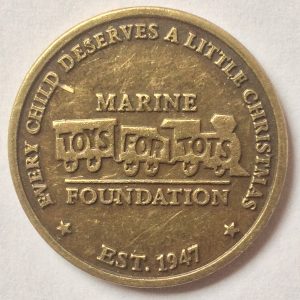
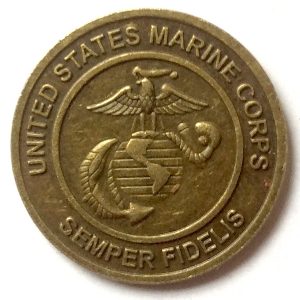
As a supporter of Toys for Tots, I recently received a request for donation. Rather than having any of the usual gimmicks a medal was attached to the request. Not an ordinary medal but a bronze medal for the Toys for Tots program. The 26mm medal (a quarter is 24.26mm) features the Toys for Tots logo on one side and the U.S. Marine Corps logo on the other. The 2mm thin (a quarter is 1.75mm) medal has an antiqued finish.
-
-
Tots for Tots Challenge Coin
-
-
Tots for Tots Challenge Coin with Marine Corps Logo
A tradition of military organizations is the presenting of challenge coins. They are part of military tradition that started during World War I when Ivy League students went to war and created these coins as an act of camaraderie. Typically, a challenge coin is a small medal, usually no larger than 2-inches in diameter, with the insignia or emblem of the organization. Two-sided challenge coins may have the emblem of the service on the front and the back has the emblem of the division or other representative service. Challenge coins are traditionally given by a commander in recognition of special achievement or can be exchange as recognition for visiting an organization.
While the size of this Toys for Tots medal is smaller than the typical challenge coin, it can be considered a challenge coin. A challenge coin given by the Marine Foundation to their donors in recognition of the support of the organization.
I appreciate the recognition from the Marine Foundation and will continue to be a supporter for the Toys for Tots program.
Sep 22, 2016 | copper, history, markets, tokens
Have you noticed that every election “is the most important in our history?” Or that “you have no clearer choice” than whatever any of the candidates are selling? There are so many clichés that it would require its own blog post.
But what does that have to do with numismatics?
Long-Stanton Manufacturing Company was founded in 1862 by John Stanton to make copper tokens that were used by merchants in the Cincinnati area when money was in short supply during the Civil War. Before starting his company, Stanton owned a company that provided the illustrations and dies that were used to make advertising tokens for the 1860 election.
The Election of 1860 preceded the outbreak of the Civil War. It featured fractured party nominees arguing over the future of the union. The Republican Party, formed out of the ashes of the Whig Party, nominated former representative from Illinois Abraham Lincoln. The Democratic Party nominated Illinois Senator Stephen A. Douglas. But the Democrats were split along the issue of slavery. Pro-slavery southern Democrats formed their own party and nominated then Vice President John C. Breckinridge from Kentucky. A few other candidates were nominated but these were the three that were the focus of the election.
One thing that is considered a highlight of this campaign were the famous debates between Abraham Lincoln and Stephen Douglas. The main theme of the seven debates was slavery. Primarily, Lincoln was anti-slavery and maintaining the union. Douglas was not pro-slavery but favored new territories to choose their own paths. Lincoln argued in his “House Divided” speech that Douglas wanted to nationalize slavery. This came following Douglas’s sponsoring of the Kansas-Nebraska Act that repealed the ban on slavery in the new territories passed as part of the Missouri Compromise.
Although the use of language was more refined in 1858, the issues were just as divisive.
Seven debates were not enough for the public. Manufacturers, such as the one that Stanton provided illustration and die making services for, struck tokens for the candidates and their supporters to give away to gain support. Lincoln won the Election of 1860 with a majority of the electoral votes carrying 18 of 33 states while gaining only 39.8-percent of the popular vote.
Some say the election of 2016 is the most divided in our history. If we do not count the Election of 1824 in which nobody received a majority of electoral votes and the results had to be decided by the House of Representatives, it could be one of the more contentious election since the 1976 Carter-Ford race.
The folks at Long-Stanton thinks there is an indecision in this election, although the polls show that the country is about evenly split. They think to celebrate the 156 years since John Stanton created his tokens the company created their Indecision 2016 token.
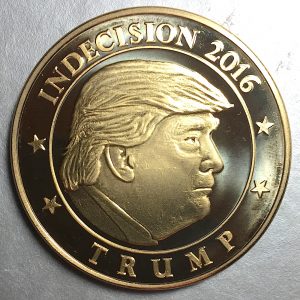
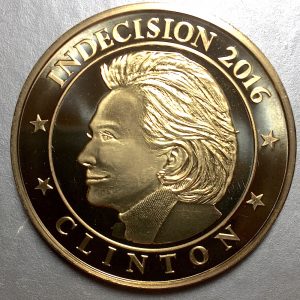
Indecision 2016 token is 39mm and made of brass. Portraits of each of the candidates are on either side. If you are undecided, you can flip the token to choose who you will vote for.
Unfortunately, the portraits barely represent the candidates. While the TRUMP side of the token is passible the CLINTON side would not be recognizable if it was not marked. While I do not consider either candidate physically attractive these portraits are worse.
Since it is expensive to produce tokens and medals to just give away, the tradition of striking these types of pocket pieces are no longer part of the campaign. If you have ever read Warman’s Political Collectibles: Identification and Price Guide, you would see all the interesting trinkets that would be produced in support of the candidates. Nowadays, those who collect political memorabilia would be hard pressed to find something more than a button or lapel pin.
Having received the Brexit token, I decided to purchase one of the Long-Stanton Indecision 2016 tokens for my collection. Although the token looks better in hand since it has a proof-like strike, a close-up view of the portraits are about as bad as the images on Long-Stanton’s website. For $8.95 for a single token, including shipping, it is not a bad deal. They do offer discounts for buying more than a few.
-
-
Long-Stanton Indecision 2016 Token – Donald Trump side
-
-
Long-Stanton Indecision 2016 Token – Hillary Clinton side
Included in the package was an aluminum token from Long-Stanton that is “GOOD FOR 50 IN MERCHANDISE.” It does not identify the exact value of 50 whether it means cents or dollars, but it does not matter since it is unlikely to be redeemed from my collection. At 31mm it is smaller than the Indecision 2016 token but it is a throwback to times when tokens were created for store credit before paper coupons became ubiquitous.
-
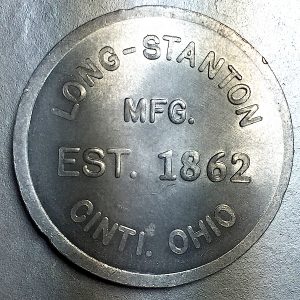
-
Aluminum Long-Stanton Manufacturing Token
-
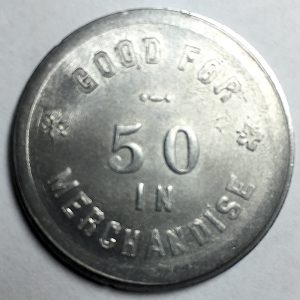
-
Aluminum Long-Stanton Manufacturing Token reverse offering “50 IN MERCHANDISE”
Rather than go with my numismatic collection, this token will go along with a small collection I have of political memorabilia. It will join other numismatic-related items that are related to my favorite president Teddy Roosevelt. I hope he is not insulted by either of these candidates. Somehow, I think T.R., George Washington, Thomas Jefferson and Abraham Lincoln might not be happy if they were around today.
Sep 19, 2016 | ancient, coins, legal, policy
 Here we go again… the government want to take your ancient coins away from you.
This is different from other conspiracy theories because since there is no mechanism for them. Here, foreign governments are working in collusion with the United States Department of State Cultural Property Advisory Committee (CPAC). The problem with CPAC is that it is not a real committee. They are largely a rubber-stamp part of the State Department’s Bureau of Educational and Cultural Affairs kowtowing to any foreign government who feels that items found in their country have been stolen from regardless of the evidence. This includes common ancient coins or coins that were removed from circulation long before the existence of the 1970 UNESCO Convention that created this situation.
If you want to read a more extensive discussion on the problems facing collectors of ancient coins, read my post “An ancient dilemma” from 2014.
The information comes from the Ancient Coin Collectors Guild (ACCG). Even if you are not a collector of ancient coins you should appreciate that the problems with governments wanting to stop your hobby. If they go after the ancients, what is to prevent these countries from trying to recall obsolete money? We need to support the ACCG and the community to prevent overreach by foreign governments and a committee who does not care what the coin collectors think.
Here’s the current issue as outlined by ACCG Executive Director Peter Tompa
Dear Fellow ACCG Member:
The State Department’s Bureau of Educational and Cultural Affairs and its Cultural Heritage Center have announced a comment period for a proposed extension of a Memorandum of Understanding (MOU) with Cyprus. See https://www.federalregister.gov/articles/2016/08/10/2016-19018/notice-of-meeting-of-the-cultural-property-advisory-committee
The U.S. Cultural Property Advisory Committee will review these comments and make recommendations based upon them with regard to any extension of the current agreement with Cyprus.
According to U.S. Customs’ interpretation of the governing statute, import restrictions authorized by this MOU currently bar entry into the United States of the following coin types unless they are accompanied with documentation establishing that they were out of Cyprus as of the date of the restrictions, July 16, 2007:
1. Issues of the ancient kingdoms of Amathus, Kition, Kourion, Idalion, Lapethos, Marion, Paphos, Soli, and Salamis dating from the end of the 6th century B.C. to 332 B.C.
2. Issues of the Hellenistic period, such as those of Paphos, Salamis, and Kition from 332 B.C. to c. 30 B.C. (including coins of Alexander the Great, Ptolemy, and his Dynasty)
3. Provincial and local issues of the Roman period from c. 30 B.C. to 235 A.D.
You may ask, why bother to comment—when Jay Kislak, CPAC’s Chairman at the time, has stated that the State Department rejected CPAC’s recommendations against import restrictions on Cypriot coins back in 2007 and then misled both Congress and the public about its actions? And isn’t it also true that although the vast majority of public comments recorded have been squarely against import restrictions, the State Department and U.S. Customs have imposed import restrictions on coins anyway, most recently on ancient coins from Bulgaria?
Simply because, our silence allows the State Department bureaucrats and their allies in the archaeological establishment to claim that collectors have acquiesced to broad restrictions on their ability to import common ancient coins that are widely available worldwide. And, of course, acquiescence is all that may be needed to justify going back and imposing import restrictions on more recent coins that are still exempt from these regulations.
Under the circumstances, please take 5 minutes and tell CPAC, the State Department bureaucrats and the archaeologists what you think.
How do I comment? Go to https://www.federalregister.gov/articles/2016/08/10/2016-19018/notice-of-meeting-of-the-cultural-property-advisory-committee to submit short comment just click on the green box on the upper right hand side of the above notice that says “submit a formal comment” and follow their directions.
If you are having trouble, go to the Federal eRulemaking Portal (http://www.regulations.gov), and enter Docket No. DOS-2016-0054 for Cyprus, and follow the prompts to submit comments. What should I say? The State Department bureaucracy has dictated that any public comments should relate solely to the following statutory criteria:
- Whether the cultural patrimony of Cyprus is in jeopardy from looting of its archaeological materials;
- Whether Cyprus has taken measures consistent with the 1970 UNESCO Convention to protect its cultural patrimony;
- Whether application of U.S. import restrictions, if applied in concert with similar restrictions by other art importing countries, would be of substantial benefit in deterring a serious situation of pillage and that less drastic remedies are not available;and,
- Whether the application of import restrictions is consistent with the general interest of the international community in the interchange of cultural property among nations for scientific, cultural, and educational purposes.
(See 19 U.S.C. § 2602 (a).) Yet, collectors can really only speak to what they know. So, tell them what you think within this broad framework. For instance, over time, import restrictions will certainly impact the American public’s ability to study and preserve historical coins and maintain people to people contacts with collectors abroad. (These particular restrictions have hurt the ability of Cypriot Americans to collect ancient coins of their own culture.) Yet, foreign collectors—including collectors in Cyprus—will be able to import coins as before. And, one can also remind CPAC that less drastic remedies, like regulating metal detectors or instituting reporting programs akin to the Treasure Act and Portable Antiquities Scheme, must be tried first. Finally, Cyprus is a member of the European Union, so why not allow legal exports of Cypriot coins from other EU countries?
Be forceful, but polite. We can and should disagree with what the State Department bureaucrats and their allies in the archaeological establishment are doing to our hobby, but we should endeavor to do so in an upstanding manner. Please submit comment just once, before the deadline on September 30, 2016.
Thank you for your help,
Peter,
Peter K. Tompa,
Executive Director
Ancient Coin Collectors Guild
Sep 16, 2016 | advice, coins, commentary, shows
A reader who found the Coin Collectors Blog through a search came across the two-part series I wrote in 2012 about “How Are Coins Priced” (links to Part I and Part II). After asking a few questions this new reader asked me about the section about Negotiating in Part II.
My principles of negotiating are to be nice, do your homework, know when to stop and always be gracious. Although some of us consider negotiating a sport, there is no reason to be nasty. Always say “please” and “thank you” even if you did not buy the coin. Thank that dealer for taking the time to talk with you. Good will can go a long way!
As a new collector, this reader visited a few regional shows before going to the World’s Fair of Money. Thinking that as a big show there might be some good finds and can jumpstart an interesting collection. While this was not my reader’s first large show, it was the first time the family visited the World’s Fair of Money. It was also an excuse to go visit Mickey’s first theme park.
With his permission I am reprinting his note. I removed the section that described the dealer and his inventory:
My family and I went to Anaheim for the World’s Fair of Money. As we searched the tables looking for something of everyone’s interest we came across a table with books of coins. While I have seen notebooks like this with pages full of coins this was the first time we have seen so many. Each of us sat at the dealer’s table and started to look through the books.
My son is interested in Middle Eastern coins because my family emigrated from the Middle East after World War II. My daughter is fascinated by Queen Elizabeth and want to try to collect different coins with her picture. My wife’s family is from Japan and she has been picking up some older Japanese coins. As for me, I decided to try to complete a set of quarters after collecting the states quarters.
We are collectors. We are not putting the kids in front of the books to keep them occupied. At one point my son, who is trying to learn Arabic, was asking me what a few coins said and picked out a small handful for his collection. Nobody else found anything they liked.
We finished five minutes later and went to pay. My son has his own money and asked the dealer for the price. If we go by the numbers written on the coins, the price was $42. While that does not sound like much it is for a kid whose job is to cut grass and do odd jobs around the neighborhood. No discount was offered.
Standing next to my son I asked if he could do better on the price and that’s where the trouble began. He turned to me and said, “For what, hogging my table?” I was taken aback! Not only were we really looking to buy but my son was buying. As a matter of fact when my wife did not see anything she like she gave up her chair to another collector passing by.
I sort of stammered something about that we are all collectors and were looking but did not find anything and he said, then he said something like, “Then you should have gone somewhere else!” He was very rough.
I asked my son what he wanted to do. It was his collection and his money. With nobody else around this dealer’s table he blurts out, “yeah, kid, I don’t have time for this. Give me 40 and go away.”
I could see that my son was conflicted. While he wanted the coins he did not like the dealer. He then dropped his head and said in a soft voice, “No Thank you.” Although he looked like he wanted to cry the dealer responded, “great, now I have to figure out what book to put these coins in.” My son reached over and tapped the book and walked away.
I have never been embarrassed for my son like this. Why would a dealer treat a child or a customer like this?
I had no answers for these parents. Even though I do not deal with coins, when I do shows I try to treat everyone with courtesy, even when I can tell they have no intention of buying from my inventory.
When I am working shows, as I will be this weekend, days can be long and difficult. You have to be attentive to everything around you not just to complete the sale but to also prevent theft. Even on the slowest day, it does not pay to get nasty with a customer or potential customer.
This is not the first time I have heard stories like this and based on this reader’s description, it is not the first time I have heard this type of story about the dealer. I know for some it is just a job and like many jobs, after a while there are aspects that can be frustrating.
But this is a job that is about customer service for a product people do not have to buy. Coin collecting is a luxury, not a necessity. Even if you are frustrated, showing it to customers will give you a reputation and hurt business. Then what will you do when the customers do not show up?
There comes a point in time when you have to ask yourself whether it is worth the investment in time, money, and your sanity to continue or would it be better to just retire? Unfortunately, when it comes to some of the very long-time numismatic dealers who attend some of these major shows, there are too many that should consider retirement.
Sep 12, 2016 | coins, commentary, grading
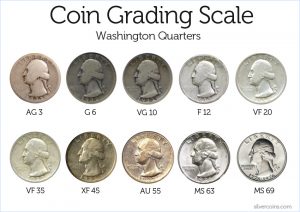 Over the last few years there have been many numismatic writers who have taken to their keyboards to complain about the state of coins grading. Aside from your intrepid blogger there was a series of articles that appeared in Coin World by Q. David Bowers. In his articles, Bowers notes that even though the American Numismatic Association grading standards have not changed in quite some time, coins in older holders usually are graded higher today than they were when originally graded.
One area where this is hurting the hobby is when trying to buy coins using online auctions. In a less than scientific study, I have noticed that while looking for a specific coin that coin once graded by the Professional Coin Grading Service in their old green holders (OGH) tend to sell at a price half-way to what it would be if it was the next grade higher. Coins in older Numismatic Guarantee Corporation holders sell close to a similar price.
It is not known how many coins are cracked out of their holders and submitted to the grading services are submitted as raw coins. Most of these “crack out artists” do not turn in the labels for the grading services to adjust their population reports. Some coins could be counted several times by all of the major grading services while collectors fish for better grades.
Part of the problem is with the concept called market grading. Rather than looking at the coin and determine the technical state of preservation, the grading services take that grade and try to rank it within the market of similar coins. In the mean time, they participate in forums that teach technical grading without explaining market grading.
Could there be a better way? On the CDN Publishing Blog is a post by Rick Snow suggesting a different type of grading system based on a 15-point technical scale. Coins would be graded on a 0-5 scale for the condition of the planchet, state of the die as struck, and the strike. In this notation there would be no “Full Bands,” “Full Head,” or similar designations. Those coins would receive a strike score of 5. If that Jefferson nickel does not show all six steps, then the strike would be a 4. A final column would be a color designator with either a percentage of color loss from the original strike or RD (red), RB (red-brown), or BN (brown) for copper coins.
Rather than seeing a grade like XF, AU, or MS and trying to figure out why the coin received the grade, a coin would receive a grade like:
“Adjectival grade” (“Qualifier”: “Factor for Planchet”, “Factor for Die”, “Factor for Strike”, “Color Designation”).
As an example: Gem AU (13: 4, 4, 5, 10%)
The “Qualifier” would be the sum of the factors for the planchet, die, and strike.
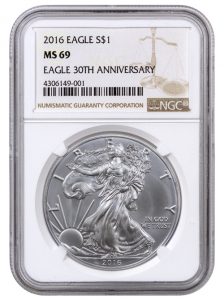
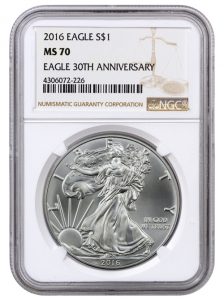
It is an interesting idea especially for the current bullion coins. Honestly, can anyone really tell the difference between an American Silver Eagle graded MS69 versus one graded MS70? Yet, just because a grading service can allegedly tell the difference, there could be a two-to-three times difference in the price. However, I wonder if those coins were cracked out of their holders and resubmitted would they maintain their grades?
Could you tell the difference if they were not in the holders?
-
-
2016 American Silver Eagle graded MS-69 by NGC
-
-
2016 American Silver Eagle graded MS-70 by NGC
Although the grading services claim that they are doing what is best for the hobby, they are for-profit corporations that has to satisfy a market that seems to be more interested in the plastic and the label than the coin it holds. Even these verification services are for-profit corporations that has owners and investors to answer to. One is even into “market making” by doing arbitrage-like trading of its own stickered coins. This type of market making questions their independence because it appears that they are using their influence to drive up the price of those coins.
Would this type of grading be better for the hobby by providing the collector with more information? Is there an alternative that would fix the current system? Or is the current system just fine? Read the article on the CDN Publishing Blog and leave comments there and/or here!
Sep 10, 2016 | coins, commentary, news, US Mint
 The U.S. Mint announced that they will hold a one-day forum to “share perspectives on the past, present, and future of the numismatic hobby.” It is part of their preparation for the U.S. Mint’s 225th anniversary in 2017. The agenda will be the future of the Mint and the numismatic environment as a whole.
“It seems only appropriate that, while we as a bureau are celebrating our history, the Mint is also looking for ways to improve the way we engage our customers and invigorate our relevance into the future,” said United States Mint Principal Deputy Director Rhett Jeppson.
It will be interesting to hear the discussion and to observe the outcome of this forum because of the limited things the U.S. Mint can do without an act of congress. Although the U.S. Mint can create medals without an act of congress many of the medals they produce are required by law such as the duplicates of the awards to congressional gold medal recipients. As for legal tender coins, most of what the U.S. Mint does is governed by legislation. Although there is some leeway in areas like special finishes for proof and other non-circulating legal tender (NCLT) coins, what the U.S. Mint is allowed to produce is governed by law (see 31 U.S. Code §5112).
One area that they U.S. Mint has had a lot of freedom is the with the 24-karat gold special issue coins. As part of the bill that created the Presidential $1 Coins, there was a section (31 U.S. Code §5112(q))) that allowed the U.S. Mint to string $50 gold bullion coins of .9999 purity (24-karat). The law says that only the first issue must resemble the 1913 Type 1 Buffalo Nickel. Subsequent designs are at the discretion of the Secretary of the Treasury with designs reviewed by the Citizens Coinage Advisory Committee and the U.S. Commission of Fine Arts.
Subsequently, the U.S. Mint used this law to issue the 2009 Saint-Gaudens Ultra High Relief Gold Coin, 2014 Kennedy Half Dollar 50th Anniversary Gold Coin, 2015 American Liberty High Relief Gold Coin, and the 2016 Centennial Gold Coins. Even though the coins are popular and their low mintage does help generate interest, these coins are not affordable to the ordinary collector.
One way to make these available to the average collector is to strike a version as a medal, similar to the First Spouse medals that resemble their gold counterparts without a denomination. First Spouse medals are struck on the same planchet as the modern dollar coins.
The U.S. Mint does not have the freedom other world mints have. It is highly regulated by a congress with a parochial view on its constitutional obligation to coin money (Article I, Section 8). Remember, the U.S. Constitution says that “The Congress shall have Power… To coin Money, regulate the Value thereof, and of foreign Coin,” not micro-manage the process.
From a collector’s perspective, I am not sure what the U.S. Mint can do. They can take notes and recommendations from this forum and ask congress to make changes. However, given the behavior of the members of congress does anyone really think that they will craft any reasonable legislation?
Shortly after the press release landed in my Inbox I responded to the U.S. Mint expressing my interest in attending.
Those interested in attending should submit requests to USMintNumismaticForum@usmint.treas.gov by no later than Sept. 15, 2016. Individual requests to attend should include the person’s affiliation (e.g., hobbyist, coin dealer, coin grader, etc.). Seating is limited and submitting a request does not guarantee admission. Attendance will be at the cost of the participant. Detailed information will be provided to confirmed attendees. For those unable to attend or who do not receive an invitation, any formal presentations made by the Mint during the forum will be made available online as soon as practicable after the event.
Sep 8, 2016 | cash, counterfeit, currency, news
One of the strangest set of stories about the problem of counterfeiting was the several stories that came out at the end of August about people trying to make purchases with movie prop money. This has caused regional U.S. Secret Service across the south to issue warnings.
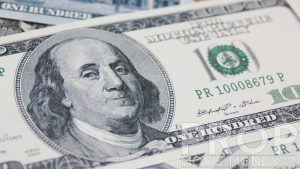
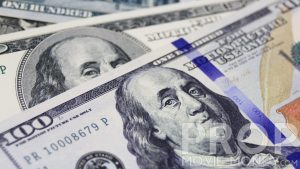
Prop movie money is designed to look close enough to real U.S. currency so that a moviegoer would not be able to tell the difference on screen. When these notes are examined closely, they are clearly marked with “THIS NOTE IS NOT LEGAL TENDER” and “FOR MOTION PICTURE USE ONLY.” Prop money is smaller than real U.S. currency and does not have the anti-counterfeiting features of a real Federal Reserve Note. But that has not stopped people from trying to pass these notes as real currency.
-
-
Prop Movie Money
-
-
Prop Movie Money
-
-
Prop Movie Money
Here is a sample of the reports about people trying to use prop money as real currency:
In Athens, Georgia, a 30 year-old man beat a customer with a baseball bat at a fast food restaurant when he alleged the customer bought marijuana using two prop $100 notes.
Police in the Gwinnett County, a suburb of Atlanta, are looking for two suspects who went on a spending spree by buying two cars and paying with prop money.
Prop money has shown up in Morristown, Tennessee, northwest of Knoxville.
U.S. Secret Service issued a warning in the Tampa Bay area when someone tried to buy a smartphone using prop money and noted that there has been an increase in the use of this currency.
Areas of East Texas have reported several cases in which prop money has been used. Texas Bank and Trust reported that they have seen a few of these notes were deposited into accounts at their bank.
Sources have not confirmed the source of this recent uptick in prop money usage but noted that the currency can be purchased online. Although eBay rules do not allow for this type of currency to be sold on its site, a recent search yielded several listings offering prop money. There is no restriction on Etsy where searches lead to over 300 listings of all types of prop or replica money.
Why was the criminal in the in the Dateline video attached to my post “How easy is it to pass counterfeit currency” so successful? Like he said, nobody pays attention!
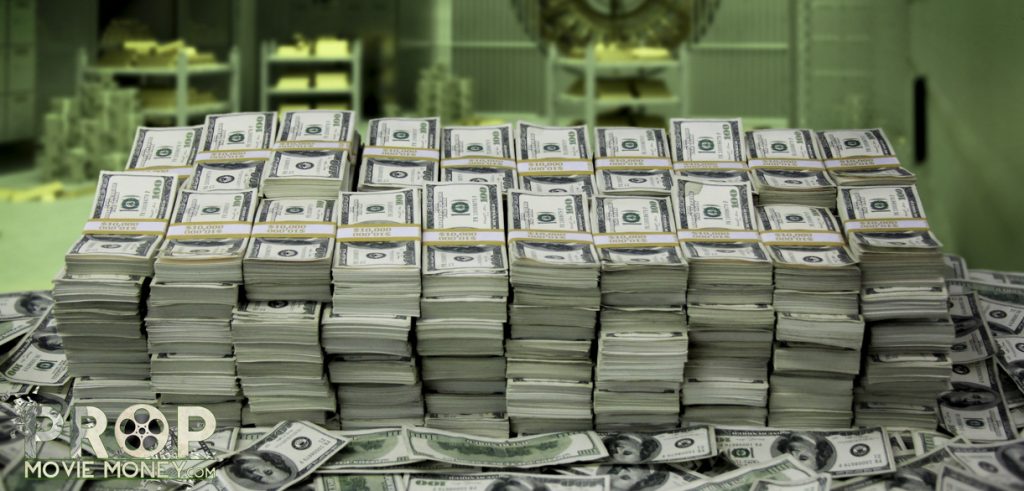
Prop Movie Money
Sep 4, 2016 | coins, commemorative, legislative
 At the beginning of each month, I review the previous month’s activity in congress looking for numismatic nuggets that we hope will bring us new coins to collect. However, congress has been on their summer vacation since mid-July, right before the conventions.
There are two ways of looking at congress being away for at least seven weeks: they get how much vacation while the rest of us have to work? At least they aren’t doing anything to mess things up further.
If congress sticks to their own law of two commemorative programs per year, the next available year is 2019. Although most commemorative programs are fund raising programs, let’s have one that has some meaning. Maybe at some point, in between budget battles, congress will pass Apollo 11 50th Anniversary Commemorative Coin Act.
The Apollo space program has to be one of the greatest accomplishments this nation has made at least in the 20th century. We were challenged by President Kennedy to make it to the moon and to return the astronauts safely back to earth. And in 1969, after getting beat at every milestone into space, Apollo 11 landed on the moon and safely returned their three astronaut payload to Earth before the Soviet Union could do so.
Apollo 11 was one of the most impactful memories of my youth, especially for that year. It only rivals rushing home from school (we had to walk in those days but I think I ran that day) to watch the last out of the 1969 World Series to begin that celebration!
Sen. Bill Nelson (D-FL) introduced the bill in the Senate on May 19, 2016 (S. 2957) and Rep. Bill Posey (R-FL) introduced the same bill in the House of Representatives on June 10, 2016 (H.R. 2726). Both bills have been referred to committee.
If congress passes either of these bills, it would create the following commemorative program:
- Commemorative program issued in 2014
- Required design elements:
- Convex in shape “to more closely resemble the faceplate of the astronaut’s helmet of the time”
- “The Secretary shall hold a juried, compensated competition to determine the design of the common obverse of the coins minted under this Act, with such design being emblematic of the United States space program leading up to the first manned Moon landing.”
- Winning designer to receive no less than $5,000 for their design.
- Common reverse design “shall be a representation of a close-up of the famous ‘Buzz Aldrin on the Moon’ photograph taken July 20, 1969, showing just the visor and part of the helmet of astronaut Edwin ‘Buzz’ Aldrin, in which the visor reflects the image of the United States flag, astronaut Neil Armstrong, and the lunar lander.”
- Mintage Limit: 50,000 $5 gold; 400,000 silver dollars; 750,000 clad half-dollar; 100,000 five-ounce silver proof dollars
- Surcharges of $35 per $5 gold; $10 per silver dollar; $5 per half-dollar; and $50 per five-ounce bullion.
- Payouts: 50-percent to Smithsonian Institution’s National Air and Space Museum’s “Destination Moon” exhibit; 25-percent to the Astronauts Memorial Foundation; and 25-percent to the Astronaut Scholarship Foundation.
Considering how times have changed and we seem to have a different look on the space program, it would be wonderful to honor this achievement to remind everyone of the accomplishment.
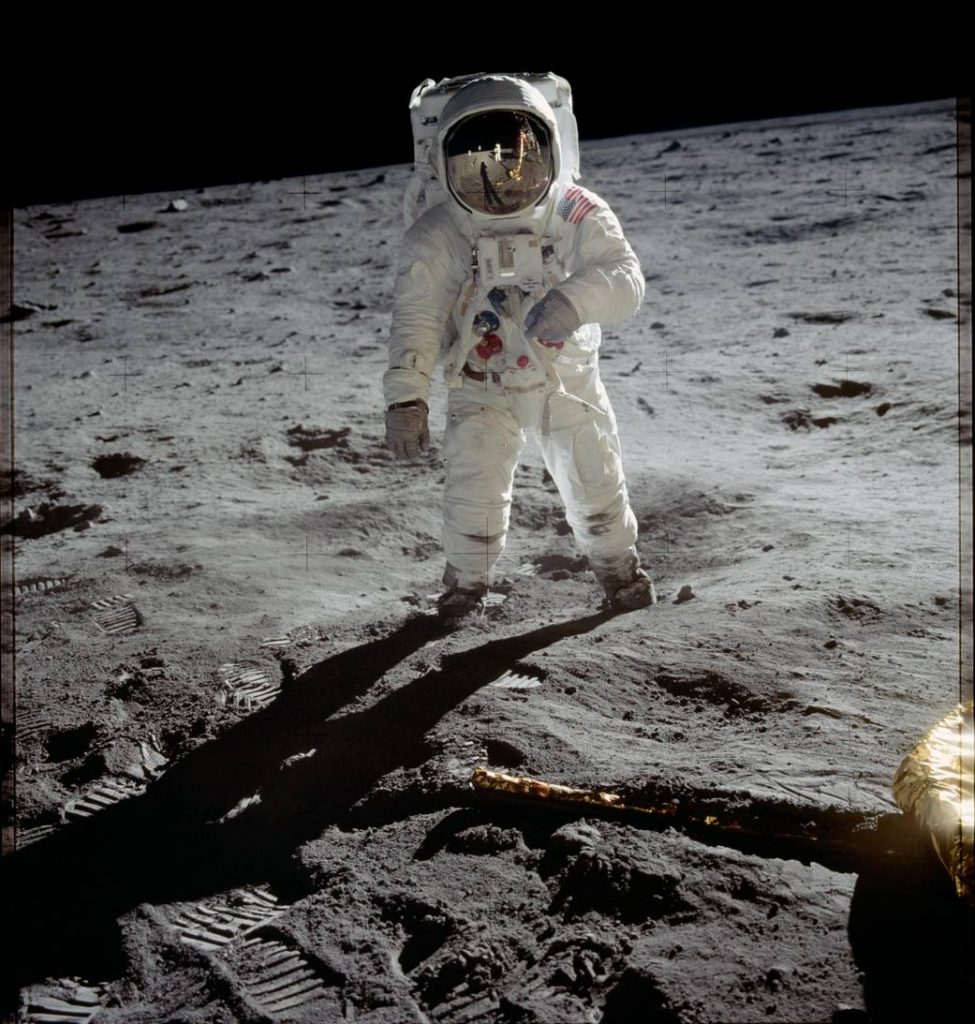
“Buzz Aldrin on the Moon” taken July 20, 1969


 Loading ...