May 29, 2022 | news
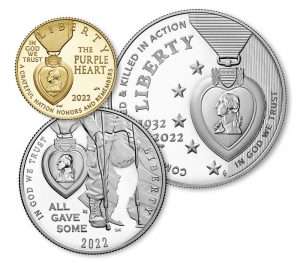
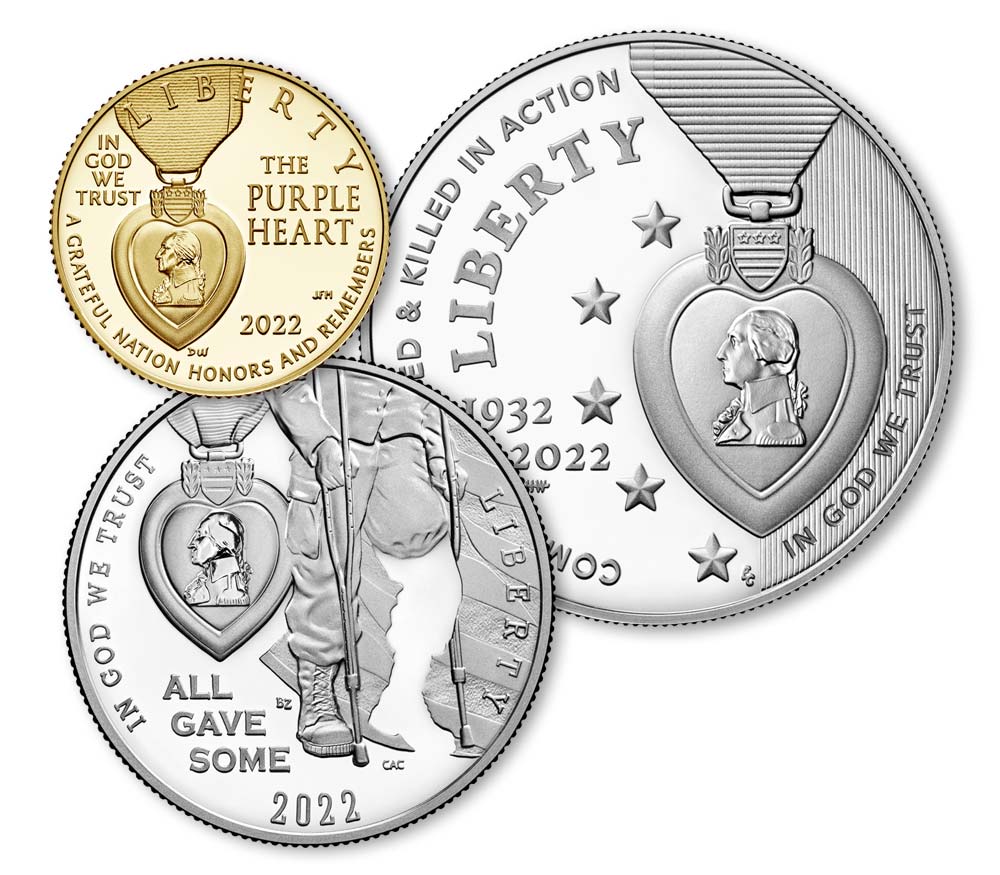
National Purple Heart Hall of Honor 2022 Three-Coin Proof Coins (U.S. Mint Image)
Memorial Day took on national significance following World War I when the nation began to recognize all those who gave the ultimate sacrifice during all conflicts. By the end of World War II, most of the celebrations were renamed to Memorial Day. Memorial Day did not become an official holiday until 1967 with the passage of the Uniform Holidays Act (sometimes referred to as the Monday Holiday Bill). The law set Memorial Day to the last Monday in May, changing it from the traditional May 30.
The modern Memorial Day is a holiday celebrating the lives of those sacrificed in defense of the United States and its ideals at home and abroad. We honor the memories of those who paid the ultimate sacrifice so that we can collect what we like. They have gifted us the freedom so that I can write this blog and you can read and share it with others.
And now the news…

May 24, 2022
The Modiin haul. The seizure featured a historically significant silver shekel.

→ Read more at
news.artnet.com
May 25, 2022
The Royal Mint has created the largest ever coin in its 1,100-year history in celebration of the Queen's Platinum Jubilee.
→ Read more at
penarthtimes.co.uk
May 26, 2022 | commentary, currency, policy
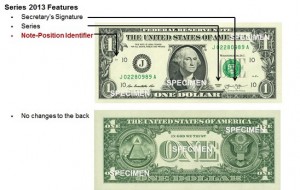
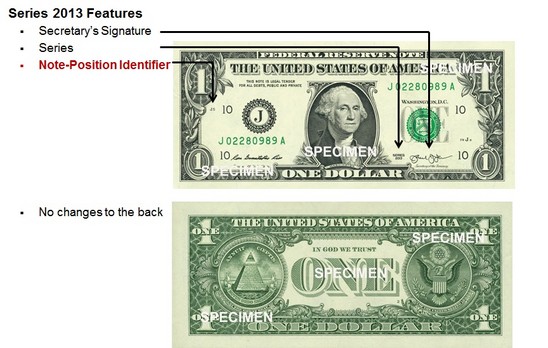
Changes to the Series 2013 $1 Note
For most of the 21st century, many groups have advocated for eliminating the $1 bill, while others provide a counterpoint to maintain the status quo. While the discussion of eliminating the note has economic and policy concerns that lawmakers must address, how would the U.S. government implement the policy?
The Federal Reserve Act of 1918 gives the Federal Reserve the authority to procure, distribute, and manage the nation’s currency supply. They must procure the paper money from the Treasury Department, but the Federal Reserve is required to tell Treasury how much money they need to print. But does the Fed determine which notes to print?
The law (12 U.S. Code § 418) says that the Treasury Department prints notes in “the denominations of $1, $2, $5, $10, $20, $50, $100, $500, $1,000, $5,000, $10,000 as may be required to supply the Federal Reserve banks.” The statement suggests that the Federal Reserve banks set the printing requirements. Does this mean that the Federal Reserve banks can tell Treasury that it no longer requires them to print the $1 note?
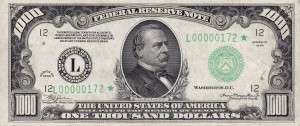
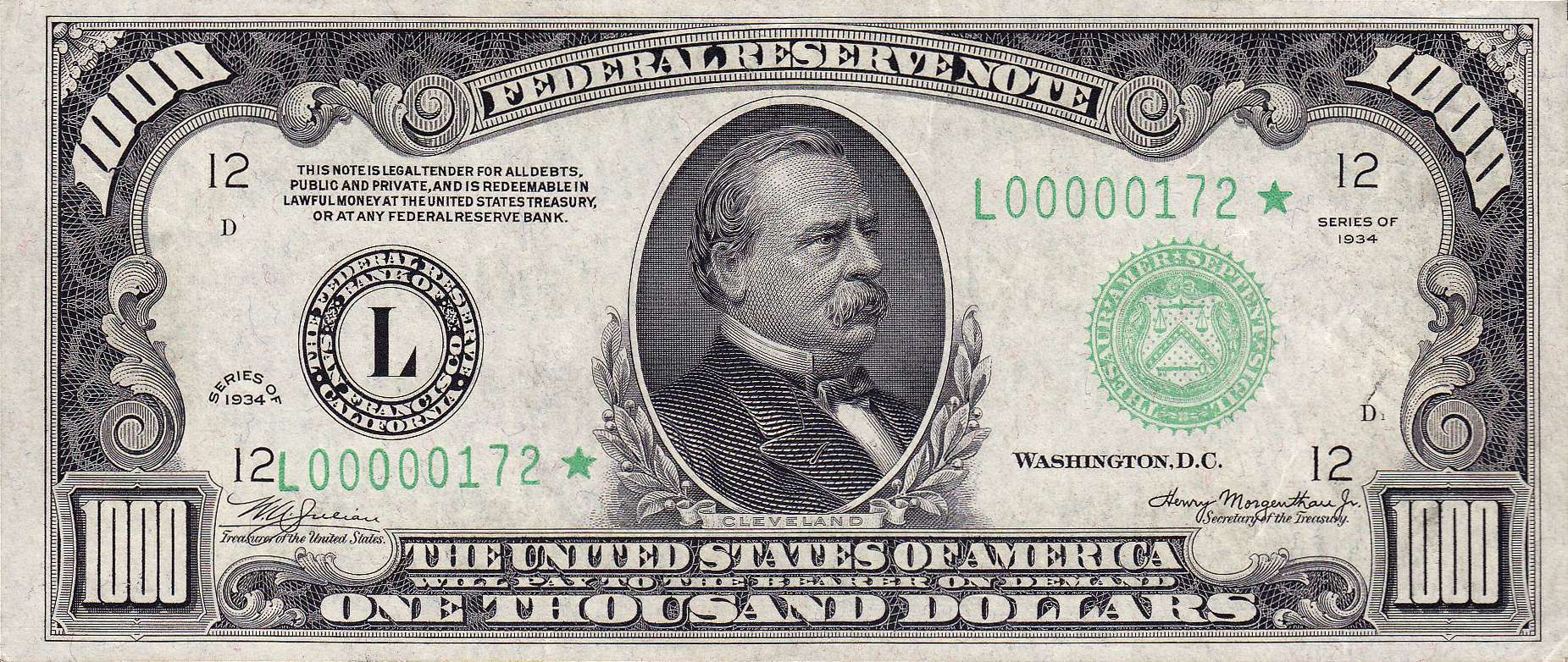
Series 1934 $1000 Federal Reserve Note
Although the denominations remain part of the law, the Federal Reserve Act gives the Federal Reserve latitude to manage the currency supply as it deems necessary. It was a policy enacted by the Treasury and Federal Reserve in tandem.
The agreement was not as easy as the history books want us to believe. In 1969, William McChesney “Bill” Martin was the Federal Reserve Chair. Martin was appointed by Harry S. Truman in 1951, fiercely guarded the Federal Reserve’s independence, and was known to push back against presidential policies with a minimalist approach to managing market factors. In the 1960s, Martin ran afoul of Lyndon Johnson and Richard Nixon for not doing more to help prevent a recession.
Following a meeting with Nixon in October 1969 about what his administration saw as an impending recession, Nixon announced that he would replace Martin when the Federal Reserve chair’s term expired on January 31, 1970.
It was not the first time the Federal Reserve changed United State currency without legislation. Since the formation of the Federal Reserve, the Federal Reserve authorized the printing of gold certificates, silver certificates, Legal Tender notes, Federal Reserve Banknotes, and the ongoing Federal Reserve Notes.
Before the formation of the Federal Reserve, the Treasury Department determined what currency to print and its design. Treasury Secretary Franklin MacVeagh proposed reducing the size of the currency paper in 1909. After years of study and discussion, Secretary Andrew Mellon approved new smaller designs issued in 1929. The change did not require new legislation.
Based on history, Treasury Secretary Janet Yellen and Chairman of the Federal Reserve Jerome Powell can decide to withdraw the $1 Federal Reserve Note from circulation. Powell can instruct the Federal Reserve Banks to stop issuing $1 bills and use the $1 coin instead. When the notes return to the Federal Reserve System, they can withdraw the notes and destroy them as they do with old currency.
Yellen can refuse by saying that she is following her boss’s policies, the President of the United States. But the Federal Reserve is an independent agency and does not have to ask for permission. By law, if the Federal Reserve does not order the printing of new $1 bills, the Bureau of Engraving and Printing will not print new currency.
Politics may prevent Yellen and Powell from making this decision, but they can do it and allow the United States to join the rest of the civilized world that no longer carries its unit currency in paper form.
May 25, 2022 | currency, Federal Reserve, policy
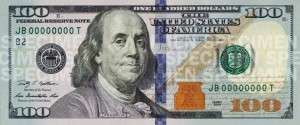 Would ending the circulation of the $100 Federal Reserve Note force the Russian people to pressure Putin over his Ukraine attack?
According to an opinion piece published in the Wall Street Journal by Markos Kounalakis (sorry, it’s behind a paywall), the sanctions on Russia are not reaching their people. Kounalakis believes that the United States should stop circulating the $100 bill to reach the people.
The United States dollar is the world’s reserve currency, and it is used as a safe store of wealth by people and companies. The Euro may represent an easily transactional currency, but the dollar is where the world turns for a store of wealth. In Russia, where the banks are not trusted, average citizens keep their savings in dollars.
According to the Federal Reserve, more than 661,500 pounds of $100 bills are in Russia as of 2019. Russians are stuffing them in a mattress and not using them for commerce.
Removing large-denomination currency from circulation is not new. In 1969, the Treasury withdrew the $500 and $1000 notes from circulation to make it more challenging for drug traffickers to move large amounts of cash.
In 2016, some economists made a case to stop circulating the $100 bill and the €500 banknote, even claiming the €500 note was nicknamed the “Bin Laden.” Eventually, the European Central Bank (ECB) stopped circulating the €500 banknote in 2018. But that has not stopped their use by criminals since the ECB has not demonetized the notes.
Even if the United States wanted to stop the circulation of $100 notes in Russia, it would not be an easy process. First, who would have the authority to make this determination? According to the Federal Reserve Act of 1918, it is the Federal Reserve’s job to manage circulating currency independently. The law that created the Office of the Comptroller of the Currency (OCC) allows this Treasury bureau to oversee the mechanisms that go into currency movement.
The government has more latitude over managing currency than coins. The law requires the U.S. Mint to strike cents, 5-cents, dimes, quarter dollars, half-dollars, and dollar coins (31 U.S. Code § 5111). On the other hand, the law (12 U.S. Code § 418) sets the denomination types, but it does not require the Federal Reserve to circulate all denominations.
If the President decides that it is in the best interest of U.S. foreign policy to stop the circulation of $100 notes, the Federal Reserve must decide if it is in the best interest of the Federal Reserve System to do so. However, the law complicates the matter by having the OCC oversee the institutions managing the currency. The blurry line between the authority of the Treasury Department and the independence of the Federal Reserve could create tension.
Should the policy regarding issuing $100 Federal Reserve Notes change, currency collectors may find opportunities to collect $100 notes.
May 24, 2022 | coins, commemorative, legislative

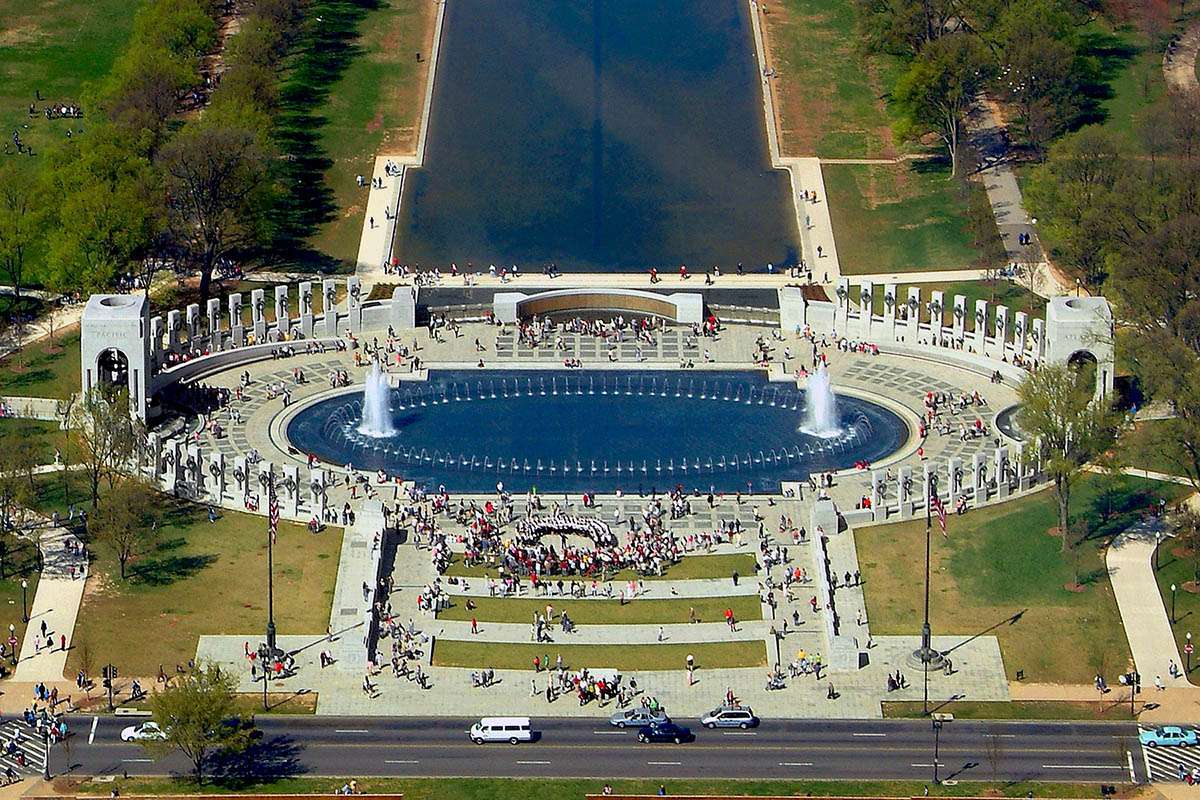
World War II Memorial from the Washington Monument
Without noticeable prompting or any other reason, the Senate Banking Committee discharged the Greatest Generation Memorial Act (S. 1596) and was passed by unanimous consent by the Senate.
If passed, the bill will require the minting of up to 50,000 $5 gold coins, 400,000 $1 silver coins, and 750,000 clad half-dollar coins in commemoration of the National World War II Memorial in Washington.
At the end of the sale, the Treasury will pay all surcharges ($35 per gold coin, $10 per silver dollar, and $5 per clad half-dollar) to the Friends of the National World War II Memorial to help maintain the memorial.
The Senate sent the bill to the House of Representatives, where it is being held at the desk because it was a bill not introduced by the majority party.
S. 1596: Greatest Generation Memorial Act
Summary: This bill directs the Department of the Treasury to mint and issue up to 50,000 $5 coins, 400,000 $1 silver coins, and 750,000 half-dollar clad coins in commemoration of the National World War II Memorial in the District of Columbia. The design of the coins shall be emblematic of the memorial and the service and sacrifice of American soldiers and civilians during World War II. All surcharges received from the sale of such coins shall be paid to the Friends of the National World War II Memorial to support the National Park Service in maintaining and repairing the memorial, and for educational and commemorative programs.
Introduced in Senate — May 12, 2021
Read twice and referred to the Committee on Banking, Housing, and Urban Affairs. — May 12, 2021
Senate Committee on Banking, Housing, and Urban Affairs discharged by Unanimous Consent. — May 16, 2022
Passed Senate with an amendment by Unanimous Consent. (text of amendment in the nature of a substitute: CR S2515-2516) — May 16, 2022
Measure laid before Senate by unanimous consent. — May 16, 2022
Message on Senate action sent to the House. — May 17, 2022
May 23, 2022 | coins, news
Sorry… we are one day late for many reasons including just being tired. More to come.
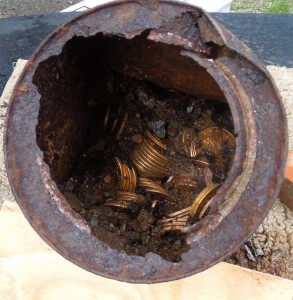
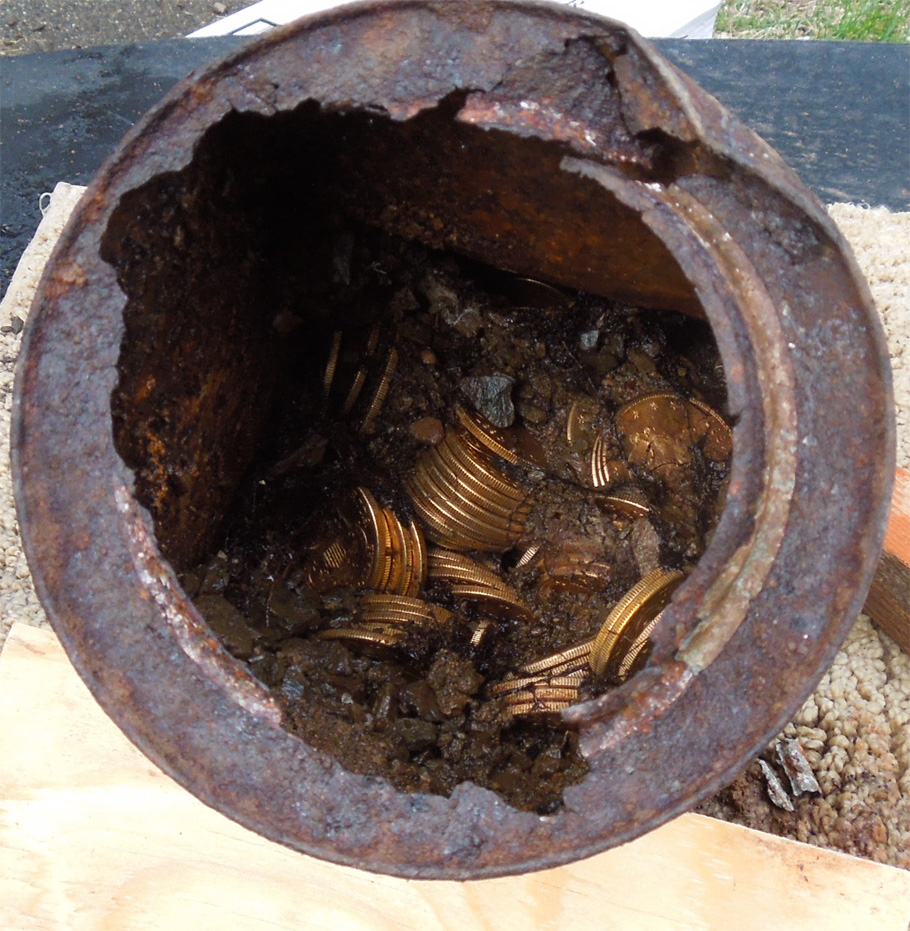
One of the cans found as part of the Saddle Ridge Gold Coin Hoard
Of course, the metal detectorists are looking for treasures. Few save any of the coins they find. They will consign the coins to an auction and collect the payment. The coins will end up in the hands of collectors and museums that will enjoy them for years to come.
I have never been interested in exploring with a metal detector. In the United States, most finds are limited to the 200-300 years. Detectorists find belt buckles, watches, rings, some coins, and other items dropped along the way. But nothing compares to finding coins from over 1,000 years ago or medieval coins from 500 years ago.
These unburied coins are sometimes the only record of history. Recently, a hoard revealed a problem with inflation during the Roman Empire that taught historians about ancient economics.
I am not saying that there are no exciting finds in the United States. The Saddle Ridge Gold Hoard is a recent example, but the finds in England and the rest of Europe can change our knowledge of history.
I do not know if I will be able to go to Europe to see if I can find a treasure, but it is interesting to watch from afar.
And now the news…
May 13, 2022
One of only three known gold examples of the “Eid Mar” aureus A small but potent piece of history is up for sale in Zurich this month, when Numismatica Ars Classica offers one of only three known examples of the “Eid Mar” aureus, celebrating the “liberation” of Rome after the bloody assassination of the dictator Julius Caesar on the Ides of March in 44BC.
→ Read more at
ft.com
May 18, 2022
Britain’s Royal Mint unveiled a special new commemorative rainbow-colored 50 pence coin on Wednesday as a tribute to celebrate the 50th anniversary of the Pride UK movement. The coin, designed by east London artist and LGBTQ activist Dominique Holmes, uses state-of-the-art printing technology to emboss it with the colors of the Pride progress flag.
→ Read more at
nbcnews.com
May 20, 2022
When it comes to buying silver , coins are one of the most popular places to start. A coin collector or investor who is used to buying gold may like the idea of taking that same investment strategy and applying it to silver.
→ Read more at
menafn.com
May 20, 2022
About 1,800 antique coins, jewellery and stamps, pottery plates with inscriptions, and an ancient bronze figurine were seized this week at the home of a resident of the city of Modi’in in the centre of the country, the Israel Antiquities Authority (IAA) announced Thursday.
→ Read more at
jwire.com.au
May 15, 2022 | news
 It has been an interesting week. I tried to keep up with the news and the collecting world, but a health issue sidelined me. Unfortunately, I was diagnosed with COVID. I am feeling better, but it does affect my breathing. I am glad I am fully vaccinated.
I was not completely sidelined. While trying to breathe, I was able to go online and find some interesting items online. The purchase taught me something about an area of numismatics that I did not know existed. It will be something I write about when I receive the new purchase.
During the week, the U.S. Mint mailed a package that arrived in my mailbox containing the Negro Leagues Baseball Commemorative Proof Set. The coins look better in hand than the U.S. Mint’s website images.
As the Paxlovid works to get me back in the game, it will take a few days to get everything back together, and I will be ready to get back to collecting.
Life is short. Have fun collecting.
And now the news…
May 10, 2022
On May 9, the Greater Toronto Area (GTA) Trans-National Serious and Organized Crime Section (TSOC) charged an Ontario resident with uttering counterfeit money and possession of counterfeit money after the Royal Canadian Mounted Police (RCMP) identified and seized approximately 10,000 counterfeit toonies.
→ Read more at
cottagelife.com
May 14, 2022
Remember when no one wants to touch the bills or coins for fear of getting caught COVID-19 (new coronavirus infection)Would you like to replace what was considered contaminated cash with a credit card?
→ Read more at
worldakkam.com
May 9, 2022 | books, coins, education, poll
 I am getting ready to open the next chapter of my life, and I was thinking about how I can leverage my knowledge and experience to enhance the collecting community. As an experienced collector of all types and a dealer in areas other than numismatics, I learned a lot about collectors and their habits that could benefit a general audience.
As I was thinking about sharing my experiences, I wondered where most people learned about their collectibles. But the resources I had are different than those available today. Even the way we take in and understand knowledge is different. I thought it would be interesting to ask the numismatic community how they learn about collecting.
So let’s ask the question:

Loading ...
May 8, 2022 | coins, commentary, news
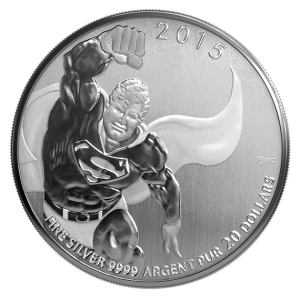
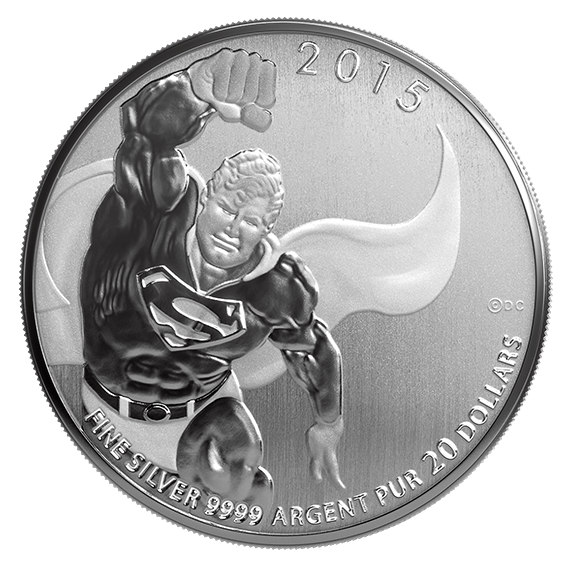
Reverse of the Royal Canadian Mint 2015 Superman $20 for $20 coin featuring “The Man of Steel”
After reading yesterday’s blog post, the comics dealer asked me how to become a coin dealer to sell comics-themed coins.
My reader knows that the comics industry is exploding and that the publishers are dabbling in non-fungible tokens (NFT) to see if they can extend the market. Those skeptical of the NFT market are looking for alternatives. A comics dealer that expanded to other publications, toys, and other collectibles understands that extending his market with coins will be profitable.
Walk into any hobby shop and see how every hobby has evolved. Comics, sports, and antiques have seen a rise in collecting, and all have seen the benefit of cross-collecting. A sports dealer is also selling comics and other collectibles with sports themes. Comics dealers are collectible cards and souvenirs from the ComicCons, the same as the sports dealers are selling game tickets.
Coin dealers extend their business into metals and jewelry, and their stores look the same as they did 10 years ago. The dealers may be making a living, but it is not expanding the hobby. But is it their job to expand the hobby or make a living? Unfortunately, this attitude is typical with the dealers trying to set ANA policy and is not helping the hobby’s growth.
And now the news…
May 4, 2022
The most successful artistic design of the Croatian national side of the €1 coin has been selected, the Croatian National Bank (HNB) said in a press release.
→ Read more at
croatiaweek.com
May 5, 2022
Found in Switzerland, some of the buried Roman coins were minted during a time of relative political stability, between 332 and 335 C.E.
→ Read more at
smithsonianmag.com
May 7, 2022 | coins, commentary
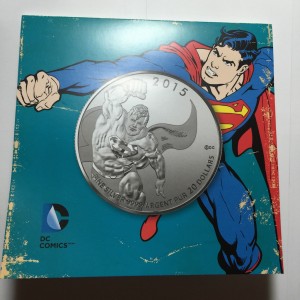
Cover with the 2015 $20 Canada Superman coin
Free Comic Book Day is more than an effort to get people into the stores to buy comics. The publisher will take the opportunity to tweak a story, start a new story arc, or introduce new characters. They spend a few pages in the free comic book to enhance their stories or introduce new characters. The free comic book may also have an existing story that can summarize the story to convince readers to start reading the series.
Free Comic Book Day is more than a giveaway day. It is a marketing tool for the story writers to interact with the readers and get them attracted to the stories. The publishers and store owners use the giveaway to keep current customers interested and lure in new customers.
Although the publishers will introduce many new stories and characters, almost 90-percent will not last more than a few issues. The publishers know this and are willing to try whatever it takes to ensure that the readers come back for more. Once the readers are hooked, the publishers extend the brand into movies and other collectibles where collectors can purchase the merchandise anywhere.
The comic book industry accomplishes more in one day than the numismatic industry accomplishes in one week. Considering how ubiquitous money is in society, It is any wonder that we can raise new collectors.
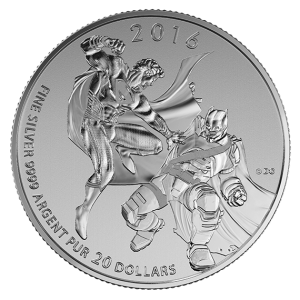
2016 Canada Batman v Superman: Dawn of Justice $20 silver coin
There is nothing wrong with comics and the comics culture. Comics readers love their characters, especially the superheroes, that they extend their buying beyond the comic book. Why not invite them into your shop to add comic book character coins to their collection.
You may not find coins with Superman, Batman, Captain America, or Spider-man exciting coins, but they are legal tender coins made of silver or gold that excite this crowd. Contact the publishers and see if you can source material to supplement the coins. It could create a partnership that could benefit both collectibles.
It might not be selling rare proof-like Morgans, but it will get people in your shop to look at your other inventory. Maybe they will see the Buffalo nickels and think those Type 1 coins are so cool that they might start a collection.
I have an idea… on Free Comic Book Day, the numismatic community can work with Marvel and DC to create a brass token that would be available to the collecting public. Some to the coin store, get the token for free. Let the publishers work on tokens and medals associated with their comics and sell them through coin stores. Then the coin stores can contact the New Zealand Mint or the Royal Canadian Mint to purchase a supply of comic book character coins and join the fun.
May 6, 2022 | coins, quarter
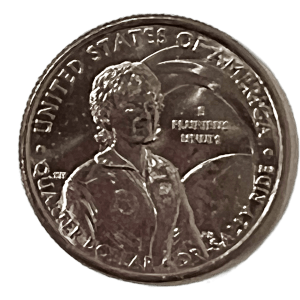 The current quarter in the American Women Quarters Program honors Dr. Sally Ride. These coins are showing up in change in an increasing number, with several landing in my pocket this week.
Dr. Ride was a physicist, astronaut, educator, and the first American woman to rocket into space aboard the Space Shuttle Challenger in 1983. At 32, Ride was also the youngest American in space.
On STS-41G in 1984, also on the Challenger, Ride was joined by Dr. Kathryn Sullivan, a geologist, making it the first space mission with two female crew members.
Following her retirement from NASA, Ride and Tam O’Shaughnessy teamed up to write science books for young people. They also started an educational company to inspire young people, especially girls, in science, technology, engineering, and math (STEM).
Ride received many honors during her life, including induction into the Astronaut Hall of Fame, National Women’s Hall of Fame, and Aviation Hall of Fame.
The reserve depicts Dr. Sally Ride next to a window on the space shuttle. It was designed by Elana Hagler of the Artistic Infusion Program and sculpted by U.S. Mint Medallic Artist Phebe Hemphill.